

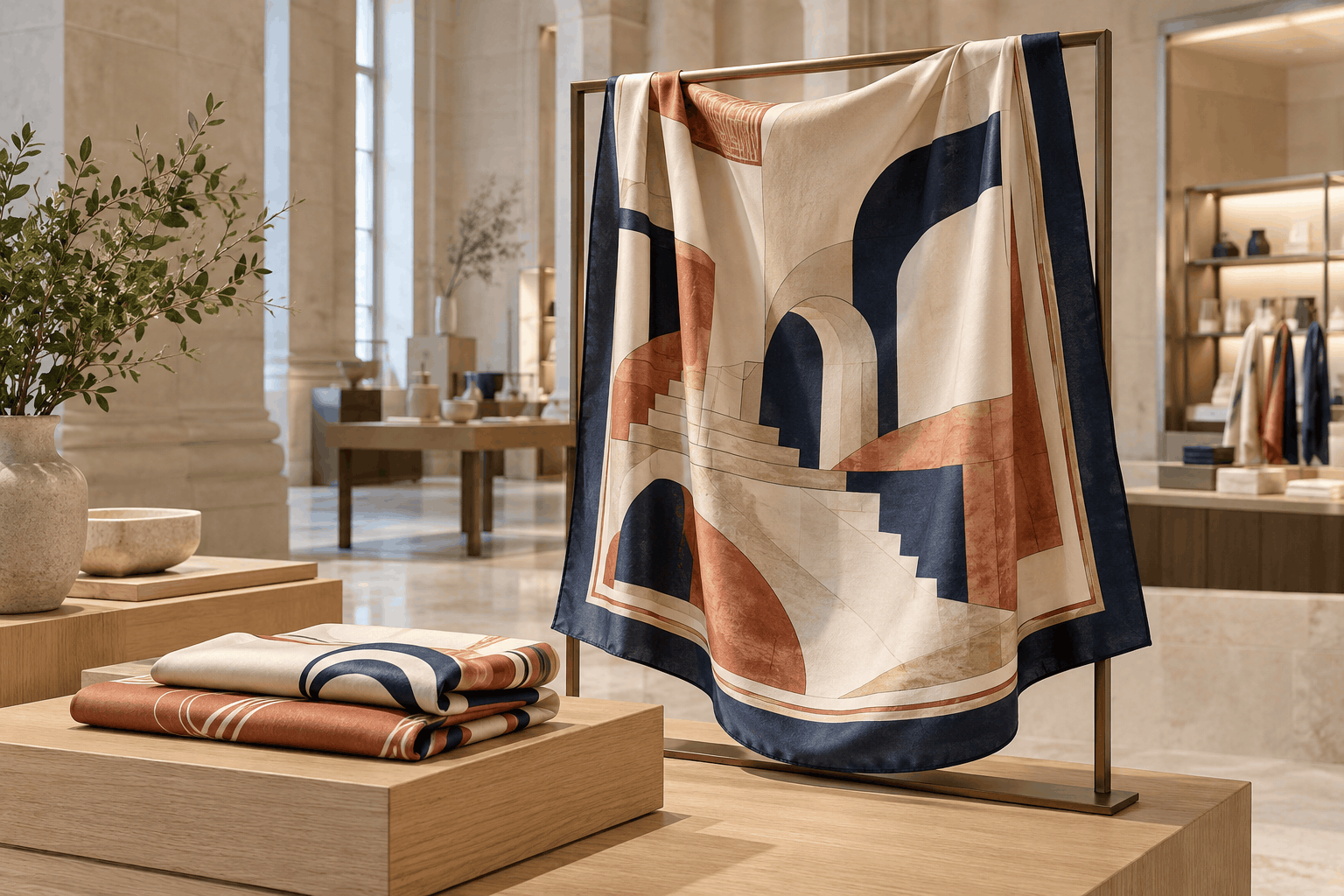
A museum shop scarf should give visitors a reason to take part of the collection home—and a reason to wear it afterwards. That requires more than placing an artwork on a square of silk.
To plan an exclusive collection of museum shop silk scarves, define the visitor, the cultural source, the scope of exclusivity and the retail economics before commissioning artwork. Then approve the design on fabric, prepare the story and packaging, and build a realistic launch and replenishment plan.
This guide is for museum retail buyers, merchandising teams and cultural institutions developing a small collection for an exhibition, permanent collection or institutional anniversary.
1. Start with the retail purpose
Decide what the collection needs to do. An exhibition souvenir, an enduring museum signature and a premium gift for members may share a cultural reference, but they need different stock plans and selling stories.
Write a short commercial brief covering:
- Audience: local members, international visitors, exhibition enthusiasts, gift buyers or online customers.
- Sales channels: the physical shop, museum website, selected partner outlets or a combination.
- Price position: where the scarf will sit alongside your existing accessories and gifts.
- Selling period: a fixed exhibition window or an ongoing collection.
- Success measures: units sold, margin, stock remaining and customer response.
Use your own shop’s sales history where available. If scarves are a new category, treat the first order as a test with explicit assumptions, rather than borrowing another museum’s sales expectations.
2. Define what “exclusive” actually covers
Exclusivity should describe a specific agreement. An exclusive sleeve around an existing scarf does not make the scarf design exclusive.
- Exclusive artwork: a composition developed for the institution, with ownership and permitted uses agreed separately.
- Exclusive colourway: an agreed palette reserved for your collection, while other versions may remain available elsewhere.
- Exclusive format: a particular size or product configuration reserved for agreed channels.
- Exclusive presentation: museum-specific packaging, cards or labels around an otherwise available product.
Before describing a collection as exclusive, document the products, sales channels, territories and duration covered. Clarify supplier website sales, repeat orders, any renewal conditions and how remaining stock will be handled when the arrangement ends.
A limited edition is a separate decision. If you promise a fixed edition size, agree how pieces, replacements and any later versions will be controlled.
3. Select a source that can become wearable design
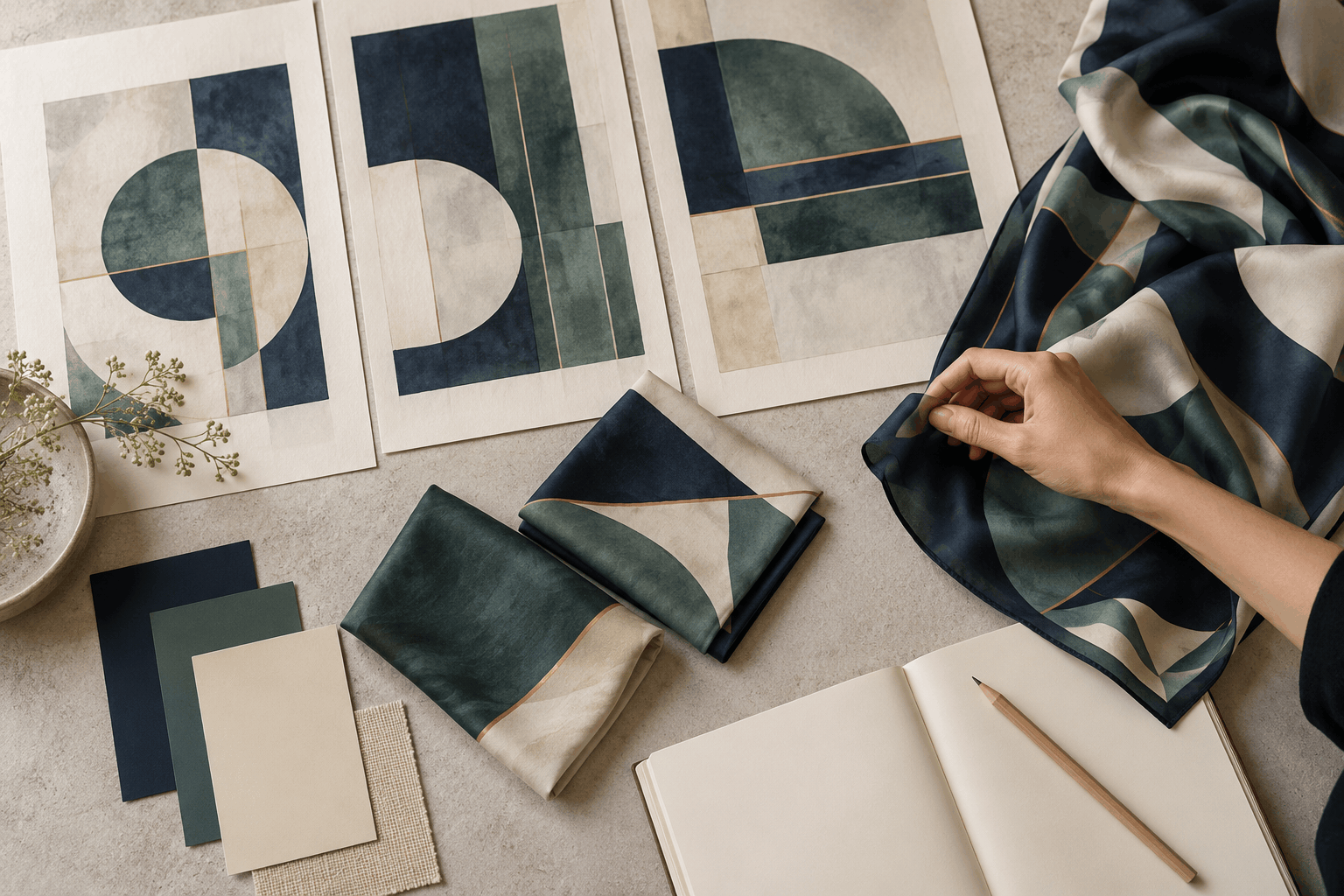
A strong source might be a textile pattern, architectural detail, botanical study, decorative border or a carefully chosen element from a painting. Begin with its relevance to the institution, then explore how it behaves on fabric.
Ask whether the source offers useful colour relationships, recognisable details and enough visual structure to work when folded. A full artwork may become difficult to read in a neck knot; a thoughtful detail or original interpretation may work better, subject to approval.
The V&A’s brand licensing programme provides an example of museum collections informing contemporary products through research and design development. It is a reference for the approach, not an affiliation with Lanting Loom.
Involve the relevant curatorial or collection team early. Where a source has particular cultural or community significance, identify who should advise on its use before developing merchandise around it.
4. Confirm artwork permissions and approval responsibilities
Owning or displaying an object does not, by itself, establish permission for every commercial use of its image. Ask the institution’s rights team to confirm the position for each selected source and image file.
For example, The Met’s Open Access guidance permits commercial use of images specifically designated Open Access, while explaining that other rights may apply. It also distinguishes image use from permission to use museum trademarks or suggest endorsement. Do not extend one museum’s policy to another collection.
Record the approved source file, permitted adaptations, required credit, applicable fees and any restrictions on sales or promotion. Confirm separately how the museum name, logo and commissioned scarf artwork may be used.
Name an approver for each area: rights, cultural interpretation, brand identity, product quality and commercial release. One person should consolidate feedback so the supplier receives a single agreed revision list.
5. Build a focused assortment
A collection needs a clear relationship between its pieces, not necessarily a large number of designs. For an initial test, consider one lead design with a complementary colourway or a second format only where it serves a distinct customer need.
Count stock-keeping units carefully. Two designs in two colourways and two sizes create eight separate products to buy, display and replenish. That can spread a modest opening order too thinly.
Ask suppliers to confirm minimum order quantities by design, colourway and size. Do not assume that a total collection quantity can be freely divided between variants.
For each item, agree the finished dimensions, silk composition, weave, fabric weight, printing treatment, reverse appearance, hem and label placement. Lanting Loom’s bespoke silk scarf service offers a starting point for discussing a project-specific specification.
6. Check the economics before approving the range
Request an itemised quotation that separates artwork development, sampling, production, packaging and delivery. Include any agreed licensing costs, inspection charges and destination-specific import costs in the internal budget.
Work from the selling price the shop expects to realise, allowing for planned member discounts or promotions. Use a consistent tax basis when comparing revenue and cost.
Gross margin percentage = (net sales revenue − cost of goods sold) ÷ net sales revenue × 100.
Have your finance team confirm which costs belong in that calculation. Review development and launch costs separately as well, so a healthy product margin does not conceal an unprofitable project overall.
Compare a cautious sales case with your expected case. A lower unit quotation at a larger quantity may still leave more cash tied up in unsold stock. Our guide to custom silk scarf costs explains the main quotation variables.
7. Approve a physical sample, not only a screen image
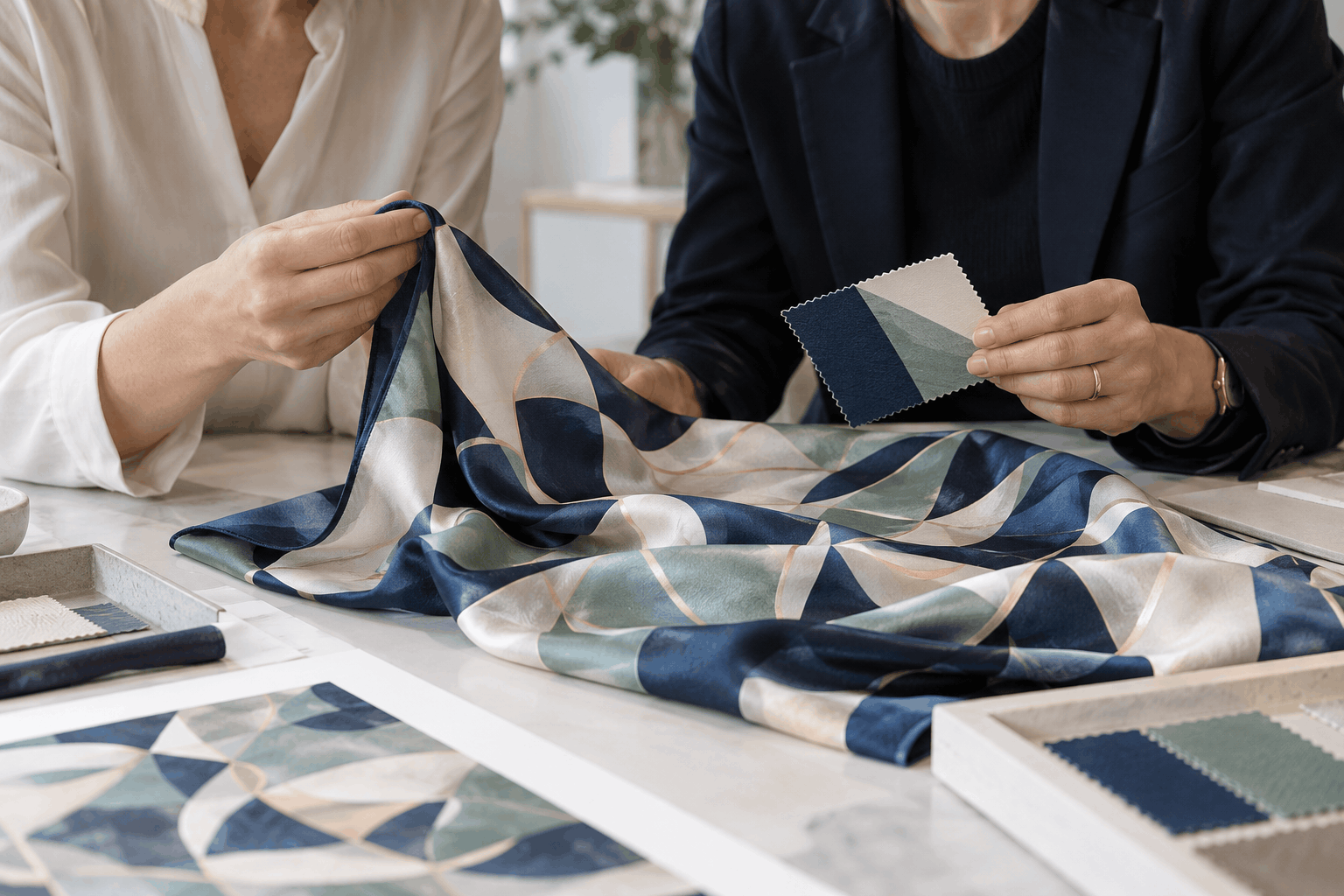
A digital layout establishes composition; it cannot establish how the finished scarf will feel, drape or appear under shop lighting. Agree the sampling stages and which approval allows production to begin.
Review the sample against a written specification:
- Artwork: correct crop, orientation, borders, detail and approved credits.
- Colour: comparison with agreed physical references under consistent lighting.
- Fabric and finish: handle, dimensions, reverse appearance, hem, corners and labels.
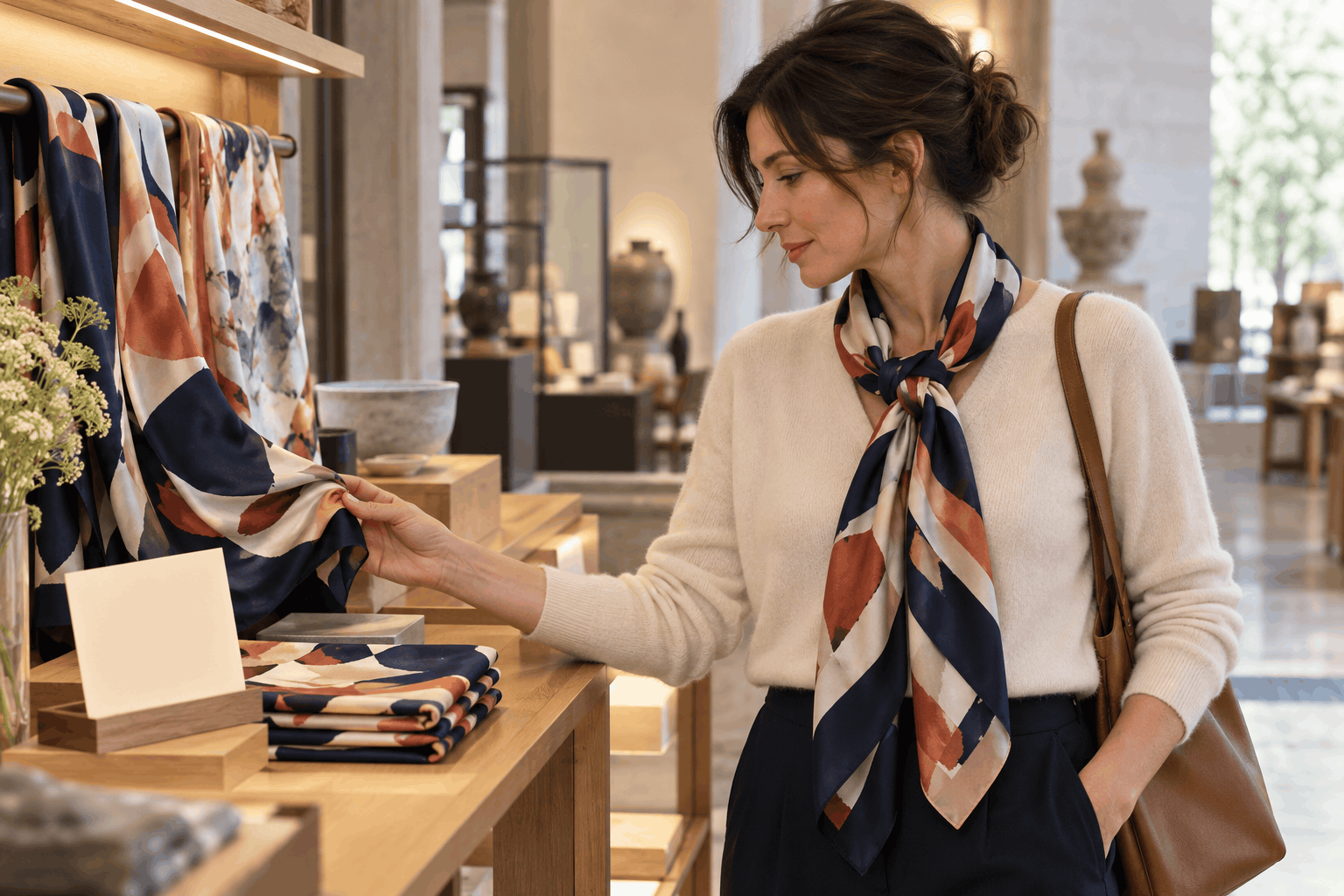
- Wearability: the design opened flat, folded, knotted and draped.
- Presentation: how the scarf fits its packaging and how easily staff can demonstrate it.
Agree relevant test evidence and acceptance criteria with the supplier and your quality team. Keep an approved reference sample and record any changes required before bulk production.
8. Give the collection a clear, accurate story
The story card should answer three questions: what inspired the design, how it was interpreted and why it belongs in this museum shop.
Include approved object information and credit lines where relevant. Distinguish a reproduction from an adaptation or an original composition inspired by a collection. Describe the actual manufacturing process without implying that a printed scarf uses the same technique as an antique textile.
Plan product names, descriptions, material and care information, required market-specific labels, barcodes and translations before packaging approval. Confirm which details appear on the scarf, packaging, website and point-of-sale materials.
Lanting Loom’s design stories explain its approach to separating cultural sources from contemporary interpretation.
9. Work backwards from the on-sale date
Build the schedule around goods being checked and ready in the shop, rather than the factory dispatch date. Ask the supplier for project-specific timings for artwork, approvals, sample revisions, production, packing and transport.
Include your own review time, receiving checks, photography, website setup and staff briefing. Exhibition opening dates leave little room for a sample that needs another revision, so make decision deadlines visible to everyone involved.
For replenishment, confirm repeat-order minimums, production lead times, colour reference retention and packaging availability. Exhibition-specific stock also needs a plan for sales after the exhibition closes, consistent with the agreed rights and exclusivity terms.
10. Prepare the display and measure the response
Show the scarf both as artwork and as something to wear. An open display communicates the composition; a folded or styled example helps a visitor imagine using it.
Give shop staff a short explanation of the source, material and exclusive element. Online, include the complete design, a close view of the finish and a styled photograph, together with dimensions and care information.
Track performance by design and colourway. Note customer questions, returns, discounts and stock availability alongside sales. A design that sold out early should not be compared directly with one that remained in stock throughout the period.
A practical brief to send your scarf supplier
Bring the decisions together in one document:
- Museum or institution, collection theme and intended audience.
- Source images, rights status, required credits and approval contacts.
- Requested exclusivity scope and intended sales channels.
- Preferred formats, fabric specifications and number of variants.
- Opening quantity and realistic reorder expectations.
- Target retail position and purchasing budget, with currency.
- Packaging, labelling, barcode and language requirements.
- Delivery destination, required arrival date and launch date.
- Sampling expectations and the process for final approval.
Explore Lanting Loom’s museum and cultural institution projects and bespoke scarf options to discuss a collection brief. Quantities, exclusivity, development scope and delivery should be confirmed for the individual project.
Frequently asked questions
What makes a museum shop scarf exclusive?
A defined agreement reserving particular artwork, a colourway, format or presentation for specified channels and a specified period. Custom packaging alone does not make the underlying scarf design exclusive.
Can a museum print any artwork in its collection on silk?
Do not assume so. Confirm the rights and image-use position for the selected work, including adaptations, credits, branding and commercial use, before production.
How many designs should a first collection include?
There is no universal number. Begin with a focused range supported by your audience, budget and supplier minimums. Every additional size and colourway creates another stock commitment.
What is the minimum order for custom museum scarves?
It depends on the supplier, specification and level of customisation. Request minimums for each design, colourway and size, plus separate terms for repeat orders.
How long does an exclusive collection take to develop?
Timing depends on rights review, design work, sampling, approvals, production and shipping. Obtain a written project schedule and allow time for revisions before committing to a launch.
