

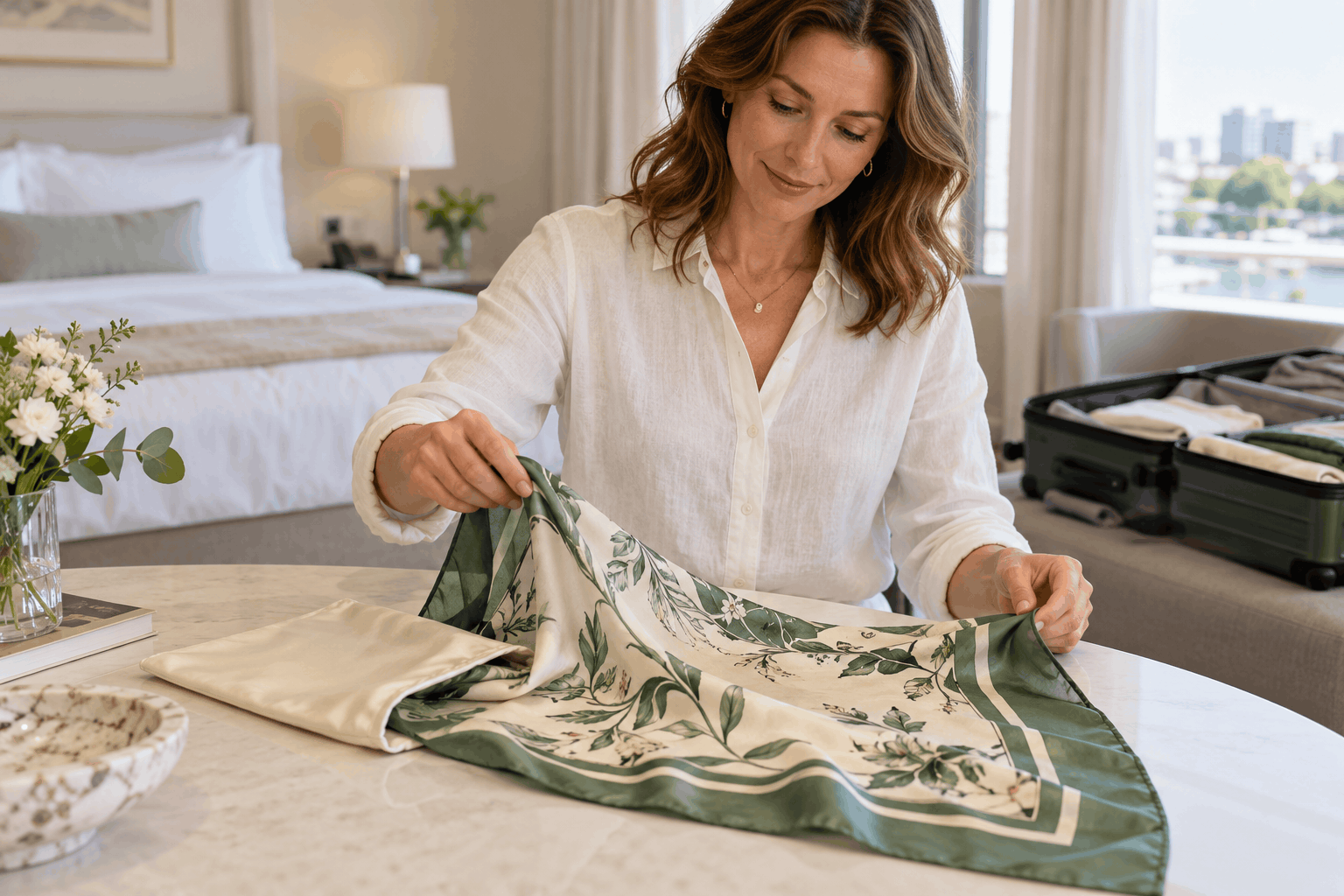
A silk scarf takes up little space in a suitcase, but squeezing it into the last available gap can leave it crumpled before your trip begins. A little preparation helps preserve its drape and keeps delicate fabric away from things that might catch, stain or crush it.
To pack silk scarves for travel, start with clean, completely dry scarves, fold or roll them loosely with plain acid-free tissue, and place them in a smooth protective pouch or suitable box. Keep them separate from liquids and sharp accessories, avoid compression and unpack them soon after arrival.
No packing method guarantees completely crease-free silk. The aim is to minimise sharp folds and pressure while protecting the fabric, print and finished edges.
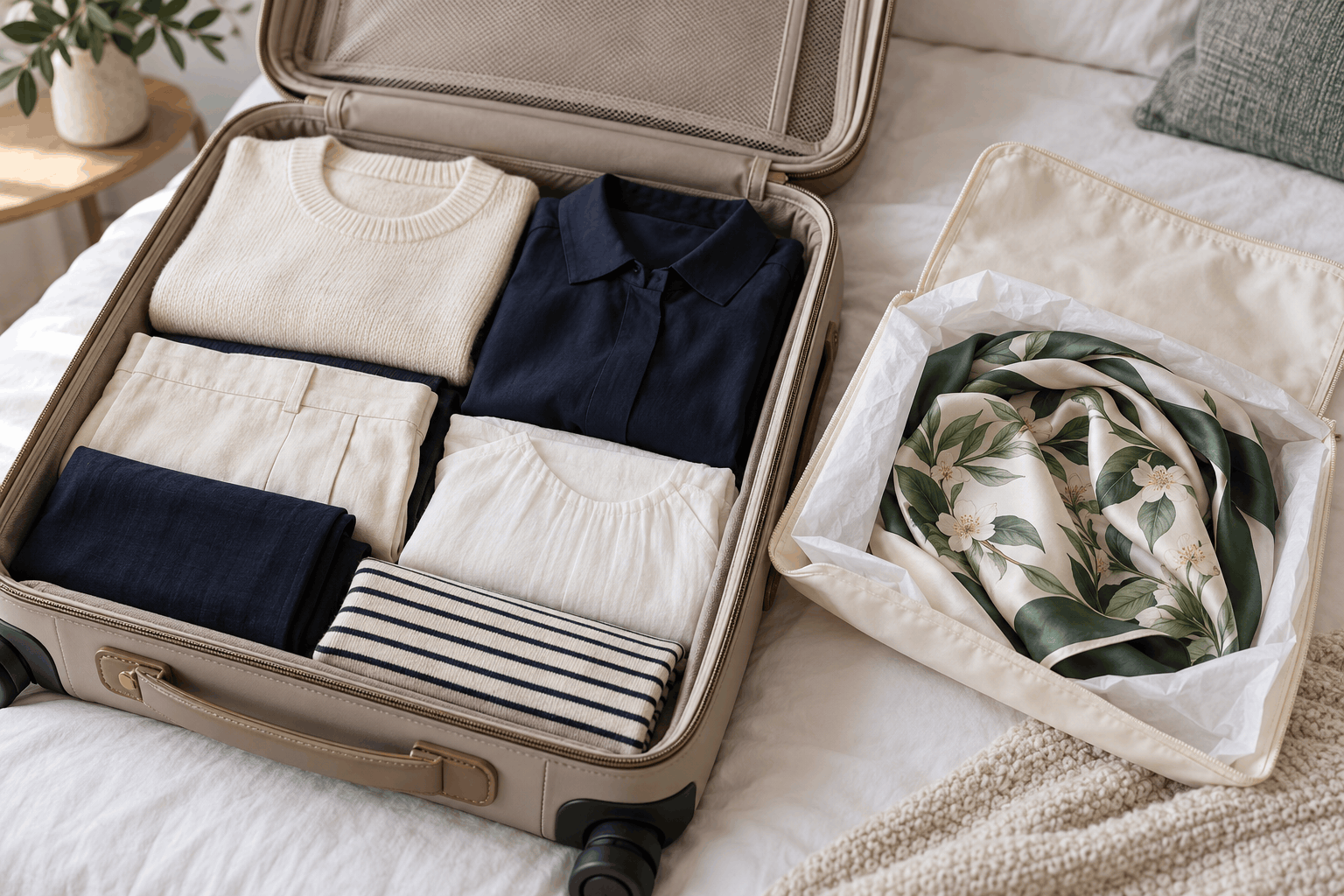
Choose the scarves you will actually wear
Begin with your outfits rather than packing every favourite design. One scarf that coordinates with several tops may be more useful than several scarves that each require a different outfit.
For a short trip, you might choose a compact square for daytime and a larger scarf for dinner. This is a planning suggestion, not a required number. Check that the larger piece gives the coverage you want before relying on it as an evening wrap.
Our silk scarf size guide can help you compare formats. Try each scarf with the clothes you are taking, then pack only the combinations you enjoy.
Prepare a clean packing space
Use a smooth, dry surface with enough room to open the scarf. Remove rings or bracelets that could catch the fabric and make sure your hands are clean and dry.
Untie any knots and inspect the scarf before packing. Deal with existing stains according to its care instructions rather than folding them out of sight. If it has just been worn, allow it to air and check that it is dry.
Have your pouch ready before you begin. Its size should guide the final folded shape, so you do not have to refold the scarf into an increasingly tight bundle.
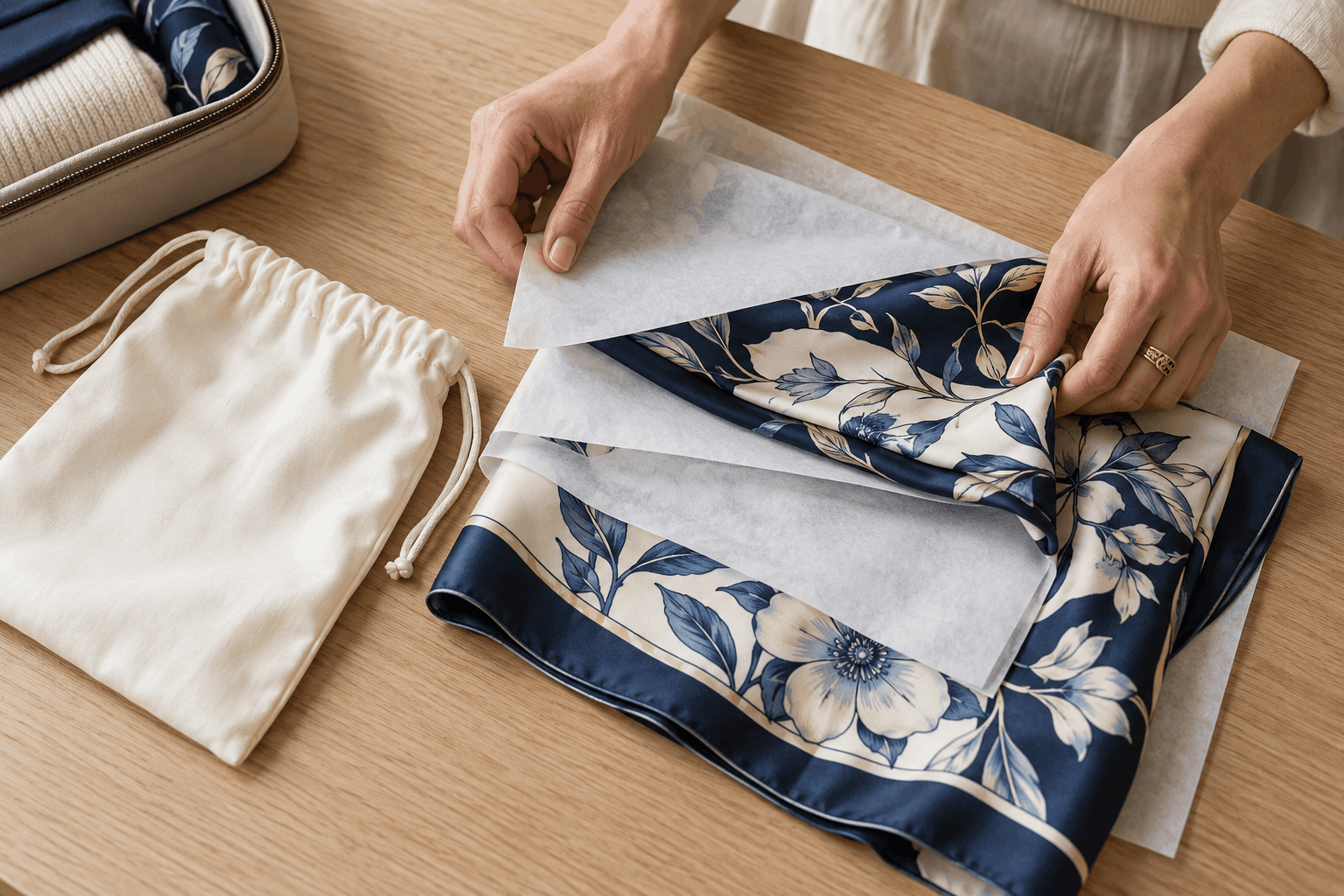
Method 1: loose folding with tissue
Loose folding is practical when you have a flat space in your luggage or a shallow protective box. It also makes it easy to keep a square scarf’s edges aligned.
- Open the scarf on your clean surface and gently ease out bunching without stretching it.
- Lay a sheet of plain, unprinted, acid-free tissue over the fabric.
- Bring one side over to create a broad fold, allowing the tissue to sit between the layers.
- Fold again only as much as needed to fit the pouch or box.
- Lift the folded scarf with both hands and place it inside without pressing it flat.
Avoid running your fingers firmly along the folds as though making a paper crease. If the parcel needs several tiny folds to fit, use a larger pouch.
Do not flatten a rolled hem to make the edges look perfectly sharp. The packed scarf should feel relaxed, not compressed into a rigid rectangle.
Method 2: a soft roll for a deeper pouch
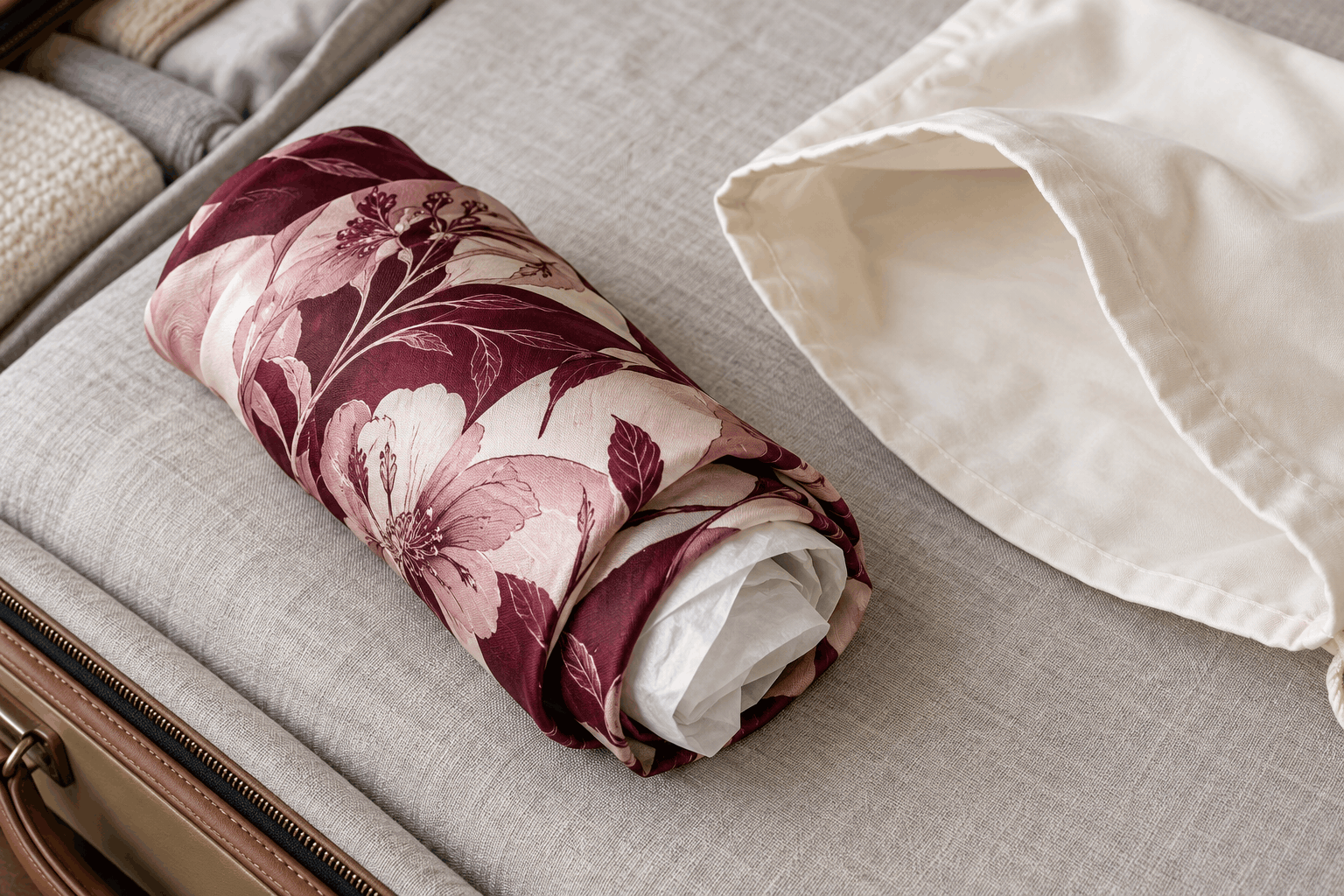
Rolling can suit a pouch with more depth. It reduces the need for repeated crosswise folds, although you may still need a broad lengthwise fold to make the scarf fit.
- Lay the scarf flat and add plain acid-free tissue.
- If necessary, fold it loosely lengthways to match the available pouch width.
- Starting at one end, roll the scarf and tissue together into a soft cylinder.
- Guide the edges as you roll so they do not twist or bunch.
- Place the roll in a pouch that closes without squeezing it.
Do not stretch the silk to tighten the roll or secure it with an elastic band. A tightly rolled scarf can still develop pressure marks, especially if heavier items flatten it during the journey.
Choose folding or rolling according to your luggage space. Neither method compensates for an overfilled case.
Choose a pouch or box that protects without squeezing
A useful scarf pouch has a clean, smooth interior, enough space for the fabric and a closure that does not trap the edges. If it has a zip, move the scarf fully clear before closing it.
A shallow box can help keep its shape around other belongings, but a presentation box is not automatically crush-proof. Check that the lid fits without pressing on the scarf and that the box is practical for your luggage.
A soft pouch protects against contact and loose objects; it does not prevent crushing. Place it where the contents will not bear down on it. Avoid scented sachets, printed wrapping paper and clips inside the scarf’s compartment.
If you do not have a dedicated pouch, a clean, smooth fabric bag used only for delicate items can be a simple alternative. Check the seams and interior for anything rough.
Give the scarf a protected place in your suitcase
Once most of your luggage is packed, look for a broad, lightly loaded space among soft garments. Keep the scarf away from the wheels, frame, shoe soles and hard corners of chargers or other equipment.
Do not place it under a compression strap or inside a tightly compressed packing cube. Close the case gently: if you need to force it shut, rearrange the contents rather than using the scarf parcel to fill a narrow gap.
Keep toiletries in a separate, securely closed container. A fabric scarf pouch is not a barrier against a leaking bottle. Store jewellery, scarf rings and brooches in their own case rather than wrapping them inside silk.
For a scarf needed immediately after landing, use an accessible protected compartment in your hand luggage. A valuable or sentimental scarf may also be easier to keep track of there, provided you protect it from pens, keys and drinks.
Pack several scarves so each is easy to retrieve
If you are taking more than one scarf, give each its own loose tissue wrap or pouch. This lets you remove one without pulling the others into a tangled pile.
Keep the arrangement simple enough to repeat during the trip. A packing system that requires a complicated sequence of folds is unlikely to survive several hotel changes.
For a destination wedding or special dinner, keep the scarf with your planned outfit in mind. Our guide to wearing a square silk scarf as a shawl can help you decide whether you need a compact accent or a more generous wrap.
Unpack before you need to wear it
On arrival, remove the scarf from its pouch and open it on a clean, dry surface. Give it time to relax before deciding that a crease needs treatment. Light packing lines may soften, but deeper folds may remain.
If using a hanger, choose a smooth padded one suitable for scarves. Avoid clips, rough wooden edges and narrow hooks that concentrate the scarf’s weight in one place.
Keep it away from bathroom splashes, heaters and direct sunlight. A clean shelf or drawer can be more useful than leaving it beside cosmetics on a dressing table.
Handle remaining creases according to the care label
Check the scarf’s instructions before reaching for an iron or steamer. Permission to use one method does not automatically make every heat or moisture treatment suitable.
If ironing is permitted, follow the specified setting and use a clean pressing cloth. Inspect unfamiliar hotel equipment first and test cautiously on an inconspicuous area. Do not press rolled hems flat or apply heat over a stain.
A steamer can release droplets, and hanging silk in a steamy bathroom exposes it to uncontrolled moisture. Neither is a universally safe shortcut. Avoid wrinkle-release sprays unless the product is expressly suitable for your scarf.
If you are unsure, ask the maker or a cleaner experienced with silk. Our silk care guide explains the importance of following the individual label. You can also consult GINETEX’s care-symbol guide to help interpret garment-care instructions.
Repack carefully for the journey home
Keep used scarves separate from shoes, damp swimwear and soiled clothing. If a scarf has been splashed or stained, do not rub it or experiment with hotel soap. Follow its care guidance and seek appropriate cleaning advice.
Allow any dampness to dry naturally before packing. Reuse the tissue only if it is clean and dry, and leave the scarf untied in its pouch.
After returning home, unpack it rather than leaving it compressed in the suitcase until your next trip.
A quick silk scarf packing checklist
- Choose scarves that work with the outfits you are taking.
- Check that each scarf is clean, dry and untied.
- Use broad folds or a loose roll with plain acid-free tissue.
- Choose a smooth pouch or suitable box with room to spare.
- Separate liquids, jewellery and hard or sharp objects.
- Keep the scarf away from compression straps and heavy items.
- Unpack early and follow the care label for any crease treatment.
Browse Lanting Loom’s square scarves and long scarves to find a format that fits your travel wardrobe. A few well-chosen pieces, packed with room around them, are easier to enjoy throughout the journey.
Frequently asked questions
Is it better to roll or fold silk scarves for travel?
Both can work. Loose folding suits flat spaces, while a soft roll suits a deeper pouch. Avoid tight folds, stretching and compression whichever method you choose.
Will tissue paper stop all creases?
No. It provides a layer between folds and helps organise the scarf, but pressure and time in luggage can still leave marks. Use plain acid-free tissue and avoid overpacking.
Can I pack silk scarves in a compression cube?
A cube used loosely as an organiser may be suitable if its interior is smooth. Compressing it defeats the aim of leaving the silk room, so keep scarves out of tightly cinched sections.
Can I remove creases with steam from a hotel shower?
It is not a reliable care method for every silk scarf. Moisture and splashes can affect some finishes. Unpack first, then use only a treatment permitted by the care instructions.
Should I leave a scarf tied to my handbag while travelling?
You can wear it that way, but it remains exposed to friction, handling and weather. For protection during transit, untie it and place it in a separate pouch inside your bag.
