

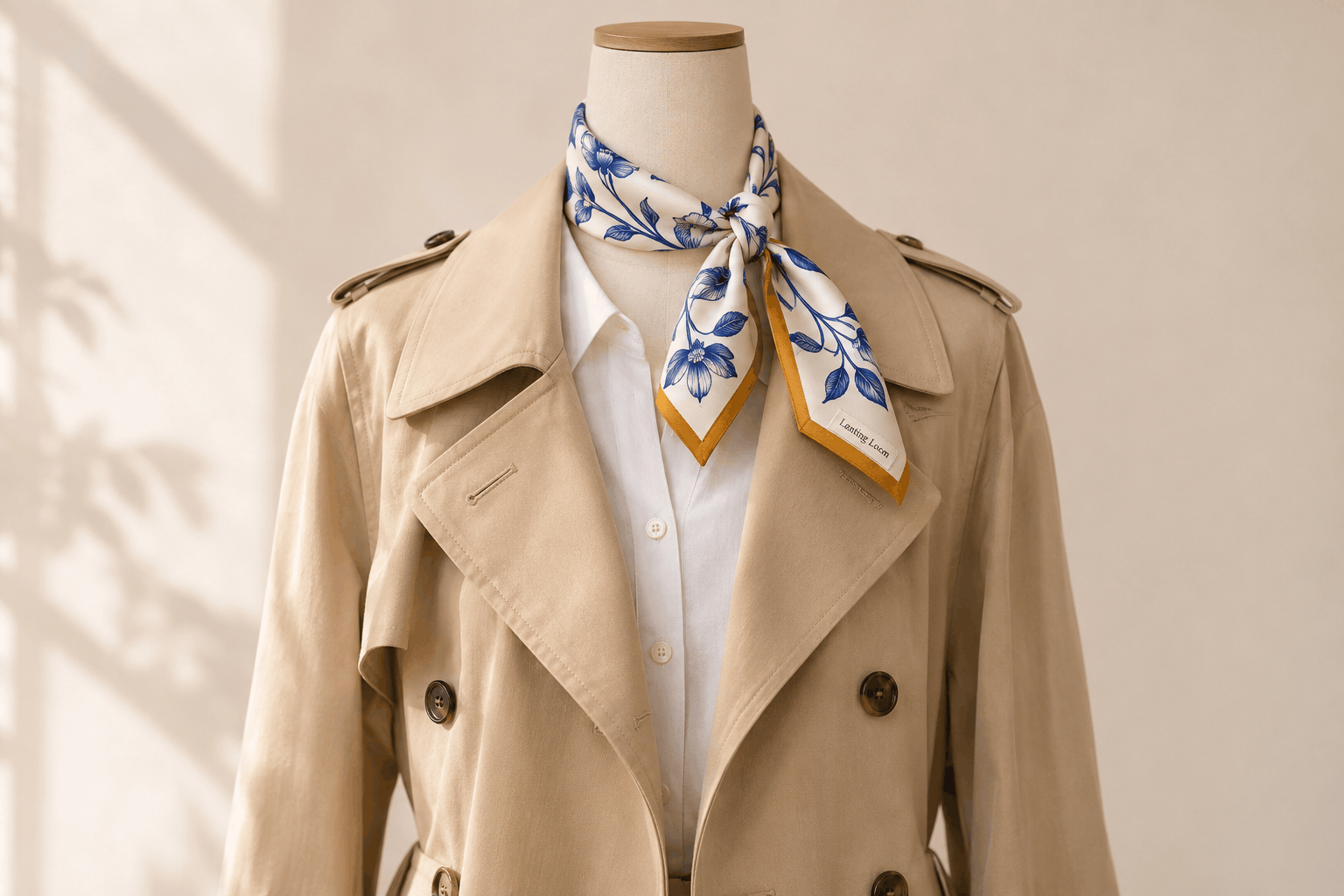
A trench coat gives an outfit structure. A silk scarf brings movement, colour and a detail that feels personal. Together, they can make a white shirt and jeans feel considered, or soften the formality of a workday outfit.
If you are wondering how to wear a silk scarf with a trench coat, begin with the neckline: tie a small scarf loosely above the lapels, let a longer scarf fall inside an open coat, or display a larger square in a soft triangle. Keep the fabric clear of buckles and buttons, and leave enough room to turn your head comfortably.
The six looks below offer different ways to balance the scarf with your coat, from a compact neck knot to a handbag accent for warmer days.
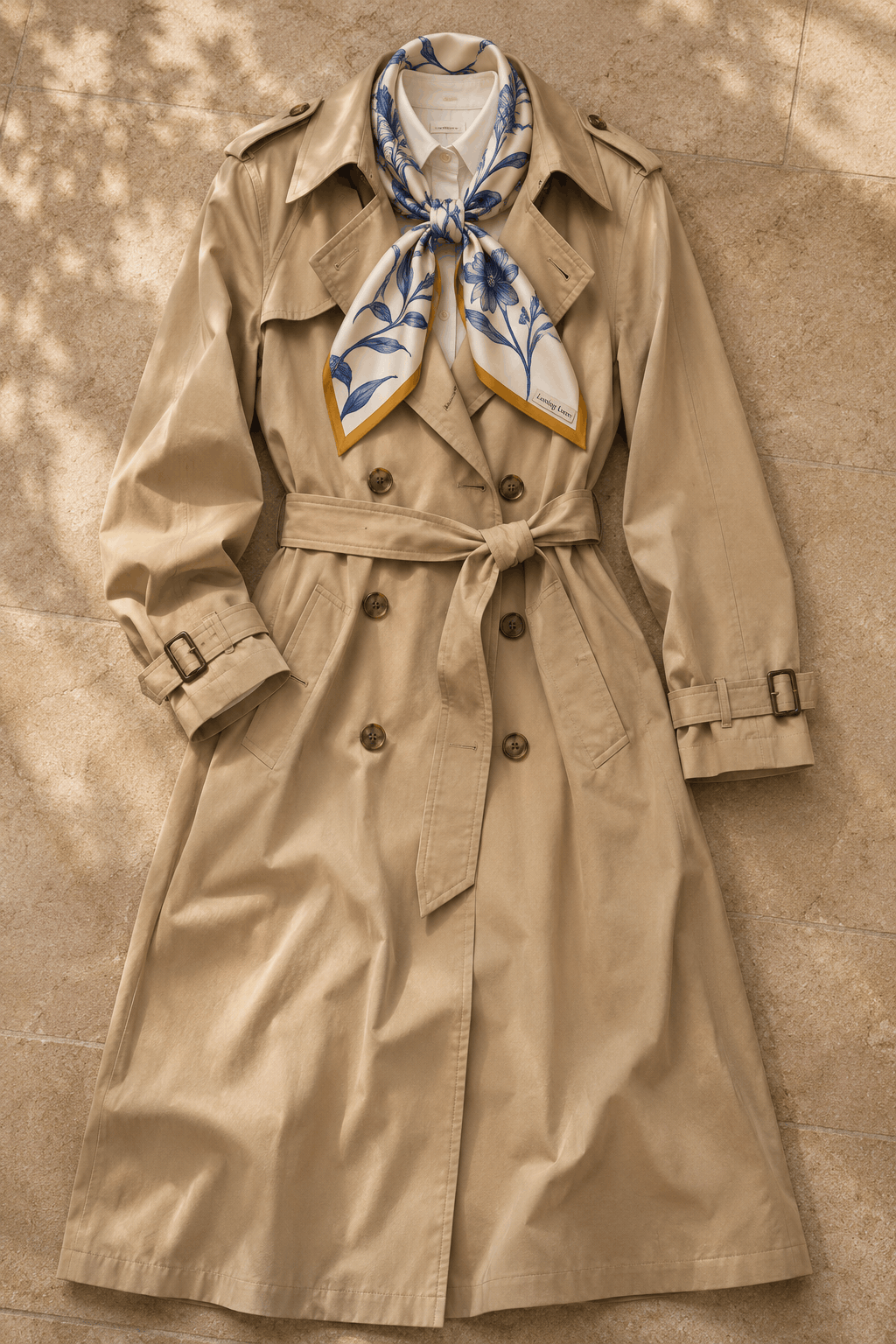
Before You Begin: Match the Scarf to the Coat
Look at the trench coat’s collar, lapels and overall shape before choosing your fold. A coat with broad lapels and prominent buttons already has plenty of detail, so a small scarf accent may be enough. An open, understated trench gives a longer drape more room.
- For a compact neckline: choose a small or medium square that leaves enough length for a comfortable knot.
- For a visible triangle: choose a larger square with a central design you want to show.
- For a long front drape: use a long scarf or a large square folded diagonally.
- For a shoulder drape: choose enough width to sit comfortably over the coat without stretching.
These are starting points rather than fixed size rules. Your neckline, the scarf’s thickness and the coat’s cut all affect the result. Try the arrangement with the coat on before deciding whether it needs more or less fabric.
1. The Small Off-Centre Neck Knot
Best for: a beige trench, a white shirt and straight-leg jeans or tailored trousers.
A small knot adds colour close to the face while leaving the trench’s lapels visible. It is an easy everyday option when you want the scarf to feel like part of the outfit rather than its main feature.
- Lay a square scarf flat in a diamond shape.
- Fold two opposite corners towards the centre, then continue folding into a narrow band.
- Drape the band around your neck and tie a relaxed, flat knot.
- Move the knot slightly to one side and arrange the two tails.
- Put on your trench and smooth the collar around the scarf.
Keep the knot above the opening of the lapels so it remains visible. If the scarf fills the whole neckline, try a narrower fold or a smaller square.
Finish the look: choose one colour from the scarf and repeat it subtly in your shoes, bag or knitwear. There is no need to match every accessory.
2. The Long Drape Inside an Open Trench
Best for: a navy or black trench worn open over a plain top.
Two long ends create an uninterrupted line down the front of the outfit. This arrangement gives the print room to show without adding a knot at the neck.
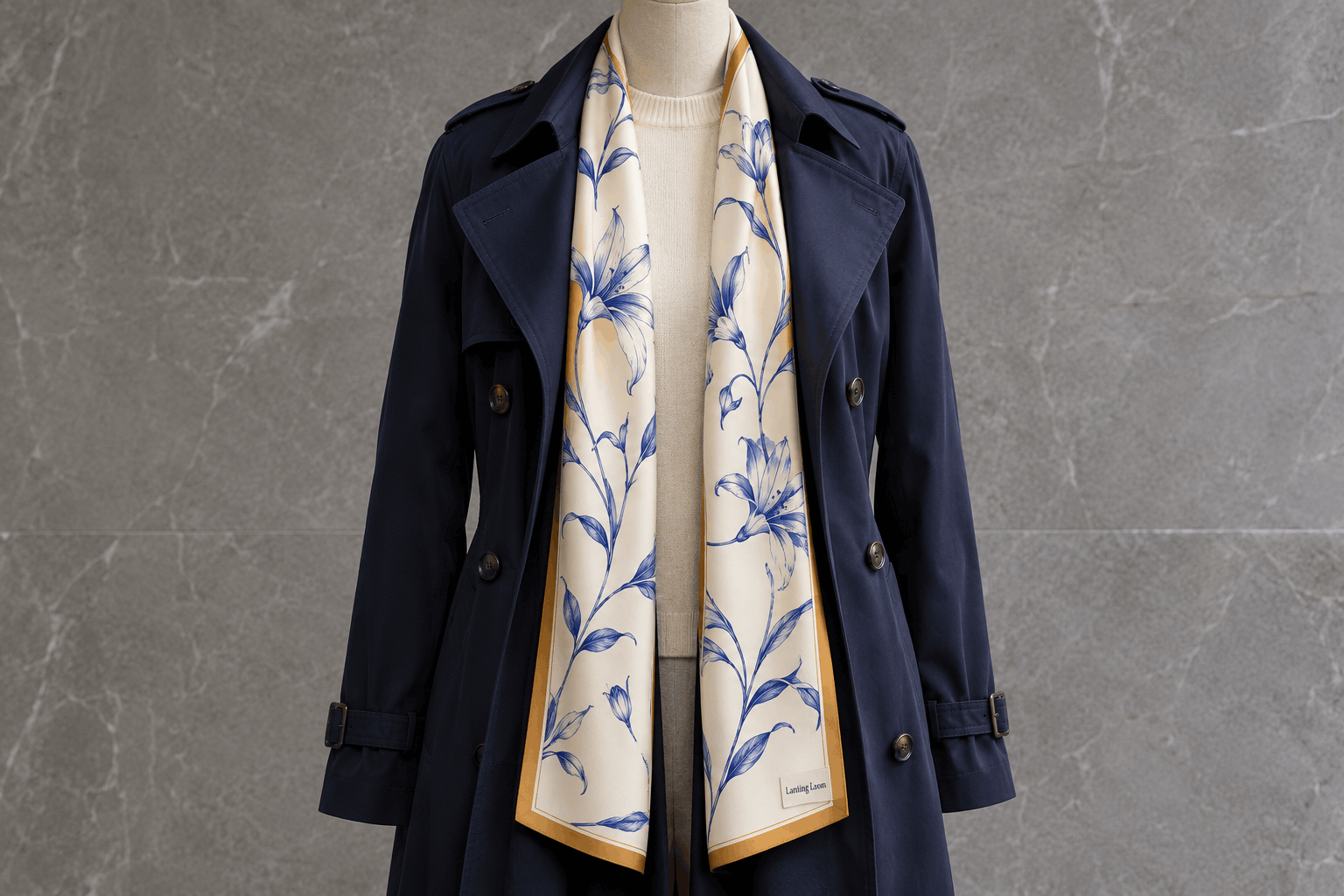
- Fold a long scarf lengthways into a loose band, or fold a large square diagonally into a band.
- Place the centre behind your neck.
- Let both ends hang down the front, inside the open coat.
- Adjust them to roughly equal lengths, or leave a small difference for a relaxed finish.
- Check that the scarf lies flat beneath the lapels and stays clear of the coat’s fastening.
A light scarf against a dark coat creates a clear contrast. For a quieter look, choose a print with a background close to the colour of your top.
Finish the look: keep the layer underneath simple—a cream knit, white T-shirt or plain blouse lets the scarf’s pattern remain easy to read.
This loose arrangement is best when you can keep the coat open. If you need to fasten it, tuck the scarf carefully inside and check that the ends are not caught beneath the belt buckle.
3. The Soft Triangle at the Neckline
Best for: showing a larger part of the scarf’s artwork with a simple trench.
A triangle fold reveals more of the design than a narrow band. The broad front section sits between the lapels, bringing colour to the centre of the outfit.
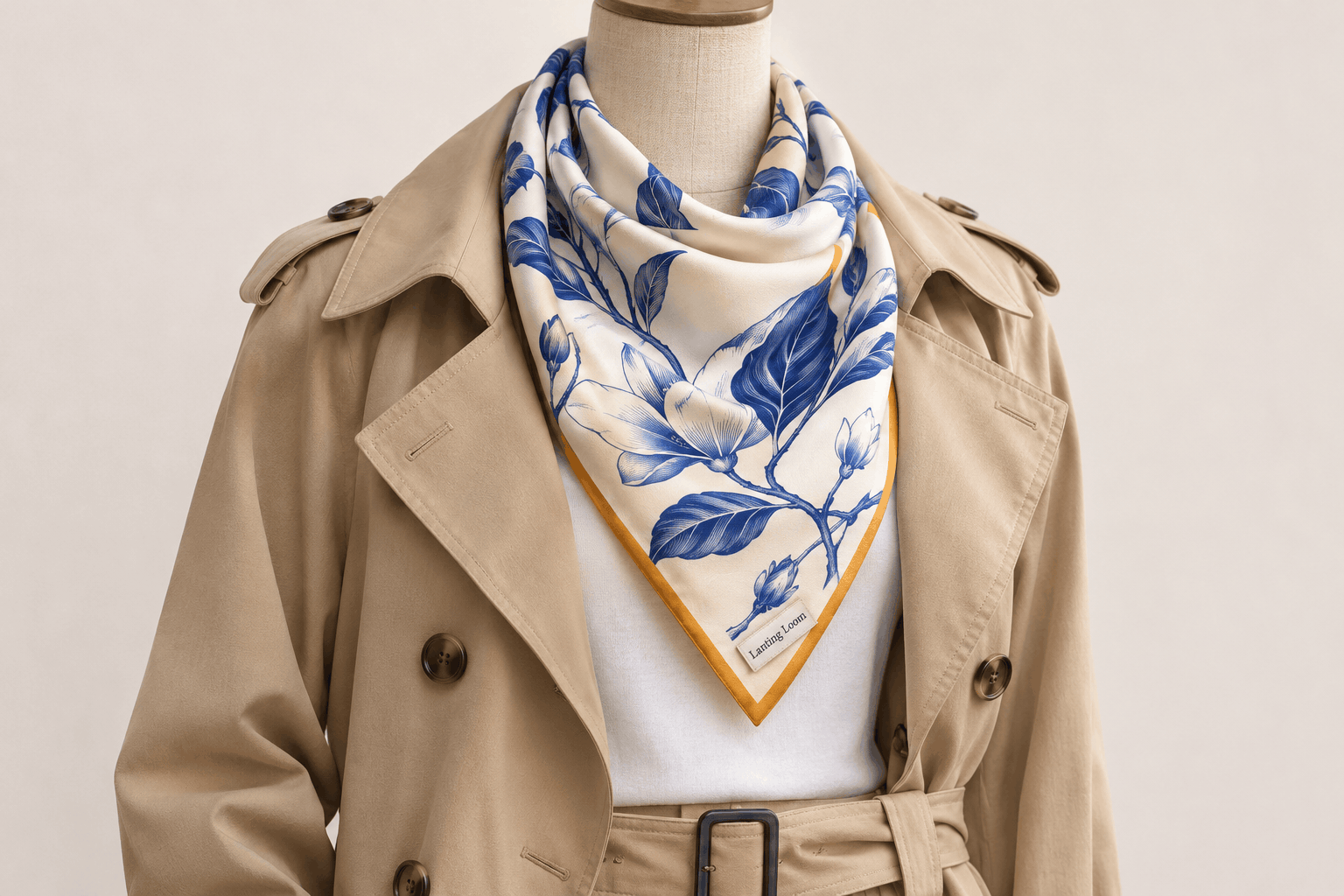
- Fold a large square scarf diagonally in half.
- Place the triangle against your chest, with its point facing down.
- Take the two side ends around your neck and cross them loosely at the back.
- Bring the ends forward and tie them gently beneath the front triangle, if there is enough length.
- Arrange the triangle between the trench’s lapels, keeping the neckline relaxed.
If the ends do not reach comfortably, use a larger scarf or choose the small neck-knot style instead. The fabric should drape without pulling against your throat.
Finish the look: turn the scarf before folding to choose which part of the print appears at the front. A border can frame the triangle, while a central motif can become the focus.
A large printed square such as Azure Arabesque offers room to explore this arrangement. Its 88 × 88 cm format and cobalt, turquoise and pale-aqua palette provide several colours to draw into a neutral outfit.
4. The Scarf-Ring Drape
Best for: a polished workday outfit or a simple dress beneath an open trench.
A scarf ring gathers the ends at the front and adds a small metallic detail. It works particularly well when you want a defined arrangement without a prominent knot.
- Fold the scarf into a smooth band and place it around your neck.
- Bring both ends forward.
- For a simple single-opening ring, pass both tips through in the same direction.
- Position the ring below the collarbones, where it can sit without pressing against a button or lapel.
- Separate the ends and let them fall inside the open coat.
Choose a smooth ring that suits the folded fabric. A heavy ring or an opening that is too large may slide down; an opening that is too small may compress or catch the silk.
Finish the look: a restrained ring is usually enough when the trench already has visible buckles or metal details. Let the scarf provide the pattern and keep the other accessories simple.
Check the arrangement after putting on your coat. A ring that sits neatly over a blouse may need moving once the lapels are in place.
5. The Asymmetric Shoulder Drape
Best for: a dinner outfit, gallery visit or a short walk in dry, calm weather.
For a softer silhouette, let a generous scarf sit over the coat rather than inside it. An asymmetric drape can reveal more of the textile and soften the trench’s structured shoulders.
- Open a long scarf across part of its width, or fold a large square into a broad diagonal band.
- Drape it around the back of your neck over the coat, leaving one end longer.
- Bring the longer end loosely across your chest and over the opposite shoulder.
- Let the remaining end fall down the front.
- Adjust the fabric so it does not bunch against the collar or catch beneath an epaulette.
This is an intentionally loose style, so some movement is natural. It is less practical for windy weather, carrying a heavy shoulder bag or frequent reaching.
Finish the look: use a plain coat and a simple outfit underneath. A broad scarf drape already adds plenty of shape and pattern.
If you keep having to replace the scarf on your shoulder, switch to a front knot or ring rather than pinning through the silk.
6. The Handbag Accent with a Clear Neckline
Best for: warmer days, a buttoned trench or an outfit with a detailed collar.
You do not have to wear the scarf around your neck to make it part of a trench-coat outfit. A small scarf tied to a bag adds colour while keeping the coat’s neckline clear.
- Choose a small square scarf or a narrow twilly.
- Fold a square into a band.
- Tie it around one smooth section of a handbag handle, away from buckles, zips and sharp hardware.
- Arrange the ends so they sit clear of the ground and the bag’s opening.
- Check that the knot holds without pulling the silk tightly.
Finish the look: pair a neutral trench and bag with one expressive scarf. Blue, green, rose or a warm ochre border can add a clear point of colour without changing the rest of the outfit.
Check the handle before tying: rough edges, surface treatments and colour transfer can affect delicate fabric. Remove the scarf in wet weather and untie it after use.
Which Scarf Colours Work with Your Trench?
Begin with the coat’s colour, then decide whether you want gentle coordination or a stronger contrast. The following combinations are styling suggestions, not rules.
| Trench colour | Scarf colours to try | Overall effect |
|---|---|---|
| Beige or camel | Cobalt and ivory; jade; burgundy | A distinct colour accent against a warm neutral |
| Navy | Ivory; pale blue; soft rose; restrained ochre | Lightness and contrast around the face |
| Black | Cream and ink; emerald; orchid tones | A clear graphic or coloured focal point |
| Olive | Ivory; muted pink; warm gold; deep blue | Soft contrast with an earthy base |
| Stone or pale grey | Mineral blue; plum; charcoal; soft green | A restrained palette with a defined accent |
If your coat has a checked lining, consider how much of it will show when worn open. A scarf with an open, spacious design may be easier to combine with a visible check than another dense pattern.
Small Adjustments That Make the Outfit Feel Balanced
- Leave some of the lapels visible. This helps preserve the trench’s shape, particularly with a large scarf.
- Choose one main detail. A prominent knot, statement earrings and a high collar can compete for space around the face.
- Check the coat both open and closed. A long drape may need tucking away when you fasten the front.
- Keep silk away from hardware. Check belt buckles, buttons, bag chains and zip teeth before heading out.
- Match the style to your day. A compact knot is easier for commuting; a loose shoulder drape suits quieter occasions.
For more scarf-styling inspiration beyond outerwear, PORTER’s silk-scarf styling feature explores other ways to bring silk into an outfit.
A Trench Coat Does Not Make Silk Rainproof
Even when your coat offers some protection from the weather, an exposed silk scarf can still get wet. In rain, tuck it fully inside the coat or put it away in a dry, protective pouch.
Put the scarf on after perfume, cosmetics and hair products have dried. After wearing, untie it and let it air before storing it. Follow the care label supplied with the piece and consult our silk care guide for further advice.
Frequently Asked Questions
Should a silk scarf go inside or outside a trench coat?
Either can work. Inside the lapels gives a cleaner, more contained arrangement. Outside the coat shows more of the print and creates a softer drape, but leaves the silk more exposed to weather and movement.
What size silk scarf is best with a trench coat?
Choose the size for the look. A small or medium square suits a compact neck knot, a larger square suits a triangle fold, and a long scarf suits an untied front drape. Check that you have enough length to fasten the scarf comfortably.
Can I wear a silk scarf with a belted trench?
Yes. A small neck knot or triangle fold can sit neatly above the belt. If the scarf has long ends, keep them clear of the buckle and avoid trapping delicate silk tightly beneath the belt.
How do I keep the scarf from looking bulky?
Try a narrower, flatter fold, a smaller scarf or fewer layers around the neck. Let the trench’s lapels lie naturally, and avoid pushing a large knot directly beneath a closed collar.
Can I wear a printed scarf with a checked trench?
Yes. Start with one shared colour and vary the scale of the patterns. A small area of scarf print at the neck is an easy way to experiment without covering much of the coat.
Make a Familiar Coat Feel Personal
A different fold can change what you notice in a scarf: a narrow band reveals the border, a triangle displays more of the artwork, and a long drape creates a flowing line beneath the coat.
Begin with the style that suits your routine, then experiment with colour and proportion. Explore the Lanting Loom silk scarf collection for designs that bring a personal story to the pieces you already enjoy wearing.
