

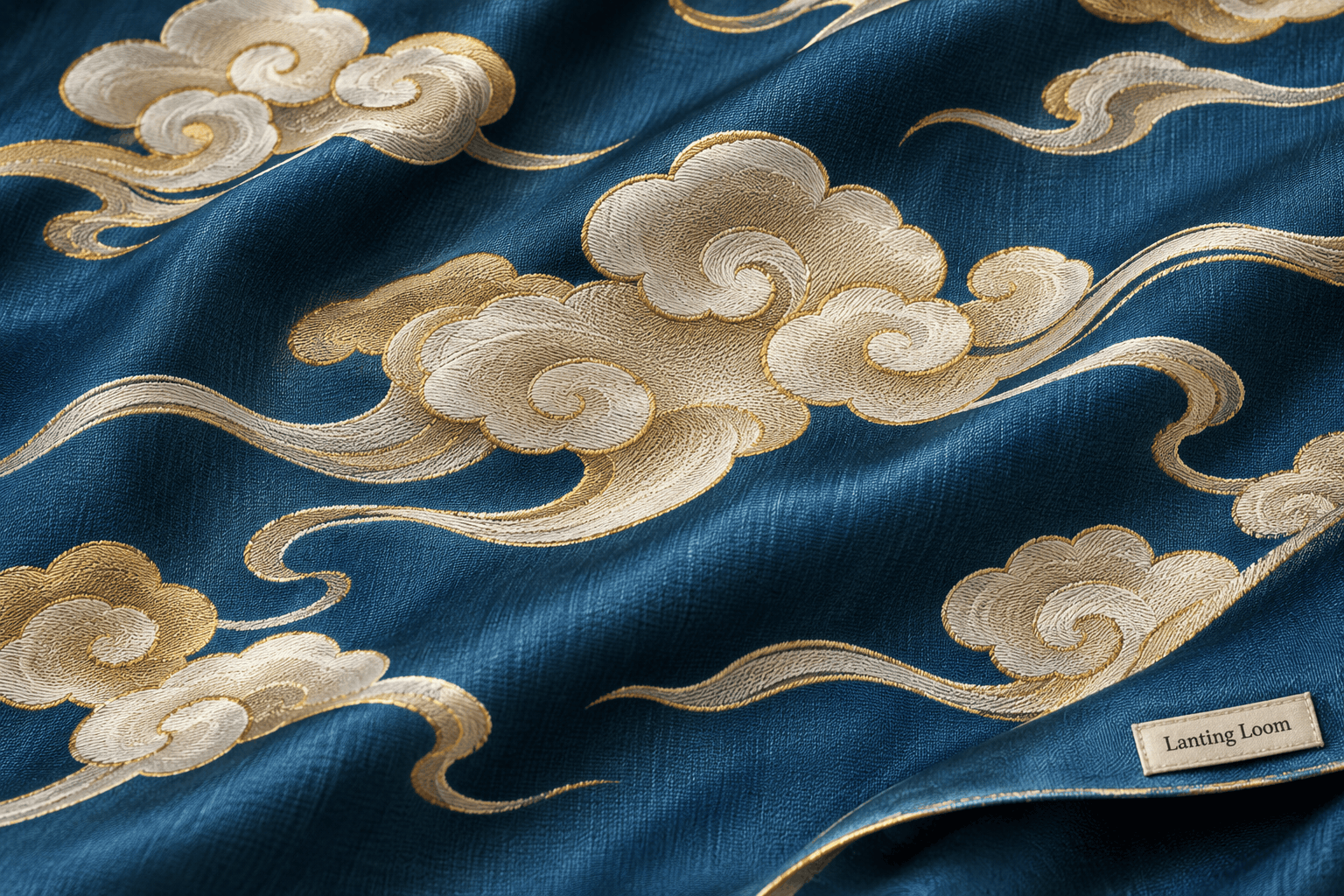
A curling cloud can be a small detail on a ceramic vessel or the movement that brings an entire textile to life. Rounded heads, sweeping trails and repeated curves turn something fleeting in nature into a recognisable decorative form.
Chinese cloud motifs often carry auspicious associations: good fortune, blessings and the hope that things will go well. In other settings, clouds help establish a celestial world or organise the space around figures and symbols.
Their meaning depends on the object. Understanding the difference between a general cloud pattern, an auspicious cloud and a ruyi-related form makes these designs more rewarding to look at—and more meaningful to translate into contemporary silk.
What Are Auspicious Clouds?
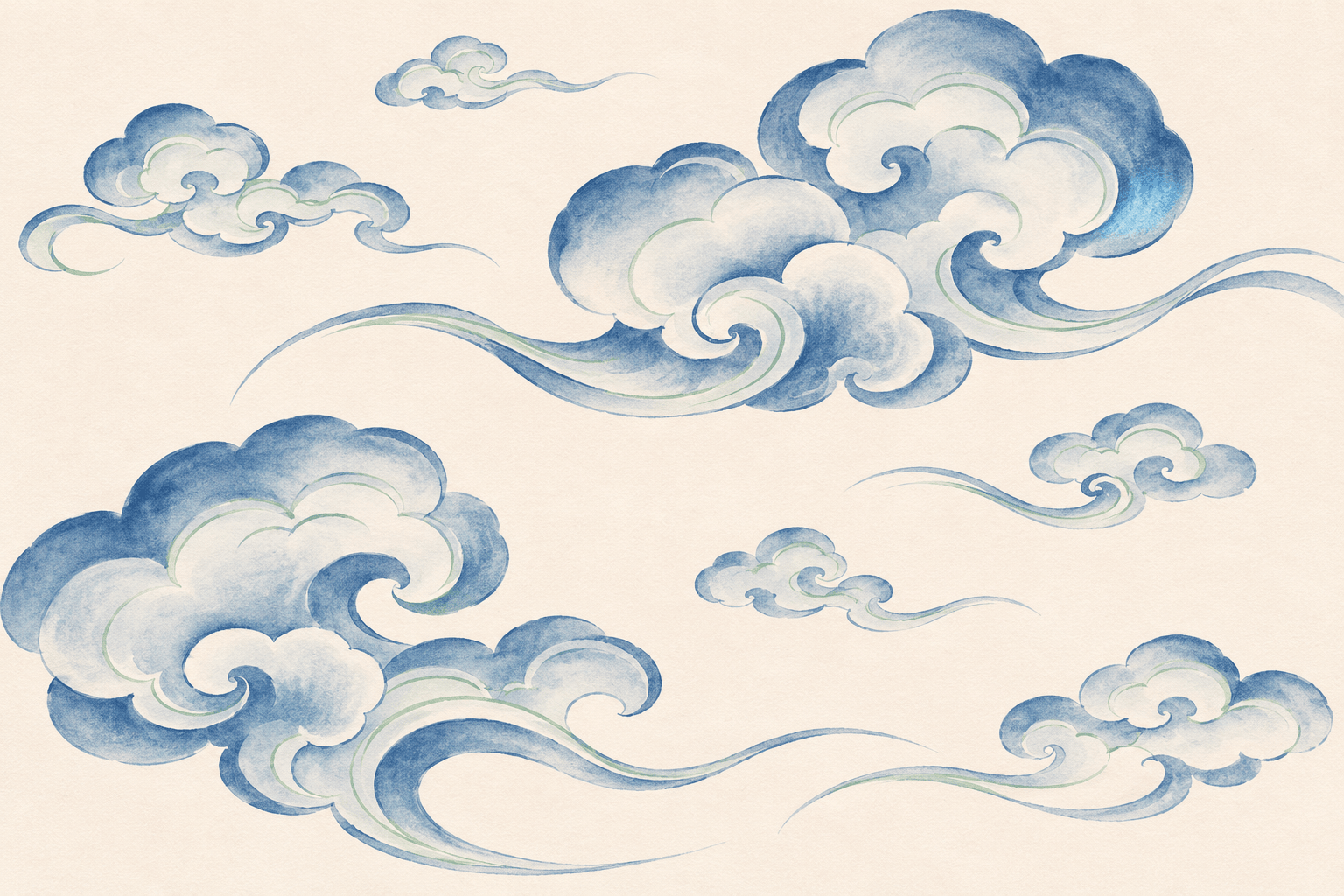
Xiangyun (祥云; traditional form 祥雲) means auspicious clouds. “Auspicious” describes something understood as favourable or promising good fortune.
In decorative art, that association becomes a visual expression of good wishes. A cloud pattern can contribute to a celebratory composition without spelling out a message in words.
However, not every painted cloud should be read as a good-luck emblem. Clouds may describe weather, create distance in a landscape or establish the setting of a religious scene. The title, accompanying motifs and historical context help clarify their role.
Cloud Motif, Auspicious Cloud and Ruyi: What Is the Difference?
| Term | Basic meaning | Useful distinction |
|---|---|---|
| Yunwen (云纹 / 雲紋) | Cloud pattern or cloud motif | A broad description of the design, without specifying one symbolic message |
| Xiangyun (祥云 / 祥雲) | Auspicious clouds | Emphasises favourable associations and good wishes |
| Ruyi (如意) | “As you wish” or “according to your wishes” | Names an object and an auspicious idea; it is not simply another word for cloud |
| Ruyi-shaped cloud motif | A cloud form related visually to the lobed head of a ruyi | Connects a particular decorative shape with the wider language of wish fulfilment |
These terms overlap, but they are not interchangeable. A long drifting cloud band and a compact ruyi-like cloud head can belong to the same broad visual family while looking quite different.
The Connection Between Clouds and Ruyi
A ruyi is a curved, sceptre-like object whose head may resemble a cloud or the lingzhi fungus. Its name expresses the wish that events unfold as desired.
The Metropolitan Museum of Art describes a seventeenth-century ruyi sceptre attributed to Hu Wenming with a cloud-shaped head and explains its association with good fortune.
The Palace Museum’s introduction to ruyi also traces the relationship between the object and decorative forms. It notes the established use of ruyi cloud patterns during the Ming and Qing periods, including on clothing, furnishings and architectural details.
This relationship helps explain why some cloud ornaments look deliberately shaped rather than like a natural patch of vapour. Their rounded outline participates in a decorative vocabulary that viewers could recognise.
It is still worth avoiding an overly simple origin story. Cloud imagery has varied forms and contexts; not every cloud pattern should be described as a direct copy of a ruyi sceptre.
What Do Chinese Cloud Motifs Mean?
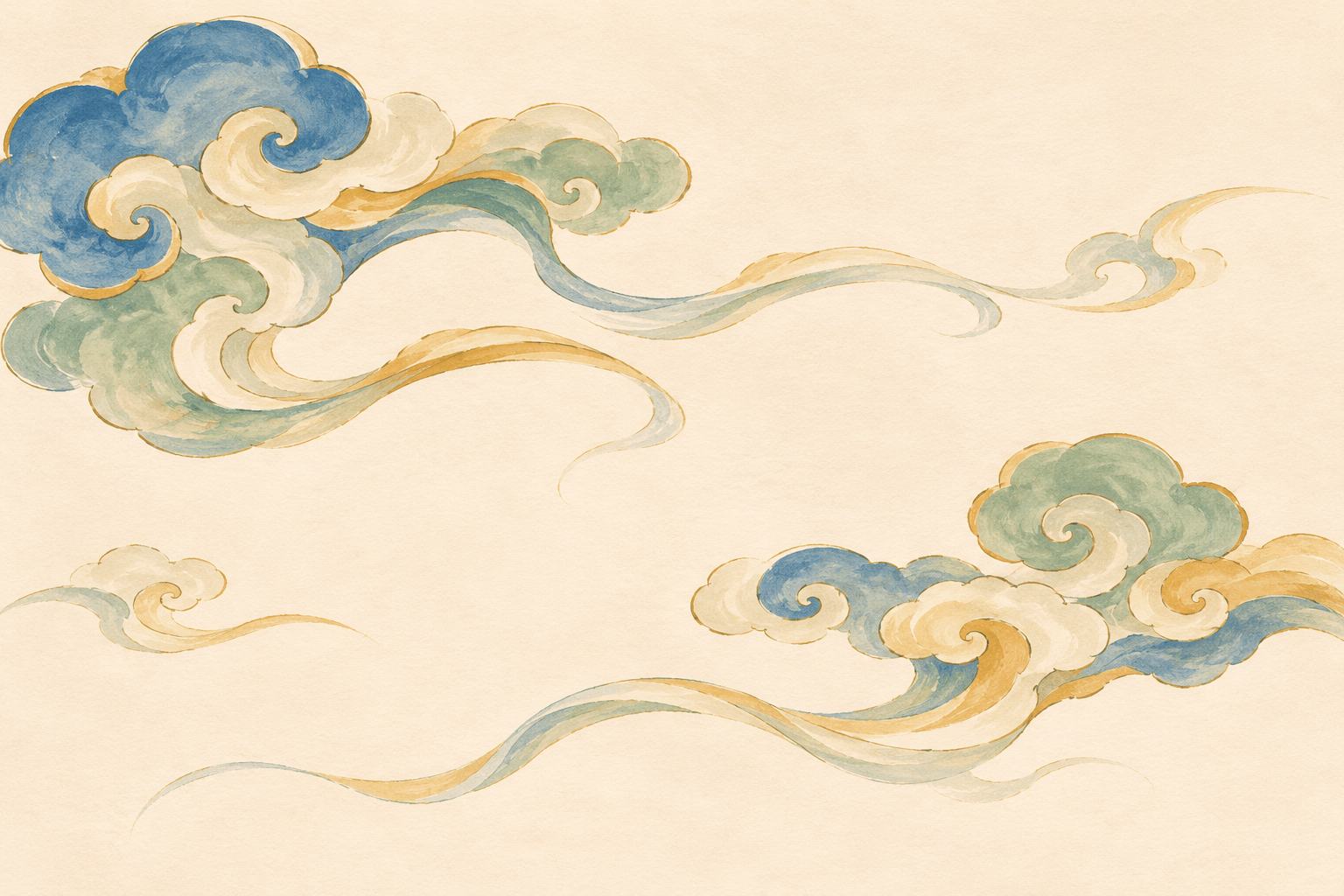
Good fortune and favourable wishes
In an auspicious composition, clouds can help communicate a wish for happiness and favourable circumstances. This makes them relevant to objects intended for celebration, presentation or gift-giving.
That meaning is a cultural expression of hope. A cloud motif does not promise that an object will change its owner’s luck.
A celestial setting
Clouds can also suggest a world beyond ordinary earthly space. Their placement around figures or other motifs may be part of the subject, rather than simply a decorative background.
The Asian Art Museum’s Rug with Scene of Bats and Clouds offers a useful example. Its interpretation connects clouds with the heavens and bats with a spoken association between the words for bat and happiness, creating a combined blessing.
The meaning comes from the relationship between the motifs. Looking at the clouds alone would miss part of the message.
Movement and visual rhythm
Clouds also perform a practical visual role. A curling trail can guide the eye between larger elements, while repeated cloud heads can create a measured rhythm across a surface.
This is a way of looking at composition rather than a fixed symbolic translation. A designer may use cloud forms for their movement while also acknowledging their auspicious associations.
Cloud Motifs in Historical Silk Textiles
Silk provides an especially rich setting for cloud designs. Curves can travel across a textile, gather around a central motif or repeat in a pattern that changes as the fabric folds.
A sixteenth-century Sutra Cover with Dragons and Phoenixes amid Clouds in The Met’s collection shows cloud imagery within a woven silk object made for a religious text. The museum relates its ornamental style to designs also found on imperial ceramics and lacquerware of the period.
This is evidence of motifs moving across materials. A cloud design was not limited to a single kind of object or one production technique.
Another Met example, Sutra Cover with Wavelike Clouds and Auspicious Symbols, is catalogued as a sixteenth-century woven textile made with silk and metallic thread. Its title also reminds us that clouds can appear as flowing, wave-like forms rather than isolated rounded shapes.
When discussing these objects, the material description matters. Woven patterning, embroidery and printing produce imagery in different ways, even when the visible subject is similar.
How to Look at a Chinese Cloud Pattern
Begin with the whole object, then move closer to the details.
- Read the identification. A museum catalogue or documented design story is more reliable than guessing from a curling outline.
- Look at the shape. Notice whether the clouds form rounded clusters, extended trails, bands or borders.
- Notice what surrounds them. Figures, animals, inscriptions and other emblems may explain the intended theme.
- Check the object’s purpose. A religious textile, garment and decorative vessel may use related forms differently.
- Separate observation from interpretation. “The curve creates movement” is a visual observation; a specific historical meaning needs supporting context.
Not every spiral is a cloud, and a cloud-like outline alone does not establish an object’s date, origin or significance.
Bringing Cloud Motifs into Contemporary Silk Design
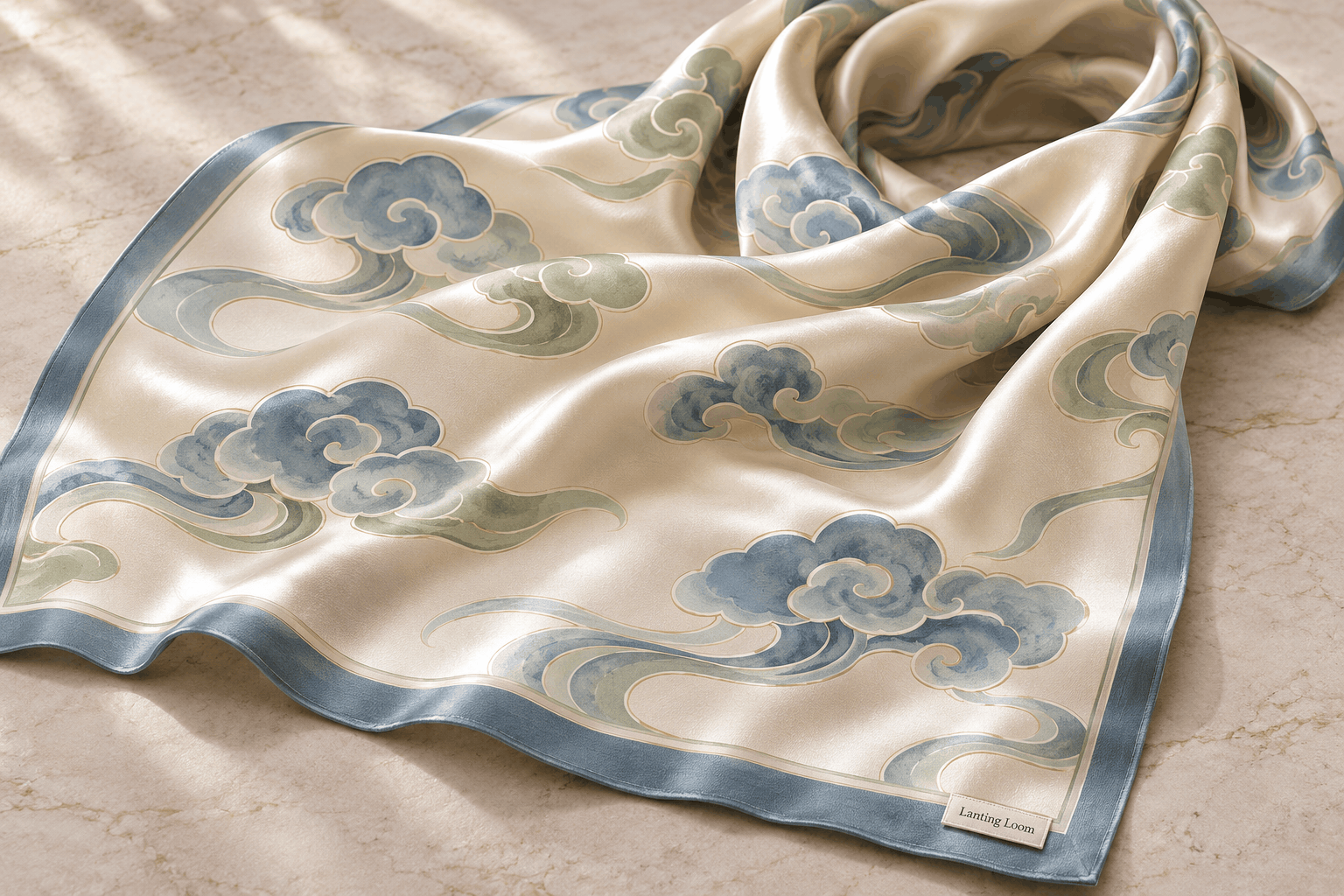
Cloud forms offer a contemporary designer a useful balance of structure and movement. A rounded head gives the eye somewhere to pause, while a tapering trail leads it onwards.
On a scarf, the design also needs to work in motion. A composition that looks balanced when laid flat may reveal only a small section when tied at the neck. Well-placed curves and borders can keep the design interesting in both forms.
Possible approaches include:
- An open composition: a few cloud forms surrounded by generous space.
- A flowing border: cloud trails arranged around the scarf’s edge.
- A restrained repeat: smaller motifs balanced across the surface.
- A larger abstract interpretation: curves and layered colour that retain the feeling of drifting clouds.
Mineral blue, muted jade, warm ivory or a restrained gold accent can offer contemporary colour directions. These are design choices, not a universal historical colour code.
A printed cloud pattern should be described as printed. Cultural inspiration alone does not establish that a scarf is handwoven, embroidered or made using a heritage craft.
What Can an Auspicious Cloud Gift Express?
A cloud-inspired gift can carry a generous, open-ended wish: that life goes well, that plans unfold happily or that the recipient enjoys the next stage of a journey.
For a birthday, it might accompany warm wishes for the year ahead. For a graduation or new role, you could connect it with hopes for the future. These are personal applications of auspicious imagery, rather than fixed rules assigning clouds to particular occasions.
A simple card could say:
I chose this cloud-inspired design with a wish that the months ahead bring good things and that your plans unfold as you hope.
For someone interested in art, the relationship between cloud forms and ruyi offers another point of connection. A short, accurate explanation can add depth without turning the gift into a history lesson.
Explore Lanting Loom’s silk scarves and gifts and read each product’s design story to confirm its inspiration. Our gift services explain available presentation and personal-message options.
Frequently Asked Questions
What does xiangyun mean?
Xiangyun means auspicious clouds. It describes cloud imagery associated with favourable signs or good fortune.
Are all Chinese cloud patterns auspicious?
No. Clouds may serve scenic, atmospheric, religious or decorative purposes. Their meaning depends on the complete work and its context.
Is a ruyi the same as a cloud?
No. A ruyi is an object associated with the idea of wishes being fulfilled. Its head can resemble clouds or lingzhi, and related shapes appear in decorative cloud motifs.
Were cloud motifs used only on imperial objects?
No. Although they appear on imperial works, their use extends across different objects and settings. A cloud motif alone does not establish an imperial connection.
Can a modern scarf use auspicious clouds respectfully?
Yes. A thoughtful interpretation can acknowledge the source, explain the meaning accurately and describe the actual production method. It can also adapt the scale and colours to make the design wearable today.
Good Wishes in a Flowing Form
Auspicious clouds bring together visual movement and a generous idea: the hope that things will go well. Their forms can be elaborate or restrained, but their significance becomes clearer when we look at the objects, stories and motifs around them.
In contemporary silk design, that understanding allows a cloud to remain both beautiful to wear and meaningful to give.
