

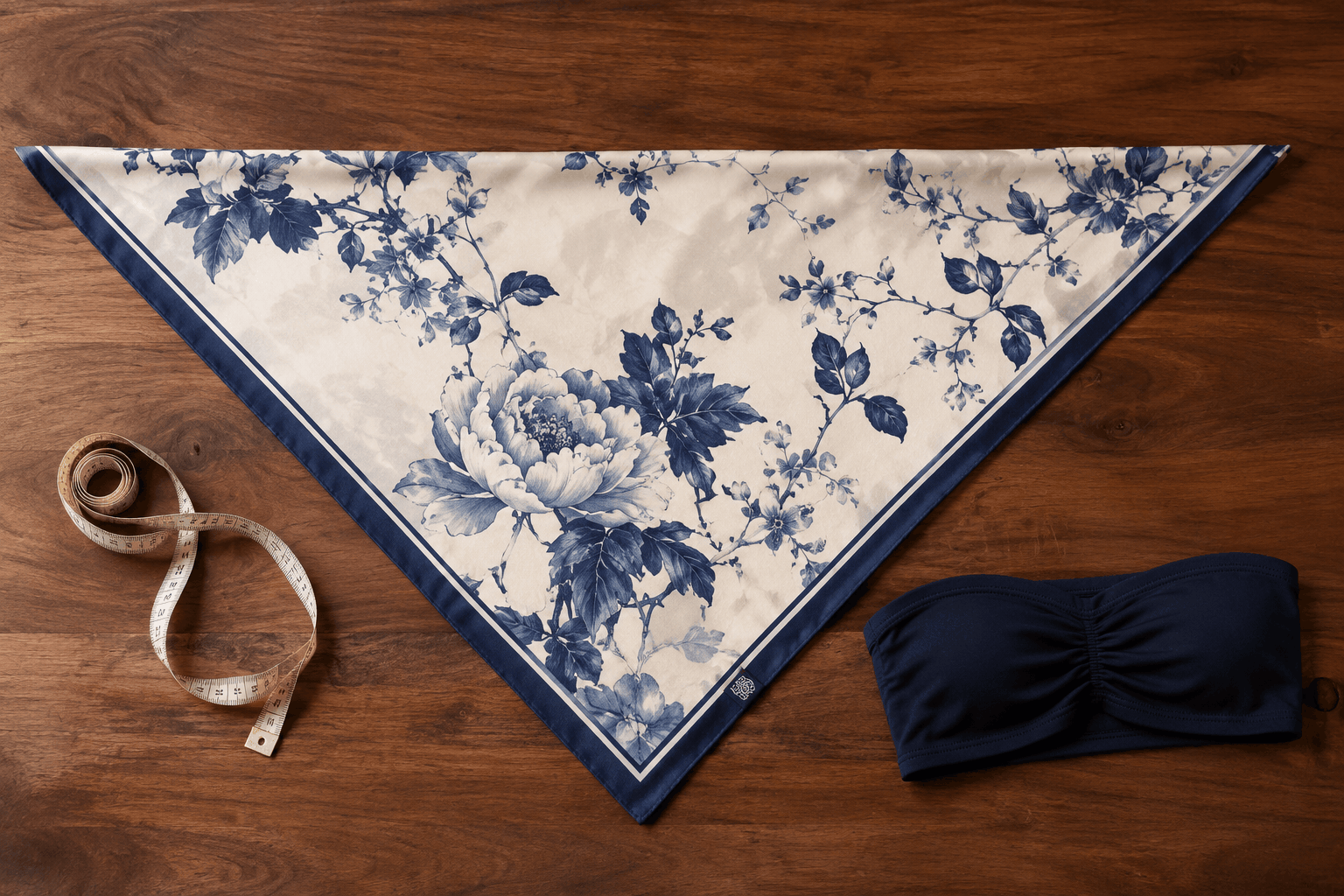
The simplest way to wear a silk scarf as a top is to fold a large square diagonally, hold the straight edge across your upper chest and tie the two long corners behind you. The point falls towards the waist, giving the print almost as much space as it has when the scarf lies flat. Try it first over a bandeau you already like wearing. You can then adjust the silk for the best view of the artwork without relying on the knot for coverage.
Before choosing a scarf, check two things: whether the ends reach comfortably around you with room for a knot, and where the front point lands with the trousers or skirt you plan to wear. A scarf can work beautifully on one count and come up short on the other.
What size silk scarf do you need for a top?
For a triangle top, an 88 or 90 cm square is a useful size to try first. Those measurements describe one side of the square. Once you fold it diagonally, the long edge that goes around your body is longer. The figures below give you a starting point for comparing scarves you own or are considering.
| Square scarf size | Approximate folded edge, tip to tip | What to check |
|---|---|---|
| 63 × 63 cm | 89 cm (35 in) | Check the reach first. The corners may meet with too little silk left for a knot. |
| 88 × 88 cm | 124 cm (49 in) | Try the triangle over your intended base layer and check the coverage at each side. |
| 90 × 90 cm | 127 cm (50 in) | The folded edge is only about 3 cm longer than that of an 88 cm square. If the smaller one is well short, try a larger format. |
| 110 × 110 cm | 156 cm (61 in) | Expect more fabric at the knot and a deeper front point. Check where it lands when you sit down. |
How to check before buying: Run a soft tape around your body along the line where you want the folded edge to sit. If that measurement is 100 cm, a 90 cm square gives you about 27 cm of diagonal length left over, or roughly 13.5 cm at each end when centred. Those ends taper to points, and the knot uses some of that length. For a better preview, fold a light piece of fabric of the same dimensions and try the actual tie. The Lanting Loom scarf size guide can also help you compare formats.
How to tie a triangle scarf top with a flat back knot
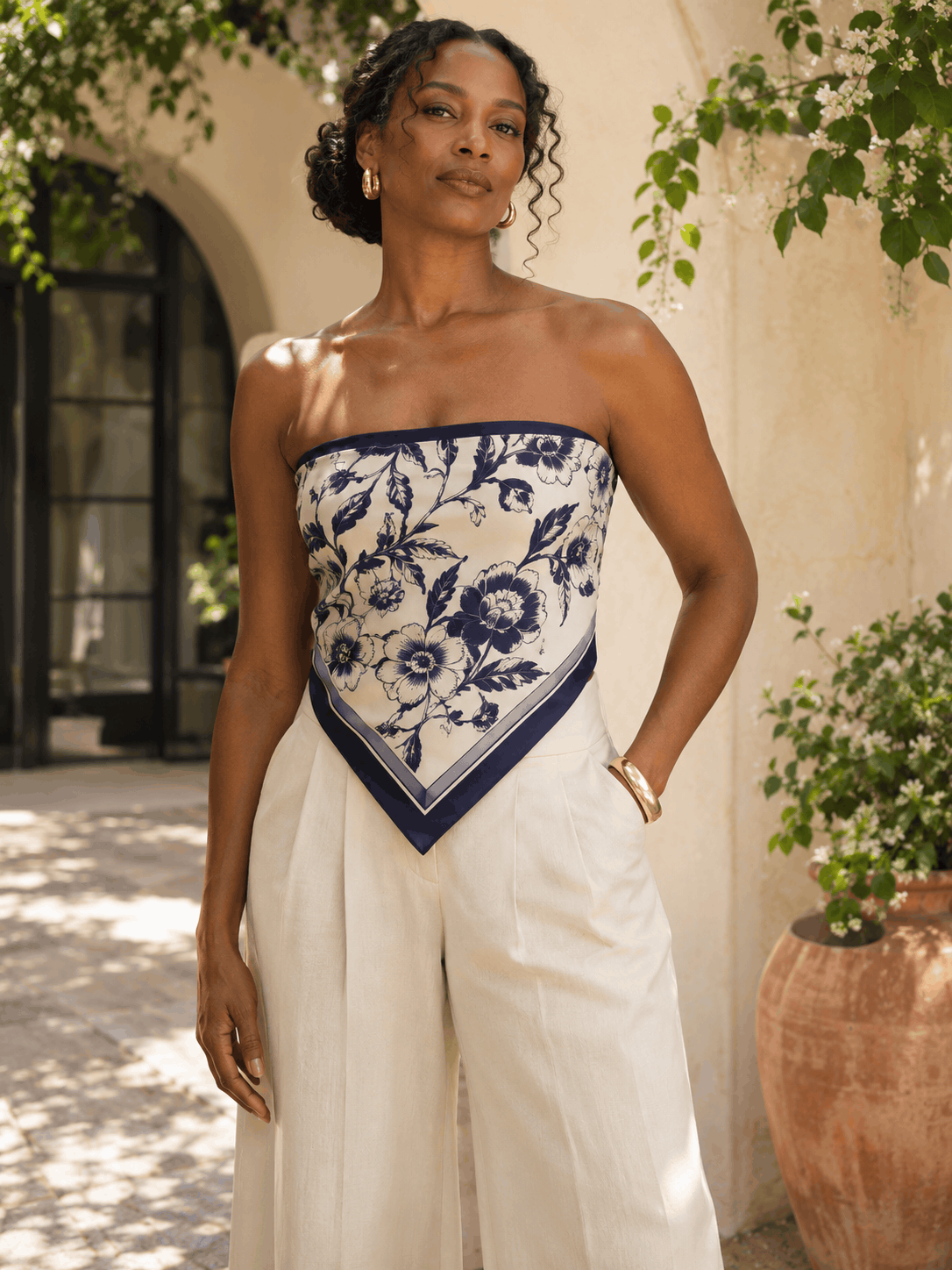
This fold suits a square silk scarf with a strong border or a motif near one corner. A border outlines the V at the waist. A flower close to the corner becomes the focal point at the front.
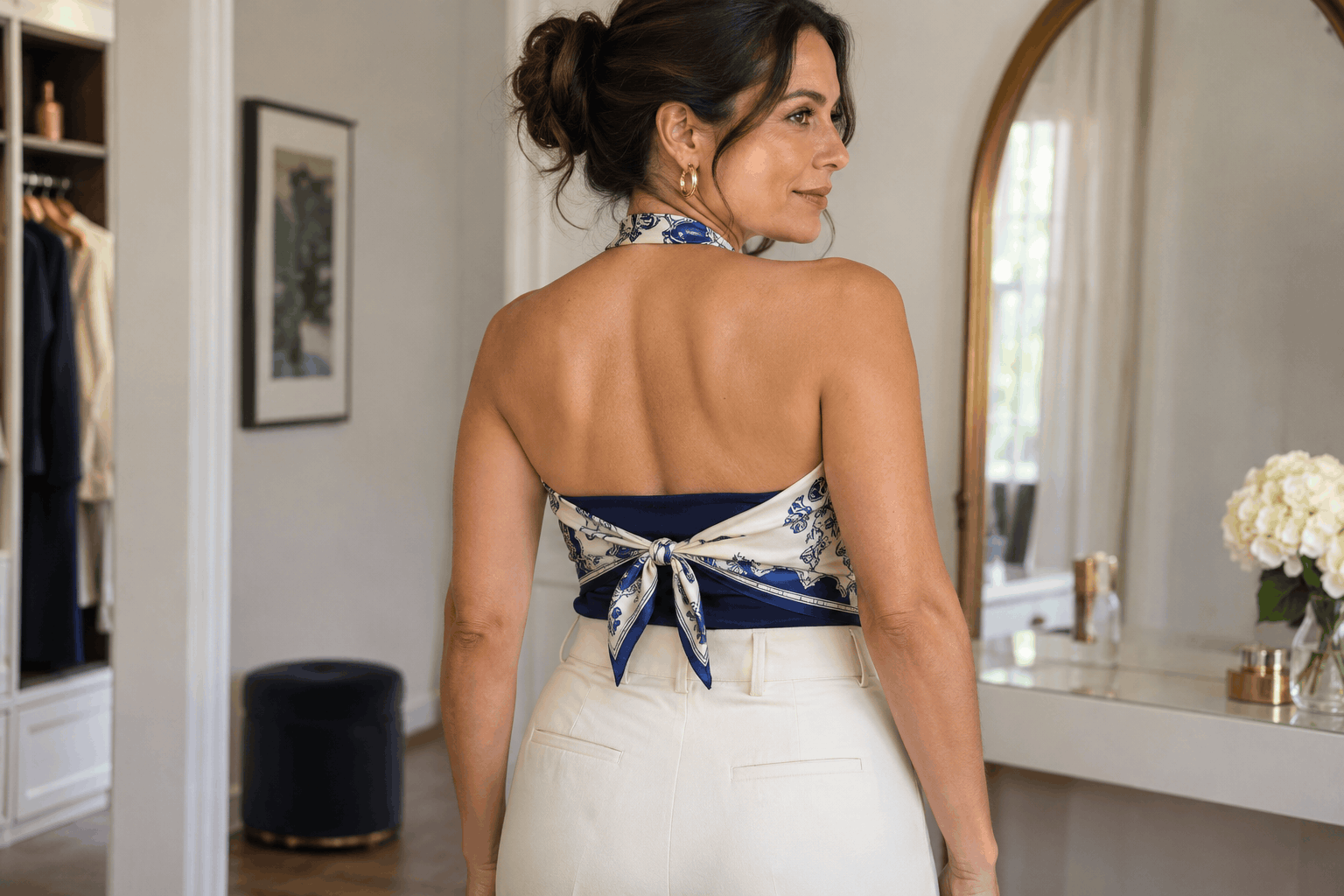
- Choose the front corner. Fold the scarf diagonally and hold it against you. Try the other diagonal as well. A change of fold can bring a different flower, colour or stretch of border to the front.
- Set the height. Put on your bandeau and the bottoms you plan to wear. Hold the long folded edge across your upper chest with the point facing down. Look at the hem from the side as well as the front: the triangle rises towards each hip.
- Tie the ends. Bring the long corners around your back. Cross the right end over the left and pass it underneath, then cross the end now on the left over the one on the right and pass it underneath. Ease the two crossings into a flat knot, leaving a visible tail on each side.
- Try the outfit in motion. Sit, reach forwards and lift your arms. The top edge should stay where you want it, and you should be able to take a comfortable breath. If the ends barely catch or the knot works loose, try a larger square. If the issue is side coverage, a camisole gives you more flexibility.
For a summer lunch, pair an ivory-and-ink-blue scarf with cream linen trousers and flat tan sandals. Choose the rise of the trousers by looking at the sides of the scarf. The front point may reach the waistband even when the sides leave a generous gap.
How to wear a side-knot scarf top over a fitted layer
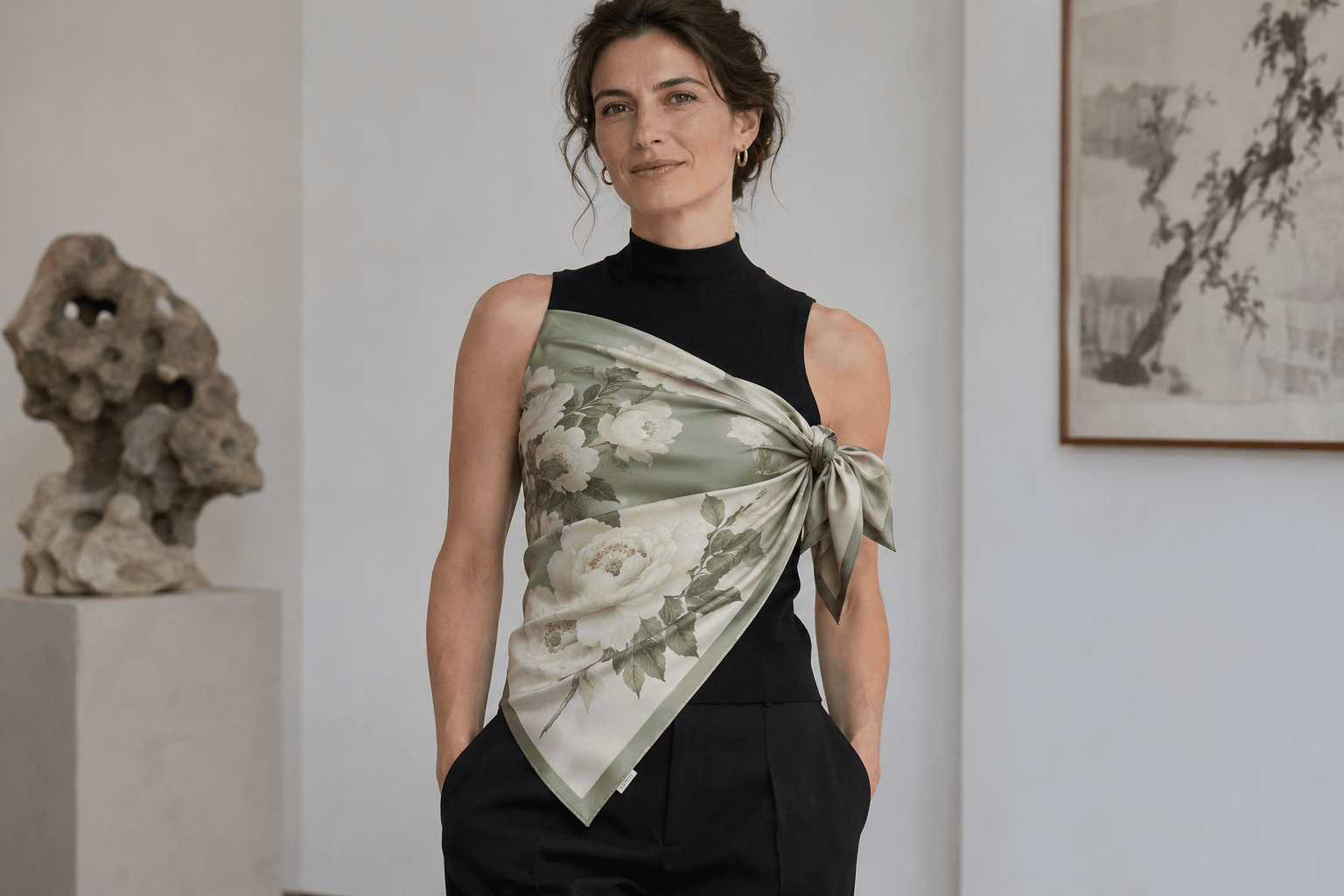
A side knot brings the fastening within reach and lets you see exactly where the print gathers. Try a sage botanical square over a black sleeveless mock neck. The black shoulder line stays visible, and a pale flower can sit open across the torso.
- Fold the scarf into a triangle. Hold the broadest part against your front, with the point a little towards your right hip.
- Bring the corners around your body so they meet on the left side. Adjust the scarf around your torso until you have enough length in both hands to tie it.
- Make a flat double knot a little forwards of the side seam, where it will clear your upper arm. Spread the front panel with your palm and turn one tail out to show the border.
Wear it with black straight-leg trousers for dinner or a gallery visit. If you will be leaning against a chair for much of the evening, this placement also keeps the knot away from the middle of your back.
Three outfits to try with a silk scarf top
- For a weekend lunch: Wear the back-tied triangle with high-waisted ivory trousers. An open linen shirt gives you a sleeve outdoors and still leaves the printed point in view.
- For an evening out: Wear a side-tied floral square over a fitted black top with matching trousers. Place the knot on the side opposite your shoulder bag so the strap and bag leave the silk undisturbed.
- For an easy denim outfit: Pair a rust or indigo scarf with straight blue jeans and an ivory camisole. Let a narrow strip of the camisole show above the silk and leave the triangular hem loose over the waistband. Dark loafers give the outfit a clean finish.
What should you wear underneath a scarf top?
A strapless bandeau gives a triangle top a bare-shoulder finish. Choose one that stays comfortable on its own, then match its colour to the scarf’s border if you want any visible edge to blend in. A fitted camisole gives more side coverage. A sleeveless mock neck makes the layering an intentional part of the outfit and works particularly well with an asymmetric fold.
Try a pale print in daylight with the intended layer underneath. An ivory ground might show the outline of a dark bandeau, while an ink-blue border might look especially good against a fine navy strap. Seeing the two fabrics together is more informative than judging either colour on its own.
Can you use a long rectangular scarf as a top?
Yes. A long rectangular silk scarf gives you a straight lower edge and a different decision to make. Its length determines whether it can wrap around you and tie. Its width determines how much of your torso it covers.
Over a fitted camisole, hold the scarf horizontally across your front and fold the upper edge down until the panel reaches your preferred hem. Carry the ends around your back and bring them to the side if the length allows. Tie them where the fabric sits comfortably, then check the knot with your arm lowered. For a scarf with a garden scene running from end to end, this horizontal fold can show a part of the artwork that disappears inside a triangle knot.
