

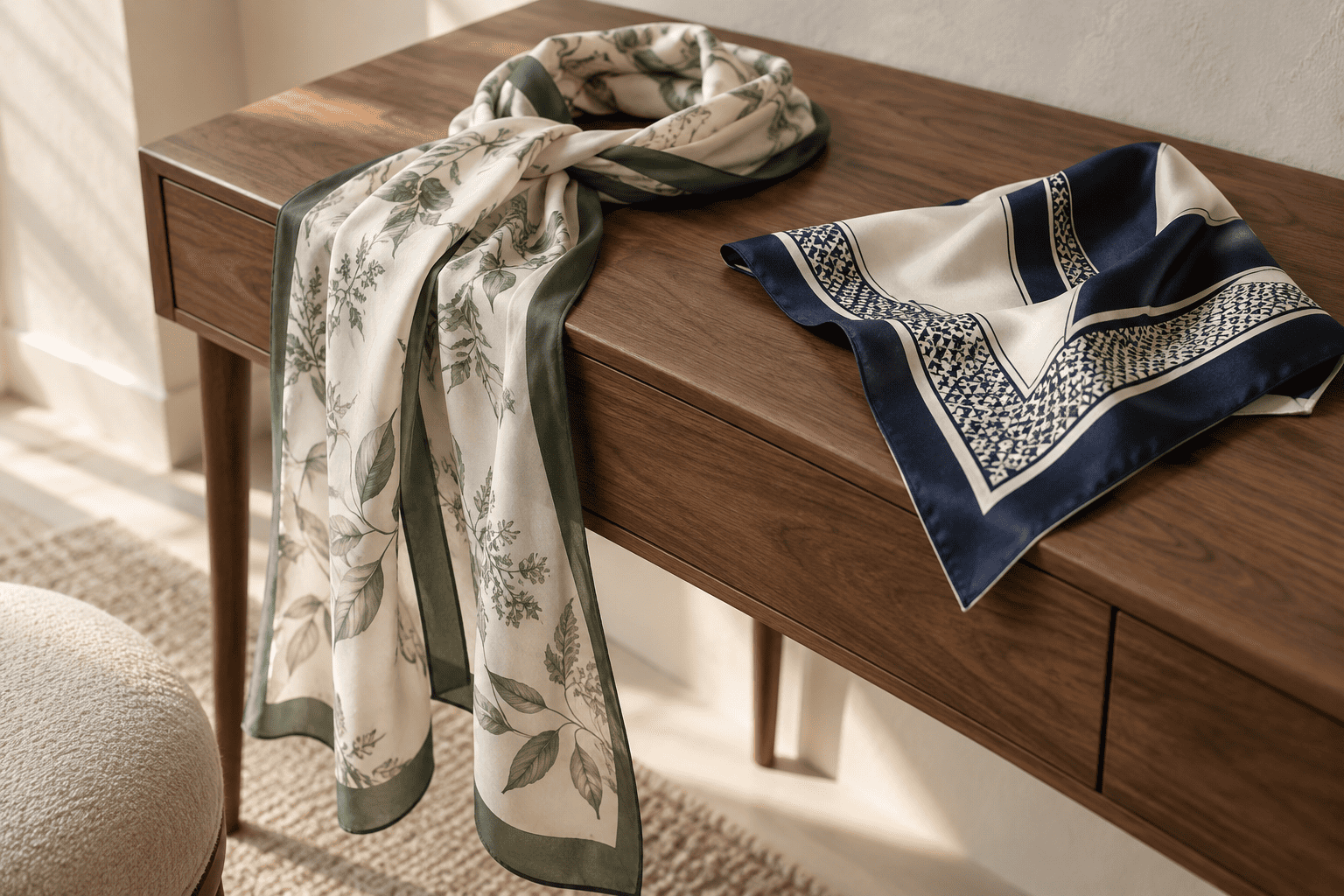
Choosing between a long silk scarf and a square scarf is easier when you picture the outfit you want to wear tomorrow. Do you imagine two flowing ends over a jacket, a small knot beside a shirt collar, or silk opened across your shoulders? Each shape makes certain looks more natural.
Choose a long silk scarf for elongated drapes, loose neck loops and wrap styling. Choose a square scarf for triangle folds, corner knots and a format you can reshape around the neck or hair. Size matters as much as shape: a small square and a large square offer very different possibilities.
In this long silk scarf vs square scarf comparison, we look at proportions, styling, fabric and gifting so you can choose the piece you will reach for most often.
Long silk scarf vs square scarf at a glance
| Consideration | Long silk scarf | Square silk scarf |
|---|---|---|
| Shape | Usually an elongated rectangle; some designs have asymmetric ends. | Four equal sides, readily folded into a triangle or band. |
| Natural starting styles | Open front drape, single loop, shoulder wrap. | Triangle drape, neckerchief knot, diagonal band. |
| Visual effect | Long lines and flowing tails. | Pointed folds, framed sections and adjustable volume. |
| Shoulder coverage | A wide rectangle can wrap around the shoulders with ends left to secure. | A large square can cover the shoulders; a petite square cannot. |
| Small accessory accents | A broad, long scarf may leave excessive fabric. | A smaller square is often easier for a compact neck or bag accent. |
| What determines quality | Fibre, construction, printing, finishing and care requirements. | The same factors; the shape itself is not a quality grade. |
Start with the actual dimensions
“Long” describes proportion, not a universal size. A 180 × 50 cm scarf and a 180 × 65 cm scarf have the same length, but the wider version gives you more fabric across the back and more volume when gathered.
Square measurements usually refer to the length of each side. An 88 cm square measures 88 × 88 cm, not 88 cm from corner to corner. Folded diagonally, its longest edge is approximately 124 cm. That gives it useful tying length, although it will not behave like a 180 cm rectangle.
For a concrete comparison, Bamboo in Blue Mist measures 180 × 65 cm, while Grace Within the Lattice measures 88 × 88 cm. The first offers a long span around the shoulders; the second can open into a broad square or fold into a pointed triangle.
If measurements are hard to picture, use a tape measure against your body or fold a piece of fabric to similar dimensions. This shows the likely coverage, though the substitute will not reproduce silk’s drape.
When a long silk scarf is the better choice
You enjoy a simple drape over everyday clothes
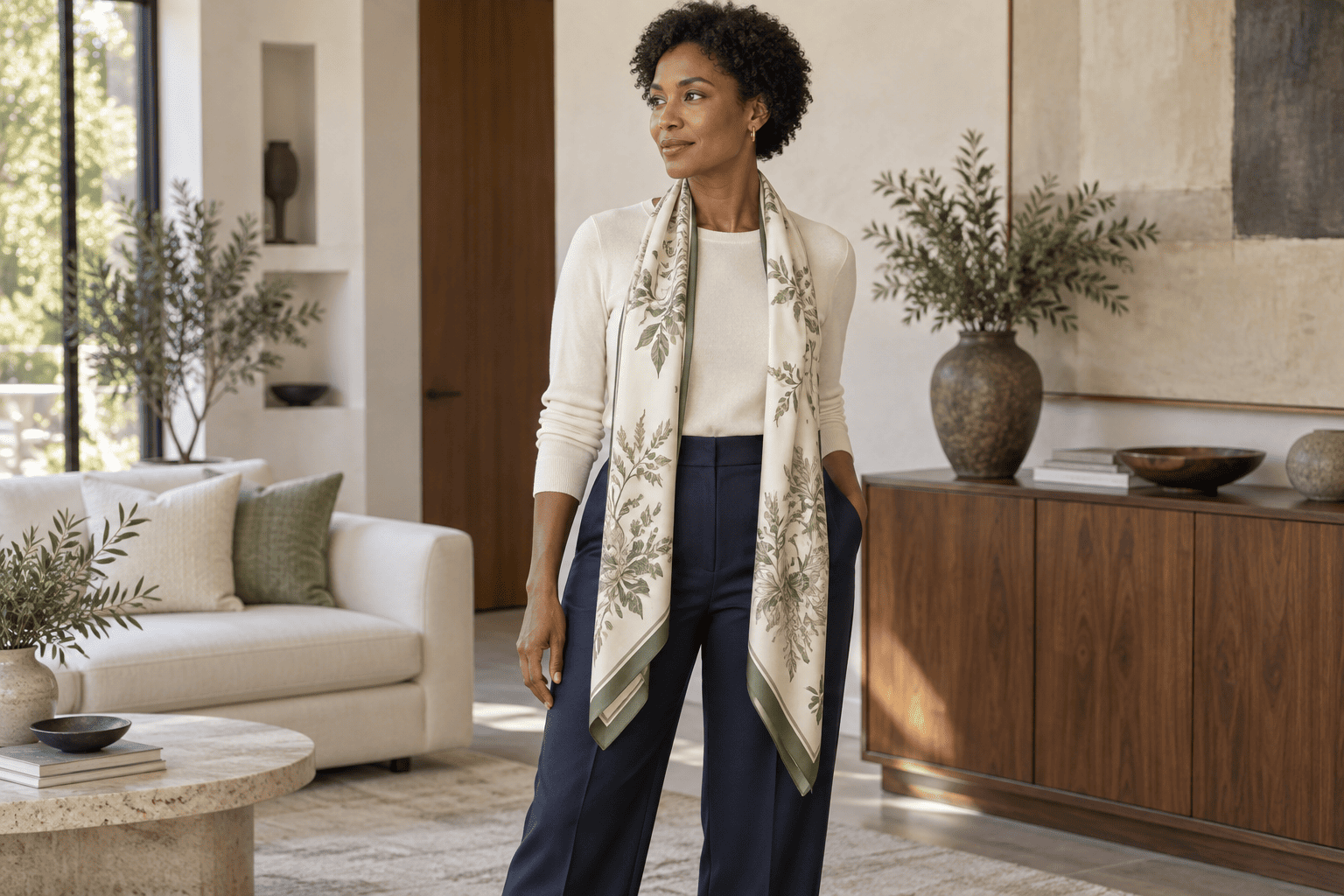
A long scarf is an easy starting point if you prefer arranging fabric to learning knots. Fold it lengthwise, place the centre behind your neck and let the ends fall over a jacket or knit. The length remains visible with very little preparation.
A loose loop uses some of that length and brings the tails higher. This is useful when an open drape feels too long for a shorter jacket or when you want the colour concentrated near your face.
You want a scarf that can become a light wrap
A wide rectangle works well across the upper back because its length can continue around the arms and forward. Look at width as well as length: a narrow ribbon scarf cannot provide the coverage of a broad silk shawl.
For dinners, weddings or travel, consider whether the ends reach comfortably in front without pulling the fabric tightly across your shoulders. Silk can provide a light layer, but warmth depends on the fabric and how you wear it.
You like seeing the design in long sections
Botanical stems, changing colour fields and flowing compositions can unfold along the tails of a long scarf. Over a plain dress, a lightly belted drape can reveal two substantial sections of the artwork. Check photographs of the scarf folded as well as open.
When a square scarf is the better choice
You prefer a defined knot or triangle
A square gives you four corners to work with. Bring opposite corners together for a triangle, or fold inward along the diagonal to create a band with tapered ends. These folds suit a neckerchief, a side knot or a triangular panel over a plain top.
For a discreet accent, choose a smaller square with enough length for your preferred knot. For a fuller triangle or shoulder drape, look at larger dimensions. Extra fabric increases your options but also adds volume around the neck.
You want to change where you wear it
A suitable square can move between neck styling, a hair band and a bag accent. These uses depend on its size: a petite square may tie around a ponytail but be too short to circle your head, while a large square may overwhelm a small handbag.
Choose for the use you expect most often. A scarf that can theoretically do many things is only versatile for you if those are things you actually enjoy wearing.
You enjoy revealing different corners of a composition
A square can show a decorative border in one fold and a quieter central section in another. Grace Within the Lattice, for example, combines an ivory centre with architectural lines and a detailed border. Changing the fold changes which colours and details frame the outfit.

Do fabric and weight matter more than shape?
They matter alongside it. Both long and square scarves can be made from silk satin, twill or other constructions. “Square” does not mean structured twill, and “long” does not necessarily mean a sheer, floating fabric.
The Canadian Conservation Institute’s textile guide explains that twill has a diagonal rib, while satin’s smooth lustre comes from long floating yarns. Those surface yarns can be pulled out of alignment, making gentle handling important.
In practice, look for photographs that show how the particular scarf falls, gathers and catches light. A heavier fabric may create a fuller knot, whatever its outline. Momme describes silk fabric weight, but it cannot tell you everything about softness, quality or ease of styling.
Which shape suits your wardrobe and proportions?
Start with your necklines. An open jacket leaves room for long tails; a detailed blouse may work better with a compact knot or with the scarf worn elsewhere. A plain dress can accommodate either a long wrap or a large square arranged over the shoulders.
Your height is a useful proportion check, not a restriction. If long tails feel distracting, loop the scarf or choose a shorter format. If a large square feels bulky, try a lighter fabric or a smaller size. Check the result while sitting as well as standing.
For colour, find one shade that connects with clothes you already own. Then consider how much pattern you want visible. A bold scarf folded into a narrow band can feel quieter than a restrained print worn fully open.
Is a long or square scarf better as a gift?
Neither shape is automatically the safer gift. A recipient who wears wraps and loose layers may welcome a wide long scarf. Someone who enjoys crisp collars, neckerchiefs or hair accessories may use a square more often.
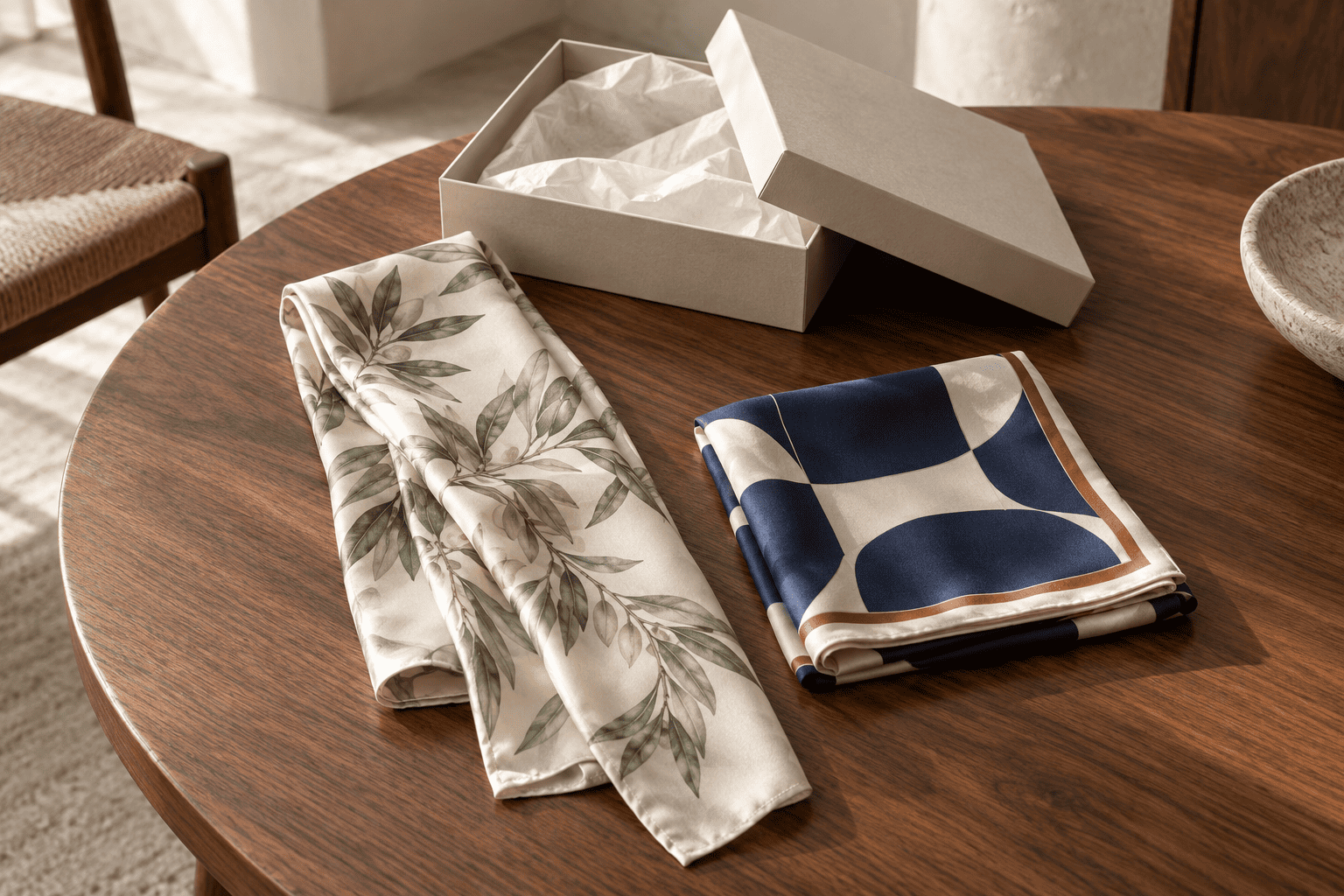
Notice their habits before choosing. If they already wear scarves, look at the formats they favour. If they rarely wear them, select a piece that works with one familiar outfit and include a simple styling suggestion. Our guide to choosing a meaningful scarf as a gift explores that personal approach.
The design’s story can add emotional value, but the colour, feel and usable dimensions should make the recipient want to wear it.
Three questions to ask before buying
- What is its main job? Choose between a small accent, an everyday neck scarf and shoulder coverage.
- Which style will I actually use? Picture one drape or knot with an outfit you already own.
- Does this specific piece suit that job? Check dimensions, fibre content, fabric, folded photographs and the care label.
Explore Lanting Loom’s long silk scarves if you are drawn to flowing lines and wraps, or square scarves if you enjoy triangles, corners and changing folds. The right choice is the one whose shape feels natural in your wardrobe and whose design keeps inviting another wear.
