

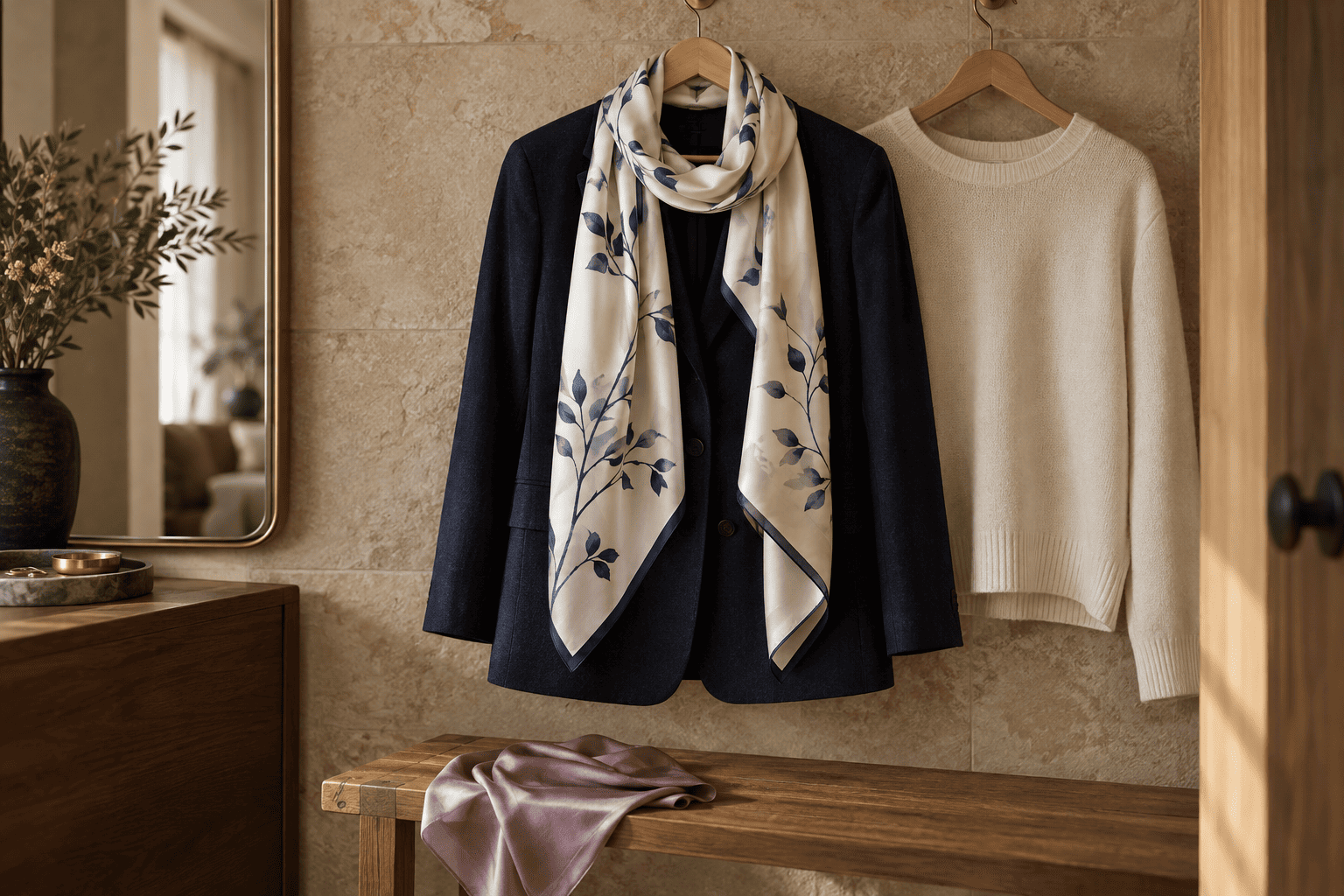
A silk scarf can make a thoughtful gift even when you cannot describe her style with confidence. Perhaps you know her through work, are choosing for a relative you rarely see or want to thank someone whose wardrobe is unfamiliar.
When you do not know her style, choose a silk scarf using a few observable clues: a colour she wears repeatedly, the scale of her accessories and a way she might comfortably use it. If those clues are missing, a discreet question is more useful than assuming that one colour or shape suits everyone.
You do not need to become an expert in her wardrobe. The aim is to make a considered choice while leaving room for her own preferences.
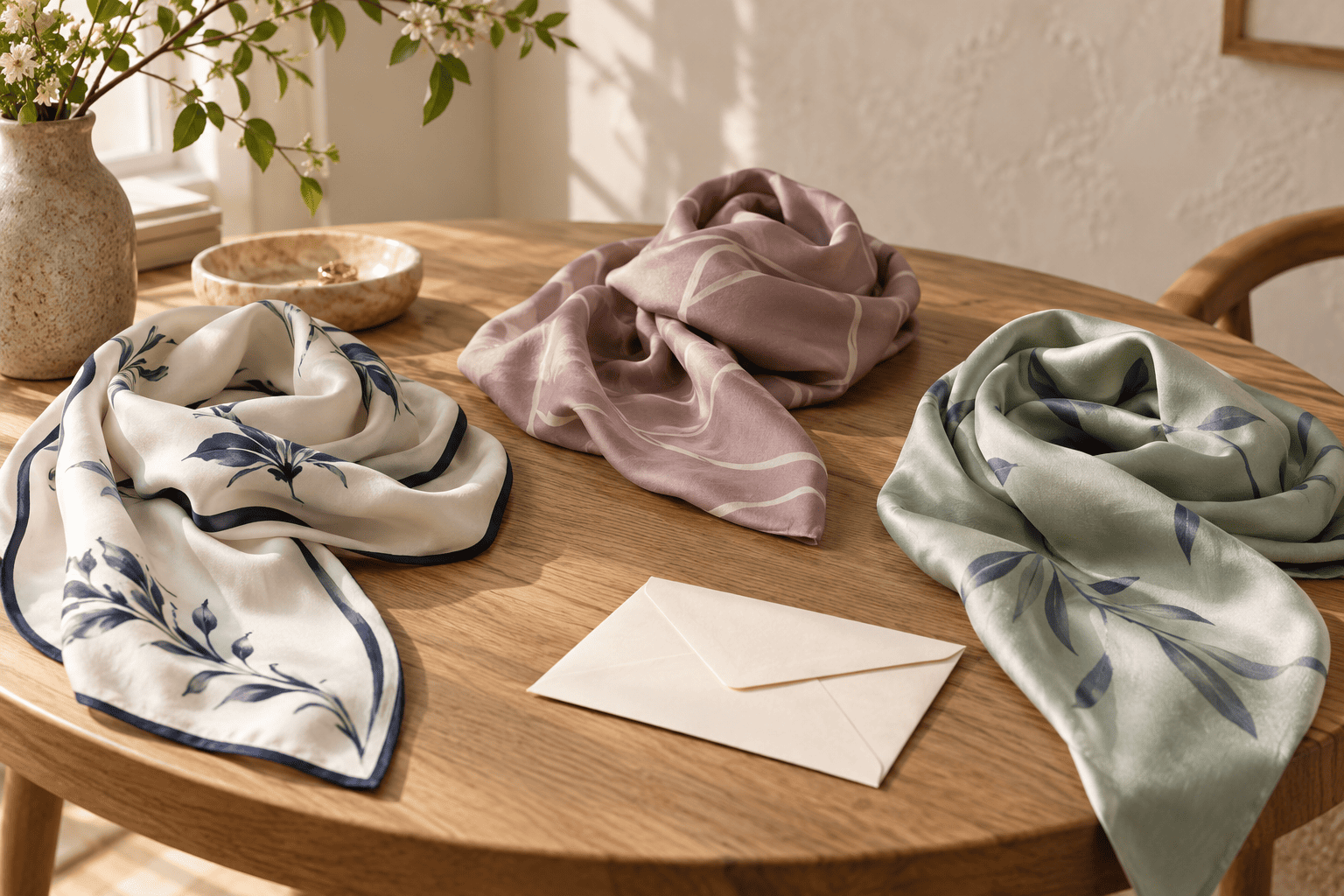
Start with three clues you can actually observe
Think about ordinary occasions when you have seen her, rather than relying on one formal photograph. An outfit chosen for a wedding may say less about everyday preferences than the jacket she wears every week.
- Repeated colour: Does she regularly wear navy, cream, black, warm brown or a particular brighter shade?
- Accessory scale: Does she favour small details, generous wraps or one noticeable statement piece?
- Likely use: Could you picture her wearing a scarf at the neck, over her shoulders or with a jacket?
These clues are starting points, not a personality test. A woman who wears black may enjoy colourful accessories; a minimal outfit does not prove she dislikes pattern. Avoid choosing by age, profession or assumptions about what women in a particular group should wear.
Choose a familiar colour before choosing a striking print
When information is limited, a colour she already wears gives you a useful connection. Look for a scarf that includes that shade, then assess whether the other colours feel compatible with clothes you have seen her wearing.
For example, a navy-and-ivory design may be worth considering if she often wears navy jackets and pale tops. Soft green could work alongside cream and warm brown. Neither is a universal safe choice; the repeated wardrobe colour is what makes the suggestion relevant.
Pay attention to the background as well as the motif. A pale scarf with a few dark strokes has a different presence from a dark scarf covered in bright flowers. Consider the amount of contrast she tends to wear near her face.
If you have no colour clues at all, shortlist two restrained palettes and seek one small piece of guidance. Buying black, beige or pink simply because it seems conventional replaces uncertainty with another guess.
Turn the clues into a small shortlist
Limit yourself to two or three scarves. A larger selection can make the decision feel more complicated without improving your understanding of the recipient.
| What you know | A direction to explore | What still needs checking |
|---|---|---|
| She often wears navy and cream | A scarf repeating one or both colours | Whether she prefers soft contrast or a bolder accent |
| Her accessories are usually compact | A smaller square or a scarf that folds neatly | Whether she enjoys wearing anything at the neck |
| She already wears loose wraps | A long scarf with comfortable shoulder coverage | The width, drape and level of sheerness |
| You know her interests but little about her clothes | A design connected to a garden, artwork or place she enjoys | The colours and format she would actually wear |
| You have no reliable clues | Ask about a colour or offer two options | Her preference before committing to a specific piece |
Pick a format with an easy first use
A scarf does not require a conventional clothing size, but its dimensions still affect comfort and styling. “One size” should not be read as “equally suitable for everyone.”
A smaller or medium square can make a compact accent when folded. Check the dimensions and styled photographs rather than assuming a particular knot will work. A broad long scarf can offer shoulder coverage, although it also creates more fabric when gathered at the neck.
Choose the format for a use you can picture. If she wears tailored jackets, consider a neat fold or an open drape. If she enjoys sleeveless dresses and light wraps, a long scarf may have a clear place in her wardrobe.
Our comparison of long silk scarves and square scarves explains the practical differences. If you have never seen her wearing scarves, avoid relying on elaborate styling to make the gift work.

Look at the design folded, not only spread flat
The complete artwork is only one view of a scarf. At the neck, the recipient may see a border, a few colour bands and a small section of the motif.
Look for product photographs showing both the open design and a worn arrangement. Ask whether the colours still work together when gathered, whether a border dominates the fold and whether the reverse is visible in the intended style.
When preferences are uncertain, a balanced design with some open space can be a useful option to compare with a denser print. This is a styling judgement, not a guarantee: a woman who loves expressive accessories may prefer the stronger pattern.
Use clear quality details to narrow the choice
You may be unsure of her favourite motif, but you can still examine the product carefully. Confirm the fibre composition, dimensions, fabric description, edge finish and care instructions.
Do not treat “silky” as proof of silk content, or assume that a higher price answers questions about construction. Inspect close photographs and read what makes a high-quality silk scarf for a fuller buying checklist.
Consider the care requirements as part of the gift. If she strongly prefers accessories that need little attention, find out whether she would enjoy caring for silk before choosing an especially delicate piece.
Ask one useful question if you are still unsure
A small question can preserve much of the surprise while removing the largest uncertainty. Try: “Do you wear blue or green more often?” or “Would you use a scarf at your neck, or prefer one for your shoulders?”
If appropriate, ask someone close to her about a specific preference. “Does she wear patterned scarves?” is easier to answer than “What is her style?” If she has already mentioned a particular design, give that information more weight than your own shortlist.
Research summarised by Stanford Graduate School of Business found across five studies that recipients appreciated explicitly requested gifts more than unrequested alternatives. Asking for guidance can therefore be part of a thoughtful gift, rather than something that diminishes it.
Make the message personal and the choice comfortable
Your note can explain a connection without claiming to know her taste perfectly. “These blue tones reminded me of the coast you love” feels natural. Avoid describing how the scarf will improve her appearance or telling her how she ought to dress.
Lanting Loom translates stories from Chinese art and culture into contemporary silk. If a design’s inspiration resonates with her interests, share that specific story alongside your own reason for choosing it.
Check Lanting Loom’s gift services and the individual product page for presentation and personal-message options. Before ordering, confirm the return or exchange window, item-condition requirements, costs and any personalisation restrictions. Leave enough time after delivery for the recipient to decide.
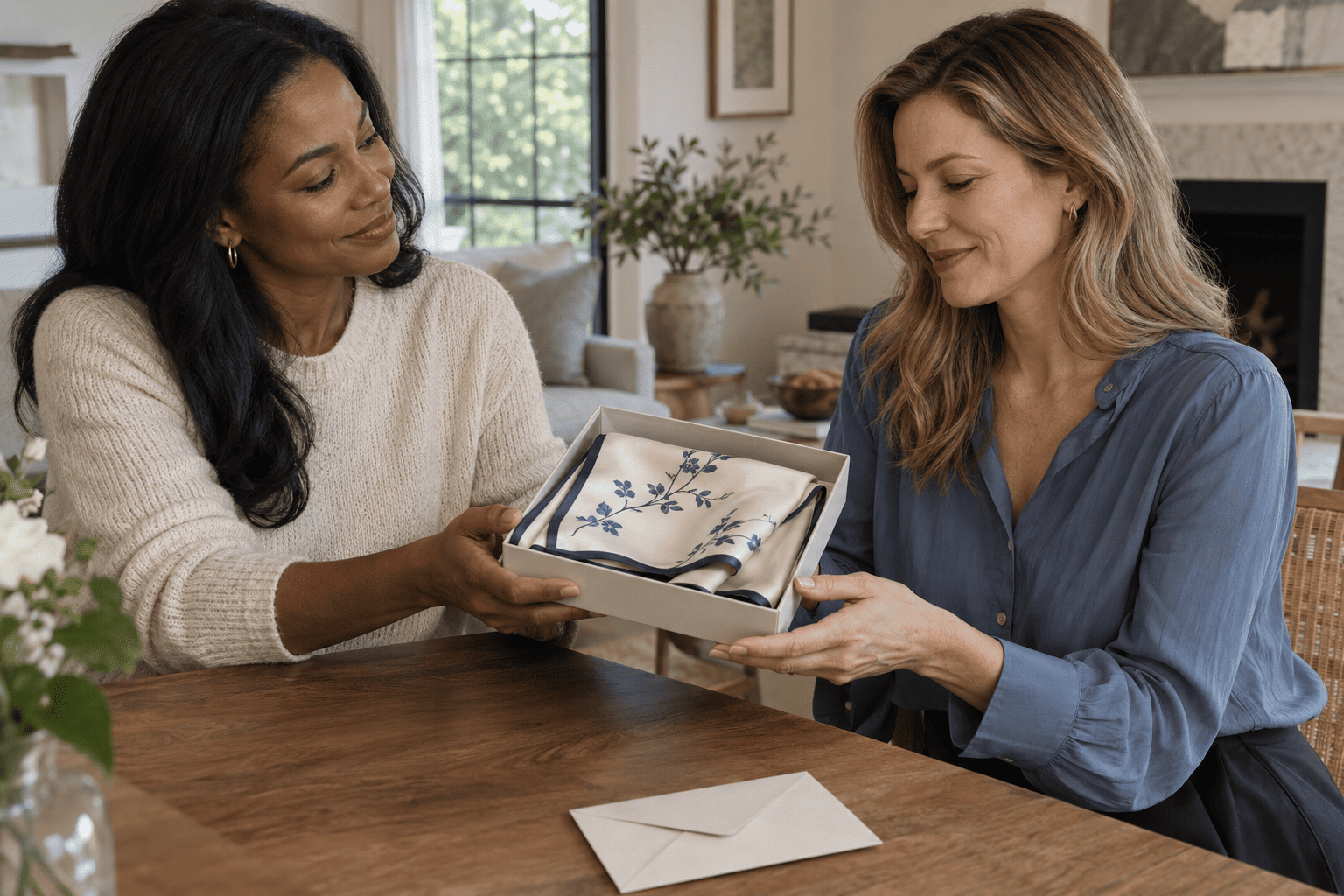
A final check before you choose
Can you name one reason for the colour, one likely way she will wear the scarf and one personal connection behind the gift? If so, you have a sound starting point. If all three answers are guesses, ask for a preference or choose together.
Explore Lanting Loom’s silk scarves with those clues in mind. The goal is a beautiful piece that leaves her free to enjoy it in her own way.
