

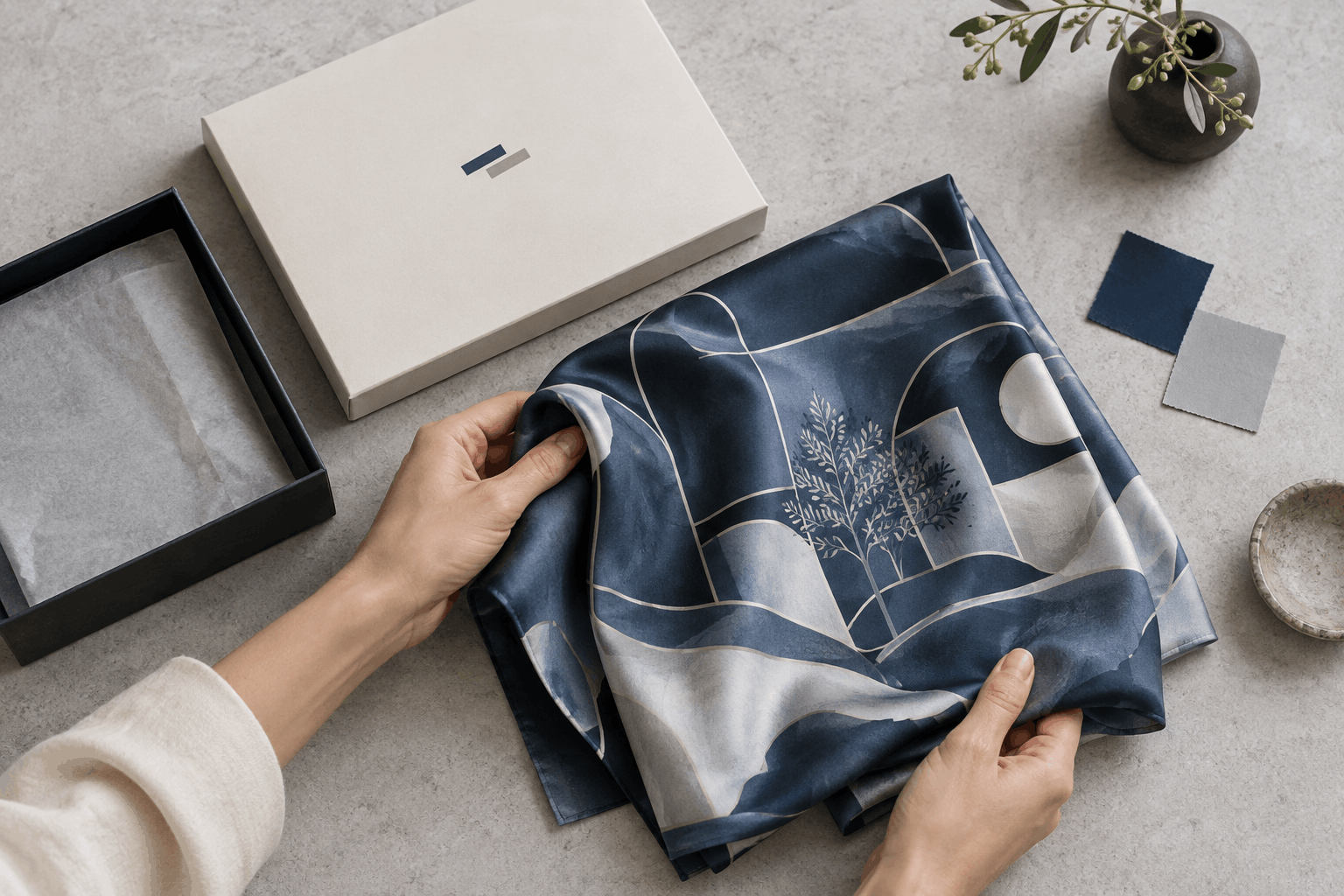
A corporate gift can identify its sender clearly while still feeling at home in the recipient’s wardrobe or daily routine. The balance comes from deciding which parts of the gift should communicate your identity and which should simply be beautiful to use.
To create corporate gifts with subtle branding, choose a small number of relevant identity cues, place them where they support the design and review them on the finished object. A logo is one option. Color, an original pattern, a meaningful reference and a signed message can also connect the gift to your organization.
Write the Purpose Before Opening the Brand Guidelines
Begin with a sentence about the recipient and occasion: “We want to thank long-standing clients with an accessory they can enjoy outside work.” That gives the design team something more useful than an instruction to make the logo smaller.
Clarify whether the object is a personal gift, an event keepsake or something intended for use in a professional setting. The appropriate visibility of your identity will differ. A conference item that needs to identify an event has a different purpose from a private thank-you.
If you are still deciding how visible the sender should be, our branded versus unbranded corporate gifts guide considers that choice. Once the purpose is agreed, the next task is to design the connection.
Give Each Part of the Gift a Job
Think of the gift as an object with supporting presentation. You do not need to repeat the same identity on every surface.
| Location | Possible branding treatment | Design question |
|---|---|---|
| The object itself | An approved small mark, a considered palette or original artwork | Does it remain appealing when used away from your organization? |
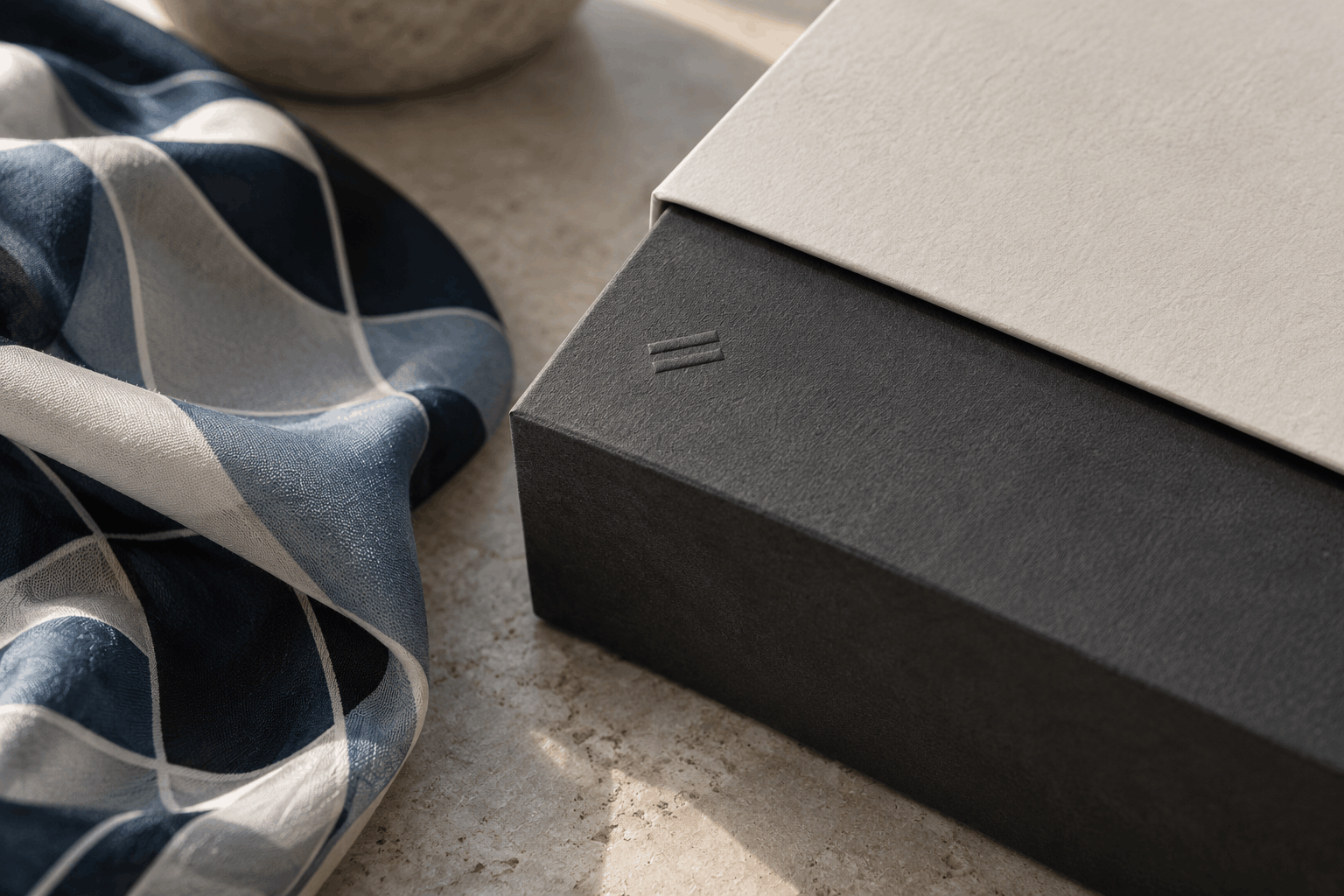
| The presentation box | A restrained printed or impressed mark, where the material allows | Is the finish clear and well executed on a physical sample? |
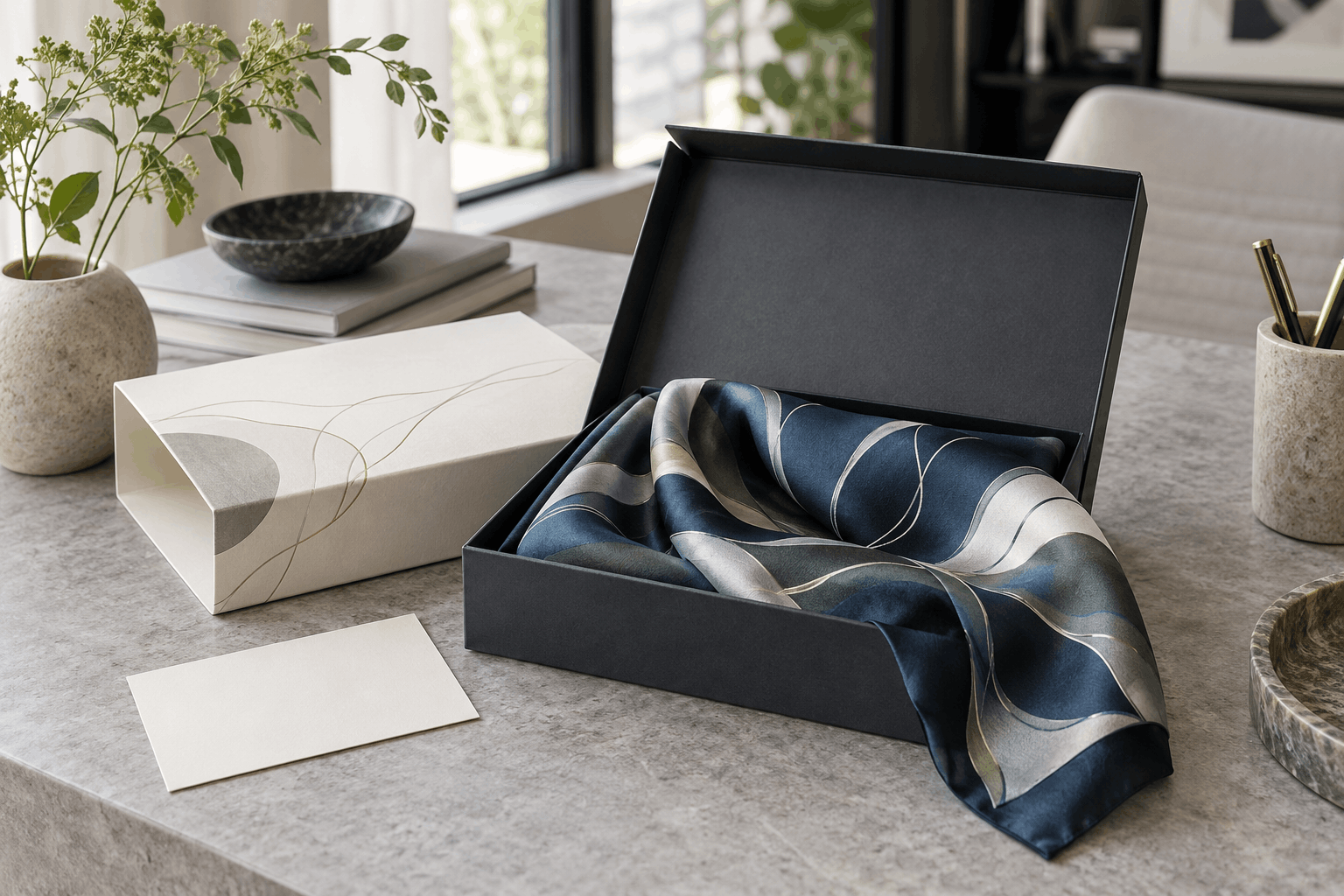
| A removable sleeve or band | The company name, event identity or anniversary detail | Can it carry the occasion without changing the permanent object? |
| The message or story card | A personal thank-you, sender identification and design explanation | Can the recipient understand who sent the gift and why? |
For example, a scarf might carry original artwork, the sleeve might identify the company and the card might name the relationship being celebrated. This creates a clear sequence without placing a logo on the scarf, box, ribbon, tissue and every insert.
These are design possibilities to discuss with your supplier. Available techniques and presentation options depend on the product, materials and project.
Use Scale, Contrast and Repetition Together
A small logo can still dominate if it is repeated across an entire surface or placed in a sharply contrasting color. Conversely, a simple mark can feel restrained when its scale, position and surrounding space are considered together.
Review the design at its actual size. Check whether the mark is visible enough for its purpose, whether fine details remain clear and how it relates to the rest of the composition. Making lettering too small to read does not create a better result.
Ask the supplier which reproduction methods suit the chosen surface. A blind impression can create a tactile detail on suitable packaging, while an approved single-color mark may suit another application. Test the result rather than assuming a technique will feel premium on every material.
Keep the mark consistent with your own brand rules. Supply approved artwork and permitted color versions; do not redraw, stretch or fade a logo simply to make it less prominent. If a quieter treatment needs internal approval, resolve that before production artwork is finalized.
Translate Identity into a Design Someone Would Choose
A distinctive corporate gift can begin with something more specific than the logo: a place connected to the organization, an architectural rhythm, an archive drawing or a pattern developed from a meaningful idea.
Consider a hypothetical engineering consultancy commissioning a scarf to mark a major anniversary. Its design brief could draw on the rhythm of a bridge structure, using repeating lines and open spaces to create an abstract composition. The company’s approved palette could provide a connection, while the anniversary date stays on the card.
The design should explain that reference honestly. Avoid attaching a story after the artwork is complete if the connection was never part of the creative process.
Lanting Loom’s corporate gifting approach includes expressing identity through color, discreet marks, architectural details and patterns connected to a place. Original artwork and adapted presentation are different project routes, with feasibility depending on the brief.
For a silk scarf, beauty and wearability remain essential. Look at the full composition, then fold it into a neck scarf or drape it as intended. A motif that looks balanced when flat may become visually dominant when only one border is visible.
Keep the Recipient Visible in the Brief
Subtle branding does not make every product suitable for every person. A scarf is a thoughtful direction when the recipient enjoys accessories, textiles or wearable art. Choose the format and palette with their preferences in mind.
For a varied audience, consider a small selection of designs or comparable alternatives. Avoid dividing choices automatically by gender or seniority. The recipient should have a reason to enjoy the object beyond its connection to your company.
Quality also needs its own assessment. With scarves, review the stated fiber composition, dimensions, print, finishing and care information. Packaging and branding cannot make up for an unsuitable fabric or an awkward format. Our guide to what makes a corporate gift feel premium considers the whole experience.

Review One Complete Gift Before Approving the Order
A collection of separate mockups can hide problems that become obvious when everything is assembled. Ask to review the proposed object, packaging and message together, with a physical sample where included in the project.
Use a short review with a clear purpose:
- First impression: What draws attention first—the gift, the message or the company identity?
- Everyday use: Does the object still work when the sleeve and card are removed?
- Clarity: Can the recipient identify the sender without searching through multiple inserts?
- Execution: Are colors, marks, edges and placement consistent with the approved design?
- Practicality: Is the packaging easy to open, protective and appropriate for delivery?
For textile projects, compare physical color references where color matching matters and discuss expected production variation. Confirm the agreed placement and dimensions of any permanent mark rather than approving a vague instruction such as “small logo in the corner.”
Keep sender branding separate from the product maker’s identity and care information. Agree any label changes with the supplier; do not assume a bespoke project automatically includes removing or replacing them.
Make the Approval Brief Easy to Follow
Give the supplier the recipient profile, occasion, quantity, budget, required arrival date and destination. Include the approved brand files, permitted treatments and the person who will consolidate feedback.
Specify what stays permanent and what can be removable. For example: “Original scarf artwork using an approved palette; company identity on the sleeve; anniversary message on the card; no sender logo required on the fabric.” That is more actionable than asking for something understated without defining the result.
Confirm the costs and timing of artwork, samples, packaging development and revisions. Agree who approves the final version and what happens if the brief changes after approval. Avoid making the delivery promise before the supplier has confirmed the complete scope.
Developing the Gift with Lanting Loom
Existing scarves with a tailored presentation may be enough for some occasions. A more specific story may call for original artwork. Start with the desired experience and let that determine the degree of customization.
Explore Lanting Loom’s bespoke silk scarves to discuss a project, or our luxury corporate gifts page for the broader selection. Share the identity cues you want to preserve and how you hope the recipient will use the gift.
A clear sender, a thoughtful design and a personal message can give your organization a presence without asking the recipient to display it everywhere.
