

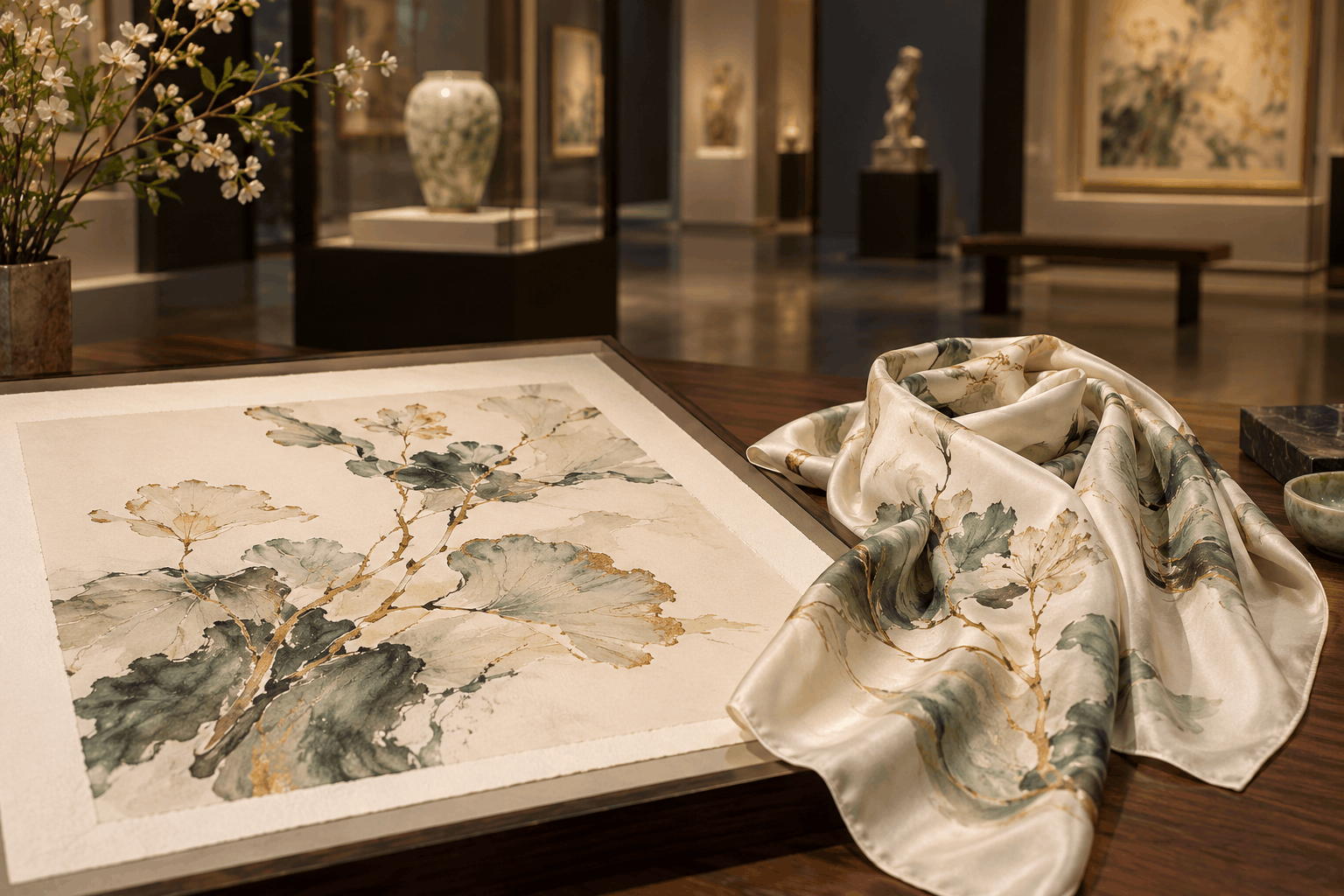
A museum silk scarf can turn an artwork into something visitors wear and keep. Before a painting, textile fragment or archive drawing becomes a repeat pattern, however, the buyer needs a clear answer to three questions: can this source be used commercially, what changes are permitted, and who must approve the result?
Artwork licensing for museum silk scarves should be resolved before production artwork and manufacturing are authorised. The review should cover the source work, the image file, the proposed adaptation, credits, branding and sales channels.
This guide is a purchasing workflow, not a determination of rights in any particular artwork. Copyright rules and other rights vary by jurisdiction; unresolved questions should go to the museum’s rights team or qualified legal adviser.
1. Separate the Object, the Artwork and the Image File
Owning or displaying an object does not automatically establish permission to reproduce its artwork on merchandise. In the United States, for example, Section 202 of the Copyright Act distinguishes ownership of a physical object from ownership of copyright.
For each proposed scarf, identify:
- The underlying work: the painting, drawing, textile design or other creative material being reproduced.
- The reproduction file: the photograph, scan or digital image supplied to the designer.
- Additional material: any museum logo, exhibition identity, text, typography or third-party artwork added to the product.
These may involve different permissions. A museum may hold an object while an artist or estate controls reproduction rights. A downloadable image may carry terms different from those assumed from the age of the original.
Do not assume that every photograph of a public-domain work has separate copyright, either. The position depends on the image and applicable law. Check the actual source and rights statement rather than applying a blanket rule.
2. Establish the Permission Route for the Exact Source
Record the artwork title, artist or maker, accession number, source URL, image filename and rights statement. Keep a dated copy of the relevant terms with the project records.
Public-Domain and Open-Access Images
Some museum images are available for commercial reuse without a bespoke copyright licence. The Metropolitan Museum of Art’s image and data policy, for example, identifies eligible Open Access images released under CC0. Check the individual image’s designation rather than assuming the whole collection has the same status.
CC0 permits copying and adaptation, including commercial use, without asking permission under the rights waived. It does not remove other possible rights, such as trademarks or privacy rights, and it does not authorise an implication of endorsement.
An open-access source therefore does not automatically make a scarf an “official museum collaboration”. Any such branding or partnership claim needs its own basis.
Images Supplied Under Specific Terms
Other institutions direct commercial users to a licensing team. The V&A’s website terms, for example, direct commercial-use enquiries to its image licensing service.
A file being easy to download is not evidence that it is cleared for product manufacture. Read the terms attached to that source and describe the intended merchandise use accurately when requesting permission.
Creative Commons Licences with Conditions
Read the exact licence and version. The Creative Commons licence overview explains the differences between attribution, share-alike, noncommercial and no-derivatives conditions.
A NonCommercial licence does not by itself authorise commercial scarf sales. A NoDerivatives licence does not permit sharing adapted material under that licence. Whether a particular edit is an adaptation can require assessment; do not assume cropping, recolouring or repeating imagery is automatically covered. Seek separate permission where the proposed use falls outside the licence.
3. Describe the Scarf Project Precisely
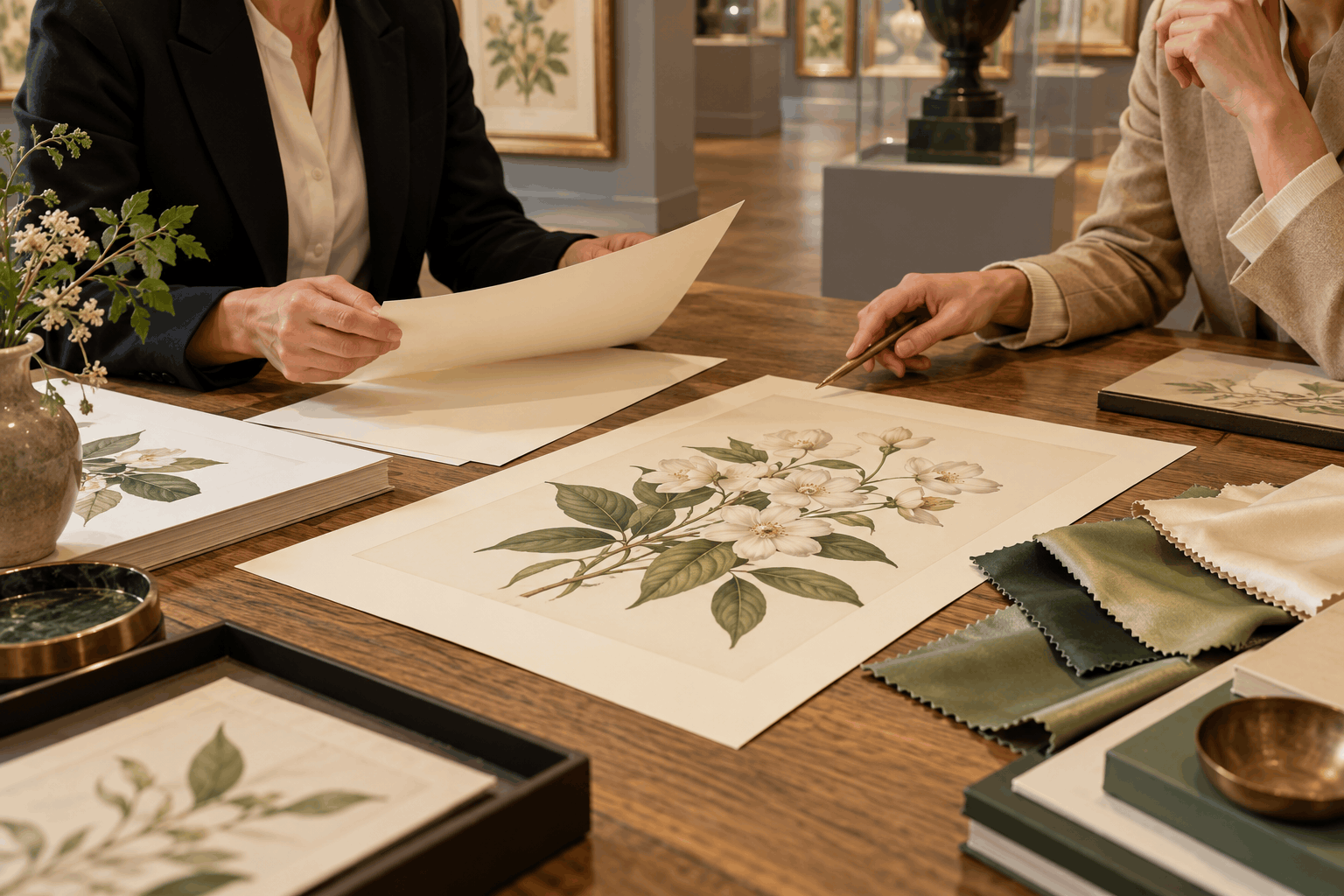
A request to “use an image” is too vague for a merchandise project. Give the rights holder enough information to evaluate the finished product and its promotion.
- Product type, material and intended scarf dimensions.
- The exact artwork and image file requested.
- Planned crops, repeats, colour changes, borders or combined elements.
- Initial quantities, colourways and proposed reorders.
- Countries of manufacture and sale, including online delivery destinations.
- Sales channels, such as the museum shop, its website or approved retailers.
- Proposed launch date and licence duration.
- Packaging, advertising and product-photography uses.
- The manufacturer and other parties who need access to the file.
Include a simple visual concept where appropriate, but confirm that permission covers any sampling that will reproduce protected material before commissioning it.
4. Agree the Scope and Commercial Terms
Where a negotiated licence is needed, make sure it addresses the actual programme. A licence for a catalogue illustration should not be treated as permission for wearable merchandise.
Product, Territory and Channels
Specify whether permission covers scarves only or also packaging, cards and promotional images. Define the sales territory and address cross-border online orders explicitly. A website can be seen worldwide even when sales rights are limited.
Quantity, Fees and Reporting
Agree how production quantities, samples, replacements and reorders are counted. If royalties apply, clarify the calculation basis, reporting periods and treatment of returns or discounts. There is no universal licensing rate suitable for every museum scarf project.
Term and Remaining Stock
Record when permission begins and ends, and what happens to unsold stock, product listings and promotional material afterwards. Any sell-off period should be agreed rather than assumed.
Exclusivity and Supplier Access
Define any exclusivity narrowly: product category, design, territory, channel and duration. Also confirm whether the designer, printer and manufacturer may receive and use the files for the agreed purpose.
Ownership of new scarf artwork, production files and commissioned photography should be addressed separately. Commissioning design work does not mean every underlying right has automatically transferred.
5. Approve the Adaptation Before Sampling
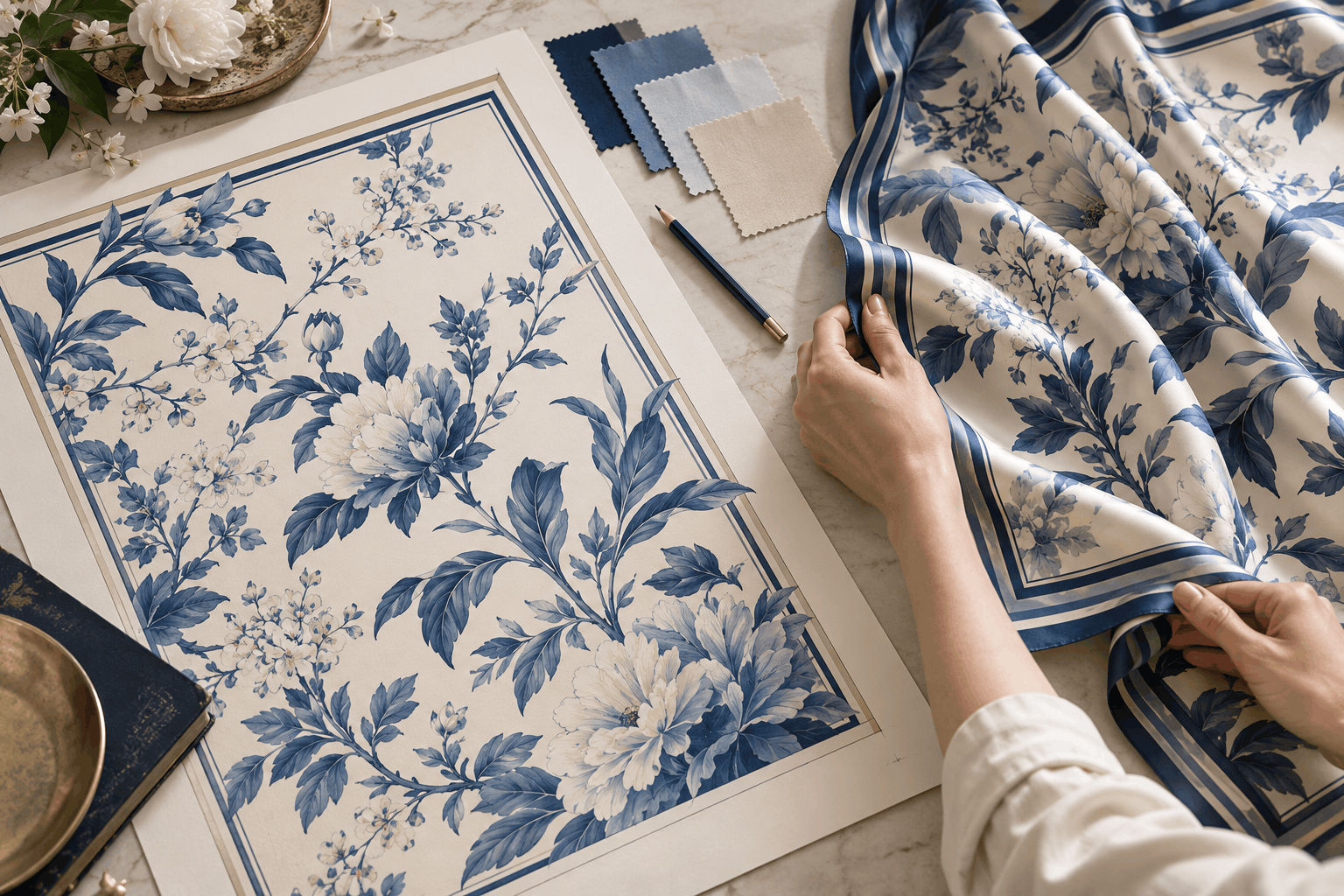
A rectangular artwork rarely fits a square scarf without a design decision. Cropping can remove meaningful details. Repetition can change the emphasis. Recolouring may alter an artist’s intended relationships between forms.
Prepare a review sheet showing the source image beside the proposed scarf layout. Identify changes clearly rather than asking reviewers to discover them.
- Which parts of the source are retained or omitted?
- Are elements mirrored, repeated, rotated or rearranged?
- Are colours changed, and how will they be assessed on silk?
- Where are borders, signatures and logos placed?
- How does the design look folded, tied and draped?
Do not remove an artist’s signature or add one to a new location without checking the permissions and approval requirements. Cultural context can also matter even where copyright permission is available; involve the relevant curatorial or community expertise where appropriate.
6. Treat Credits as Part of the Design Brief
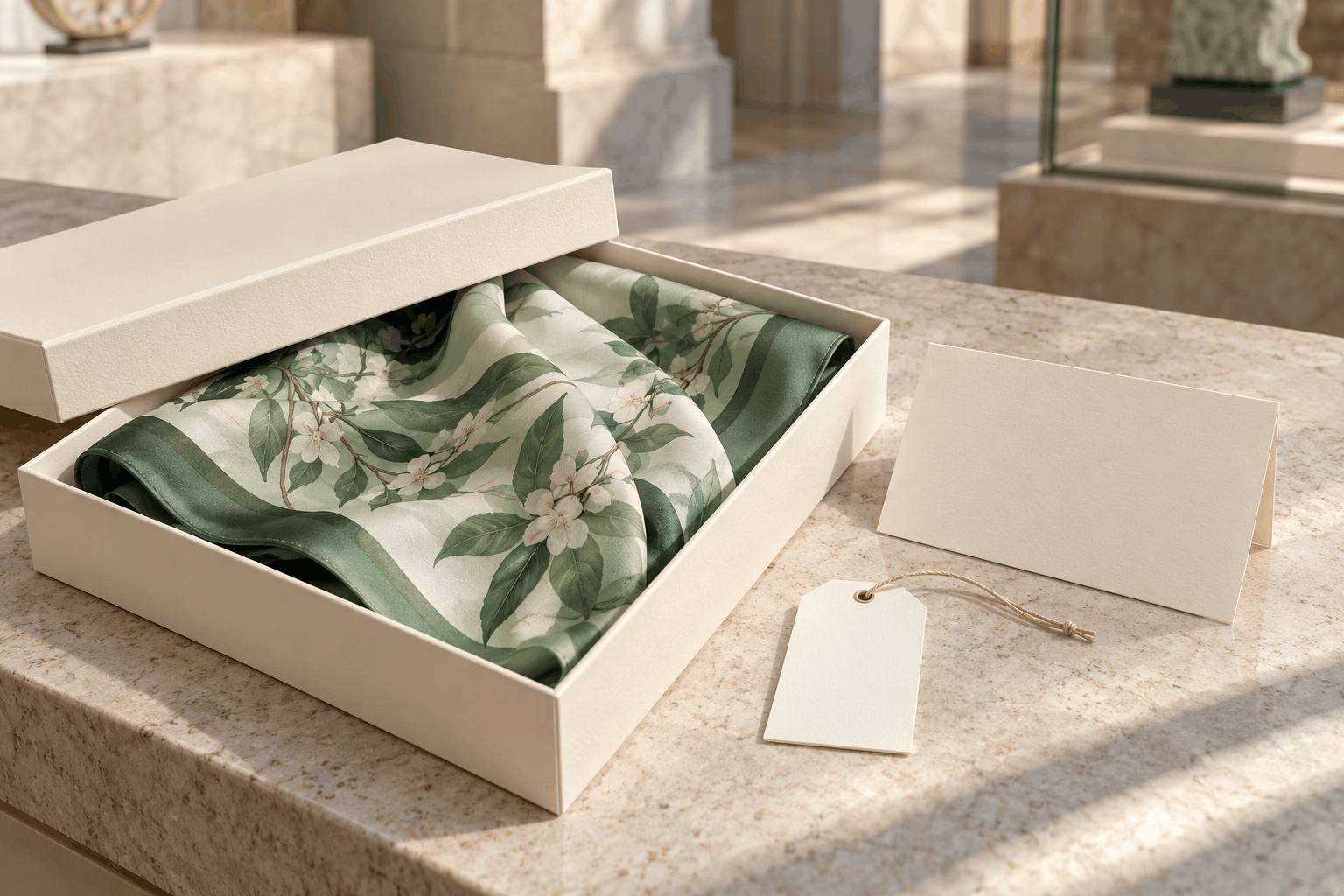
Agree the exact credit wording and where it must appear before finalising the scarf, card and packaging. A credit may need to identify the artist, work, collection, photographer or rights representative, depending on the applicable terms.
Ask the rights holder to supply or approve the wording. Confirm whether it belongs on the product, a sewn label, a hangtag, a story card, the online listing or more than one location.
Keep these functions distinct:
- Artwork identification: tells the customer which source inspired the scarf.
- Rights credit: provides attribution or notices required by the permission terms.
- Product information: describes the scarf’s material, manufacture and care.
- Partnership wording: identifies an authorised collaboration, if one exists.
Credit is not a substitute for permission. Equally, a licence may permit the artwork while still requiring specific credit placement.
Where CC0 applies, attribution is not a condition of that dedication, but accurate source identification can still be valuable editorial practice. Avoid inventing a copyright claim or implying that the source institution endorses the product.
7. Separate Rights Approval from Production Approval
Different reviewers may be responsible for different decisions. The rights team checks the permitted use and credits; curatorial staff may check interpretation; the brand team reviews identity; procurement checks the physical product and commercial specification.
Set the approval stages in advance:
- Source clearance: confirm the rights basis and authorised files.
- Design approval: approve the adaptation, layout and proposed credits.
- Physical sample review: assess colour, scale, print, fabric and finishing.
- Presentation review: approve packaging, cards and relevant marketing proofs.
- Production release: identify the final version and confirm all required approvals are complete.
A well-made sample is not evidence of licensing clearance. An approved digital layout is not evidence that the printed scarf meets the agreed quality standard. Keep both records.
Do not treat silence as approval unless the agreement expressly establishes that process. After approval, check whether a change in colourway, crop, packaging or manufacturing arrangement requires another review.
8. Keep a Complete Project Record
Store the source record, applicable terms or signed licence, correspondence, approved artwork, credit text, sample photographs and final specification together. Use clear version names so a manufacturer cannot mistake an earlier concept for the approved file.
Track expiry dates, quantity limits, reporting obligations and reorder approvals where applicable. Confirm that the manufacturer will not reuse the artwork for unrelated customers or publish it in a portfolio unless authorised.
Before reordering, compare the new request with the existing permission. A changed size, additional retailer or new territory may fall outside the original scope.
Buyer’s Pre-Production Checklist
- The exact artwork and reproduction file have been identified.
- The rights basis covers the intended commercial use and territories.
- Proposed adaptations and supplier access are authorised.
- Product, packaging and marketing uses are addressed.
- Fees, quantities, reporting and expiry terms are recorded where relevant.
- Credits and partnership wording are approved.
- Digital artwork and physical samples have completed the required reviews.
- The manufacturer has the correct final files and written production release.
Frequently Asked Questions
Does a museum need permission to reproduce an artwork it owns?
It may. Ownership of the object does not by itself settle copyright ownership. Check the underlying work, reproduction file and any additional rights relevant to the proposed product.
Can public-domain artwork be printed on scarves for sale?
It can be possible. Verify the work’s status in the relevant jurisdictions, the image source terms and any other applicable rights. Do not assume an old artwork or downloadable file is automatically cleared for every use.
Is naming the artist enough?
No. Attribution and permission are different matters. Where authorisation is required, a credit does not replace it.
Can a museum scarf use a cropped or recoloured artwork?
That depends on the rights basis and any approval conditions. Show the proposed changes explicitly and obtain the required clearance before proceeding.
Can the manufacturer arrange licensing?
Only if that responsibility is agreed and the necessary authority is established. Specify who secures permissions, who pays any fees and who supplies approved files. Do not assume licensing is included in a manufacturing quotation.
For a collection-based project, explore Lanting Loom’s bespoke silk scarf approach. Share the source artwork, rights status, intended adaptations and approval process through the corporate gifting enquiry page so the design brief begins with clear responsibilities.
