

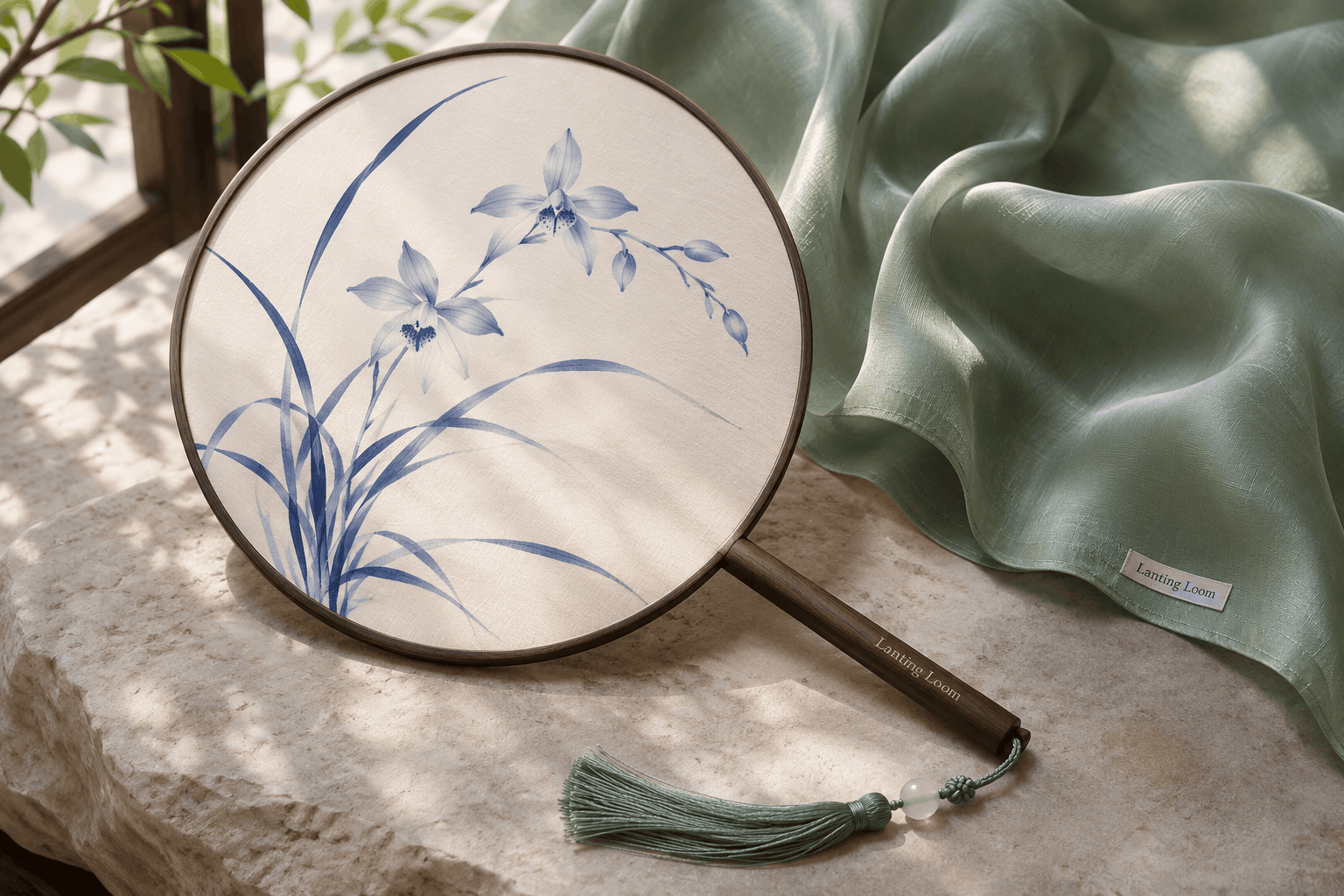
A fan in Chinese art can be an everyday cooling tool, a small painting carried in the hand or a detail that identifies a literary character. Its shape may look familiar, but its meaning is rarely limited to one idea.
Chinese fan symbolism can involve refinement, artistic accomplishment, personal exchange and the pleasures of summer. In particular stories, a fan may also suggest lost affection or identify a religious figure.
To understand what a fan symbolises, look at its form, its decoration and the setting in which it appears. A painted folding fan exchanged between friends tells a different story from an unused round fan in an autumn poem.
What Does a Fan Symbolise in Chinese Culture?
A useful starting point is to distinguish the fan’s practical function from the meanings it acquires through art and literature.
| Association | Relevant context | What to look for |
|---|---|---|
| Summer and cooling | Everyday use and seasonal scenes | A person resting, seeking shade or using the fan for comfort |
| Refinement and taste | Carefully made fans, painting and calligraphy | Materials, artistic quality, inscriptions and ownership |
| Friendship and personal exchange | Fans presented as gifts | A dedication, recipient’s name or documented occasion |
| Lost affection or changing favour | The literary tradition associated with Lady Ban | A round fan, autumn imagery and references to being set aside |
| A religious figure’s identity | Depictions of the Daoist immortal Zhongli Quan | The fan together with the figure’s appearance and other attributes |
These are contextual associations. A fan does not automatically signify romance, luck or social rank simply because it appears in a picture.
Round Fans and Folding Fans: Two Different Formats
The round fan: tuanshan
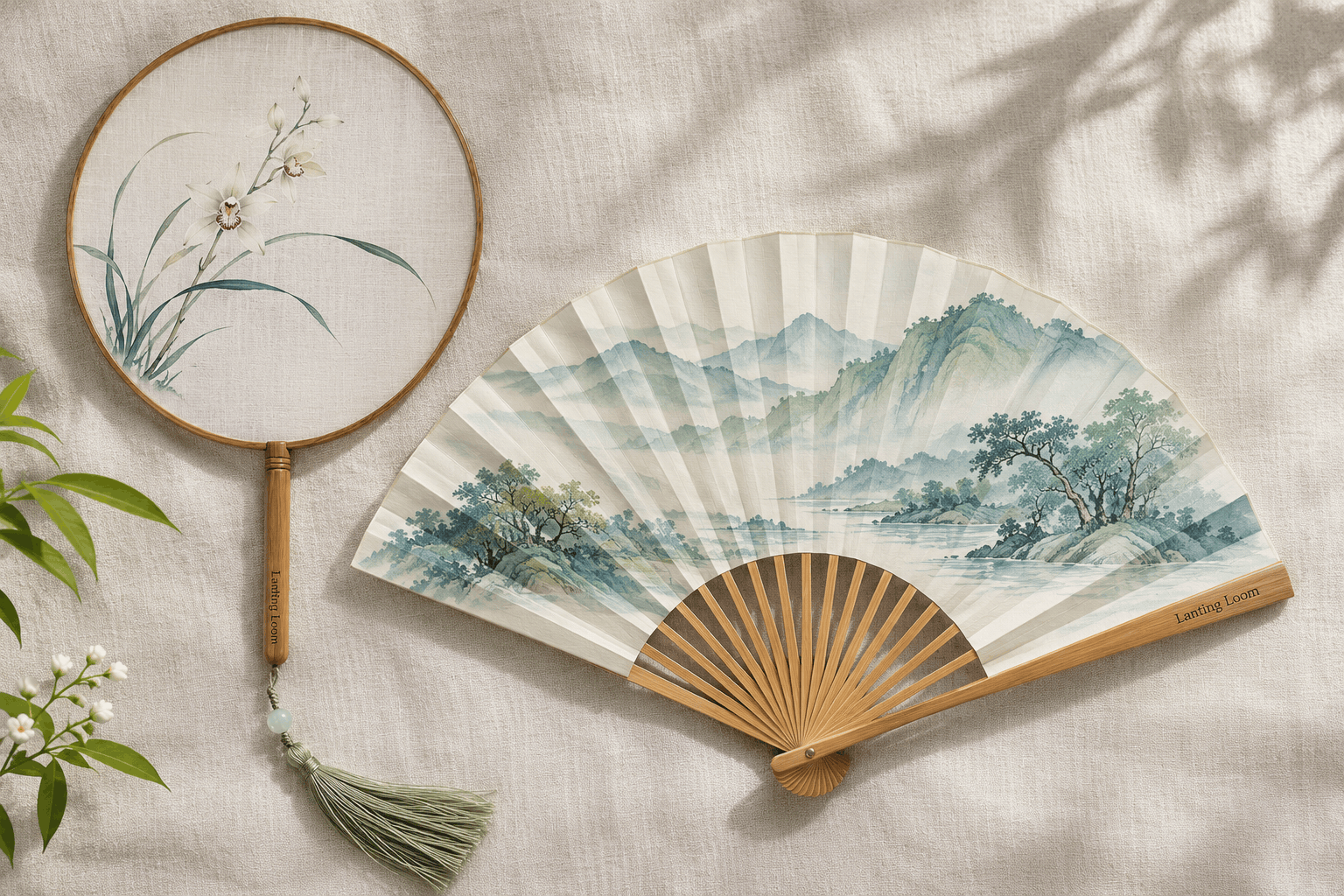
The round fan, or tuanshan (团扇), has a fixed surface supported by a frame and handle. Silk can provide a fine surface for its decoration.
Its enclosed shape offers a compact space for a branch, bird or small landscape. The circular edge can make a scene feel intimate, as though the viewer is looking through a small window.
The folding fan: zheshan
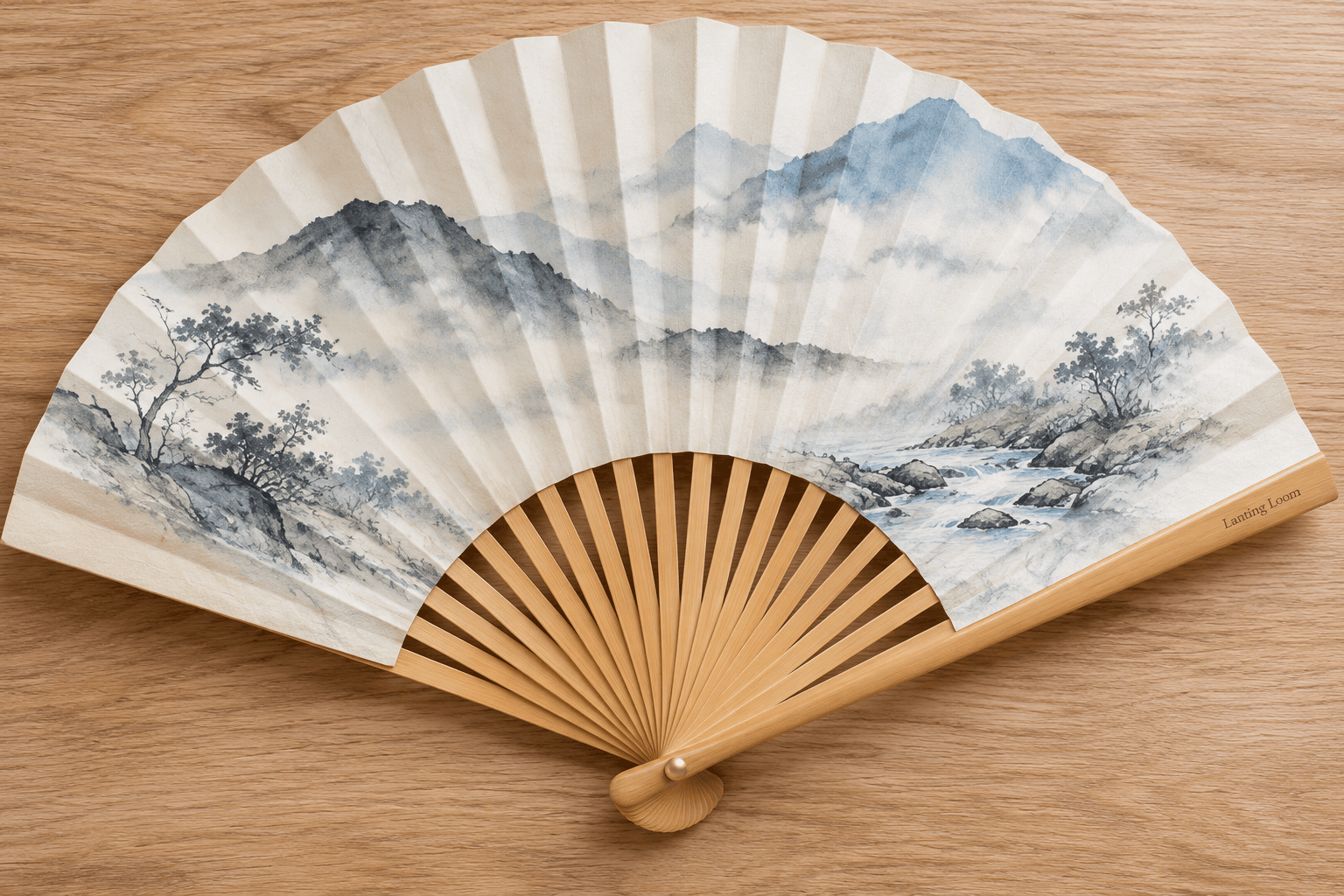
The folding fan, or zheshan (折扇), opens along ribs that meet at a pivot. Its curved surface introduces folds and a changing width that artists must take into account.
The National Palace Museum’s exhibition The Art of a Gentle Breeze explains that folding fans originated in Japan and became particularly fashionable in China during the Ming and Qing dynasties.
This history is a reminder that an object can become deeply established within Chinese culture while also reflecting exchange across East Asia.
Neither format belongs exclusively to one gender. The individual object, user and historical setting are more informative than a simple division between “women’s fans” and “men’s fans”.
Refinement: A Useful Object Becomes a Work of Art
A fan can be appreciated at several levels: the structure of its frame, the quality of its surface and the image or writing it carries. Its everyday usefulness does not prevent it from being an object of close artistic attention.
The National Palace Museum’s The Art of Staying Cool discusses fans as objects that could convey status and taste as well as provide relief from summer heat.
“Refinement” is therefore most useful when connected to something specific: a carefully chosen inscription, an accomplished painting or thoughtful workmanship. It should not be treated as a fixed quality shared by every fan.
Painting and Calligraphy in the Hand
A fan’s surface gives artists a distinctive compositional challenge. A round format has no rectangular corners. A folding fan widens towards its outer edge, while its pleats interrupt the surface.
Look at how a landscape follows the arc, how a branch enters from one side or how empty space balances the image. These choices help explain the fan’s appeal as an artistic format.
Painting and calligraphy could also appear on opposite sides. The object could reveal a different experience when turned over, combining visual imagery with writing.
Some historical fan paintings survive mounted as album leaves rather than attached to their original frames. When viewing one in a museum, check the catalogue description: a fan-shaped painting may preserve the artistic surface without preserving a complete usable fan.
Friendship, Gifts and Personal Expression
A fan decorated for a particular person could carry a relationship as well as an image. A dedication, a poem or an inscription might connect it with a meeting, a request or a gift.
The National Palace Museum documents the exchange of painted and inscribed folding fans among Ming artists and literati, including Shen Zhou, Wen Zhengming and Tang Yin. In these settings, the fan offered a portable form for artistic expression and social exchange.
The personal character of fan-giving continued in later periods. In Fans of The Met, the Metropolitan Museum of Art discusses a folding fan by bamboo artist Jin Xiya that archival records identify as a gift to his daughter.
Such examples show why the recipient and occasion matter. A gifted fan can express affection, admiration or shared interests without belonging to a single universal category of romantic gifts.
Lady Ban and the Fan Set Aside in Autumn
One of the most poignant fan associations comes from the poem traditionally attributed to Ban Jieyu, also known as Lady Ban.
In this literary image, a silk fan is welcomed during summer but risks being put away when cooler weather arrives. The changing usefulness of the fan becomes a metaphor for affection or favour that does not last.
The National Palace Museum connects Tang Yin’s painting of Lady Ban holding a round fan with this poetic tradition.
This gives the fan an emotional complexity that a simple description such as “a symbol of beauty” would miss. In the appropriate context, it can evoke vulnerability, disappointment or the fear of being forgotten.
However, a round fan in another work may have no connection to Lady Ban. Look for the title, inscription and seasonal details before applying that interpretation.
The Fan as an Attribute of Zhongli Quan
A fan can also help identify a figure. Zhongli Quan, one of the Eight Immortals in Daoist tradition, is commonly represented carrying one.
Duke University Libraries’ description of Zhongli Quan on an embroidered screen identifies his bearded appearance and fan among the features used to recognise him.
Here the fan is an attribute: an object associated with a particular figure. It should be read together with the rest of the depiction.
This does not mean that every fan-shaped ornament symbolises immortality. The identification depends on the complete image, not the accessory alone.
How to Read a Fan in a Chinese Artwork
When you encounter a fan in a painting, textile or decorative object, ask a few practical questions:
- Is the fan the artwork or part of the subject? A painted fan and a painting of someone holding a fan call for different kinds of attention.
- What format is shown? Notice the fixed frame, folding ribs or distinctive materials.
- What appears on its surface? Flowers, landscapes and inscriptions may contribute their own meanings.
- Who is holding it? A named literary or religious figure may change the interpretation.
- What does the catalogue say? Provenance, inscriptions and documented gift relationships can reveal what appearance alone cannot.
Avoid applying a generic “secret language of fans” to every Chinese image. A particular gesture needs evidence from its own cultural and artistic setting.
From Fan Art to Contemporary Silk Design
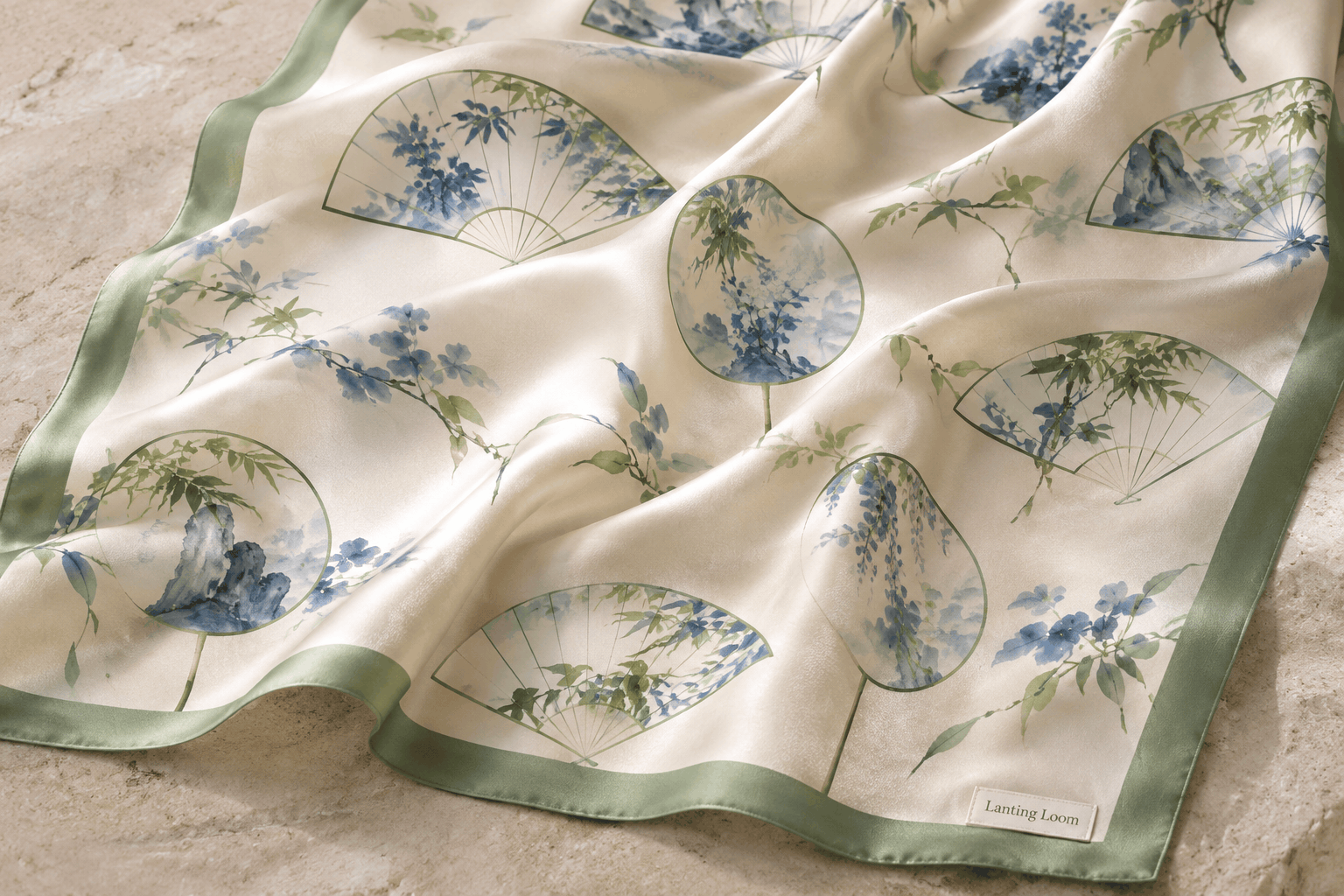
The fan offers more than a recognisable silhouette for contemporary design. Its arc can organise a composition, while its ribs suggest rhythm and its enclosed surface can hold a small garden or landscape.
On a silk scarf, fan-shaped vignettes might be spaced across an open ground or arranged along a border. A restrained palette can let the curves and changing scale provide the visual interest.
These are contemporary design possibilities rather than reproductions of a historical practice. A new composition should explain its inspiration honestly, and a printed image should be described as printed rather than hand-painted or embroidered.
Choosing a Fan-Inspired Gift
A fan-inspired design can be a thoughtful choice for someone who enjoys painting, poetry, gardens or decorative arts. The strongest connection may be a shared museum visit or the recipient’s interest in a particular artistic tradition.
You might explain the choice simply: “The small landscapes reminded me of the paintings we enjoyed together.” There is no need to attach an elaborate symbolic promise.
Explore Lanting Loom’s silk scarves and gifts and read the individual design story to confirm its inspiration. Our gift services explain available presentation and personal-message options.
Frequently Asked Questions
Does a Chinese fan always symbolise good luck?
No. Its meaning may relate to practical use, taste, artistic exchange, a literary story or a religious figure. Auspicious imagery on the fan can add another layer.
Is the round fan a symbol of love?
It can appear in works concerned with affection, but the Lady Ban tradition also gives it associations with affection lost. The specific work determines the reading.
Were Chinese fans only used by women?
No. Fans were used and appreciated by people of different genders. Paintings, inscriptions and historical accounts provide more useful context than a universal gender rule.
Are all fan paintings made on silk?
No. Fan paintings can use paper as well as silk. The catalogue or product description should identify the actual materials and technique.
A Small Object with Many Stories
A fan can bring together comfort, artistry and human connection. It may hold a landscape, preserve a personal exchange or recall a poem whose emotional meaning depends on the season.
Looking closely at those differences allows the fan to become more than a decorative shorthand: an object through which art and everyday life meet.
