


A corporate gifting brief should explain the occasion, intended recipients, quantity, budget, required delivery date and destination. It should also identify the preferred product direction, customization, presentation and approval process.
You do not need to have every design decision settled before contacting a supplier. You do need to distinguish what is essential from what is open to recommendation.
A clear brief helps suppliers propose appropriate gifts, identify practical constraints and quote on a comparable basis. It also gives your own team a shared reference when reviewing products, artwork and samples.
This guide explains what to include, followed by a corporate gifting brief template you can copy and adapt.
What Is a Corporate Gifting Brief?
A corporate gifting brief is a written outline of what an organisation wants to achieve through a gifting project and the requirements the supplier needs to work within.
It connects the purpose of the gift with the practical details of producing and delivering it.
For example, “We need premium gifts” leaves many questions unanswered. “We need 100 compact thank-you gifts for international conference speakers, delivered to one London venue before the event, with discreet branding and a personal message” provides a useful starting point.
The brief is a planning document. Final specifications, prices, responsibilities and delivery commitments should be confirmed in the supplier’s quotation and order documents.
1. The Occasion and Purpose
Start with why you are giving the gifts.
Is the project intended to welcome visiting delegates, thank long-standing clients, celebrate an anniversary or recognise employees? The answer affects the product, message and presentation.
Include:
- The organisation and a short introduction.
- The occasion or programme.
- The reason for giving the gift.
- The impression or experience you want to create.
Keep the objective concrete. “A thoughtful keepsake that acknowledges ten years of partnership” gives more direction than “something impressive.”
For milestone projects, Lanting Loom’s company anniversary gifting page offers a relevant starting point.
2. The Intended Recipients
Explain who will receive the gift and their relationship with your organisation.
A gift for employees may need a different approach from one for museum patrons, hotel guests or commercial partners. Describe relevant interests and practical needs rather than relying on assumptions about age, gender or nationality.
Useful information includes:
- Recipient groups and their relationship to the organisation.
- Whether gifts are for individuals or institutions.
- Known product or material preferences.
- Whether recipients will travel with the gift.
- Any applicable gift acceptance policies.
- Whether an alternative gift option is needed.
For a silk scarf project, explain why a wearable gift suits the audience. If some recipients prefer to avoid silk or would not use an accessory, identify that requirement early.
You generally do not need to share individual recipient names or home addresses at the initial briefing stage. A description of the audience and delivery countries is usually more useful for early planning.
3. Quantity and Variations
State the expected quantity and whether it is confirmed or provisional.
If different groups will receive different products or messages, break down the quantities. “200 gifts” is not enough if the project actually requires four designs, two packaging formats and individually printed cards.
Clarify:
- The expected total number of gifts.
- Quantity per product, design or recipient group.
- Any additional units for late additions or replacements.
- Whether the project may be reordered.
- When final quantities will be confirmed.
If the number is uncertain, request prices for clearly defined quantity options. For example, ask the supplier to quote for 100, 150 and 200 units on the same specification.
Ask whether minimum quantities apply separately to the product, each colour, custom packaging or printed inserts.
4. Budget and What It Must Cover
Give the budget in a specified currency and explain whether it is per gift or for the whole project.
Most importantly, state what the budget needs to include.
- The product itself.
- Design development or artwork adaptation.
- Samples and setup charges.
- Presentation boxes, sleeves and cards.
- Assembly and personalization.
- Shipping and any applicable import costs.
- Taxes, where relevant.
For example, “£100 per gift, including presentation and delivery to one UK address, with tax treatment shown separately” is clearer than “budget around £100.”
If the budget has not been approved, provide a realistic range and mark it as provisional. Ask the supplier to identify what changes between the proposed options.
Sharing a budget helps focus the response. It does not replace the need for an itemised quotation.
5. Required Arrival Date and Delivery Plan
Include both the event date and the date by which the gifts must be received.
These are different milestones. Gifts may need to arrive earlier for inspection, sorting, room placement or distribution to regional teams.
Explain whether delivery is to:
- One office or warehouse.
- A hotel or event venue.
- Several business locations.
- Individual recipients.
- More than one country.
At the quotation stage, provide destination countries, relevant postcodes and the approximate shipment split where known. Confirm detailed delivery instructions when the project proceeds.
For international orders, clarify who will arrange transport, handle import requirements and pay applicable charges. The International Chamber of Commerce’s Incoterms rules provide a framework for allocating delivery-related tasks, costs and risks between sellers and buyers. Where an Incoterms rule is used, ask the supplier to explain how it applies to your quotation.
For hospitality projects, also identify venue receiving hours, storage arrangements and the person responsible for accepting the delivery. Lanting Loom’s hotel and hospitality gifting page covers relevant project directions.
6. Product and Design Direction
Describe the preferred product format, but leave room for a useful recommendation if you have not made a final choice.
For example, you may want a silk scarf, a scarf-led gift set or an existing product with adapted presentation.
Separate three possible approaches:
- Curated selection: choose from existing products.
- Adapted presentation: retain the product and tailor approved packaging or message elements.
- Bespoke development: create an original design for the organisation or occasion.
These involve different decisions, costs and schedules. A request for a custom message card should not be confused with a request for an original scarf design.
Provide a few relevant visual references and explain what you like about them: the palette, restraint, composition or presentation. References should communicate direction rather than serve as instructions to copy another brand’s work.
For cultural or place-inspired projects, include the story you want to explore and identify any source material that needs permission or specialist review.
Lanting Loom’s bespoke silk scarf projects offer a route for discussing original designs connected to organisations, places and occasions.

7. Branding and Personalization
Specify where branding should appear and how visible it should be.
For wearable gifts, discreet branding on a card or sleeve may be more appropriate than a large logo on the product. Make your preference explicit.
Include:
- Approved logo files and relevant brand guidelines.
- Preferred branding locations.
- Colour references, where important.
- Required wording and languages.
- Whether messages are shared or individually personalized.
- Who will check names, titles and translations.
“Personalized” can mean several different things. A shared company message, individually named cards and a unique design for each recipient are separate requirements.
If exclusivity is important, describe the intended scope. Ask the supplier to confirm what can be agreed for the design, sales channels, territory or period involved.
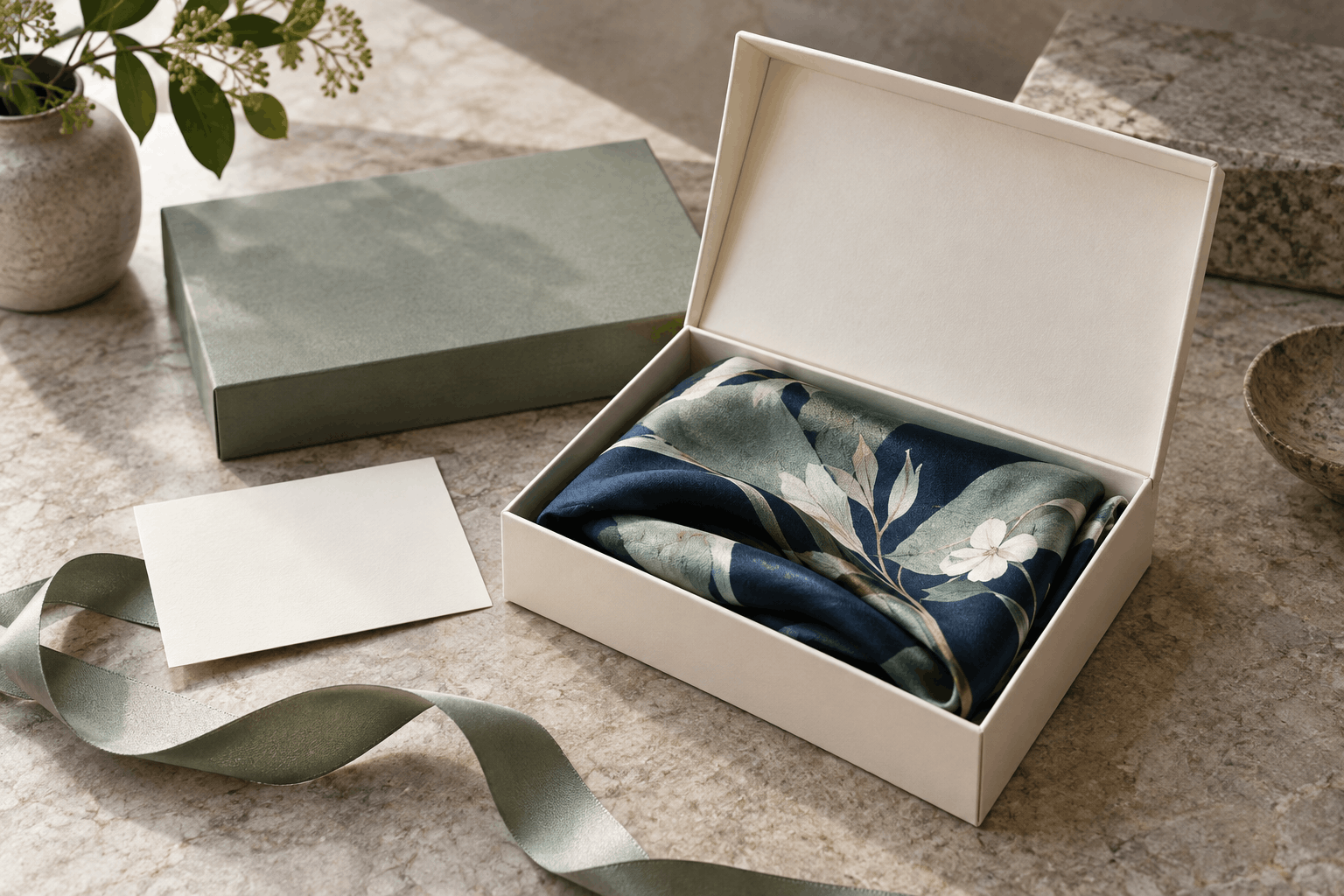
8. Packaging and Gift Contents
Describe what the recipient should find when opening the gift.
For a scarf-led project, this might include the scarf, a presentation box, a design-story card, care information and a personal message.
State whether the supplier should deliver each gift fully assembled and ready to hand over, or whether your team will add any elements.
Other useful details include:
- Preferred presentation style.
- Maximum packed size or weight, if relevant.
- Whether a carry bag is required.
- Whether the gift must fit into a separate shipping box.
- Any packaging materials to avoid.
- How different recipient versions should be identified.
If sustainability is part of the brief, turn broad language into specific requirements. Ask for the packaging composition or evidence for a claimed certification rather than relying on descriptions such as “eco-friendly.”
For possible approaches, explore Lanting Loom’s luxury corporate gifts and presentation options.
9. Samples, Approvals and Decision Makers
Name the project contact and explain who has authority to approve the product, artwork, budget and final order.
A clear approval process prevents different departments from sending conflicting feedback.
Tell the supplier:
- Who will collect and return consolidated comments.
- Which stakeholders need to review the proposal.
- Whether a physical sample is required.
- What the sample needs to demonstrate.
- When feedback and approvals can realistically be provided.
- Whether supplier onboarding or a purchase order is required.
Ask the supplier to distinguish a digital artwork proof, an existing product sample and a custom pre-production sample. Each answers different questions.
For a silk scarf, a physical sample may help assess colour, fabric feel, drape and finish. A digital proof is useful for reviewing layout and wording, but it cannot fully demonstrate those material qualities.
Confirm sample costs, timing and any differences between the sample and the proposed production specification.

10. The Response You Want from the Supplier
Make it easy to compare proposals by asking suppliers to respond to the same questions.
Request:
- The recommended product and customization approach.
- Confirmed specifications and gift contents.
- Pricing at the stated quantities.
- Separate development, sample, packaging and delivery charges.
- Minimum quantities and stock assumptions.
- An approval, production and delivery schedule.
- Payment terms and quotation validity.
- Any exclusions, unresolved questions or proposed alternatives.
Also explain how you will choose. If recipient suitability, design quality and dependable delivery matter more than the lowest unit price, say so.
A Corporate Gifting Brief Template You Can Copy
Complete the fields below. Mark anything unresolved as “to be confirmed” and give a decision date where possible.
Organisation: [Name, website and short introduction]
Project contact: [Name, role and business contact details]
Occasion and objective: [What the gift should acknowledge or communicate]
Recipients: [Groups, relationship to the organisation and relevant preferences]
Gift policies or restrictions: [Known acceptance limits, material requirements or alternatives needed]
Quantity: [Total, quantity per version and whether numbers are confirmed]
Budget: [Currency, total or per-gift amount, and included costs]
Event date: [Date, if applicable]
Required arrival date: [When gifts must be received and ready for preparation]
Delivery plan: [Countries, approximate shipment split and single or multiple addresses]
Product direction: [Preferred format or request for recommendations]
Customization route: [Existing product, adapted presentation or bespoke design]
Design story and references: [Theme, colours, approved source material and links]
Branding: [Locations, visibility, logo files and guidelines]
Personalization: [Shared or individual messages, names and languages]
Gift contents and packaging: [Items included, presentation and assembly requirements]
Samples and approvals: [Sample needs, approvers and feedback dates]
Procurement requirements: [Supplier onboarding, purchase order or invoicing needs]
Supplier response required: [Options, itemised quotation, schedule and response deadline]
Non-negotiable requirements: [What must be met]
Flexible elements: [Where alternatives are welcome]
Example: A Brief for Client Appreciation Gifts
The following is a fictional example to demonstrate the level of detail. The quantity and budget are illustrative, not a Lanting Loom quotation or availability commitment.
Project: Thank-you gifts for clients attending an anniversary dinner.
Recipients: 100 guests, with interest in wearable design confirmed by the relationship team. Please also identify a possible alternative for recipients who would not use silk.
Objective: A useful keepsake that expresses appreciation and feels connected to the occasion.
Quantity: Quote for 100 gifts and show the additional cost of 10 spare units. The final product split will be confirmed before ordering.
Budget: An illustrative target of £120 per gift, including standard presentation and delivery to one London business address. Show applicable taxes, import costs and any one-off charges separately.
Timing: The event is in approximately five months. Gifts must arrive at least two weeks before it. Exact calendar dates will be supplied with the enquiry; please confirm feasibility.
Product direction: Existing silk scarf designs with a refined palette. An original scarf commission is not required.
Branding and packaging: Discreet company branding on a presentation sleeve, a shared thank-you message and gifts supplied fully assembled.
Approval process: The marketing manager will consolidate feedback. Please quote for a physical product sample and a proof of the adapted presentation.
Response requested: Two suitable options with specifications, itemised pricing, minimum quantities and an approval-to-delivery schedule.
This gives a supplier enough information to assess the project while leaving room to recommend suitable designs.
Common Mistakes to Avoid
Using Adjectives Without Requirements
“Premium,” “unique” and “memorable” are useful intentions, but they do not define a product. Support them with information about the recipient, intended use, design direction and presentation.
Providing an Event Date Without an Arrival Deadline
State when the gifts must be received, not only when they will be handed out.
Leaving the Budget Scope Unclear
Explain whether packaging, personalization and shipping are included. Otherwise, proposals may appear comparable while covering different work.
Calling Every Change “Customization”
Specify whether you mean a message card, a presentation sleeve, an adapted colour palette or a completely original product design.
Sharing Recipient Data Too Early
Use audience descriptions and approximate destinations for initial planning. Share individual delivery details only when needed for the agreed work, through an appropriate process.
The UK Information Commissioner’s Office explains the principle of limiting personal information to what is necessary in its data minimisation guidance. For direct-to-recipient projects, agree how delivery information will be transferred, used and retained.
Frequently Asked Questions
How detailed should a corporate gifting brief be?
It should be detailed enough to explain the purpose, audience, quantity, budget, timing and delivery requirements. A concise page may be sufficient for an existing-product order; a bespoke project may need supporting artwork and specifications.
Can I send a brief before choosing the gift?
Yes. Explain the recipient, occasion, budget and practical constraints, then ask for recommendations. Identifying the right product can be part of the supplier’s response.
Should I include a budget?
Yes. A clear amount or realistic range helps suppliers propose feasible options. State the currency and what the budget needs to cover.
Do I need final artwork before contacting a supplier?
Not necessarily. Explain whether artwork already exists or needs development. Provide relevant references and clarify who will approve the final design.
Is a gifting brief the same as a confirmed order?
No. The brief outlines your needs. Confirm the agreed specification, quantities, pricing, approvals, payment terms and delivery arrangements before production proceeds.
Begin with a Clear Brief
A good corporate gifting brief gives the supplier enough direction to make a useful recommendation and gives your team a clear basis for making decisions.
Lanting Loom welcomes enquiries for curated silk scarves, gift sets, adapted presentation and bespoke design projects. Quantities, customization, samples, pricing and timing are assessed against the proposed scope.
Use the template above to outline your project, then send the details through our corporate gifting enquiry page. Start with the occasion, recipients, quantity, budget, destination and required arrival date; the remaining details can be developed together.
