

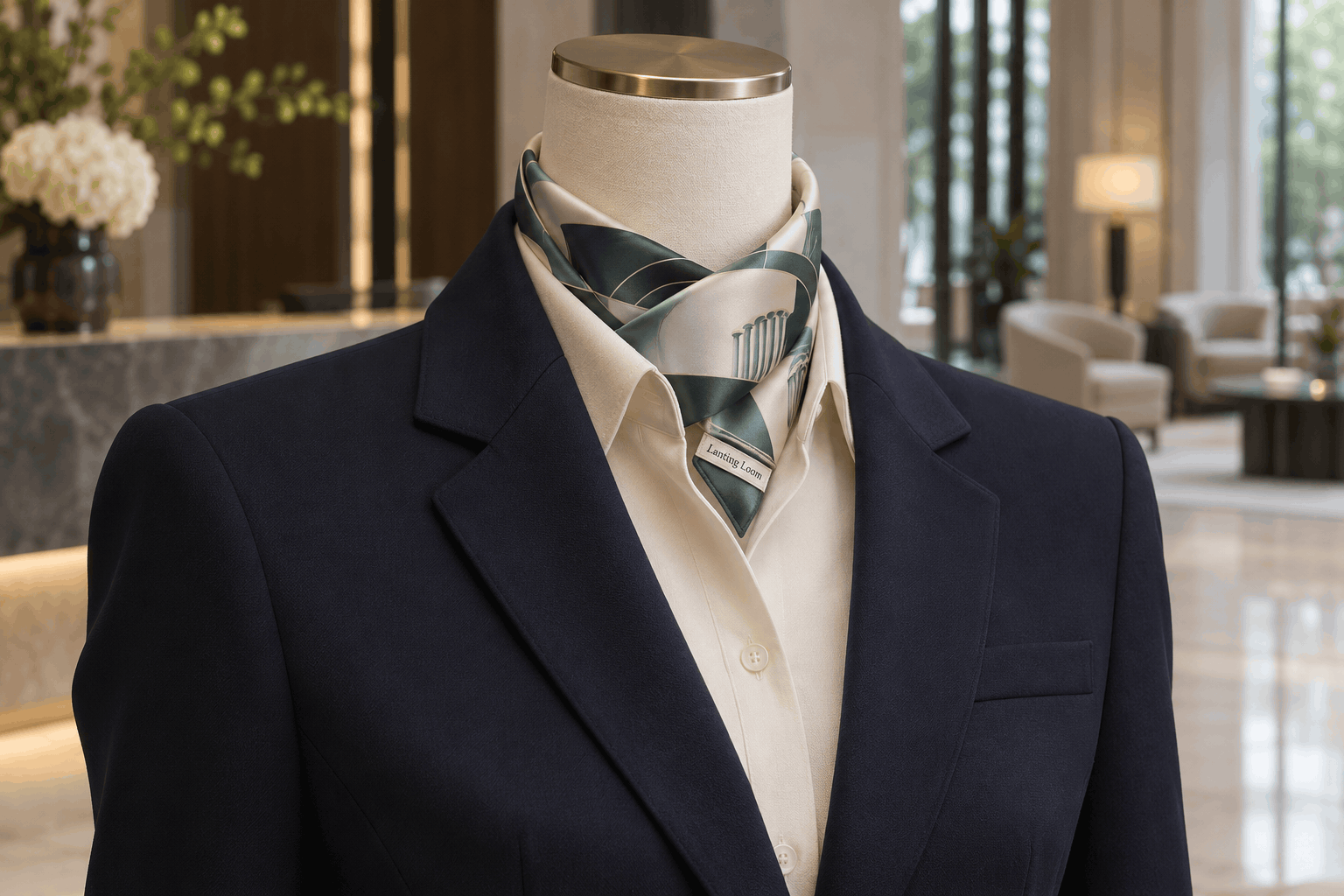
A well-designed uniform scarf can bring a hotel’s identity into a small, memorable detail. A colour drawn from the interiors, a line inspired by the architecture or an abstract reference to the surrounding landscape can connect the uniform with the property without overwhelming it.
Custom silk scarves for hotel staff should be developed around the role, the complete uniform and the cleaning routine—not artwork alone. A successful specification covers fabric, finished dimensions, colour, printing, hems, labelling, wear trials and replacement orders.
This guide is intended for hotel procurement teams, brand managers and uniform designers planning a guest-facing accessory. The examples are starting points for sampling, not universal uniform standards.
1. Define Who Will Wear the Scarf
Begin with the department and the work involved. Reception, concierge and guest-relations teams may have different requirements from restaurant service, housekeeping or maintenance staff.
Record whether the scarf will be worn throughout a shift or only for particular duties. Consider indoor and outdoor working, repeated bending, carrying luggage, food service and contact with equipment.
Loose neck accessories are not suitable for every task. The UK Health and Safety Executive’s machinery guidance warns against loose clothing that could become caught in moving parts. A short knot or scarf ring should not be assumed to eliminate that risk.
Have the hotel’s operations team confirm where a scarf is appropriate. Agree an alternative accessory or a scarf-free uniform where necessary, and consider staff comfort, accessibility and individual needs from the outset.
2. Translate the Hotel Identity into Wearable Design
The most useful design references are specific to the property: a garden layout, architectural rhythm, coastline, artwork or carefully chosen interior palette.
Translate those references into a pattern that remains attractive at a small scale. A scarf is often folded into a narrow band, so the design needs to work both opened out and tied.
- Choose a restrained palette: relate the scarf to the jacket, shirt and surrounding interiors.
- Plan the border: it may become the most visible part after folding.
- Control pattern scale: avoid relying on a central motif that disappears inside the knot.
- Keep branding discreet: test the position of a small logo rather than repeating it across every surface.
Use the hotel’s approved logo files and obtain permission for any artwork or archival imagery. Where a design draws on Chinese art or another cultural source, explain the reference accurately and avoid presenting a contemporary interpretation as a historical reproduction.
3. Specify the Fabric Beyond “Silk”
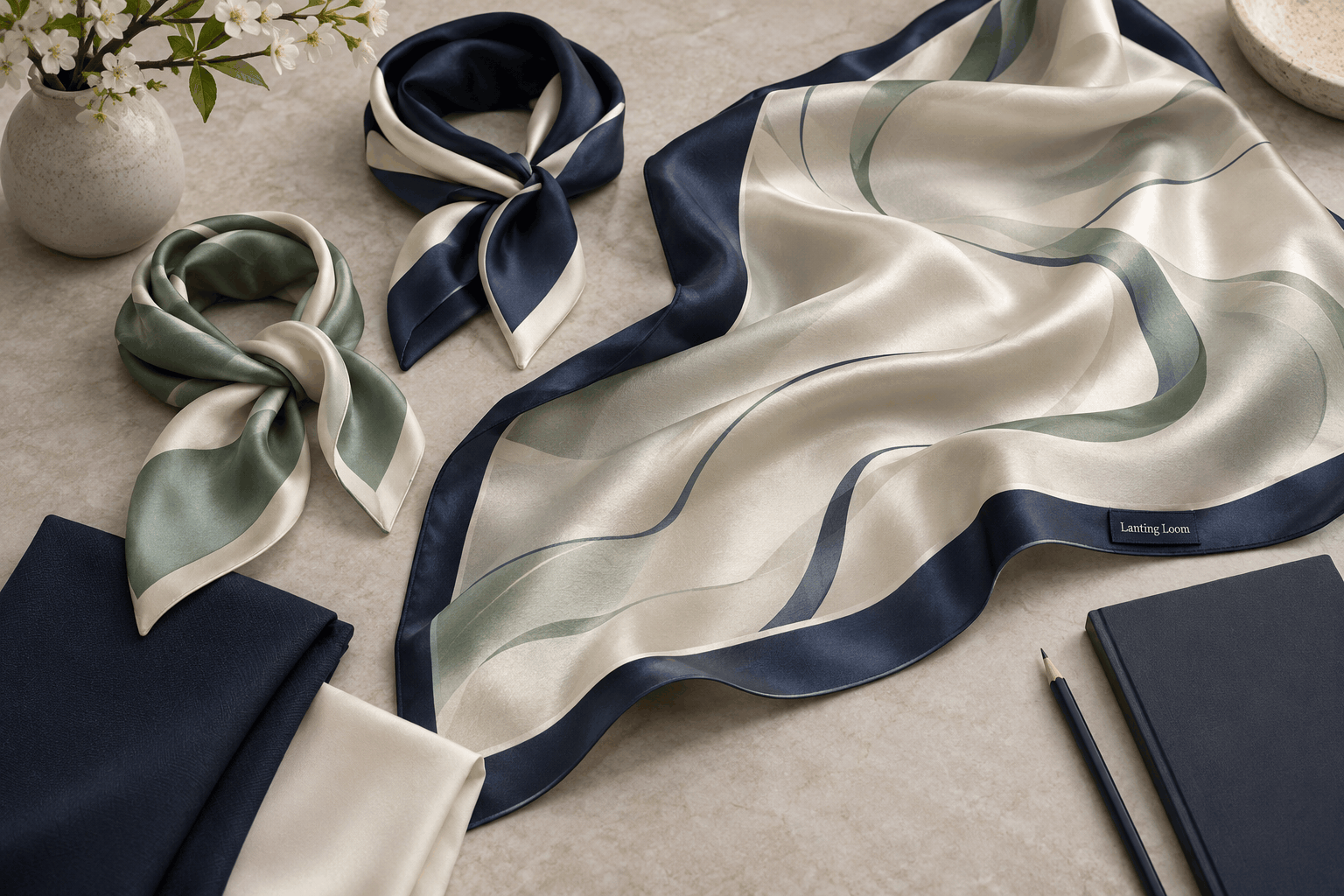
A fabric description should identify fibre composition, weave and weight. Silk is a fibre; twill and satin describe fabric constructions. A satin appearance alone does not establish that a fabric is silk.
Ask to compare physical swatches. Silk twill offers a diagonal surface texture, while silk satin can produce a more reflective appearance. Neither description guarantees the right grip, drape or durability for a particular uniform.
Specify weight in an agreed unit, such as grams per square metre or momme, together with an acceptable tolerance. A higher weight is not automatically better: the scarf still needs to fold comfortably and sit neatly at the neckline.
Inspect the fabric against the actual shirt and jacket. Check opacity, bulk, surface snagging and whether the proposed knot stays in place during normal movement.
4. Choose Dimensions Through Fit Trials
There is no single correct size for a hotel uniform scarf. The finished dimensions must work with the chosen styling method, collar shape and range of wearers.
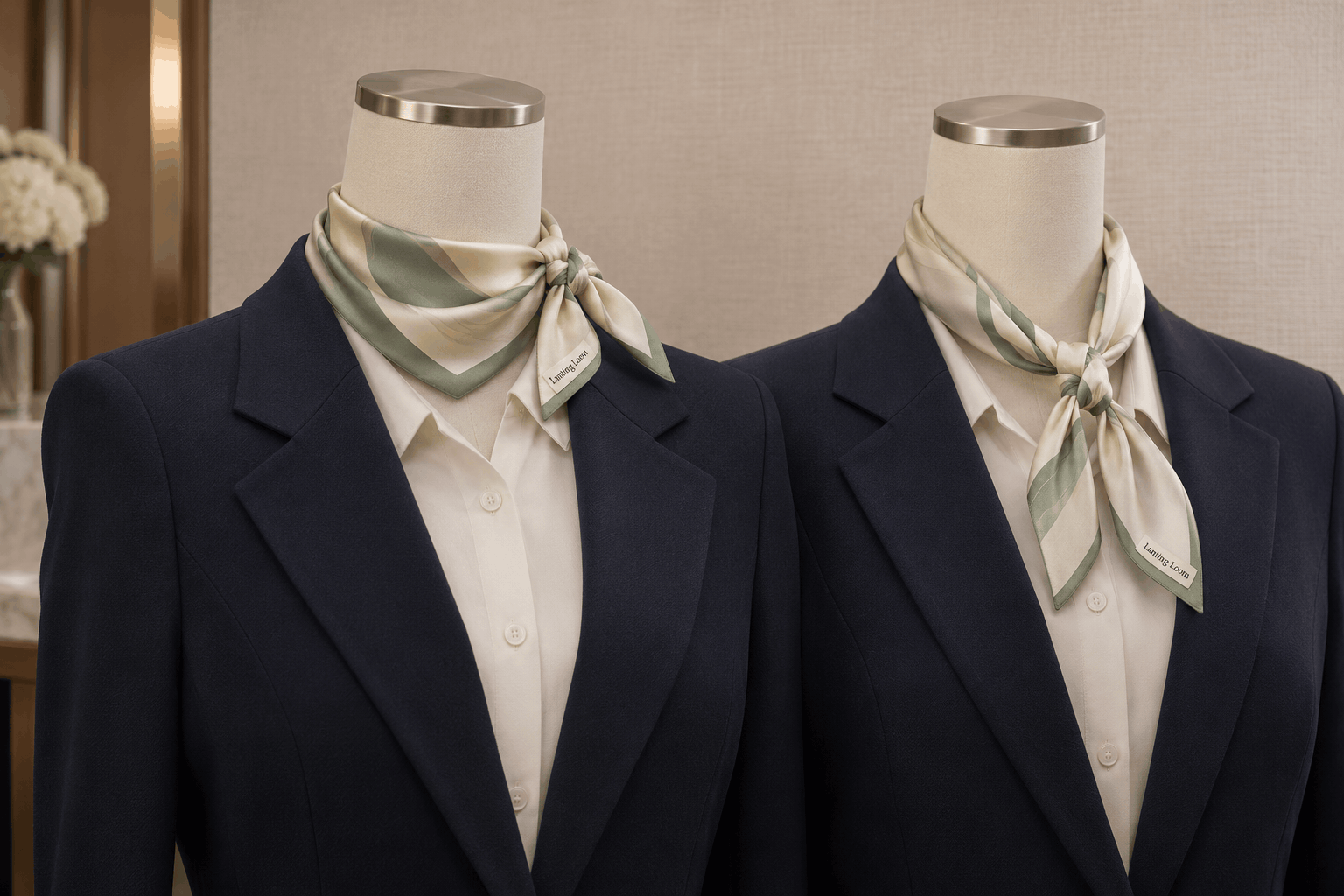
A small square can offer several folding options. A narrow rectangular scarf may simplify a prescribed look. A larger square provides more fabric but may create unnecessary bulk for a compact neckline.
For an initial comparison, a hotel might trial a square around 60 × 60 cm and a narrow format around 10 × 100 cm. These are illustrative prototype sizes, not recommendations for every team or guaranteed supplier options.
Test on representative staff rather than relying only on a mannequin. Check comfort while sitting, reaching and turning, along with end length, slipping and the visibility of name badges. Provide alternatives where one format does not fit comfortably.
5. Approve Colour and Printing on the Actual Fabric
A digital mock-up is useful for composition, but it is not a reliable final colour standard. Fabric texture, printing and lighting affect how colour appears.
Supply brand colour references, then approve a physical printed sample on the proposed fabric. View it beside the uniform under the hotel’s actual lighting as well as daylight.
Check the reverse side too. A pale reverse may become visible in a knot or folded edge. If the project requires a similar appearance on both sides, describe the expected result and confirm the proposed production method rather than relying on the phrase “double-sided”.
Agree the artwork version, logo orientation, border placement and acceptable variation before production. Retain an approved sample as the reference for both the first order and later replenishment.
6. Make Care and Performance Part of Approval
Do not assume a silk scarf can enter the same laundry cycle as the rest of the uniform. Confirm the proposed care method with the supplier and the hotel’s laundry provider before ordering.
Arrange repeated cleaning trials using the intended process. Agree the number of cycles and acceptance criteria in advance, then assess colour change, colour transfer, dimensional change, distortion, handle and hem condition.
Where formal testing is needed, ask a qualified textile laboratory to recommend suitable methods for the intended use. Useful areas to discuss include colourfastness to rubbing, perspiration and the specified cleaning process, together with dimensional stability.
A claim such as “washable silk” needs defined conditions. If the hotel requires a cleaning process the sampled scarf cannot tolerate, revise the material or accessory concept rather than depending on staff to improvise.
Use the Lanting Loom silk care guide for general context, while following the final product’s validated care instructions.
7. Agree Hems, Labels and Construction Details
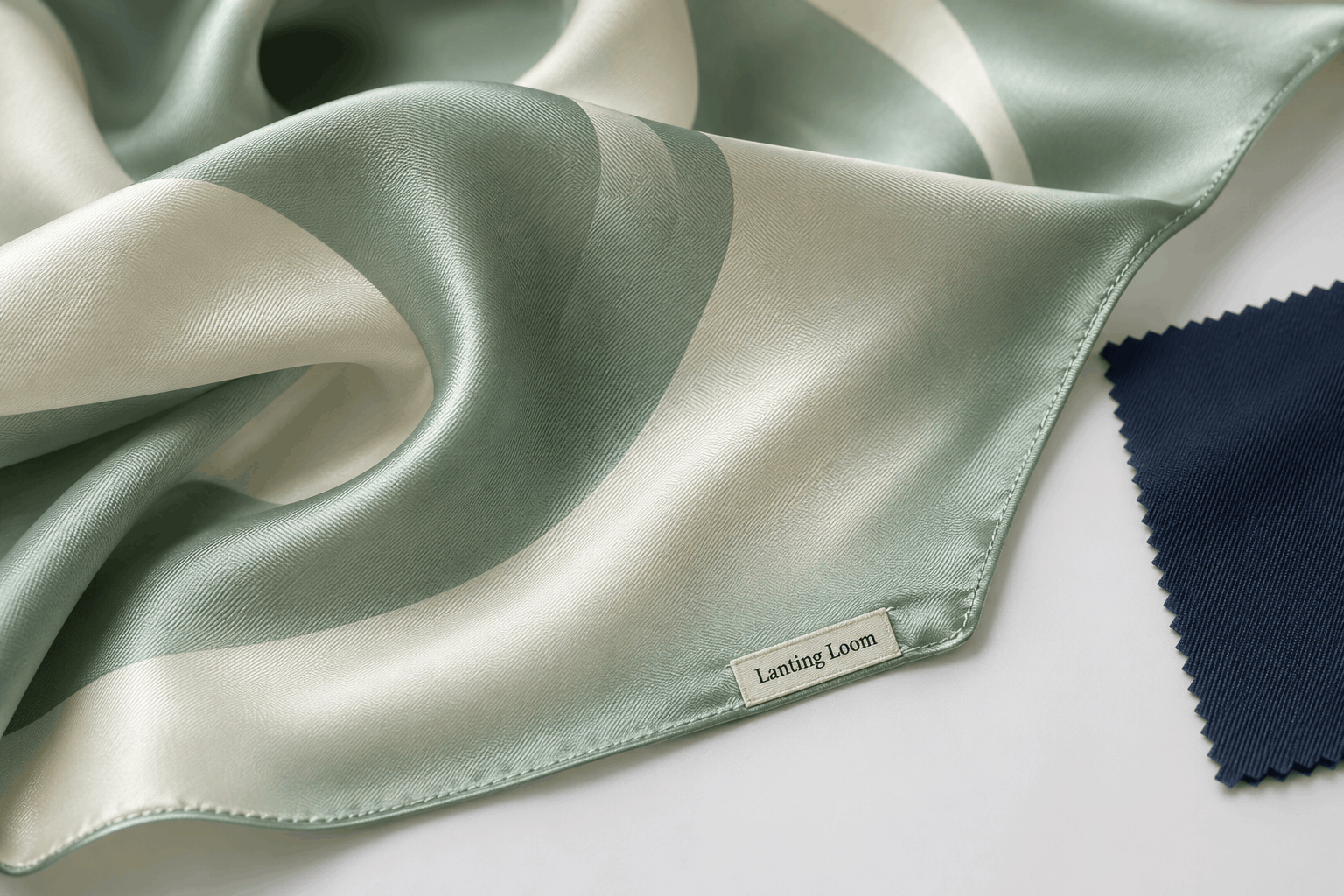
Hand-rolled and machine-stitched hems create different appearances and should be specified accurately. A hand-rolled edge may suit a particular aesthetic; a neat machine-stitched hem may suit another. Neither should be treated as proof of superior uniform performance without testing.
Check corner shape, loose threads, puckering and consistency across samples. For a sewn narrow scarf, also specify seam placement and end shape.
Position labels so they remain readable when needed without rubbing the neck or appearing unexpectedly in the approved fold. Confirm the composition, care, origin and other labelling required for the destination with the supplier.
A Practical Hotel Uniform Scarf Specification
Use the following as a briefing checklist. Replace broad descriptions with agreed details before authorising production.
| Specification area | What to confirm |
|---|---|
| Use and styling | Departments, duties, approved fold, wearer range and operational restrictions. |
| Fabric | Fibre composition, weave, weight, finish and tolerances. |
| Dimensions | Finished measurements, measurement method and acceptable variation. |
| Artwork and colour | Approved file version, physical colour reference, print placement and reverse appearance. |
| Construction | Hem or seam method, corner or end shape, thread colour and label placement. |
| Care and testing | Cleaning process, trial cycles, test methods where required and acceptance criteria. |
| Order and replenishment | Quantity by design, minimum order, lead times, retained samples and repeat-order terms. |
| Delivery and inspection | Packing, destination, delivery terms, inspection procedure and defect resolution. |
8. Plan the Order Around Daily Operations
Order quantities should reflect more than the number of employees. Allow for clean items in use, laundry turnaround, new starters and replacement stock.
Calculate an initial requirement as: staff count × agreed issue quantity per person, plus a separately planned reserve. Set those figures from the hotel’s cleaning schedule and staffing needs rather than using a universal allowance.
Compare the total programme cost, including design, samples, testing, production, delivery, cleaning and replacements. Ask when repeat-order lead time begins and how later batches will be matched to the approved reference.
Before bulk approval, obtain sign-off from the brand team, operations, procurement and the person responsible for laundry. A short illustrated styling guide can then help staff reproduce the approved look consistently.
Frequently Asked Questions
Are silk scarves suitable for every hotel department?
No. Suitability depends on duties, equipment, hygiene requirements and the cleaning routine. Assess each role and provide an alternative where a neck accessory is unsuitable.
Can a hotel logo be printed on the scarf?
Yes, subject to the agreed production method and artwork approval. Use authorised logo files and check visibility after folding; subtle placement often integrates more naturally with the uniform.
Can custom silk scarves be machine washed?
Do not assume so. Machine washing should only be specified when the finished product has been validated for the defined process. Fabric, printing and construction all affect the result.
What are the minimum order and production lead time?
They depend on fabric, dimensions, printing, finishing and quantity. Request a project-specific quotation and distinguish design and sampling time from production and delivery time.
A Uniform Detail That Works Beyond the Photograph
A successful hotel scarf looks considered, feels comfortable and remains manageable through daily use. Its value comes from the connection between design and a well-tested specification.
For a hotel scarf concept, explore Lanting Loom’s bespoke and hospitality project options. Share the property’s identity, uniform photographs, departments, intended quantities, cleaning requirements and target date so feasibility and sampling can be discussed.
