

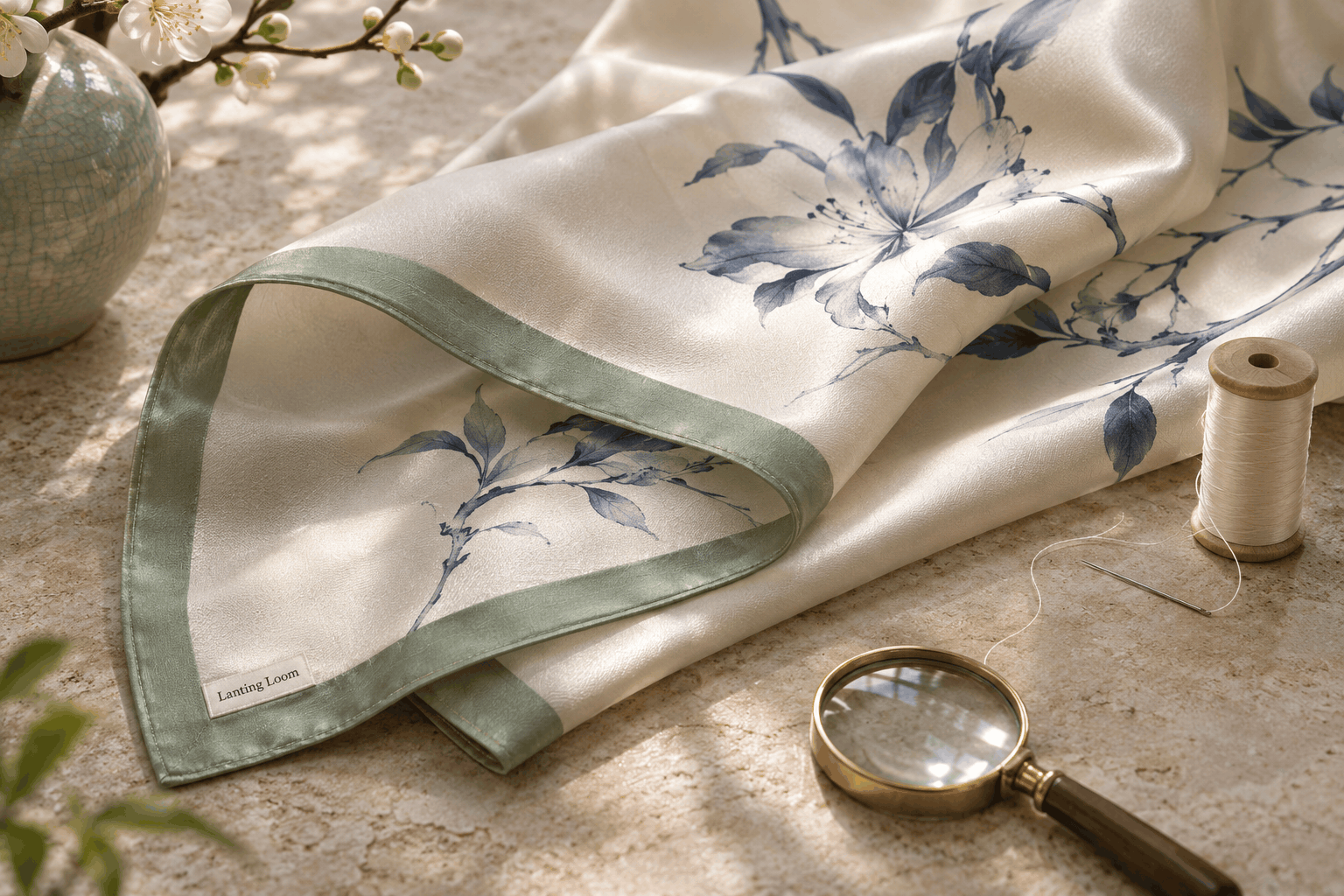
When choosing a silk scarf, it is natural to notice the colours and print first. Look a little closer, however, and the edge reveals another part of its construction: how the fabric has been turned and secured.
Product descriptions may mention hand-rolled edges, machine-stitched hems or simply a rolled hem. These terms are related, but they do not mean exactly the same thing.
A hand-rolled, hand-stitched hem is formed and secured with handwork. A machine-stitched hem is secured by a sewing machine and may also have a narrow rolled or folded shape. The method affects the appearance of the edge and the labour involved, but it does not determine the quality of the entire scarf.
What Is a Hand-Rolled Silk Scarf Hem?
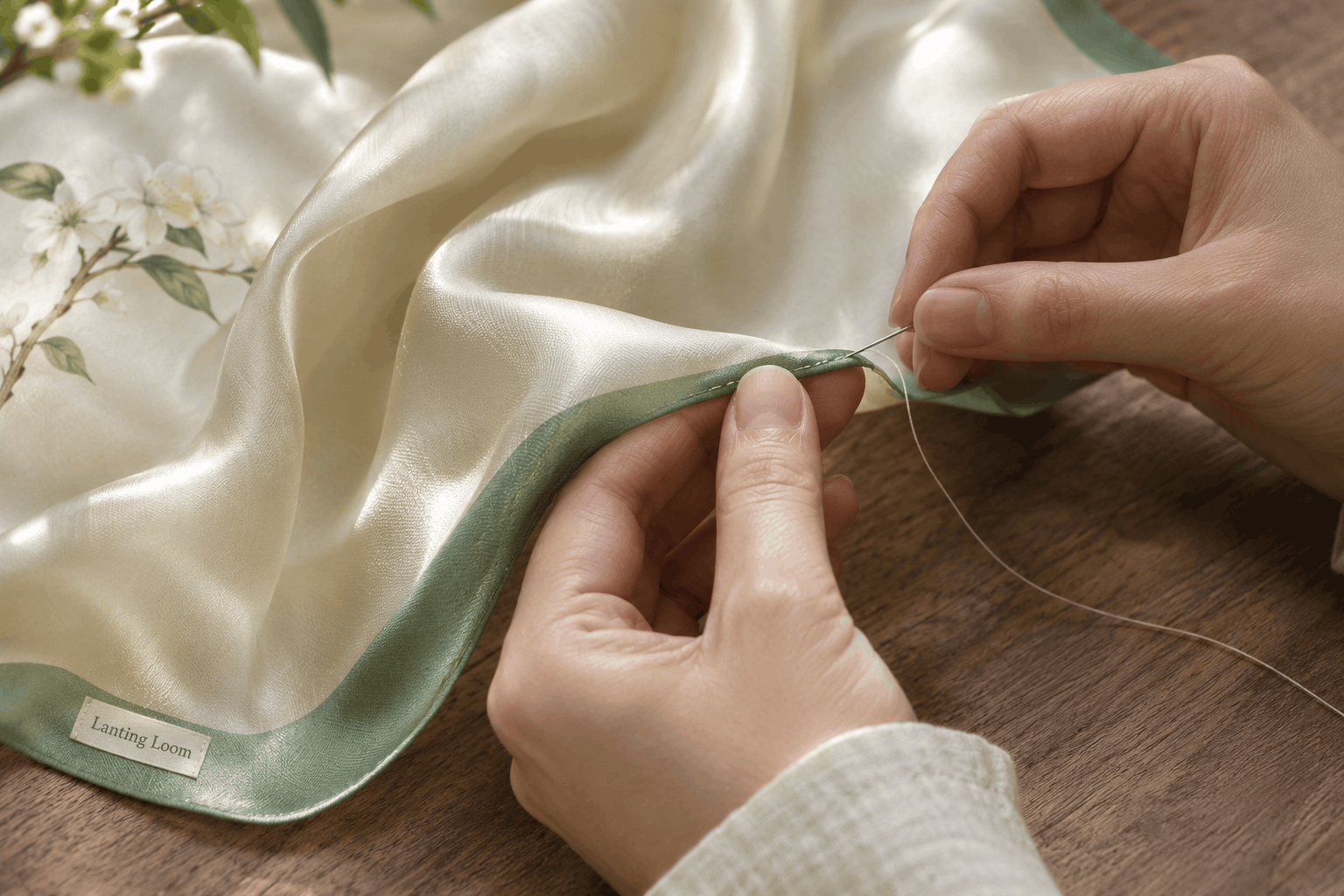
In a hand-worked rolled hem, a narrow allowance of fabric is turned inward to enclose the raw edge, then secured with small hand stitches. Different preparation and stitching techniques can achieve this finish.
The result often has a softly rounded profile, with much of the stitching concealed within the roll. Small stitch marks may still be visible where the thread catches the body of the fabric.
The sewing publication Threads describes several methods in its guide to hand-rolling a hem, illustrating why there is more than one way to create a hand-worked edge.
Careful hand finishing takes time. Slight variation in the roll or stitch spacing can occur, but a well-made hem should still look controlled and remain securely closed.
Handwork is not a reason to accept loose sections, obvious damage or badly distorted corners.
What Is a Machine-Stitched Silk Scarf Hem?
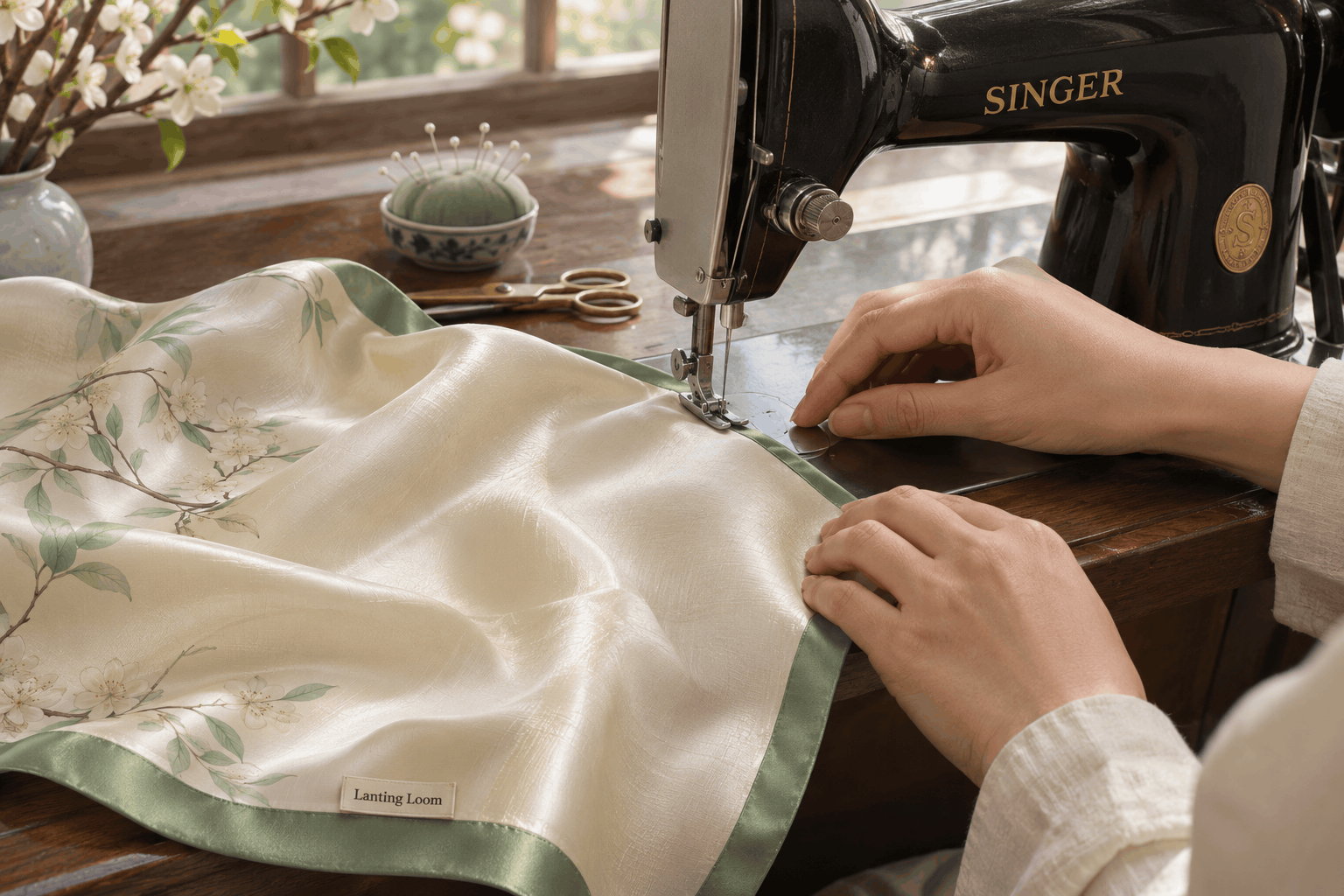
A machine-stitched hem uses a sewing machine to secure the edge. One common approach turns the fabric under into a narrow double fold and stitches it in place.
A special hemming foot can guide the fabric into this fold as it passes beneath the needle. SINGER’s rolled hem foot description explains how a machine can create a narrow rolled hem on lightweight fabrics, including silk.
This matters because “rolled hem” describes an edge construction, not necessarily a hand-sewing process.
Machine finishing also includes other methods. An overlocked or serged rolled edge, for example, uses threads that wrap around the edge and has a different appearance from a narrow folded hem with a straight stitch line. These finishes should not all be treated as visually identical.
A well-executed machine hem can be fine, neat and consistent. It still requires suitable equipment settings and careful handling of the fabric.
Hand-Rolled vs Machine-Stitched Hems at a Glance
| Detail | Hand-rolled and hand-stitched | Machine-stitched |
|---|---|---|
| How it is secured | Small stitches made by hand. | Stitches formed by a sewing machine. |
| Typical appearance | A softly rounded edge with discreet stitch marks. | Often a regular stitch line along a narrow fold; other machine finishes look different. |
| Consistency | May show subtle variation while remaining neat. | Often has more uniform stitch spacing. |
| Labour | Usually requires more manual finishing time. | Usually allows faster stitching, with preparation and operator skill still important. |
| Feel | Can create a soft, flexible edge. | Depends on the fold, stitch type, thread and tension. |
| Price | Additional labour may contribute to a higher price. | Can reduce finishing costs, but does not determine the retail price alone. |
| Quality judgement | Check secure stitches, enclosed edges and tidy corners. | Check secure stitches, enclosed edges and tidy corners. |
These are typical characteristics, not an authentication checklist. Fabric weight, technique, pressing and wear can change how a hem looks.
Is a Hand-Rolled Hem Better?
A hand-worked hem can be a desirable detail if you appreciate the time involved and prefer a softly rounded finish. It can add character to a scarf whose design and material you already love.
However, a hand-rolled edge does not automatically make one scarf better than another. A carefully made machine hem can be more satisfactory than poorly executed handwork.
Consider the whole piece:
- Material: what fibre composition is stated?
- Fabric: does its weight and feel suit how you want to wear it?
- Design: do the colours and proportions work with your wardrobe?
- Printing or weaving: is the method described clearly?
- Finishing: are the edges and corners secure and neatly handled?
- Care: are the instructions clear and practical for you?
A hem is one part of this assessment. It cannot stand in for all the others.
How to Examine a Silk Scarf Hem
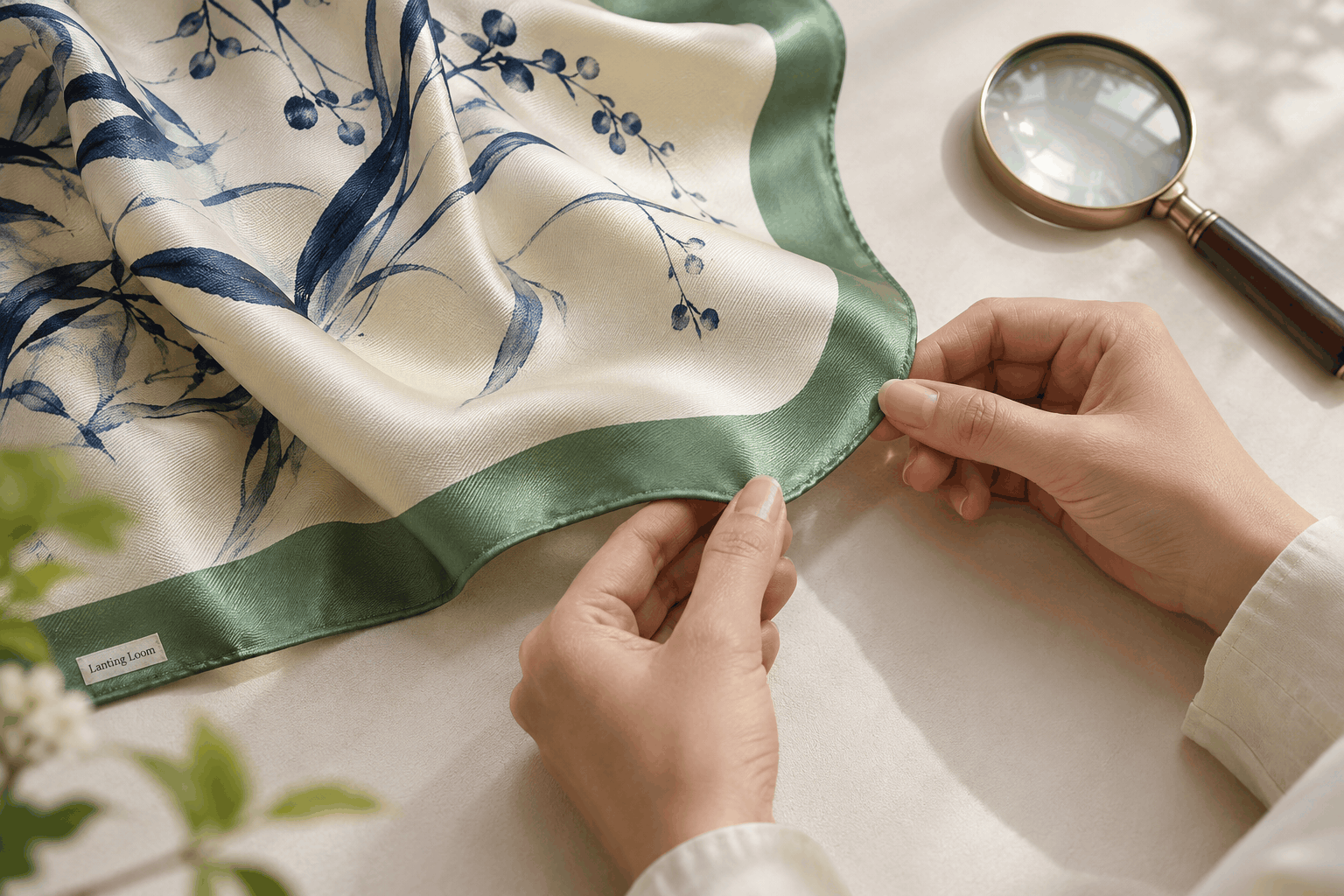
Use good light and handle the scarf gently. There is no need to pull the edge apart or stretch the fabric to inspect it.
1. Look at both sides
Turn over a short section of the border. Notice the shape of the fold and where the thread appears.
A regular visible stitch line can suggest machine sewing, while small intermittent catches can suggest hand stitching. Neither observation is conclusive on its own: techniques vary, and fine stitching can be difficult to see.
2. Check that the raw edge is contained
Look for sections where the hem has opened or raw fabric is escaping. Loose fibres at an unfinished area deserve a closer look, especially if the stitching appears to have come undone.
3. Examine the corners
Corners bring several folds together, so some additional thickness is natural. Look for a controlled finish without a large loose lump, an open section or fabric pulled sharply out of shape.
4. Let the scarf rest naturally
Lay it on a smooth surface without stretching it. Notice whether the edge gathers the fabric into pronounced puckers or pulls the border into an uneven shape.
A soft wave in lightweight silk is not automatically a fault. The question is whether the finishing creates obvious, persistent distortion.
5. Ask for confirmation
If the construction method matters to your purchase, ask whether the edge is both rolled and stitched by hand. Request a clear close-up of the actual product’s edge and corner.
Use photographs as supporting information, not as the sole proof of how a scarf was made.
What the Hem Cannot Tell You
It cannot prove that the fabric is pure silk
Hand sewing and machine sewing can both be used on different fibres. A hand-rolled edge does not establish silk content. Check the composition label and the seller’s product specifications.
It cannot prove that the entire scarf is handmade
Hand finishing describes a particular production stage. A scarf can have hand-sewn edges while its fabric is machine woven and its design digitally or screen printed.
These processes are compatible. The important point is that the description identifies which work was done by hand.
It cannot establish authenticity or origin
A rounded edge, a particular roll direction or slightly irregular stitches are not enough to authenticate a branded scarf. They also do not establish where it was made.
It cannot guarantee durability
Both types of hem can last well when properly constructed and cared for. Both can also suffer from broken threads, snagging or inappropriate cleaning. The label “hand-rolled” is not a promise that the scarf will never unravel.
Why Can Hand-Finished Scarves Cost More?
Manual finishing generally takes more time than running a prepared edge through a machine. That labour can contribute to the price.
However, there is no universal price premium that proves handwork. Fabric, artwork development, printing, production scale, packaging and retail costs also influence the final price.
When comparing scarves, compare their complete specifications. Two pieces with different sizes, materials and designs cannot be judged fairly on the hem alone.
Questions to Ask Before Buying
- Is the hem rolled and stitched by hand, or stitched by machine?
- If the description says “hand-finished,” which stage does that refer to?
- Can you provide a close-up of the actual edge and corner?
- What are the fibre composition, dimensions and care instructions?
- What should I do if stitching arrives loose or becomes damaged?
Clear answers are more useful than broad phrases such as “luxury craftsmanship” without supporting details.
How to Care for Either Type of Hem
Follow the care label supplied with the scarf. A machine-stitched edge does not make a silk scarf machine washable, and hand finishing alone does not determine the cleaning method.
Keep the edge away from rough jewellery and sharp hardware. Ease knots apart rather than tugging on a corner. If a thread becomes loose, avoid pulling it or trimming it before you know whether it is securing the hem.
Ask the seller or a repair specialist experienced with fine silk for advice if the edge starts to open. When pressing is permitted, avoid flattening a rounded hem aggressively.
For general handling and cleaning guidance, read our silk care guide.
Frequently Asked Questions
Does “rolled hem” always mean hand-rolled?
No. A rolled hem can also be produced with a sewing machine. Ask whether the rolling and securing stitches are completed by hand if that distinction matters to you.
Are slightly uneven stitches proof of handwork?
No. Subtle variation may occur in hand stitching, but irregularity is not proof of the method. Skilled handwork can be very consistent, and machine stitching can be uneven when poorly executed.
Are machine-stitched silk scarves lower quality?
Not necessarily. A neat machine hem can be appropriate for a well-made silk scarf. Judge the fabric, design and execution together.
Does a hand-rolled hem mean the scarf is handwoven?
No. Hem finishing and fabric weaving are separate processes. A claim about one does not establish the other.
Can a damaged hem be repaired?
Some loose or broken stitching can be repaired, but the options depend on the fabric’s condition and the extent of the damage. Seek advice before attempting repairs on delicate silk.
Choose the Finish as Part of the Whole Scarf
A hand-worked edge can be a pleasure to appreciate. A fine machine-stitched hem can also provide a clean, considered finish. The best choice combines a design you want to wear with suitable fabric, sound construction and an accurate description.
Explore Lanting Loom’s silk scarves, checking the specifications for each individual design. If a finishing detail is not stated, ask for clarification rather than assuming it from the price or photographs.
