

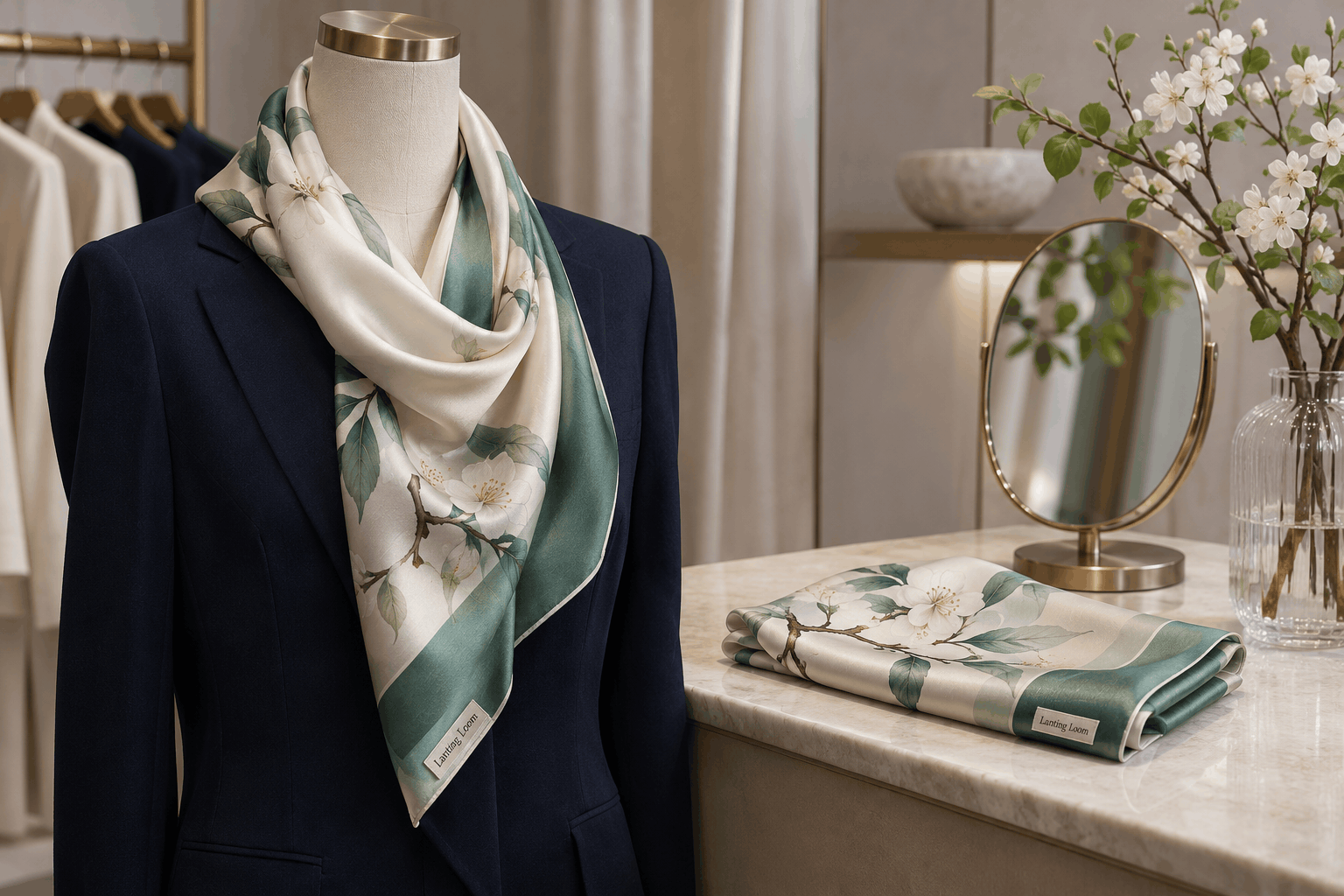
Pricing a silk scarf requires more than doubling a supplier’s quotation. A boutique must cover the cost of bringing the product into stock, allow for selling expenses and choose a price customers can understand through the scarf’s design, quality and presentation.
To price silk scarves for boutique retail, establish the landed unit cost, calculate a proposed selling price from your target gross margin, then test that price against selling costs, discounts and comparable products. Presentation should make the product’s value clear, while the numbers establish whether the offer works commercially.
The examples below use illustrative US dollar amounts. They are not Lanting Loom quotations or recommended market prices. Selling prices exclude sales tax or VAT, and product costs exclude recoverable taxes.
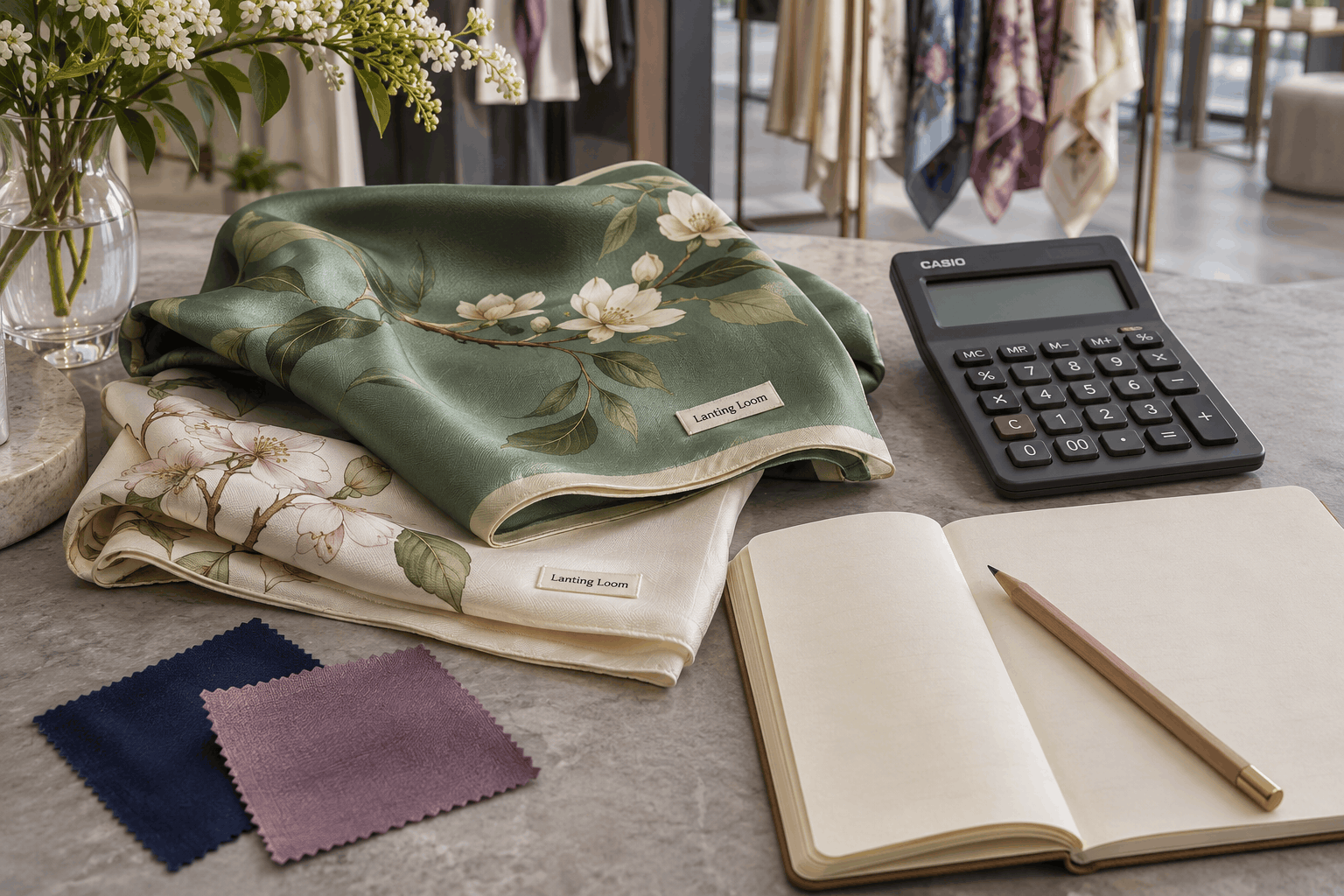
1. Start with Landed Cost, Not Just Wholesale Price
The supplier’s unit price is only the starting point. Before setting a retail price, identify what it costs to bring each scarf into saleable inventory.
- Purchase cost: the actual unit price after applicable supplier discounts.
- Inbound freight and insurance: allocated across the shipment using a consistent, reasonable method.
- Import costs: duties, clearance charges and non-recoverable taxes where applicable.
- Product preparation: directly attributable preparation costs included under your accounting policy.
Check the quotation carefully so you do not add freight, duties or packaging twice when they are already included. Convert foreign-currency purchases into your accounting currency consistently.
For example, a scarf purchased for $32 with $5 of allocated inbound freight and $3 of applicable import costs has a landed unit cost of $40.
Keep payment processing, sales commissions, outbound delivery, optional gift wrapping and general shop expenses visible in a separate selling-cost calculation. Their accounting classification can vary; the important point is to count each cost once and label your calculations accurately.
2. Understand Markup Versus Gross Margin
Markup measures the amount added relative to cost. Gross margin measures gross profit relative to sales revenue. The two percentages are not interchangeable, as explained in Shopify’s guide to markup and margin.
For the examples here, landed unit cost is treated as the cost of goods sold when a scarf sells.
- Gross profit per scarf = selling price − landed unit cost
- Markup % = gross profit ÷ landed unit cost × 100
- Gross margin % = gross profit ÷ selling price × 100
A scarf costing $40 and selling for $80 produces $40 of gross profit. Its markup is 100%, while its gross margin is 50%. That $40 still needs to cover selling expenses, overheads and the business’s eventual profit.
A 50% markup is different: adding 50% to a $40 cost gives a $60 selling price and a gross margin of approximately 33.3%.
3. Calculate a Price from Your Target Margin
To work backwards from a proposed gross margin, use:
Selling price = landed unit cost ÷ (1 − target gross margin)
Enter the margin as a decimal. For a $40 cost and a 60% target, the calculation is $40 ÷ 0.40 = $100.
| Illustrative target gross margin | Landed unit cost | Calculated selling price |
|---|---|---|
| 50% | $40 | $80.00 |
| 55% | $40 | $88.89 |
| 60% | $40 | $100.00 |
These are planning scenarios, not industry benchmarks. Recalculate the margin after rounding to your chosen shelf price.
Keystone pricing means doubling the wholesale cost. It is a convenient reference, but it can conceal additional costs. Doubling a $32 supplier price gives $64; against a $40 landed cost, that leaves a 37.5% gross margin.
4. Check What Remains After Selling Costs
A healthy-looking gross margin does not automatically produce a profitable shop.
Suppose the $100 scarf has a $40 landed cost and another $10 of variable selling expenses. The sale leaves $50 towards fixed overheads and profit, assuming those figures capture all variable costs. Rent, permanent staff costs and other fixed expenses still need to be covered.
Build this calculation around the way you actually sell. An online order may involve delivery and fulfilment costs; a concession sale may involve commission; an in-store gift purchase may involve wrapping materials and preparation time.
Also consider how long stock takes to sell. A higher theoretical margin is less useful if the assortment repeatedly remains unsold and eventually requires heavy markdowns.
5. Build a Clear Price Structure Across the Collection
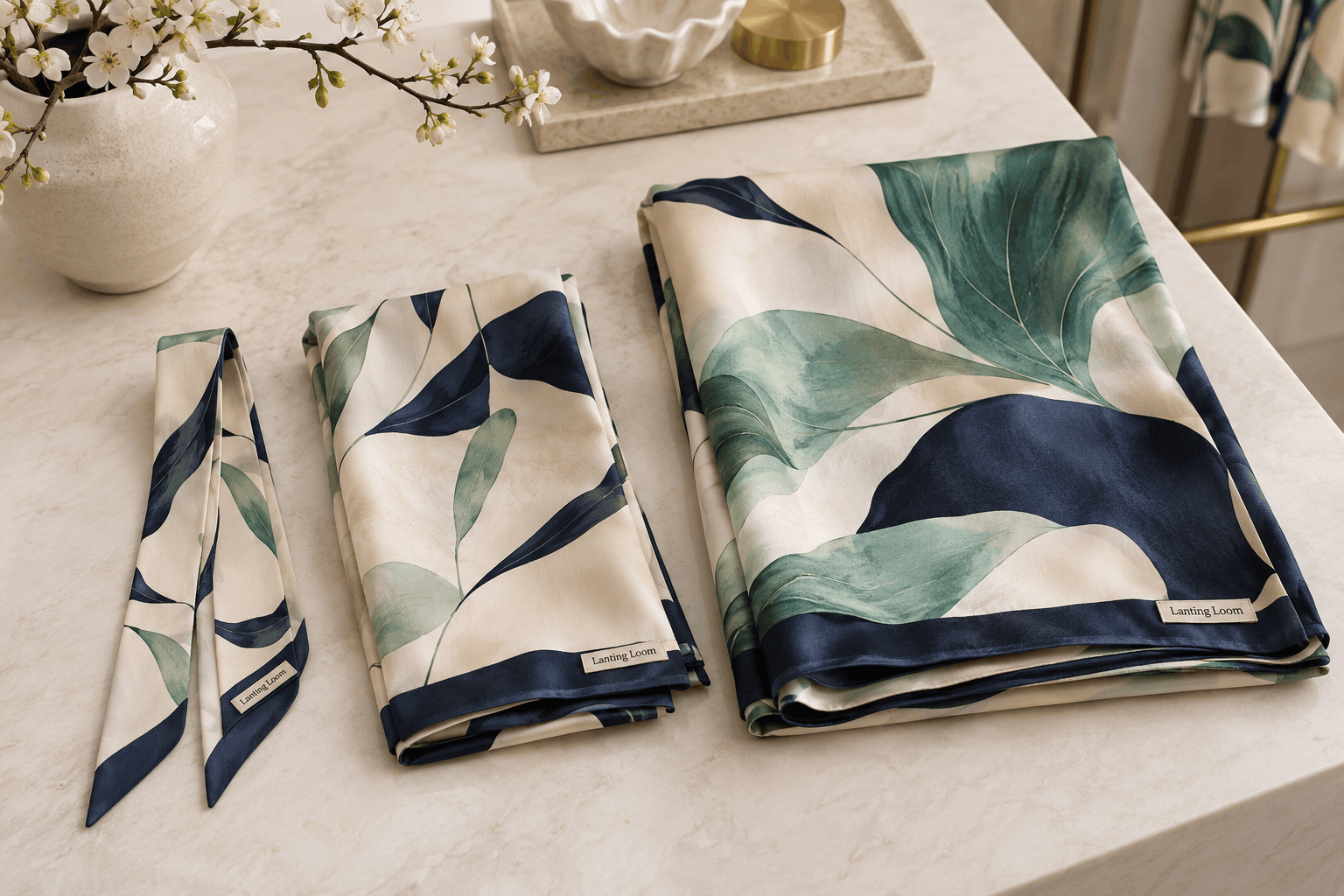
A boutique assortment should give customers understandable choices. A narrow twilly, a medium scarf, a large signature piece and a complete gift set may occupy different price points, but the differences should reflect the actual products.
Compare fibre composition, dimensions, fabric weight, print execution, finishing, original design and included presentation. Size alone is not a complete measure of value, and a heavier fabric is not automatically better for every use.
Review comparable products in your market on the same basis. A boxed gift set is not directly comparable with a scarf sold alone, and a silk blend is not equivalent to a product labelled 100% silk.
6. Test Discounts Before Offering Them
A discount reduces revenue while the scarf’s purchase cost remains unchanged. Model that effect before committing to a promotion.
| Offer | Selling price | Gross profit at $40 cost | Gross margin |
|---|---|---|---|
| Full price | $100 | $60 | 60% |
| 10% discount | $90 | $50 | 55.6% |
| 20% discount | $80 | $40 | 50% |
In this example, a 20% price reduction cuts gross profit per scarf by one-third, from $60 to $40. You would need to sell 50% more units to generate the same total gross profit, before considering changes in selling costs.
Cost any alternative offer too. Complimentary gift wrapping or a bundled accessory may appeal to customers, but neither is free to provide.
7. Let Presentation Explain the Value
Presentation helps customers understand what they are buying. Open a sample to show the complete artwork, make the fabric accessible for careful handling and provide accurate details about composition, size and finishing.
Explain cultural inspiration specifically. A verified reference to a garden, painting tradition or botanical motif is more useful than vague claims of “ancient luxury”. Distinguish printed artwork from woven pattern and hand-finished details from machine construction.
Good display cannot turn an unsuitable product into a worthwhile purchase. It can make genuine design and material qualities easier to recognise.
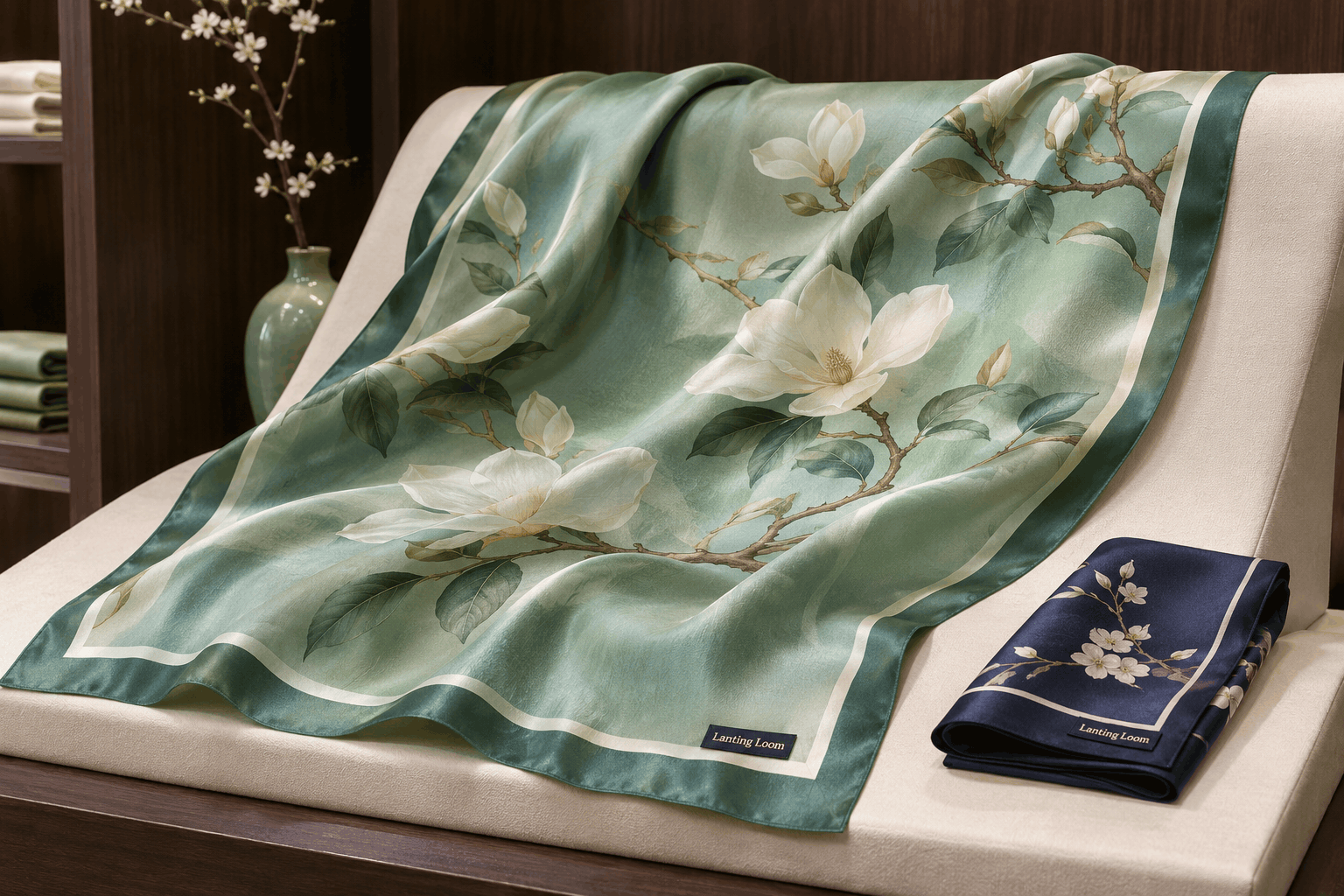
A simple styling demonstration adds another dimension. Show how the scarf works with a shirt or jacket, explain its care and give customers time to compare colours.
If you offer gift presentation, identify what is included and what costs extra. Explore Lanting Loom’s gift services for available approaches, and cost the agreed presentation into your offer.
8. Review Actual Results After Launch
Track realised selling prices, units sold, discounts, returns and stock remaining by design. Compare the margin you planned with the results you achieved.
When a design sells slowly, investigate before lowering its price. Customers may be unable to see the artwork, understand the size or imagine wearing it. Equally, the colour, product or price may simply be wrong for your audience.
Use those observations to refine the next order. A manageable opening assortment with clear replenishment terms can be easier to evaluate than a large purchase made solely to secure a lower unit price.
Frequently Asked Questions
What is a good retail margin for silk scarves?
There is no single margin that suits every boutique. Your target must work with landed costs, selling expenses, stock turnover, overheads and the prices your customers will accept. The percentages in this guide are illustrative calculations.
Does doubling wholesale cost guarantee a 50% gross margin?
Only when that wholesale cost represents the full cost used in the calculation and the product sells at the doubled price. Additional landed costs or discounts reduce the resulting margin.
Should gift packaging be included in the scarf price?
Either an inclusive price or a clearly priced optional service can work. Calculate the materials and preparation costs, avoid double-counting supplier-included packaging and explain the offer clearly.
What should I request before placing a boutique order?
Ask for product specifications, unit prices, minimum quantities, delivery terms, included packaging, payment terms and replenishment information. Confirm any recommended retail price and whether it includes tax.
Build a Price You Can Explain and Sustain
A considered retail price connects sound costing with an appealing product and a clear customer experience. Know your costs, test your assumptions and make the scarf’s real qualities visible.
Browse the Lanting Loom collection for contemporary silk designs. For boutique retail or collaboration enquiries, visit our corporate and retail enquiry page and share your market, store concept, intended assortment and quantities so available options can be discussed.
