

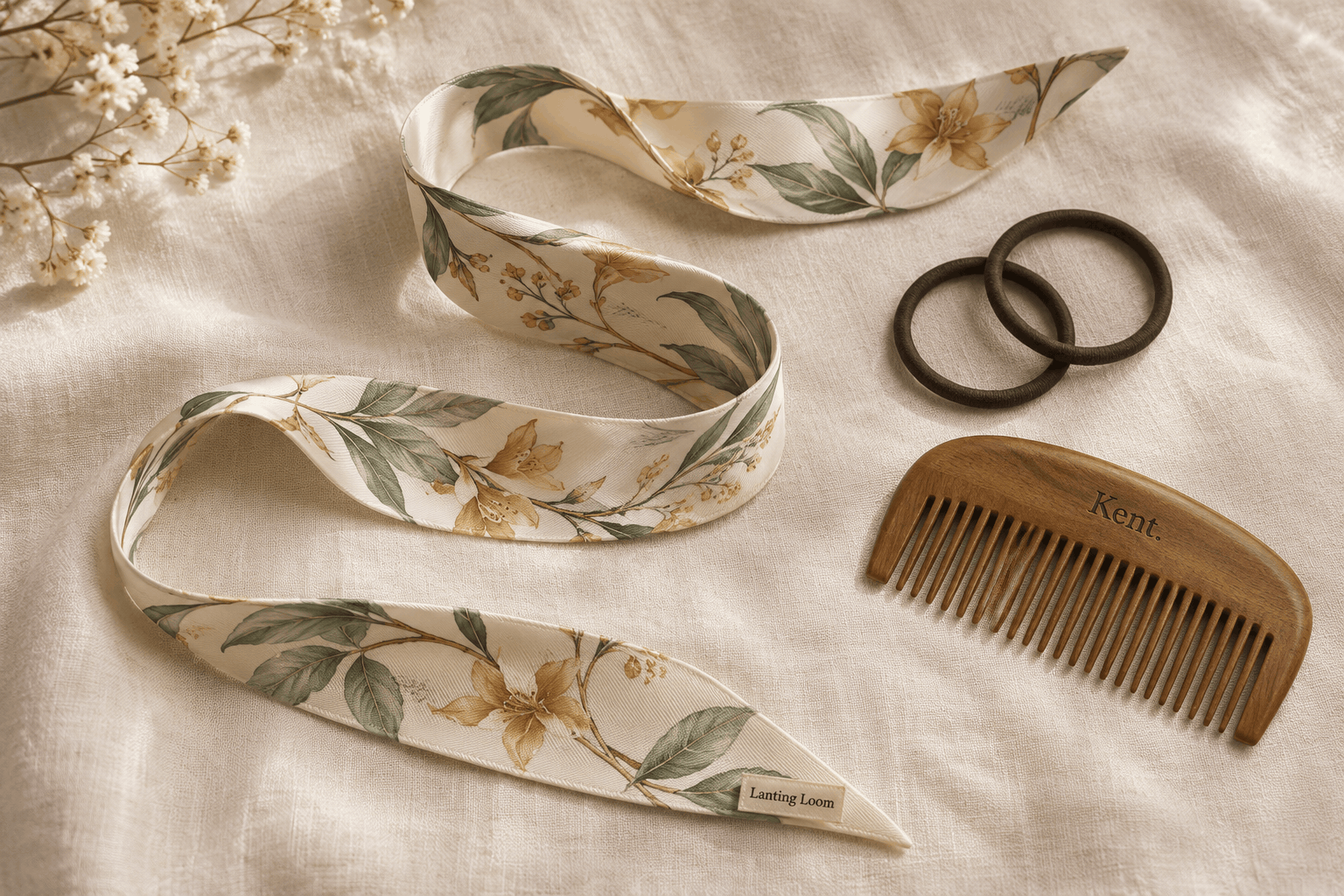
A narrow silk scarf can make a familiar hairstyle feel more considered. Tied around a low ponytail, wrapped at the base of a bun or woven through a braid, it adds colour and movement without needing an elaborate arrangement.
To tie a silk twilly in your hair, secure the hairstyle with a suitable hair elastic first, then add the scarf over that foundation. For a ponytail, knot it around the elastic. For a bun, wrap it around the base. For a braid, carry the scarf tails alongside two of the three hair sections as you plait.
The important detail is to let the hair fastening provide the hold. The silk supplies the decoration, so there is no need to pull it tightly against your hair or scalp.
What Is a Silk Twilly?
In this guide, a twilly means a narrow, ribbon-shaped silk scarf, often finished with pointed ends. It is less bulky than a square scarf and can be tied with little or no folding.
Dimensions vary between products. Check the actual length and width rather than assuming that every narrow scarf will work for every hairstyle. A short ribbon may be enough for a ponytail accent, while a large bun or a long braid needs more usable length.
For an example of this accessory format, the Hermès Equateur Twilly is described as a silk ribbon that can be worn in the hair, among other ways.
Before You Begin
Prepare the hairstyle before adding the silk. This makes the scarf easier to position and reduces the need to keep undoing the knot.
- Start with dry hair. Keep the scarf away from wet hair and freshly applied products.
- Choose a comfortable elastic. A smooth, fabric-covered hair tie provides a useful foundation.
- Check accessories. Avoid exposed metal joins, rough clips or damaged pin tips near the silk.
- Look at the print. Decide which side or section you want to show before tying.
- Check the available length. Leave enough fabric for the fastening and the tails or bow you want.
Keep a second mirror nearby so you can check the back of your hair. For the braid, practising with your hair brought over one shoulder may be easier than working entirely behind your head.
1. The Silk-Twilly Ponytail
Best for: a quick everyday accent, a white-shirt outfit or a relaxed weekend look.
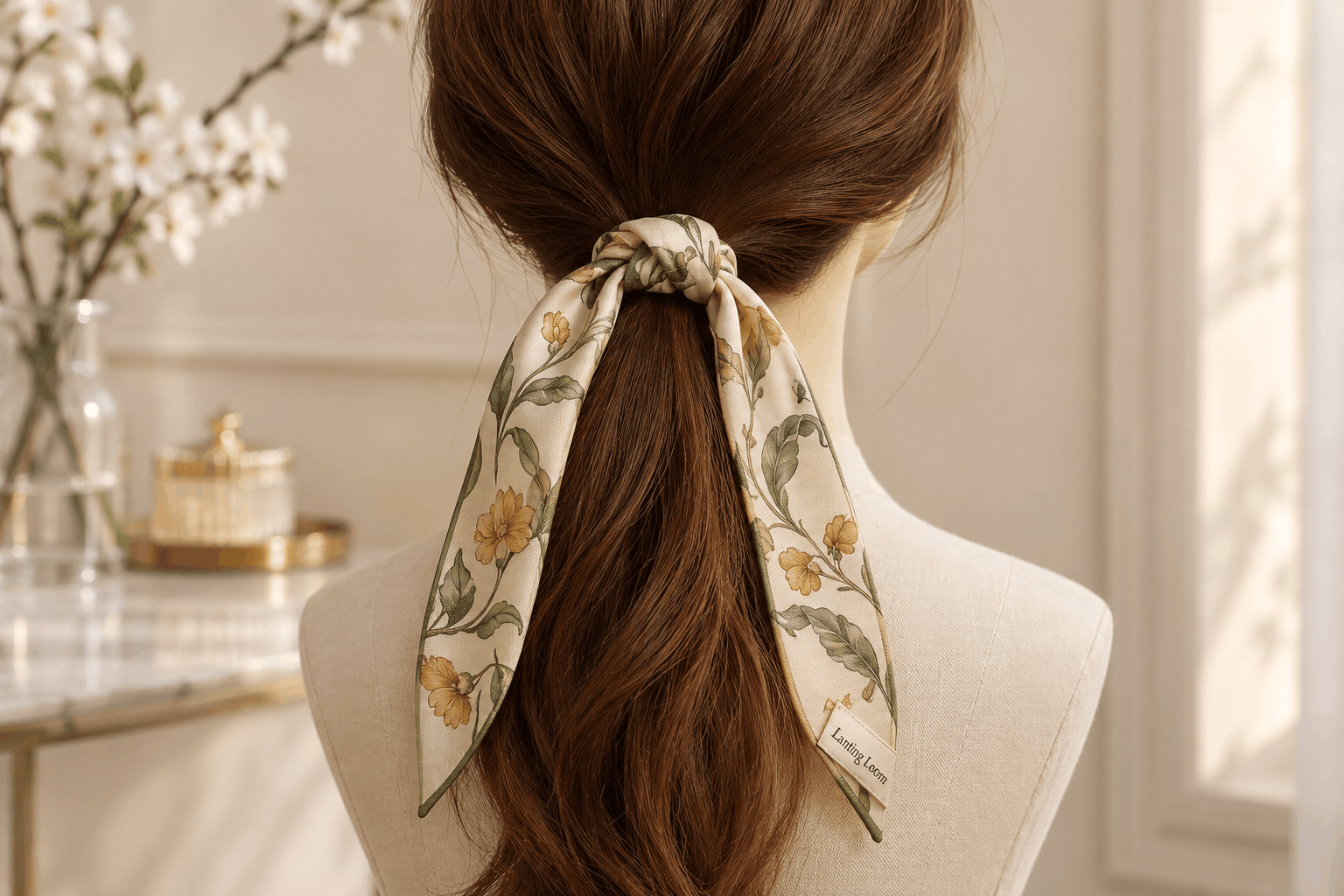
A ponytail is the simplest place to begin. The twilly covers the elastic, while its ends fall beside the hair and move as you walk.
How to Tie It
- Gather your hair into a low or mid-height ponytail and secure it with a hair elastic.
- Check that the ponytail feels comfortable and holds without the scarf.
- Place the middle of the twilly underneath the ponytail base, directly against the elastic.
- Bring the two ends around the sides of the base and cross them over the elastic.
- Tie a gentle double knot, keeping loose hairs out of the crossings.
- Arrange the knot above or beside the ponytail and let the two tails hang freely.
There is no need to wrap the scarf repeatedly. One turn around the base usually leaves more fabric for the visible ends and keeps the arrangement light.
For a bow: if enough length remains, make two small loops instead of leaving long tails. If the loops feel cramped, return to a simple knot rather than pulling harder.
Styling detail: a low ponytail gives the scarf a quiet, relaxed setting. A higher ponytail creates more movement, so check that the ends do not catch on earrings or clothing.
2. The Silk-Twilly Bun Wrap
Best for: a neat daytime bun, an understated dinner outfit or keeping scarf tails relatively short.
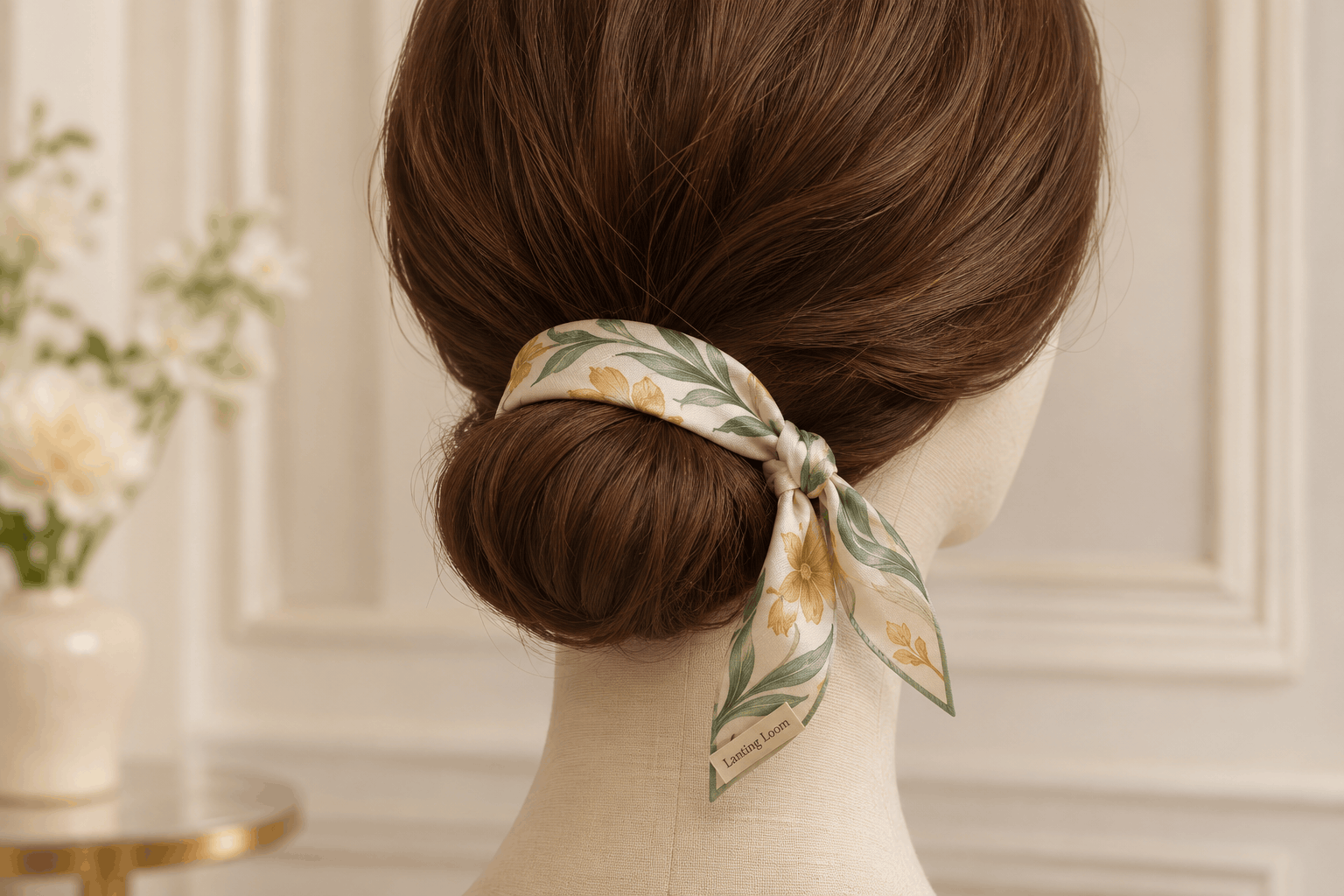
Wrapping silk around the base of a bun creates a clear band of colour. The bun should already be secure before the scarf goes on.
How to Tie It
- Gather your hair into a ponytail at the position you want the bun.
- Twist or arrange the ponytail into a bun and secure it with an elastic or suitable hairpins.
- Check that the bun stays in place independently.
- Place the middle of the twilly against the base of the bun.
- Bring the two ends around the base in opposite directions until they meet.
- Tie a small, gentle double knot at the side or underneath, then arrange the tails.
Keep the scarf around the base rather than stretching it over the entire bun. This allows the shape of the hairstyle to remain visible and uses less fabric.
If the scarf ends barely meet, choose a longer ribbon or tie the twilly around the ponytail base before forming a different style. A large bun naturally needs more length around its circumference.
Styling detail: move the knot to one side for a visible accent, or underneath for a quieter finish. Avoid pushing a pin through the silk to hold the tails down.
3. The Silk-Twilly Braid
Best for: hair long enough to plait and occasions when you want the scarf’s colour to appear through the hairstyle.
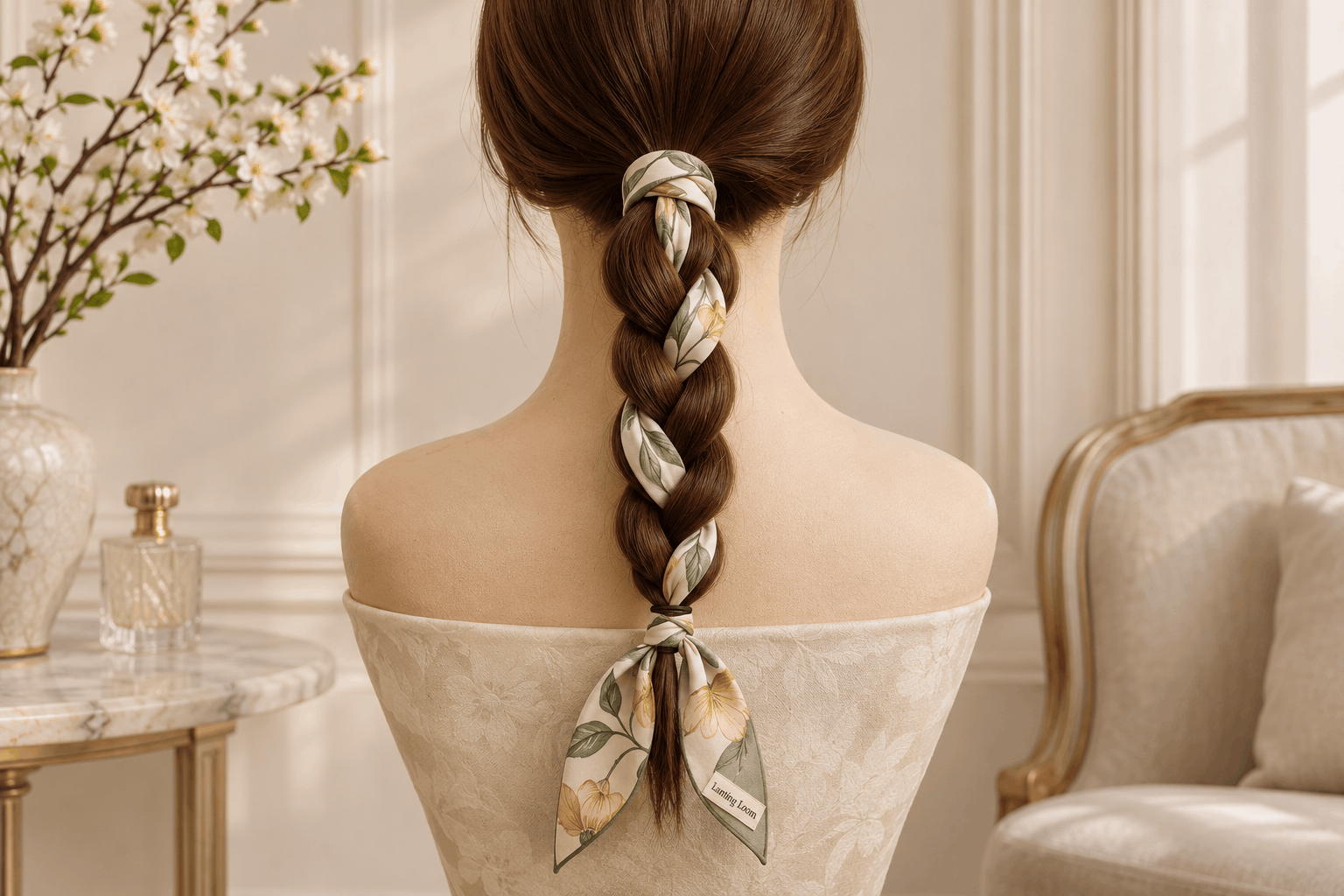
For this version, the twilly travels alongside the hair rather than replacing a hair section. You still work with three sections, which keeps the method close to an ordinary three-strand braid.
How to Weave It In
- Secure your hair in a comfortable low ponytail.
- Tie the centre of the twilly around the ponytail elastic, leaving two roughly equal scarf tails.
- Divide the ponytail into three hair sections: left, centre and right.
- Add one scarf tail to the left section and the other to the right section. Keep the centre section as hair only.
- Cross the right section over the centre, carrying its scarf tail with it.
- Cross the left section over the new centre, again carrying its scarf tail with it.
- Continue alternating sides. Keep each scarf tail paired with its original hair section as that section changes position.
- Stop while enough scarf remains for a small finishing knot. Secure the braid with a second hair elastic.
- Tie the remaining scarf tips gently around the lower elastic, if their length allows.
Use relaxed, even tension. The braid should hold its shape without needing to pull the ribbon tight. Keep some of the printed side facing outward as you work, but do not worry if the fabric turns slightly.
What If the Twilly Is Shorter Than Your Hair?
You do not need to weave it all the way to the ends. Finish the braid higher, while the scarf still has enough length for a knot, and leave the remaining hair loose beneath the elastic.
Another easy option is to braid the hair without the scarf, then tie the twilly around the bottom elastic. This gives you a decorative finish without needing enough ribbon for the full plait.
Styling detail: a narrower ribbon reveals small flashes of print between the hair sections. A wider ribbon becomes more prominent and can make the braid bulkier.
Which Style Should You Try First?
| Style | Good starting point for | Length consideration |
|---|---|---|
| Ponytail knot | Beginners and quick everyday styling | Enough to circle the elastic, tie and leave visible tails |
| Bun wrap | A compact, defined accent | Enough to circle the bun base and form a comfortable knot |
| Woven braid | Anyone comfortable making a three-strand braid | Extra length for the crossings and a finishing knot |
| Braid-end accent | A shorter ribbon or a simpler alternative | Only enough to tie around the lower elastic |
How to Keep the Twilly from Slipping
Start by checking whether the hairstyle or the scarf is moving. If the ponytail elastic slides, retie the hair before adjusting the silk. If only the scarf moves, check its position over the elastic and the shape of its knot.
- Tie over a stable base. A smooth, covered elastic gives the scarf a defined place to sit.
- Finish the knot. A single crossing may loosen; a gently completed double knot may hold better.
- Keep the tails balanced. A large difference in length can encourage the scarf to rotate.
- Avoid excessive wrapping. Too many turns can leave ends too short to fasten comfortably.
- Test before leaving. Turn your head and move normally, then make any small adjustments.
If the scarf still slips, choose a simpler knot or another placement. Avoid spraying products onto the silk or relying on a very tight knot to compensate.
Choosing a Colour and Print
A hair accessory shows only part of a scarf’s design. Small motifs, flowing lines and a defined border can remain visible even when the ribbon is folded or woven.
For a subtle effect, choose colours close to your outfit. For more contrast, try an ivory or pale-coloured ribbon against dark hair, or a deeper green, blue or plum against lighter hair.
You can also repeat one small colour from a blouse, dress or bag. The twilly does not need to match every accessory; one connection is usually enough to make the outfit feel considered.
When browsing the Lanting Loom collection, check each piece’s dimensions and format. A broad square scarf can be folded into a band, but it will create a fuller effect than a narrow ribbon.
Removing the Scarf Without Tugging
Take the scarf out slowly rather than pulling one end through the hairstyle.
- For a ponytail: loosen the scarf knot and lift the ribbon away before removing the hair elastic.
- For a bun: untie and unwrap the scarf before taking out the pins or elastic holding the bun.
- For a braid: undo the lower scarf knot, remove the lower elastic carefully and unbraid from the bottom upwards, separating silk from hair as you go.
If hair has become caught in a knot, loosen the fabric with your fingertips and free the strands gently. Do not pull harder to force the scarf out.
Caring for Silk Worn in the Hair
Apply hair products before adding the twilly and allow them to dry. Avoid direct contact with hairspray, oils and perfume, and keep hot styling tools away from the scarf.
After wearing, untie the ribbon and allow it to air before storing it. If it needs cleaning, follow the individual care label rather than assuming it can be washed like a hair tie.
Our silk care guide explains how to handle, store and care for silk. For a mark or stain you are unsure about, use the customer-care information in our FAQ to seek guidance before trying a treatment.
Frequently Asked Questions
Can I use a silk twilly instead of a hair elastic?
For these styles, use an elastic to secure the hair first. The twilly adds colour and decoration over the fastening, so you do not need to pull the silk tightly to hold the hairstyle.
Can I wear a twilly in short hair?
If your hair is long enough for a small ponytail or half-up section, you can tie a short ribbon around its elastic. Keep the knot and tails proportionate. Hair that cannot be gathered may need a different accessory or placement.
Will a short twilly work in a long braid?
It may not reach the full length. You can finish the braid higher while leaving hair loose below, or tie the twilly around the lower elastic after braiding instead of weaving it through.
Can I use a square silk scarf for these styles?
Yes, if you fold it into a band and it has enough usable length. It will usually add more volume than a narrow ribbon, so check the knot and avoid forcing several thick layers around a small fastening.
Is a silk twilly suitable for curly or textured hair?
It can be used as a decorative accent on a comfortably secured ponytail, bun or braid. Adapt the base style to your usual routine and choose enough scarf length for the volume of hair. The hair does not need to be straightened for these looks.
A Small Detail with Plenty of Possibility
Start with the ponytail knot if you are new to wearing silk in your hair. Once that feels familiar, try a bun wrap or weave the ribbon through a simple braid.
The most successful arrangement is one that feels comfortable, shows a detail you enjoy and is easy to undo at the end of the day. Explore Lanting Loom for silk designs that bring colour, artistry and meaning to everyday dressing.
