

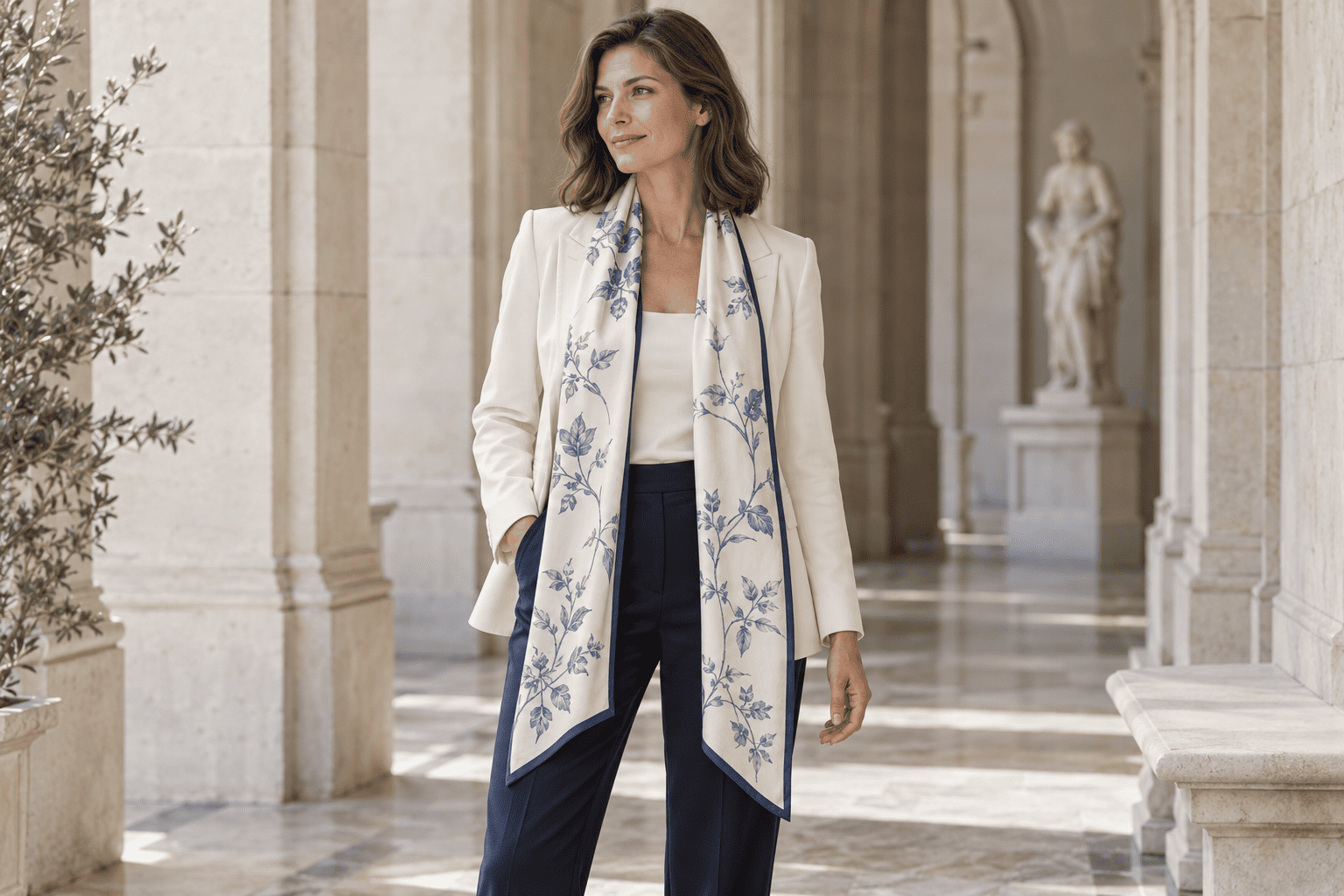
Learning how to wear a long silk scarf begins with one simple idea: let the fabric do some of the work. A loose fold can reveal a beautiful border; a single loop can bring colour close to your face. You do not need an elaborate knot to make silk feel considered.
The easiest starting points are an open front drape, a relaxed neck loop and a broad shoulder wrap. Once those feel natural, try the ten styles below, choosing each one around your neckline, the scarf’s proportions and how much movement you want.
Before you start: choose your fold and proportions
For neck styles, fold the long edges inward to make a loose band about 10–15 cm wide. For shoulder coverage, leave the scarf open. These are starting points, not rules: adjust the width until the silk sits comfortably.
Length gives you room to wrap; width affects coverage and the fullness of a knot. For reference, Lanting Loom’s Butterfly in Magnolia Light measures 175 × 50 cm, while Garden Song in Olive measures 180 × 60 cm. Your height, neckline and the fabric’s weight will also change the result.
Before tying, choose which colour or motif you want facing outward. Fold gently by hand rather than pressing a sharp crease, and keep every neck style comfortably loose.
1. The open front drape
A simple way to show the scarf’s length over a blazer, fine knit or plain dress.
- Fold the scarf lengthwise into a relaxed band.
- Place its centre behind your neck and let both ends hang down the front.
- Adjust the ends to sit evenly, or leave one slightly longer.
Keep the silk outside the lapels if you want the print visible. If the ends feel too long for your outfit, move to a loop instead of hiding excess fabric in your waistband.
2. The single loose loop
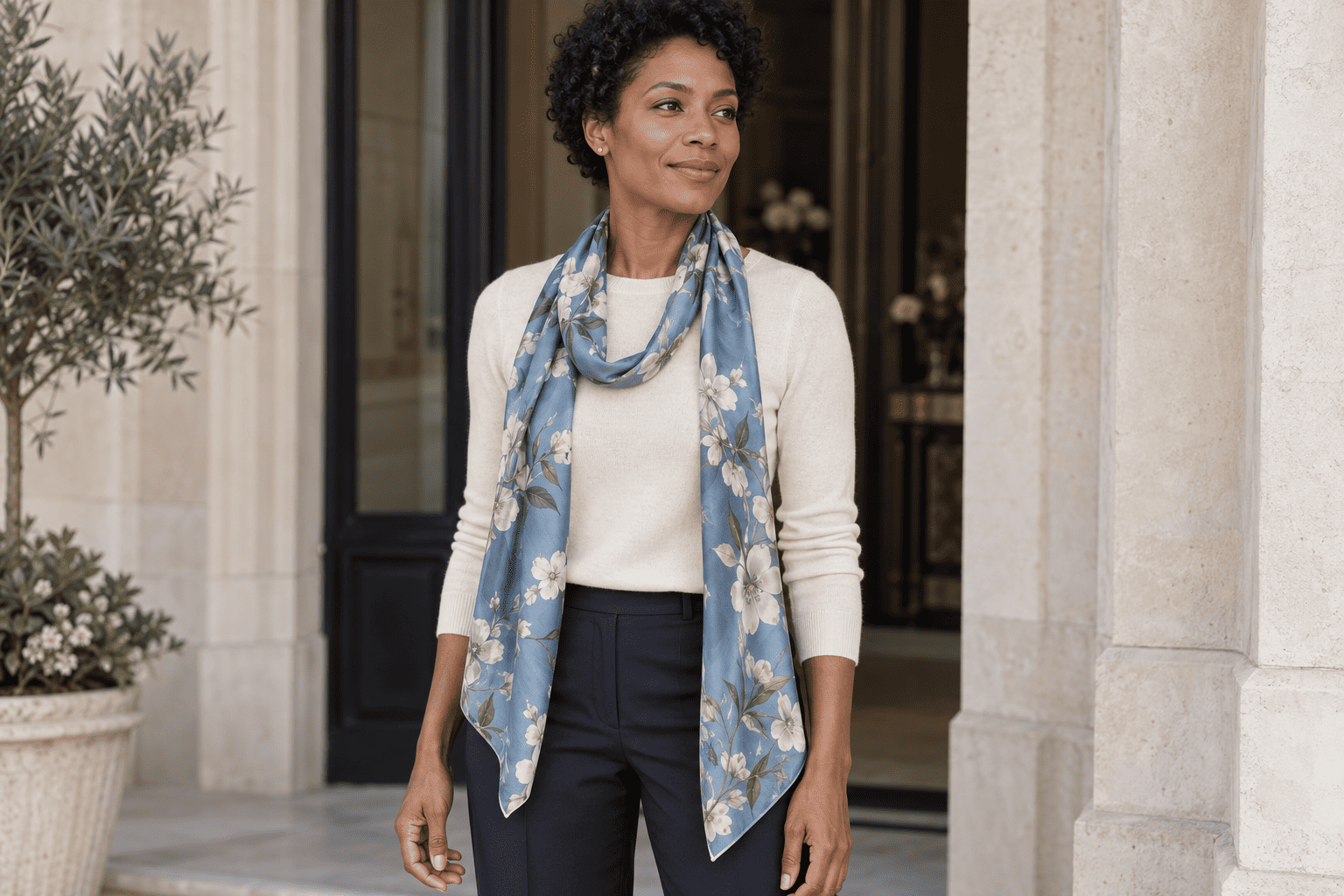
This adds softness around an open coat or a simple crew neckline.
- Drape the folded scarf behind your neck, leaving one end much longer.
- Take the longer end across the front, around the back of your neck and forward again.
- Ease the loop away from your throat and arrange both tails at the front.
Keep the loop airy. If it looks bulky, unfold and refold the band more narrowly, or choose a lighter scarf. A small difference in tail length keeps the finish relaxed.
3. The low front knot
A low knot brings the two ends together without filling the neckline.
- Begin with an open front drape and approximately equal ends.
- Cross one end over the other at upper-chest level.
- Pass that end underneath and through the opening to make one loose overhand knot.
Let the knot rest below the collarbones rather than tightening it against your neck. Pair it with an open shirt or a clean V-neck, leaving enough visible fabric below the knot to show the design.
4. The folded pull-through
A useful choice when you want shorter tails over a jacket.
- Fold the scarf into a long band, then bring its two short ends together.
- Place the doubled scarf behind your neck, with the folded loop on one side and both ends on the other.
- Feed both ends through the folded loop and settle it loosely.
This uses more length than a front drape. If the tails barely emerge, choose another style; pulling harder will not improve the proportions. Lightweight silk usually makes a less bulky pull-through.
5. The one-shoulder toss
Try this for an easy, asymmetric line over a smooth sweater or tailored coat.
- Drape the scarf behind your neck with one end longer than the other.
- Lift the longer end across your chest and lay it over the opposite shoulder.
- Let that end fall down your back while the shorter end remains in front.
Keep the section across your chest soft rather than taut. This is an unsecured drape and may shift as you move; for a busy day, the single loop is more practical.
6. The broad evening wrap
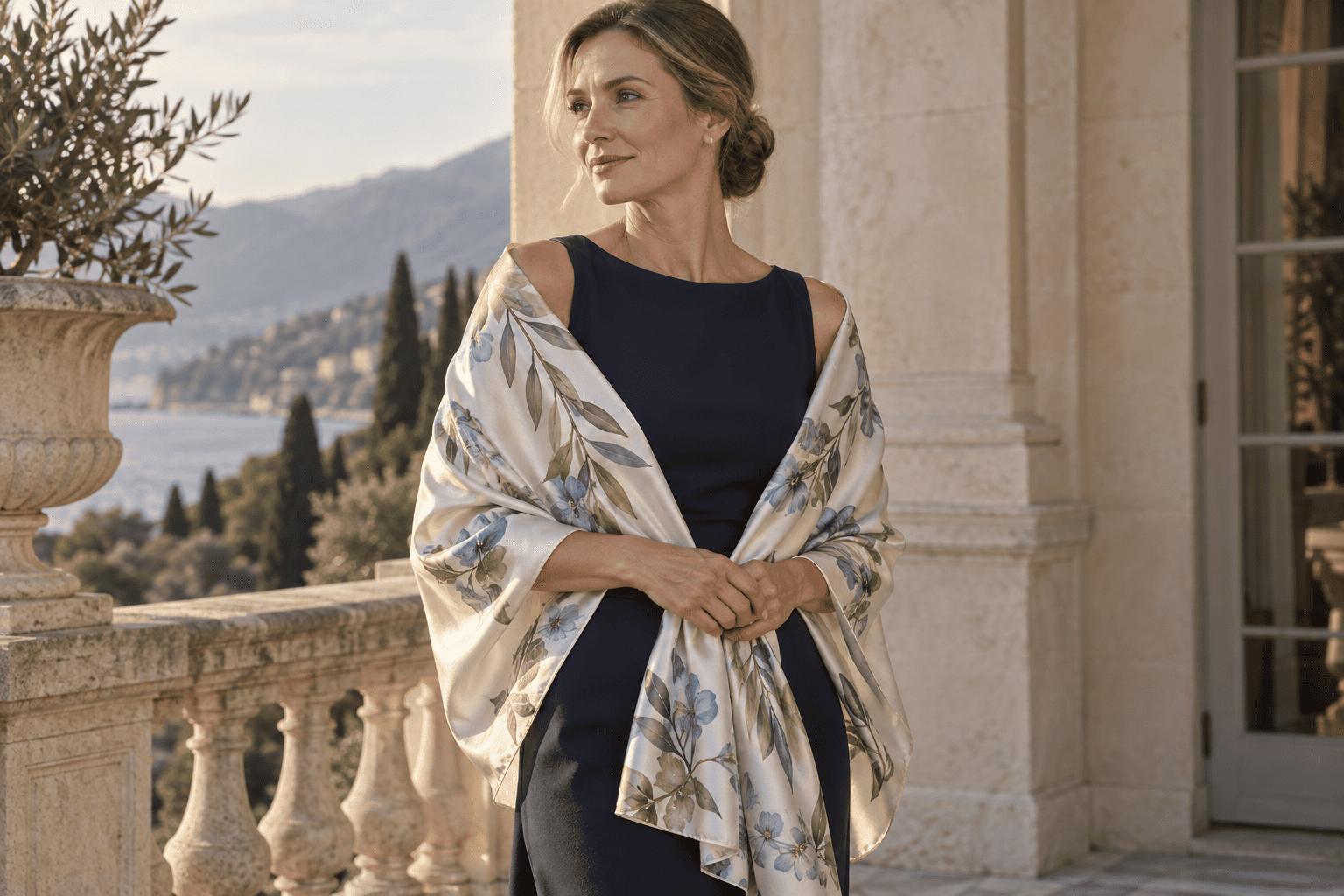
A wide long silk scarf can add light shoulder coverage to a sleeveless dress.
- Open the scarf and centre it across your upper back.
- Bring both ends forward over your upper arms.
- Allow the edges to fall naturally, holding the ends loosely in front if needed.
Leave the fabric broad enough to reveal the composition. Garden Song in Olive’s 60 cm width offers more coverage than a narrow band, although the fit depends on your shoulders. Silk adds a light layer, not the warmth of a winter shawl.
7. The scarf-ring drape
A suitable scarf ring gathers the silk without a conventional knot.
- Arrange a folded scarf around your neck with both ends at the front.
- For a simple single-opening ring, gently feed both ends through together.
- Position the ring below your collarbones and spread the tails slightly.
Follow the accessory’s instructions if its construction differs. Choose smooth edges and an opening large enough for the folded fabric. If the ring slides or requires force, change the accessory or style rather than repeatedly pulling the silk through it.
8. The lightly belted drape
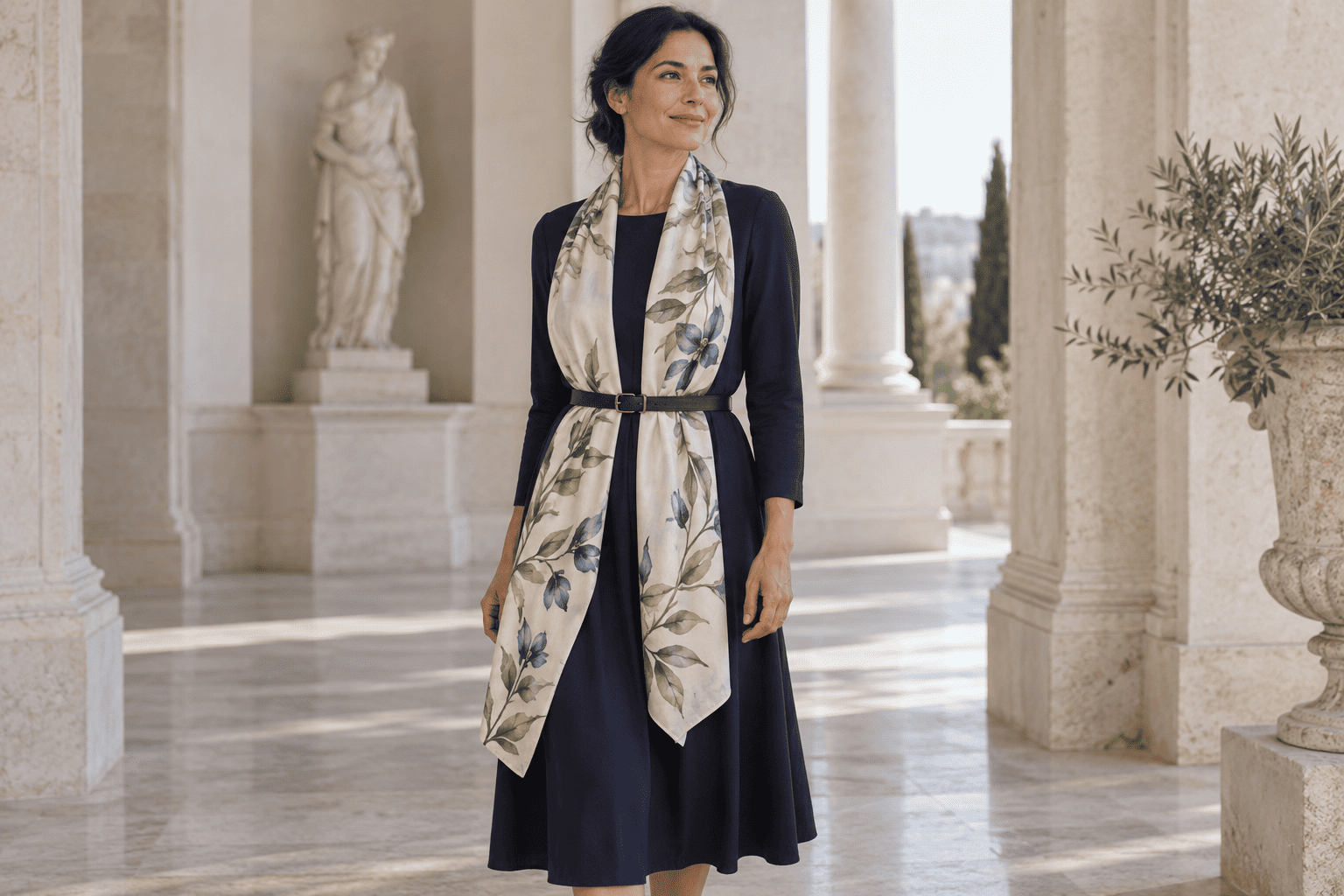
This gives a plain dress or long tunic a more defined silhouette.
- Drape the scarf behind your neck, leaving two broad panels down the front.
- Smooth the panels so the sections you want to display face outward.
- Fasten a smooth belt around your waist over both panels, keeping the scarf’s back section free.
The belt should hold the silk lightly, not clamp it. Lift the belt before repositioning the scarf, and avoid rough edges or exposed hardware. Let the tails hang naturally below the waist.
9. The soft side bow
A loose bow suits a plain blouse when you want a more decorative neckline.
- Fold a lightweight scarf into a narrow band and drape it behind your neck.
- Tie a loose overhand knot slightly to one side.
- Make one loop, wrap the other end around it and draw a second loop through, as when tying a shoelace.
Keep the loops modest and the tails longer. If the bow becomes stiff or oversized, try the low front knot instead. A full-width, heavier scarf may be better suited to draping than bow-making.
10. The relaxed waist sash
Move the colour away from your face by wearing the scarf over a simple dress.
- Fold the scarf lengthwise into a broad, soft band.
- Wrap it around your waist over the garment.
- If there is ample length, tie a relaxed square knot at one side: right over left, then left over right.
Check that you can sit comfortably and that the knot holds without tension. This depends on your waist measurement and the scarf’s length; do not force a short scarf to fit. Treat it as decoration, not a belt supporting trousers.
Make the style work with your outfit
With a detailed collar, choose a low drape or wear the scarf at your waist. With a simple neckline, a loop or bow can become the focal point. For a patterned outfit, reveal one quieter section of the scarf rather than its entire design.
Check the result while standing and sitting. If you prefer shorter tails, try the folded pull-through. If you want to show more of the artwork, choose the evening wrap or belted drape. There is no single correct length on the body.
Keep the silk comfortable and protected
Use gentle folds and avoid snagging hardware. The Canadian Conservation Institute explains that satin’s long surface yarns can be pulled out of alignment, altering its appearance—a useful reason to be careful with rough rings and jewellery.
Apply perfume and cosmetics first and let them dry before dressing the scarf. Untie it after wearing, and follow its individual care label. Our silk-care guide covers handling, cleaning and storage. Keep loose ends away from flames, moving machinery and bicycle wheels.
Find your everyday silk signature
You do not need to master all ten styles. Start with one that suits your usual clothes, then change the fold, visible colour or knot position. Explore Lanting Loom’s long silk scarves for designs you can enjoy both gathered close and opened out: stories woven in silk, worn your own way.
