

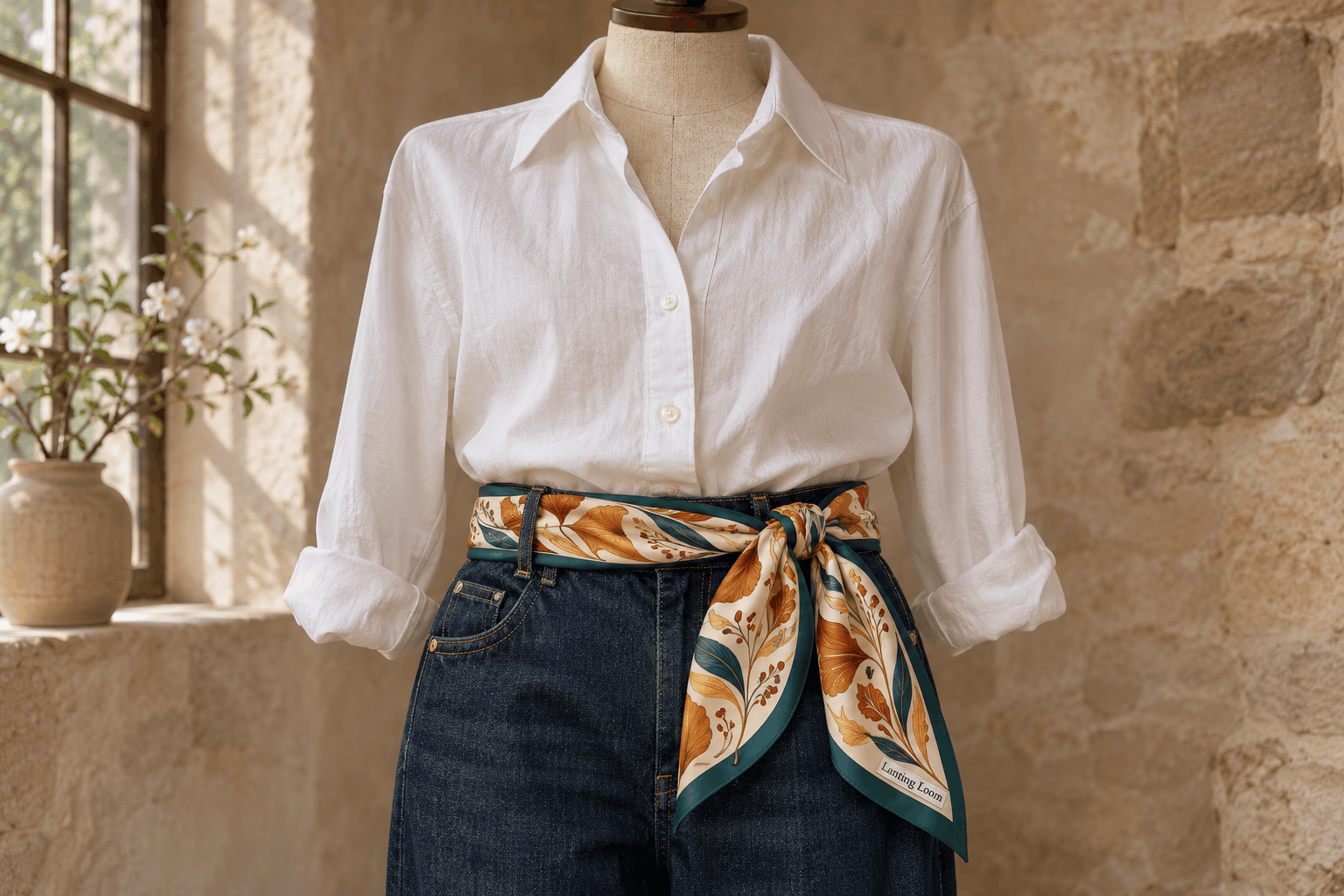
A silk scarf can bring colour, movement and a little softness to the waist of an outfit. Thread it through jeans, tie it around a plain dress or wear it as a loose sash over a long shirt. The effect can be beautifully simple: familiar clothes, finished with an unexpected detail.
The key to wearing a silk scarf as a belt is choosing enough usable length for your outfit and your knot. A scarf that looks generous around the neck may feel surprisingly short around the hips, especially once you allow for folds and hanging ends.
For an easy starting point, measure around your outfit where the scarf will sit, choose a scarf with room left for tying, and finish with a small, flat knot. Treat it as a decorative accessory rather than a belt that needs to hold loose trousers in place.
Can You Wear a Silk Scarf as a Belt?
Yes. A silk scarf can work as a full waist sash, a decorative belt threaded through loops or a small accent tied to one belt loop. The best option depends on its dimensions, the clothes underneath and how much fabric you want to show.
Waist styling is also an established way to wear a square scarf. For example, Hermès includes wearing a scarf around the waist among the styling possibilities for a 90 cm design. However, that does not mean every 90 cm square will fit every wearer or every knot.
For a comfortable result, start with trousers or a dress that already fits well. The scarf should add shape and interest without needing to withstand constant pulling.
What Size Silk Scarf Do You Need for a Belt?
There is no single scarf size that works for everyone. Your waist or hip measurement, the thickness of your clothes, the fold and the knot all affect the length you need.
Measure over the clothes you plan to wear
- Choose the position. Decide whether the scarf will sit at your natural waist, around a dress or through lower trouser loops.
- Measure that route over your outfit. Follow the belt loops if you intend to use them.
- Allow for the knot and tails. A compact knot usually needs less fabric than a bow with generous loops.
- Test before dressing. Use a soft fabric strip of a similar width to try the knot and measure the length it uses.
For example, if the route around your outfit measures 90 cm and your trial knot and tails use another 50 cm, you would need approximately 140 cm of usable length. This is an illustration, not a universal sizing rule: your preferred finish may need more or less.
Understand the difference between scarf dimensions and usable length
A square scarf folded diagonally can provide more length than its side measurement suggests. However, its narrow tips, folded bulk and the fabric used in the knot reduce the length available for a comfortable belt.
| Scarf dimensions | Approximate length before tying | How to assess it |
|---|---|---|
| 63 × 63 cm square | 89 cm along the diagonal | Often more useful as a belt-loop accent; check carefully before planning a full waist tie. |
| 88 × 88 cm square | 124 cm along the diagonal | May work for a compact waist knot if your measured route leaves enough fabric. |
| 90 × 90 cm square | 127 cm along the diagonal | Check the finished folded length rather than relying on the size label alone. |
| 110 × 110 cm square | 156 cm along the diagonal | Offers more potential tying length, but also creates a thicker folded band. |
| 175–200 cm long scarf | Its stated length, before tying | Can offer room for longer tails or a bow; check whether its folded width suits the outfit. |
These are general size examples, not a list of Lanting Loom stock sizes. Square-scarf diagonal measurements are rounded geometric lengths, not guaranteed wearable belt lengths.
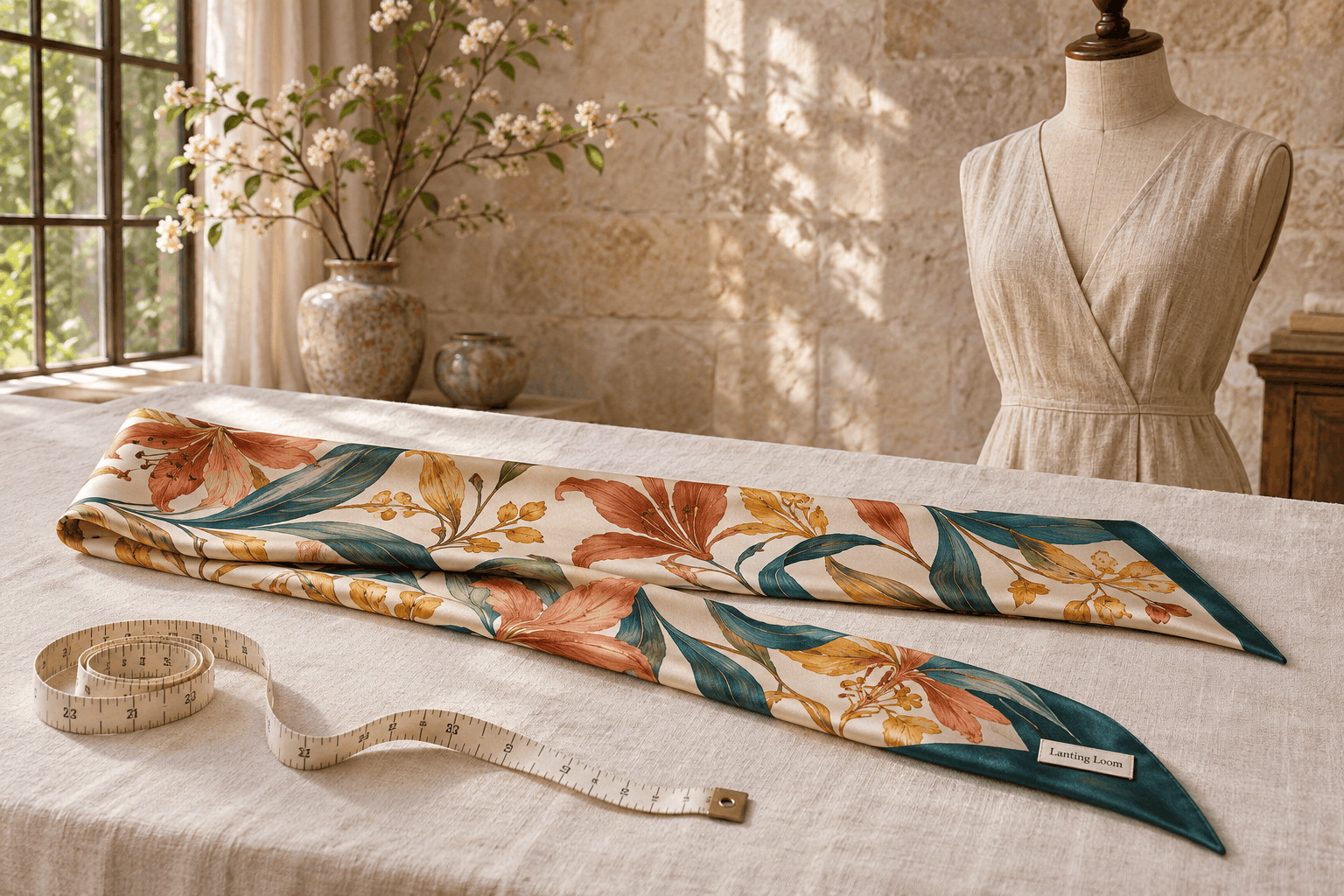
How to Fold a Silk Scarf into a Belt
For a square scarf
- Lay the scarf on a clean, smooth surface.
- Fold it diagonally into a triangle.
- Fold the triangle’s point towards the long folded edge, then continue folding into a band.
- Adjust the band’s width to suit your belt loops or the sash effect you want.
- Smooth the layers gently and measure the finished length without stretching the silk.
Check which colours and motifs sit on the outside before threading the scarf. Changing the direction of the fold can reveal a contrasting border or make the pattern feel quieter.
For a long rectangular scarf
Fold lengthways until the scarf forms a band that lies comfortably against your outfit. A broad sash can look lovely over a dress, while trouser loops usually need something narrower.
Remember that making a wide scarf narrower also makes it thicker. If it will not pass easily through a loop, choose another scarf or wear it over clothing without loops.
Three Ways to Tie a Silk Scarf as a Belt
1. A small square knot
A square knot is a useful starting point when you want two short tails and a relatively flat finish.
- Wrap the scarf around your waist or thread it gently through smooth belt loops.
- Adjust the ends so they are approximately even.
- Cross the right end over the left and pass it underneath.
- Cross the left end over the right and pass it underneath again.
- Ease the knot into shape, leaving comfortable room around your waist.
Move the knot slightly off-centre if you prefer an informal finish. Silk can loosen as you move, so check the knot after sitting and walking. If the ends barely reach, switch to a longer scarf instead of pulling harder.
2. A soft side bow
A bow suits a plain shirt dress or a simple skirt, particularly when there is enough fabric for modest loops and visible tails.
- Wrap the folded scarf around your waist and cross the ends once.
- Make a loop with one end.
- Wrap the other end around the loop and draw a second loop through, as you would when tying a shoelace.
- Adjust the loops gradually and arrange the tails.
Keep the bow in proportion to the outfit. If it becomes bulky or leaves very short tails, a small knot may look cleaner.
3. A belt-loop accent for a shorter scarf
A scarf does not have to go all the way around your waist to add colour. Fold a smaller scarf into a narrow band, pass one end through a smooth front or side belt loop and tie the ends together loosely.
Let the tails sit against the trousers, keeping them clear of the floor and anything they could catch on. This is also a useful option when you want to wear a conventional belt for support.
Outfit Ideas for a Silk Scarf Belt
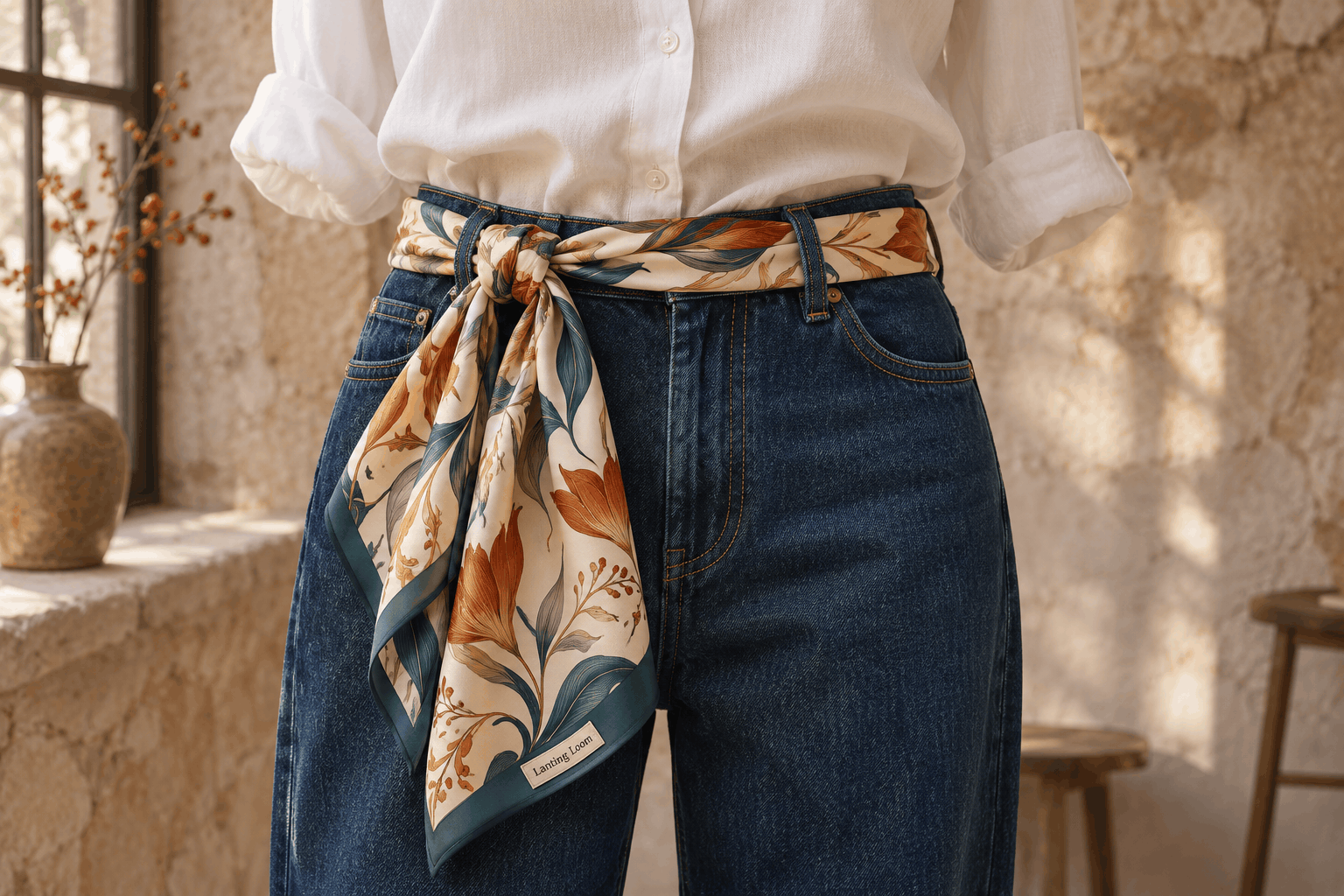
Jeans and a white shirt
Start with jeans that fit securely and tuck in a white shirt enough to reveal the waistband. Add a folded scarf through the loops, finishing with a small knot near the front.
The plain shirt gives the print room to stand out. Choose one colour from the scarf for another accessory if you want a connection between the pieces, but there is no need to match everything.
Inspect denim loops and rivets before threading delicate silk through them. Be particularly careful with new or dark denim that may transfer colour.
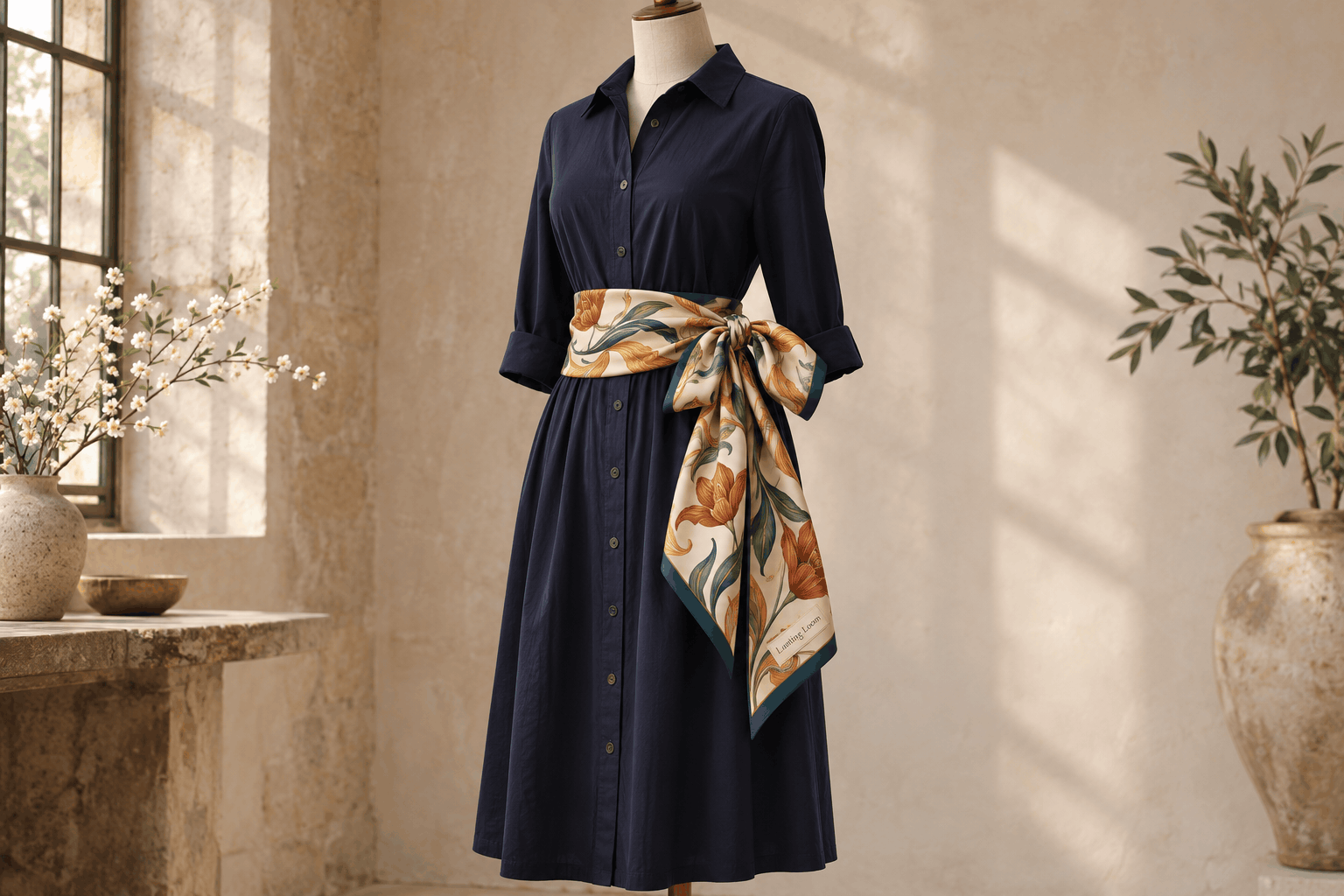
A plain shirt dress
A scarf sash can soften the waist of a shirt dress and change its mood without adding much weight. Wear a broader fold over the dress, with a knot or bow slightly to one side.
If the dress has a removable belt, try replacing it with the scarf. Navy, charcoal and other plain colours provide a calm background for a more expressive print.
Tailored trousers and a simple top
Choose a narrow, tidy fold and a compact knot. Shorter tails can sit neatly against the front of the trousers, particularly when the top is tucked in.
Check the belt-loop openings first. If the scarf bunches or catches, wear it with a different outfit rather than forcing it through.
A skirt and lightweight knit
Wear the scarf around the waistband of a skirt, with a fine knit tucked in or lightly bloused above it. A flat knot gives a defined finish without making the waist feel crowded.
If the skirt has no loops, check how the scarf behaves as you move. Smooth fabrics may allow it to shift; a loosely tied sash will not stay in exactly the same position on every outfit.
A long shirt or tunic
Wrap a scarf over a long shirt to suggest a waist without creating a sharply cinched silhouette. A broad band and small side knot can look relaxed and deliberate.
Leave enough ease to sit comfortably. If the shirt pulls or gathers heavily around the scarf, loosen it or try a different position.
How to Keep a Scarf Belt Comfortable and Protect the Silk
- Check contact points. Avoid rough loops, sharp buckles, exposed zips and jewellery that could snag the fabric.
- Keep the tension gentle. The scarf should decorate the waist without bearing the strain of holding up trousers.
- Try sitting before leaving. Check that the knot remains comfortable and the tails stay clear of anything they might catch on.
- Avoid improvised fasteners. Safety pins and sharp clips can damage silk; adhesives may leave residue.
- Untie after wearing. Ease the knot apart rather than pulling one end hard through it.
- Follow the care label. Do not assume every silk scarf can be washed at home.
For more guidance on handling, storing and cleaning your scarf, read our silk care guide.
Frequently Asked Questions
Is a 90 cm silk scarf long enough to wear as a belt?
It depends on your measurement over clothing and the knot you want. A 90 cm square has a diagonal of approximately 127 cm, but its practical tying length is affected by the fold and tapered ends. Measure the folded scarf and test the fit before planning the outfit.
Can I use a twilly as a belt?
Only if its actual length allows a comfortable wrap and secure tie. Twilly dimensions vary. A shorter design can work well tied to one belt loop as an accent.
Should I wear the knot in the middle or at the side?
Either works. A centred knot creates a more symmetrical finish, while a slightly off-centre knot can feel relaxed. Choose the position that sits comfortably and does not interfere with pockets or fastening details.
What if my scarf is too short?
Choose a longer scarf or use it as a belt-loop accent. Avoid stretching the silk or tying a knot so close to the tips that it repeatedly comes undone.
Can a silk scarf replace a normal belt?
It can replace the decorative role of a belt when your clothes already fit securely. For trousers that need firm support, use a conventional belt and wear the scarf as an additional accent.
Choose the Scarf Around the Outfit
The most useful scarf belt is one you can tie comfortably, move in easily and enjoy wearing. Start with the clothes, measure the route around them and choose a fold that shows the colours you love.
Explore Lanting Loom’s silk scarves for contemporary prints that bring a considered detail to everyday dressing. Check each design’s dimensions before choosing it for waist styling.
