

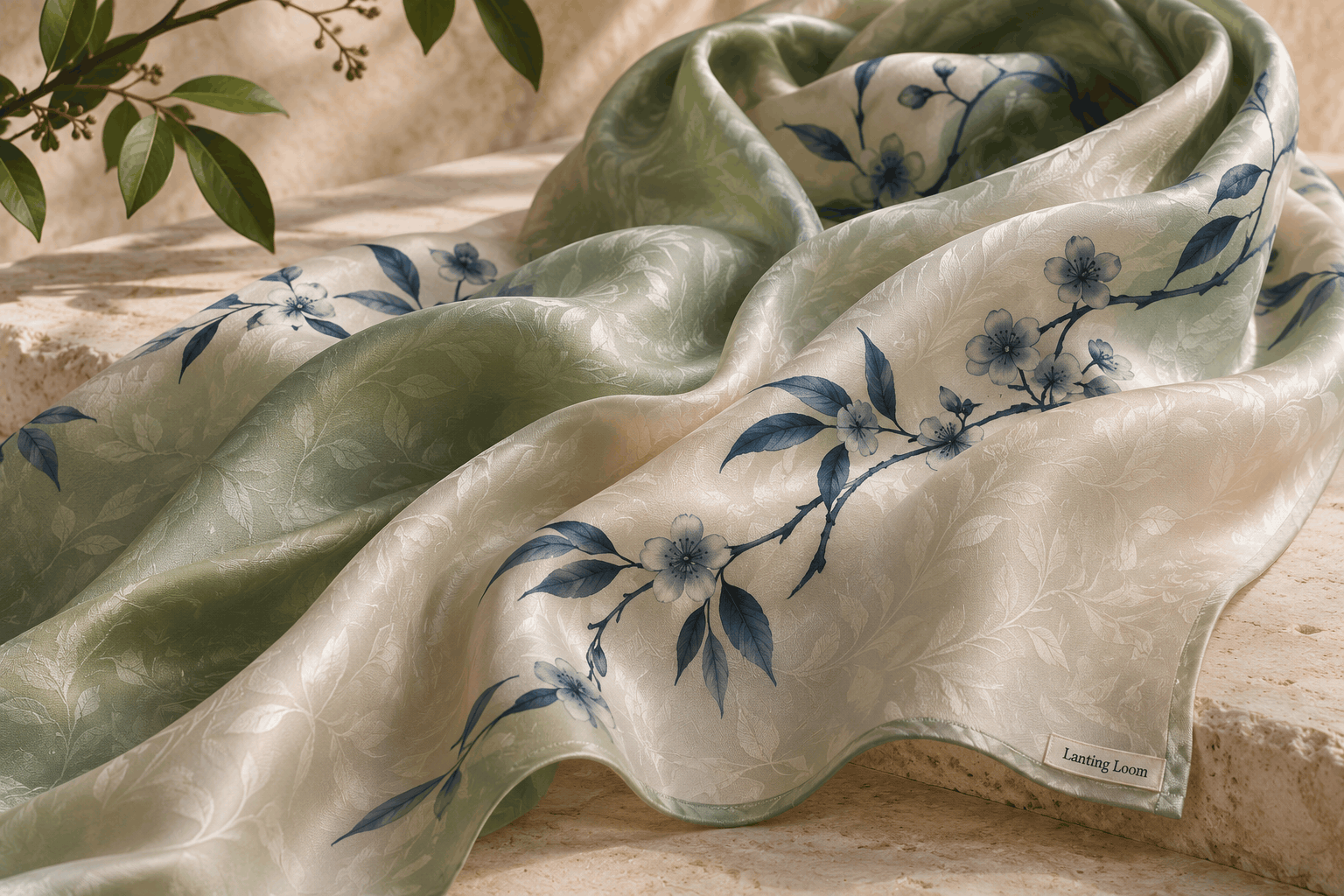
A silk scarf can reveal more than one kind of pattern. From a distance, you might notice blue flowers or flowing coloured lines. Closer up, a quieter motif may appear in the fabric itself, becoming more visible as the light changes.
This can make product descriptions confusing. Is the scarf jacquard or printed? Can it be both? And which detail tells you most about its quality?
Yes, a silk scarf can be both jacquard and printed. Jacquard describes patterning created during weaving, while printing adds a design to the fabric. A woven jacquard base can therefore carry printed artwork as well.
The two terms describe different aspects of production. Understanding that distinction makes it easier to compare scarves and appreciate how their designs are made.
What Is Silk Jacquard?
Silk jacquard is silk fabric with a pattern created through controlled weaving. The arrangement of threads forms the motif as the cloth is made, rather than the motif being added only through printing afterwards.
Jacquard equipment enables complex woven designs. The National Museums Scotland guide to the Jacquard loom explains how the mechanism allowed intricate patterns to be produced in woven textiles.
On a scarf, this patterning might appear as leaves, geometric shapes, lettering or a subtle repeating motif. It can cover the fabric or be confined to a particular area, such as a decorative band.
Does jacquard always look raised?
No. Some jacquards have noticeable texture, but others are quite smooth. A tone-on-tone pattern may become visible mainly through differences in how the woven areas reflect light.
You do not need a thick or heavily raised surface for a fabric to have jacquard patterning.
Does jacquard mean pure silk?
No. Jacquard patterning can be made using different fibres and blends. “Silk jacquard” identifies silk as part of the material description, but you should still check the stated fibre percentages.
The word “jacquard” alone does not establish fibre content, fabric weight or production origin.
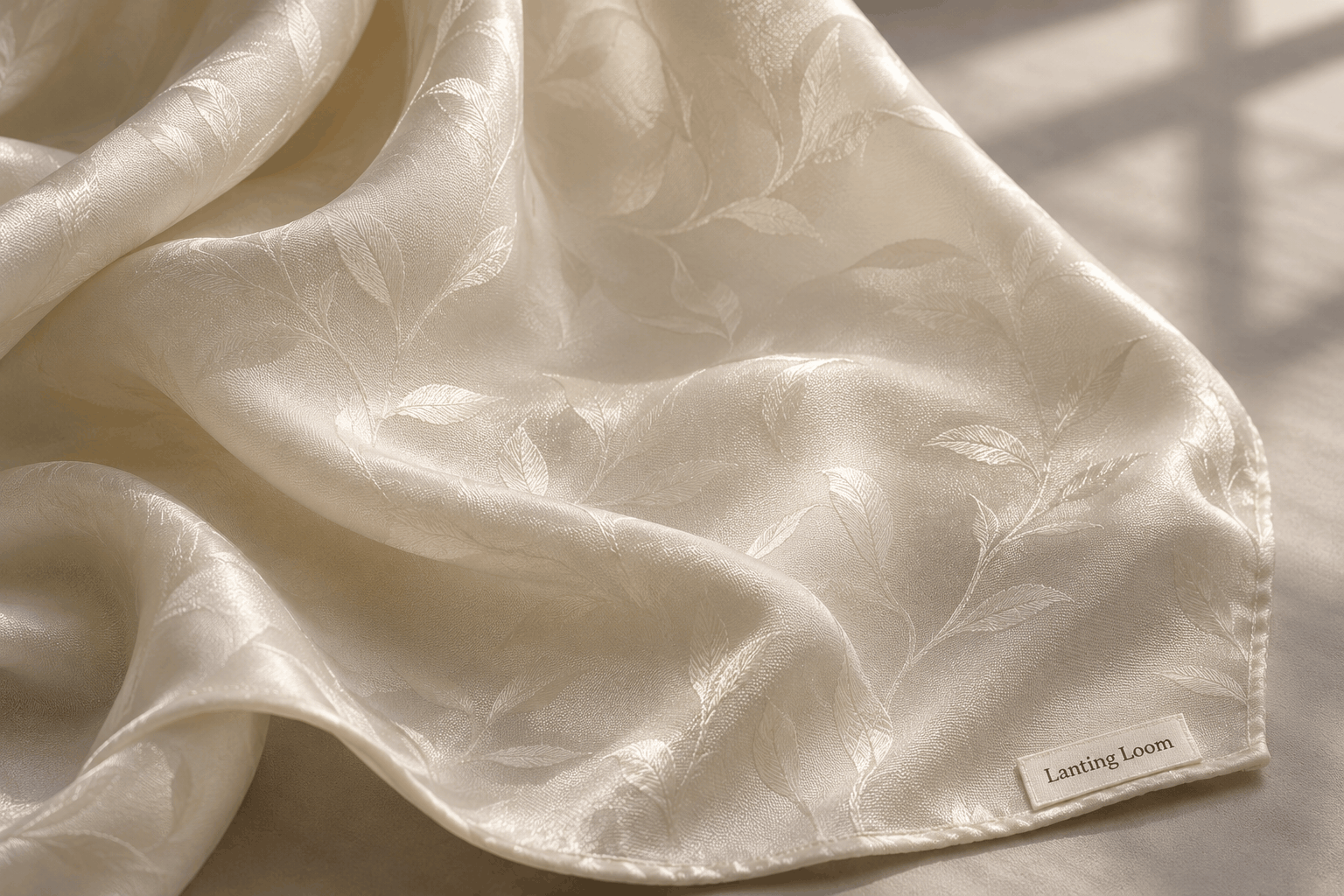
What Is Printed Silk?
Printed silk is silk fabric decorated through a printing process. The fabric already has its own weave, and the printed design adds colour, lines, motifs or imagery.
Printing can be applied to different silk fabrics, including twill, satin and suitable jacquard bases. A printed scarf is therefore still a woven textile; the distinction concerns how its decorative design is created.
Digital printing and screen printing are examples of printing methods. The term “printed silk” does not specify which method was used, whether the artwork was printed on one or both faces, or how the edges were finished.
A clear product description should separate those details rather than expecting one term to explain the whole scarf.
How Can a Scarf Be Both Jacquard and Printed?
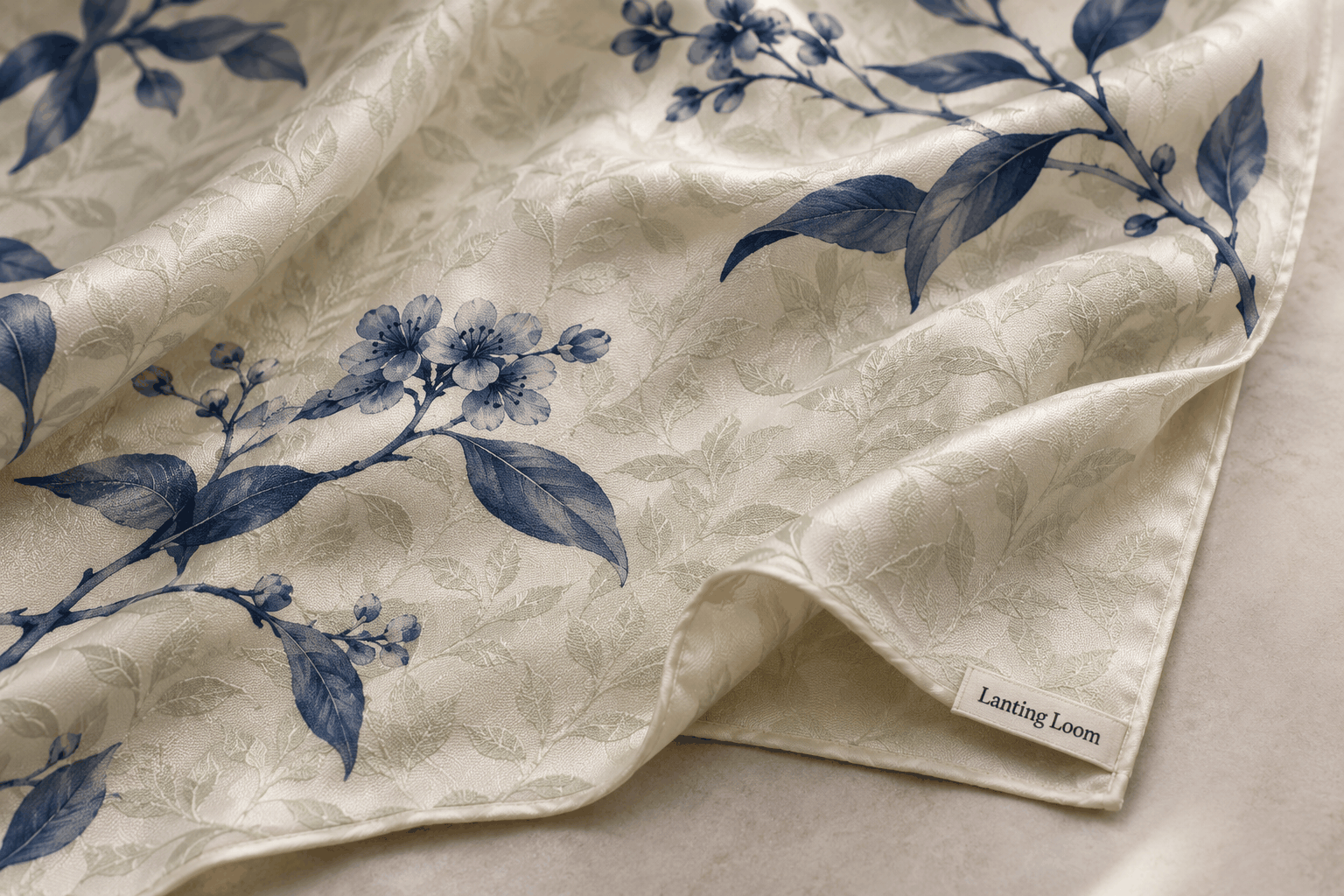
The fabric can first be woven with a jacquard pattern, then printed with a second design. This combines woven structure with printed colour and imagery in the same textile.
For example, imagine a silk base with a small tonal leaf repeat. A larger blue botanical design could be printed across it. The blue branches might be the first thing you notice, while the woven leaves emerge more quietly as the scarf moves.
The printed artwork does not have to trace the woven motif. The two patterns may align deliberately, contrast in scale or remain visually independent.
The jacquard detail may cover only part of the scarf
A scarf can also combine printed areas with a woven jacquard band or signature detail. That does not necessarily mean its entire surface has an all-over jacquard pattern.
When reading a description, distinguish between “printed silk jacquard” and “printed silk with a jacquard band.” Both can combine the techniques, but they describe different design arrangements.
Silk Jacquard vs Printed Silk at a Glance
| Detail | Jacquard patterning | Printed design | Printed silk jacquard |
|---|---|---|---|
| How the pattern is created | Through the arrangement of threads during weaving. | Through a printing process applied to fabric. | Through both patterned weaving and printing. |
| Typical visual interest | Woven motifs, texture or changing light reflection. | Colour, line, imagery and graphic detail. | The interaction of woven motifs and printed artwork. |
| Surface feel | May be smooth or more textured. | Depends on the base fabric and printing finish. | Depends on the woven base and subsequent finishing. |
| Reverse appearance | May show a related pattern with a different structure or sheen. | Depends on print penetration and whether both faces are printed. | Must be assessed for both weave and print. |
| Weight | Not determined by the term alone. | Not determined by the term alone. | Not automatically heavy or double-layered. |
| Quality | Depends on materials and execution. | Depends on materials and execution. | Combining techniques does not automatically guarantee better quality. |
How to Read a Silk Scarf Description
A useful description answers several separate questions.
- Fibre: what is the scarf made from, and in what proportions?
- Fabric construction: is it twill, satin, jacquard-patterned fabric or another construction?
- Decoration: is the design woven, printed, embroidered or a combination?
- Printed faces: is printing applied to one side or both?
- Edge finishing: how are the hems made and secured?
- Dimensions and care: will the scarf suit your styling plans and care routine?
These descriptions can overlap without contradicting one another. For instance, “silk jacquard with printed artwork and hand-stitched hems” identifies the material, pattern construction, decoration and edge finishing separately.
However, each claim should be supported by the specifications for that particular product.
Can You Tell the Difference from a Photograph?
Sometimes a photograph provides useful clues, but it may not establish the construction reliably. Fine woven motifs can disappear under flat lighting, while printed shading can imitate the appearance of texture.
Look at the fabric in changing light
A short video can reveal a tonal pattern as the scarf is tilted. Ask for a close-up in which the fabric moves gently, rather than relying only on a brightly lit flat image.
Changing sheen is a clue, not proof: different textile finishes can also affect reflection.
Ask to see both faces
The reverse may help show how a woven motif relates to the fabric structure. It may also reveal a paler printed design, different colours or visible yarn floats.
Do not assume that every jacquard is identical on both sides or intended to be worn reversibly.
Confirm which details are woven
Ask the seller to identify the woven motif and the printed artwork. This is particularly useful when a product has an all-over print but only a small jacquard band.
For an online purchase, a clear written specification is more useful than guessing from the surface appearance.
Is Jacquard Better Than Printed Silk?
Neither category is automatically better. They offer different ways to create visual interest, and both depend on the quality of the fabric and production.
A tonal jacquard may appeal if you enjoy subtle detail that reveals itself through movement. A printed scarf may appeal if colour and illustrated artwork are your main priorities. A printed jacquard can combine those effects when the two patterns work well together.
Judge the finished scarf rather than the number of techniques listed in its description. Consider whether the design feels balanced, the fabric drapes comfortably and the edges are neatly finished.
Likewise, jacquard is not automatically handwoven, and printing is not automatically hand painting. A heritage-inspired motif does not establish the use of a traditional production method.
How the Difference Affects Styling
For understated outfits
A tonal woven motif can add interest to a plain shirt, knit or dress without introducing a strong colour contrast. Try it in natural light to see how noticeable the pattern becomes.
For a clear colour accent
A printed design can connect with a colour already present in your wardrobe or become the main accent in a neutral outfit. Check the scarf folded as well as open: a large composition may look very different in a narrow neck tie.
For layered visual detail
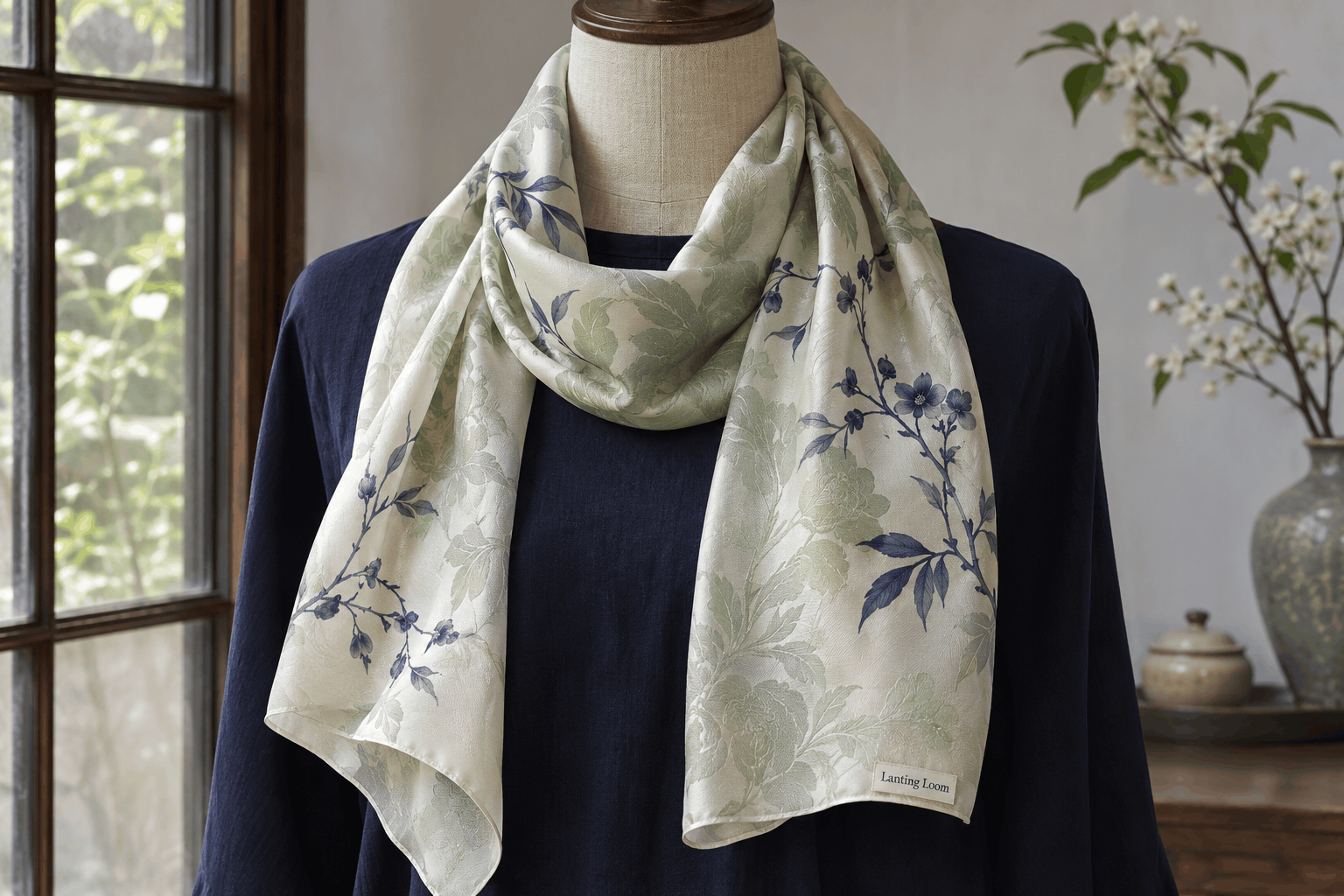
A printed jacquard can reward closer viewing, with the print visible first and the woven pattern appearing as the fabric moves. A simple outfit gives both elements space to be appreciated.
Do not assume that jacquard will always form a larger knot or feel warmer. Choose according to the actual scarf’s dimensions, weight and flexibility.
Questions to Ask Before Buying
- What is the exact fibre composition?
- Is the jacquard pattern woven throughout the scarf or limited to a band?
- Which visible elements are printed?
- Is the print applied to one face or both?
- Can I see close-ups of both sides and a short drape video?
- What are the dimensions, hem finish and care instructions?
If a listing uses phrases such as “jacquard effect” or “jacquard-inspired print,” ask whether there is any actual woven patterning. Those phrases may describe the appearance of the artwork rather than the construction of the cloth.
How to Care for Silk Jacquard and Printed Silk
Follow the care label for the individual scarf. Neither jacquard construction nor a printed design tells you, on its own, whether home washing is appropriate.
Keep delicate fabric away from rough jewellery, hook-and-loop fasteners and sharp bag hardware. Where yarn floats are exposed, take particular care to avoid catching them; do not pull or cut a snagged thread.
Untie the scarf gently after wearing and store it clean and dry. Check the label before pressing or steaming, rather than applying heat to make the fabric appear smoother.
For general guidance, read our silk care guide.
Frequently Asked Questions
Can silk jacquard be printed?
Yes. Suitable jacquard fabric can be printed after weaving, combining a structural pattern with applied artwork.
Is jacquard the same as embroidery?
No. A jacquard motif is formed during weaving. Embroidery adds decorative stitching to an existing fabric. A scarf can combine techniques, but the terms should not be used interchangeably.
Is jacquard the same as satin?
No. Satin describes a weave structure, while Jacquard refers to a method of controlling patterned weaving. A jacquard design can incorporate satin-woven areas, so the terms are not necessarily mutually exclusive.
Does jacquard mean the scarf is double-sided?
No. A woven motif may be visible from both faces, but that does not mean the scarf has been printed on both sides or designed to look identical when reversed.
Is printed silk jacquard always more expensive?
No universal rule applies. Combining techniques can add production work, but fibre, fabric weight, artwork, finishing, quantity and retail costs also affect the price.
Does a woven pattern prove that a scarf is pure silk?
No. Jacquard patterning can be produced in many fibres. Check the composition label and product specifications.
Choose the Design and Understand the Construction
Silk jacquard and printed silk describe different aspects of a scarf, and one piece can combine both. The pleasure may come from a quiet woven motif, expressive printed artwork or the way the two interact.
Explore Lanting Loom’s silk scarves with those distinctions in mind. Check each design’s specifications, choose dimensions that suit the way you dress and ask for clarification whenever a production detail is unclear.
