

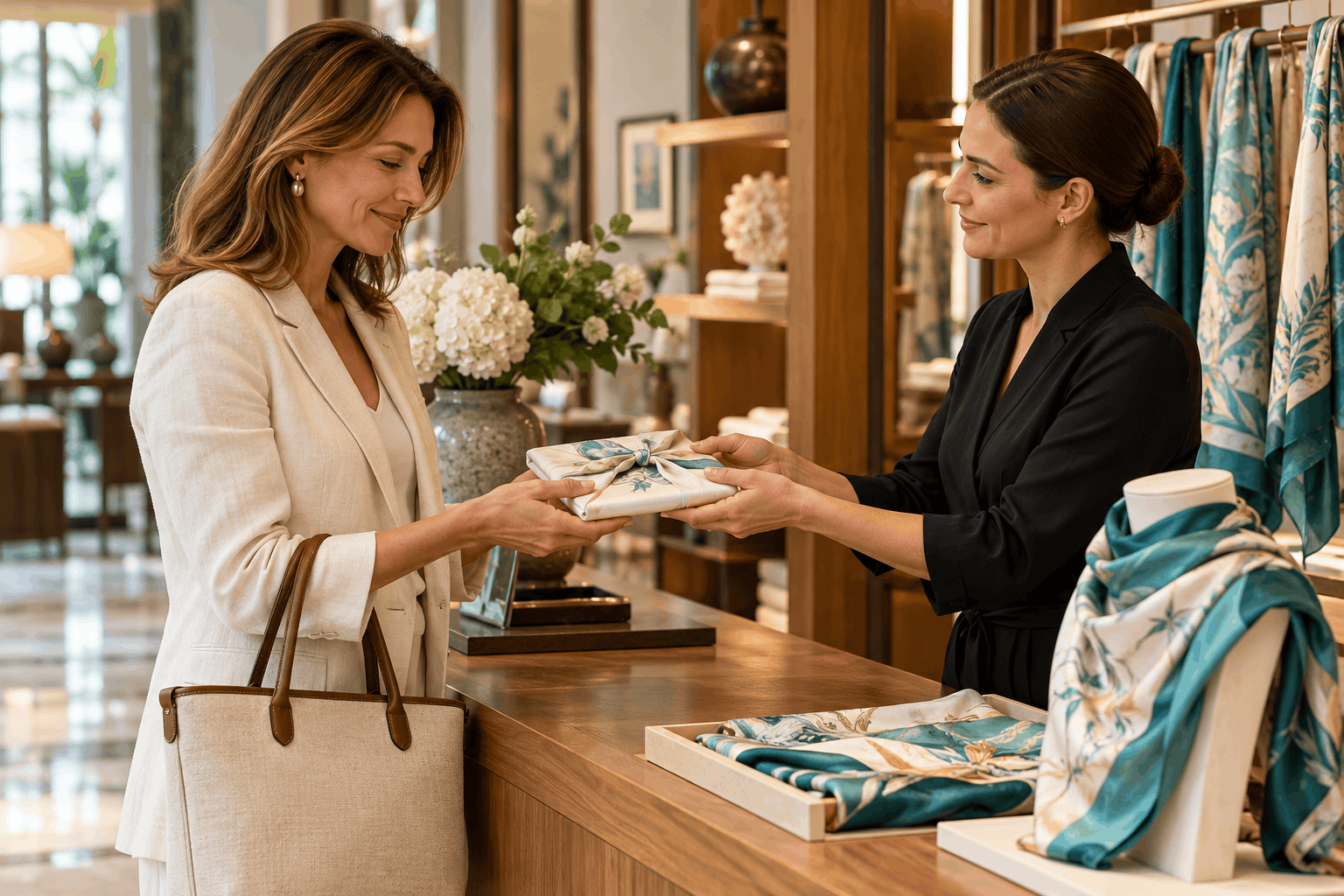
A scarf in a luxury hotel boutique has to earn its place. It should appeal to the guest as an accessory, fit the property’s atmosphere and be easy to take home. A beautiful display is only the beginning.
When buying silk scarves for luxury hotel boutiques, assess guest demand, wearable design, product quality, the full buying cost and repeat availability together. A destination story can strengthen the offer, but the scarf still needs to be something a guest wants to wear or give.
This guide focuses on scarves purchased for retail sale. Complimentary suite gifts, event gifts and staff accessories need their own quantities, budgets and specifications.
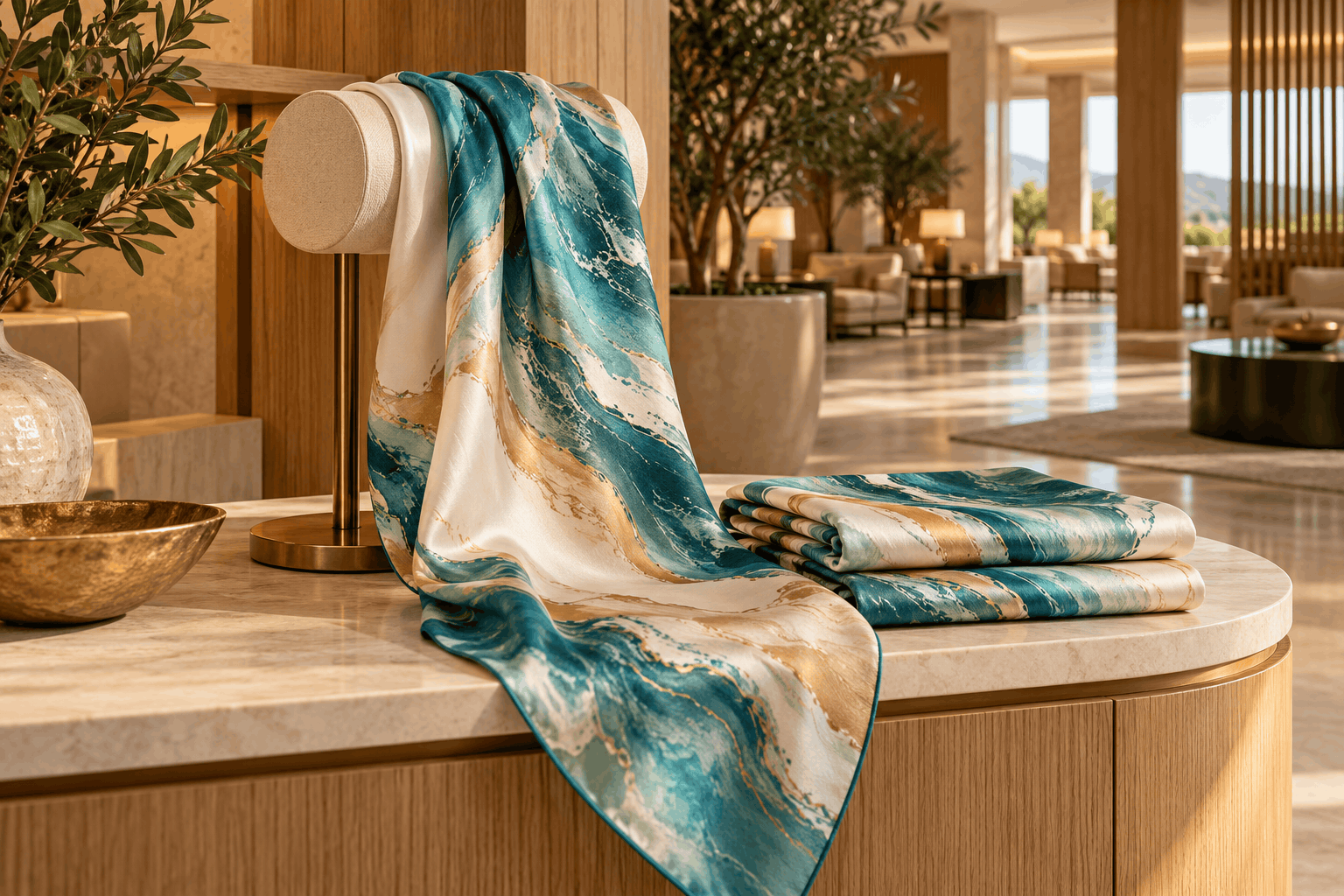
Why silk scarves can fit hotel retail
A scarf offers several possibilities within a hotel boutique: a personal purchase during a stay, a gift to take home or a reminder of a destination. It also avoids the broad clothing-size assortment required by fitted garments, although dimensions remain important for styling.
There are established examples of scarves within hospitality retail. Mandarin Oriental’s shop presents a Jim Thompson silk scarf associated with its Bangkok property, while Aman Essentials includes silk scarves within its branded accessories offering. These illustrate different approaches; they are not evidence of demand at every hotel or affiliations with Lanting Loom.
The useful buying question is specific: what would make a guest at your property choose this scarf at this price?
1. Identify the purchase occasion before selecting designs
Start with your boutique’s customers and existing sales, rather than a general assumption about luxury travellers. Ask staff what guests look for, what they struggle to find and which accessories already attract interest.
- A purchase to wear during the stay: prioritise approachable styling, suitable dimensions and colours that work with travel wardrobes.
- A gift to take home: make the material, story, price and presentation easy to understand.
- A destination keepsake: give the design a credible connection to the place.
- A repeat or post-stay purchase: provide a clear way to identify the design and ask about future availability.
Consider whether your visitors are mainly short-stay business guests, leisure travellers, local shoppers or a changing mix. Avoid treating nationality or age as a reliable substitute for observed buying behaviour.
2. Choose between an existing collection and bespoke design
An existing collection can provide a starting point for testing the category. Evaluate the supplier’s designs, available stock, retail terms and reorder arrangements before committing.
Adapted presentation may add a hotel story card or sleeve while leaving the scarf unchanged. Be clear about that distinction in the product description.
A bespoke collection may be appropriate when the property has a strong design source and a budget for development. A garden, architectural rhythm or coastal colour palette could inform original artwork. Lanting Loom’s bespoke scarf service sets out the information needed to explore that route.
If exclusivity matters, define the design or colourway, duration and sales channels covered in the agreement. A custom box does not automatically make its contents exclusive.
3. Make the destination connection desirable to wear
A hotel’s identity can appear through colour, pattern and composition without requiring a prominent logo. Look for references that a guest can appreciate even after the holiday memory becomes less immediate.
For example, a coastal property might explore the movement of water, while a city hotel might use the geometry of its architecture. These are design directions, not claims that any particular motif is locally traditional.
Keep provenance accurate. A scarf inspired by a destination is not necessarily made there. State the actual material and origin, and obtain approval for any supplied artwork or brand assets before use.
Lanting Loom’s design stories explain how cultural and visual sources can inform a contemporary composition.
4. Build a small assortment with clear roles
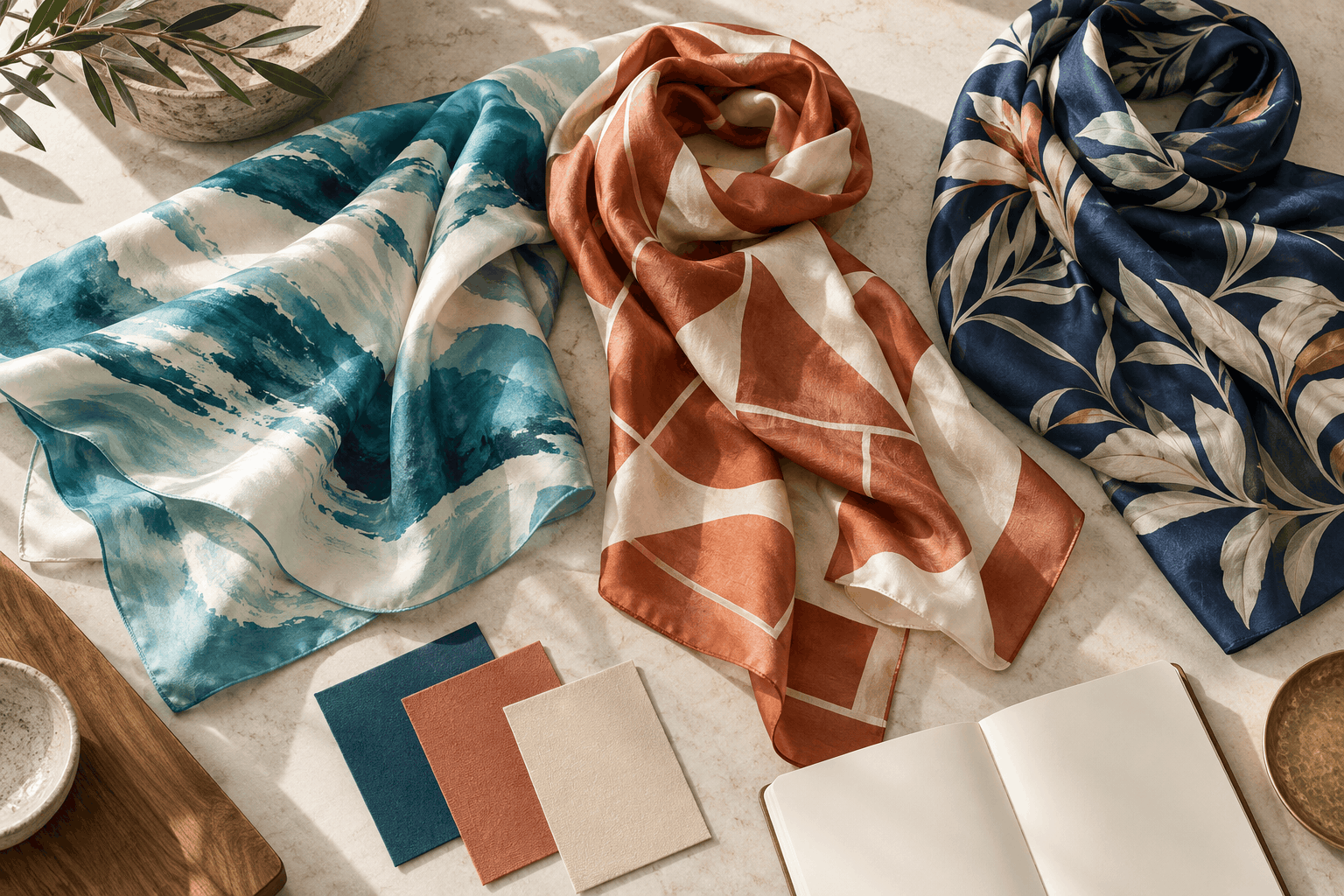
For a first purchase, consider a focused selection rather than multiple overlapping prints. One understated option, one more expressive design and a distinctive property-inspired piece could form a test range if each has a clear customer purpose.
That is an illustrative buying approach, not a recommended minimum order. The appropriate range depends on your budget, display space and supplier terms.
Compare square scarves and long scarves according to the styling you can demonstrate. A compact neck accent and a generous drape answer different needs; buying both only helps if guests understand the distinction.
Confirm minimums per design, colourway and size. Adding variants increases the stock you must display, store and replenish, even when the overall collection looks small.
5. Evaluate quality through a finished sample
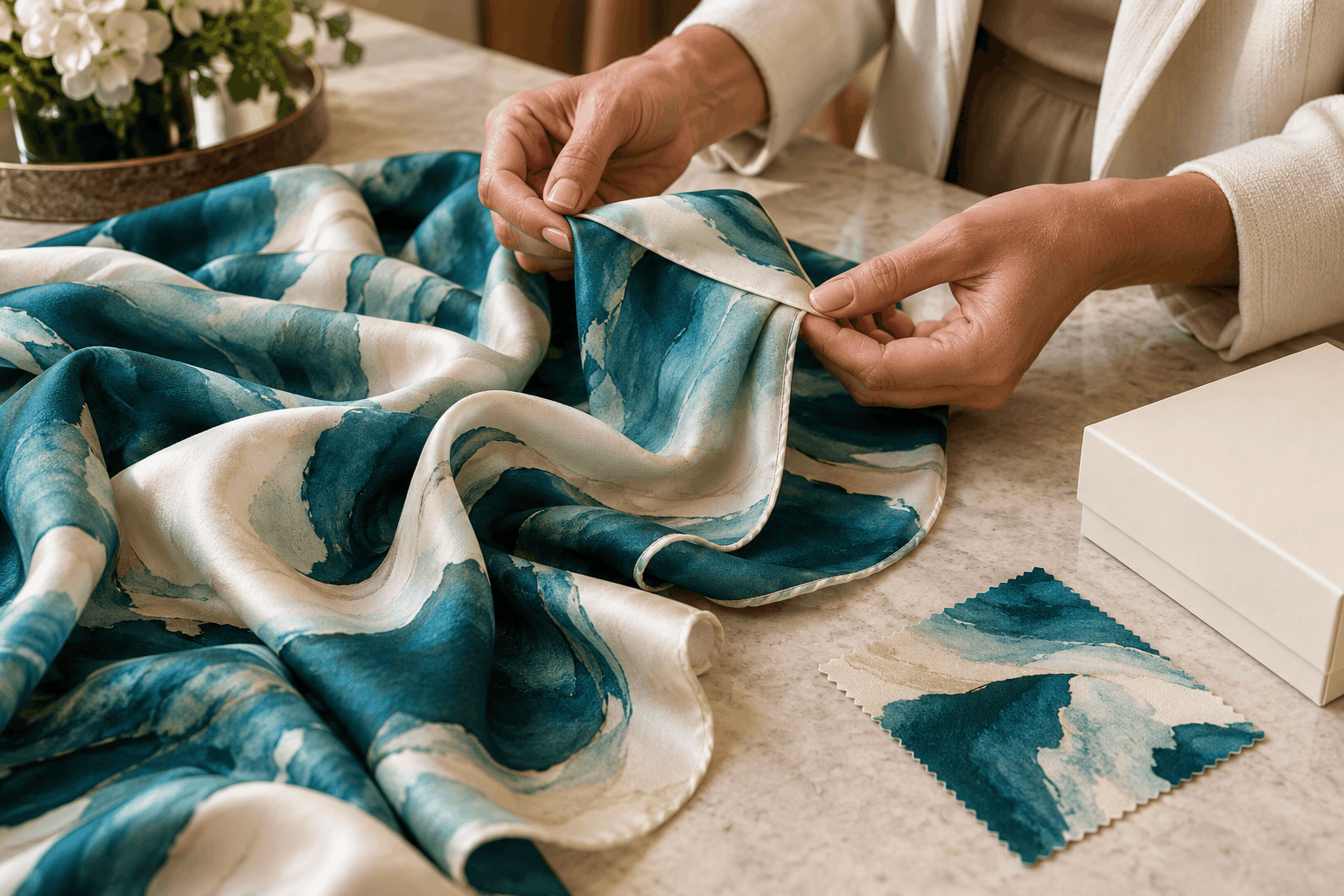
Ask for the specification and a representative finished sample before approving a significant order. Words such as “luxury” and “silky” do not replace fibre composition, dimensions, construction and care information.
Review the sample in the boutique as well as at the buying desk:
- Material and handle: does the fabric feel appropriate for the intended price and use?
- Print: are details clear, colours consistent with the approved reference and the reverse appearance acceptable?
- Finish: are the edges, corners and labels neatly completed?
- Wearability: does the design work folded and tied, as well as opened flat?
- Presentation: can staff unpack, demonstrate and repack it without difficulty?
Agree dimensional tolerances, relevant quality checks and the process for reporting defects. Keep an approved reference sample for comparison when the order arrives.
For custom work, confirm the sample revision process before production. A screen preview alone cannot establish the final colour, feel or finish.
6. Assess the complete cost of the retail offer
Compare quotations on the same basis: scarf specification, quantities, packaging, delivery destination and agreed services. Include applicable freight, import costs, packaging and other charges in your buying assessment.
Review the expected selling price alongside discounts, payment costs, returns and any separately charged development work. Ask your finance team to apply the property’s margin and tax conventions consistently.
Do not choose a larger opening order solely because it reduces the unit quotation. Consider how much stock you could realistically sell during the review period and how much cash would remain tied up in unsold pieces.
For bespoke projects, our guide to custom silk scarf costs explains the main variables to clarify. Retail supply terms should be quoted for your project rather than inferred from an online consumer price.
7. Choose packaging that suits the journey home
A guest may love the scarf but have limited luggage space. Review the complete packed dimensions, not only the folded textile. A compact protective presentation can be more useful than a large box.
Test whether the package fits a normal shopping bag or travel tote and whether it remains presentable after handling. Include concise material and care information, the design story and any required labels.
For gifts, consider a removable price label and a simple message-card option. If the hotel offers onward shipping, establish the service, charges and customer-support responsibility before staff promise it.
Keep the design story specific. Explain what inspired the scarf and where it was made without implying local manufacture or a special production technique that has not been verified.
8. Prepare staff to sell the scarf naturally
Give boutique staff a brief product guide covering the material, dimensions, inspiration, care and two simple ways to wear it. They should be able to explain why the scarf belongs in the shop without reciting a long brand history.
Display one piece so visitors can see the artwork, and use a separate demonstration sample for styling. Keep sale stock protected and periodically check display pieces for marks, snags or fading.
Make prices visible and the purchase process clear. If room charging is available, confirm the operational steps; if it is not, ensure staff can direct guests to the correct payment method.
A useful staff explanation might be: “This design takes its colours from the gardens around the property. Here is how the border looks when it is folded.” Use that wording only when the design genuinely has that source.
9. Separate retail stock from guest-gifting allocations
The same scarf may appeal to the boutique team and guest-relations team. That can work, provided the quantities and stock movements are recorded separately.
Reserve pieces intended for VIP arrivals, celebrations or events rather than taking them informally from shop inventory. Otherwise, the buyer may mistake complimentary distribution for retail demand or discover that a popular design is unavailable to paying customers.
Keep staff-accessory requirements separate too. Daily uniform use introduces wear and care expectations that should be discussed as a distinct specification.
10. Agree reorders and review actual demand
Before launching, confirm repeat-order minimums, expected lead times, packaging availability and how discontinued designs or colour changes will be communicated.
Set a review period that makes sense for the property. Track sales by design, returns, discounts, stockouts and guest questions. Consider changes in occupancy and visitor mix when interpreting the results.
Use the findings to reorder stronger pieces, adjust the display or reconsider slow sellers. Hotel occupancy alone is not a scarf-sales forecast: guests must still visit the boutique, notice the product and choose to buy.
What to include in a hotel boutique enquiry
A clear brief helps a supplier propose a realistic range:
- Property location, boutique format and typical guest profile.
- Retail sale, guest gifting or both, with separate quantities.
- Preferred scarf formats, design direction and material expectations.
- Opening quantity by design and anticipated review period.
- Target retail position, purchasing budget and currency.
- Existing collection, adapted packaging or bespoke artwork.
- Branding, exclusivity and destination-story requirements.
- Sample needs, delivery address and required arrival date.
- Expected reorder process and any online sales plans.
Lanting Loom welcomes hotel retail enquiries through its Hotels & Hospitality service. Share the guest profile, price position and operational requirements so the proposal can address the boutique’s needs. Quantities, pricing, sampling and ongoing supply are confirmed for each project.
Frequently asked questions
Are silk scarves suitable for every luxury hotel boutique?
No category is right for every property. Assess your guest profile, existing accessory sales, price position and display capacity. A focused trial can help establish whether scarves suit your boutique.
Should a hotel scarf carry a large logo?
Not necessarily. Compare discreet branding, a destination-inspired composition and branding on the presentation. Choose the approach guests are likely to enjoy wearing.
Can a boutique start with existing scarf designs?
Yes, subject to the supplier’s retail terms, stock and minimum quantities. Existing designs can be considered before investing in bespoke development, but repeat availability still needs confirmation.
What minimum order should a hotel expect?
Minimums vary by supplier, product and customisation level. Request written quantities per design, colourway and format, including the terms for reorders.
Can retail scarves also be used as VIP gifts?
They can be considered for both purposes, but allocate quantities and budgets separately. Record transfers so retail sales and complimentary gifting remain measurable.
