


A university donor may be a former student, a parent, a local supporter or someone drawn to a particular field of research. Their connection might begin with a favorite place on campus, but it may also come from a belief in an opportunity they never had themselves.
Meaningful university donor gifts connect the recipient, the institution and the purpose of their support. A thoughtfully chosen silk scarf, publication or keepsake can express appreciation, especially when it comes with a clear account of the work the donor has helped enable.
For advancement and development teams, the starting point is the relationship. Choose the object after deciding what you want the acknowledgment to say.
Give the donor something to understand as well as something to keep
A recognition gift can be beautiful, but it cannot explain a donation’s impact on its own. Pair it with a concise, accurate update about the area the donor supports.
For a scholarship supporter, that could mean an account of the opportunities the fund is helping provide. For a research donor, it might be a plain-language update on work in progress. A supporter of the library may value learning how a collection is being cataloged or made more accessible.
Be precise about what has happened, what is still planned and how the contribution fits within wider support. Avoid attributing an entire project to one donor when many people contributed, or presenting an intended outcome as an achieved result.
The Donor Bill of Rights, available through the Association of Fundraising Professionals, emphasizes recognition, information about the use of donations and respectful handling of donor information. A gift can support that relationship when it sits alongside thoughtful communication.
Choose a connection that belongs to this donor
A university crest may identify the sender, but a more specific connection can make the choice personal. Think about the part of the institution the donor values.
| Connection | Possible gift direction | What the acknowledgment should explain |
|---|---|---|
| Student opportunity | A useful keepsake with a thoughtful program update | The opportunities their support helps make possible |
| A department or field of research | A relevant publication or considered design inspired by the subject | The work, questions or resources their support contributes to |
| A long-standing campus connection | A scarf or small artwork inspired by a familiar place | Why that place matters to the university and the relationship |
| A gift in memory of someone | A discreet keepsake chosen with the family’s preferences in mind | The person being remembered and the purpose of the support |
These are starting points, not automatic assignments. Someone supporting a scholarship may care little about campus imagery, while a non-alumni donor may have a deep attachment to the university’s garden or museum.
For memorial recognition, confirm names, wording and the recipient before preparing anything personalized. An understated private acknowledgment may be more appropriate than a celebratory presentation.
Translate campus identity into a design people can enjoy
A campus offers many visual sources: branching paths, the rhythm of library windows, a garden’s planting or an artwork in a university collection. A successful gift interprets those details in a way that suits the object.
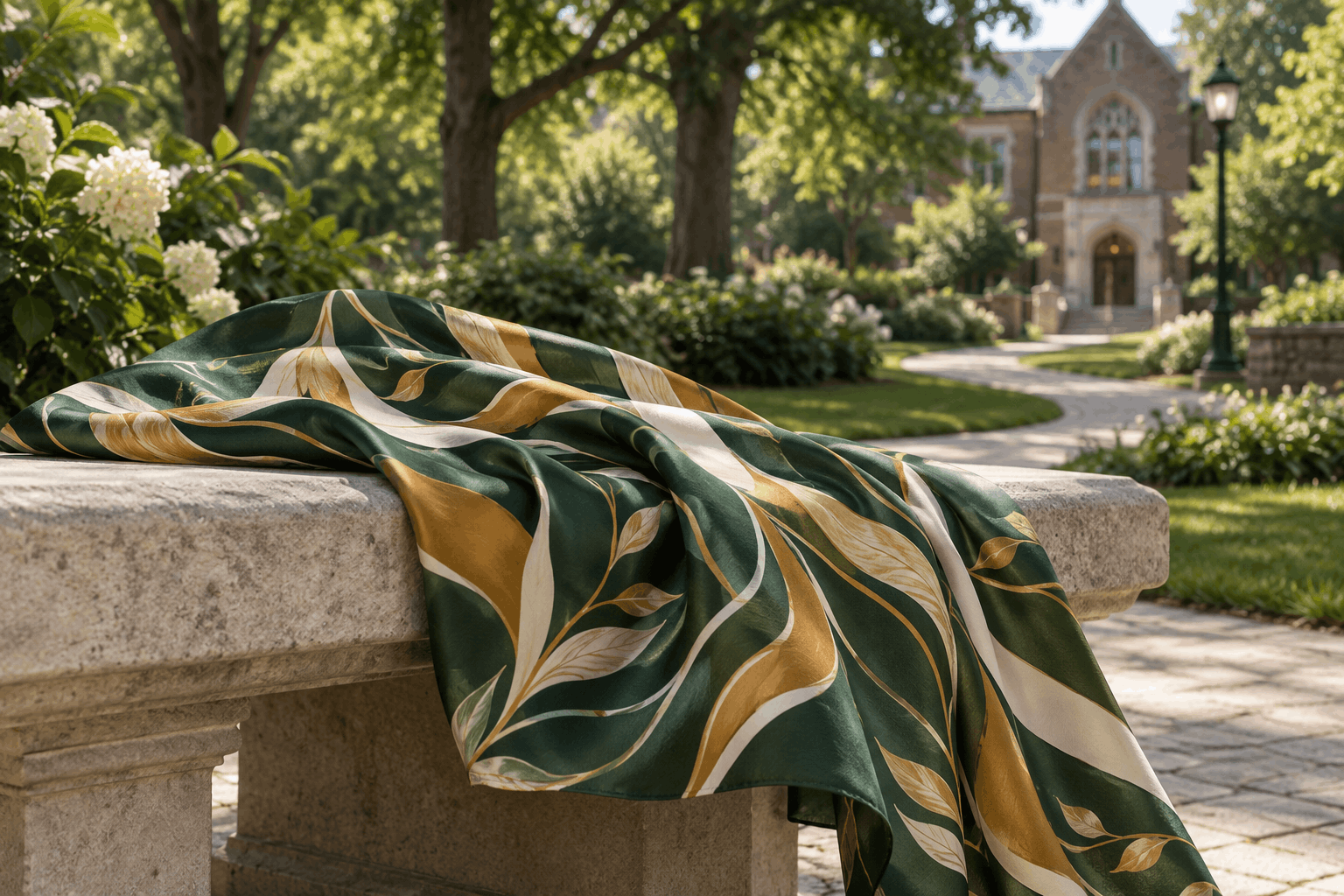
Imagine a scarf inspired by the paths and mature trees around a university library. Flowing lines and leaf forms could suggest the place without turning the fabric into a literal map. A short story card could identify the inspiration, while the finished scarf remains attractive in an everyday wardrobe.
Use the university’s colors thoughtfully. They may work as accents or part of a wider palette. A large crest or a full campaign title can be placed on a removable sleeve or accompanying card if it would dominate the object itself.
Ask the relevant university teams to review artwork, institutional marks and source credits before production. If imagery comes from an archive or collection, confirm the intended use as part of that review.
For more on keeping identity discreet, see how to create gifts with subtle branding.
Match the format to the recipient’s life
A silk scarf can be a thoughtful choice for a donor who enjoys textiles, fashion or wearable art. Consider their preferred colors, a comfortable format and whether they are likely to wear the design. Do not choose a personal accessory solely on the basis of gender or age.
Assess the sample as an object to use: check material information, fabric feel, finishing and how the pattern appears when folded or draped. A compelling design story adds meaning to a scarf that already works beautifully.
A publication may suit a donor with a strong subject interest, provided it offers relevant content and is not something they already own. A small art reproduction or design keepsake can work when the recipient has space and interest in displaying it.
If preferences are uncertain, offer a small choice of comparable options. Include a comfortable way to decline a physical gift. For some supporters, a personal letter and a relevant conversation will be the most welcome acknowledgment.
A curated gift set also needs a reason for each component. Extra items should add to the recipient’s enjoyment, and the complete package should be manageable to carry or send.

Make the words specific and the recognition comfortable
A useful message identifies the support, explains why the gift was selected and expresses thanks. Keep it warm and direct, with language that suits the relationship.
For the imagined library-inspired scarf, a note might read:
Thank you for your continued support of the university library. We chose this design for its connection to the paths and trees around a place you have helped sustain. Alongside it, we are pleased to share an update on the collection work your support contributes to. With warm appreciation from the university team.
Adapt the details to what is true. Student experiences can add a human perspective, but any quotation, image or personal story should be shared with the appropriate permission. Students should have a genuine choice about participating in donor communications.
Confirm how the donor wishes to be named and whether the acknowledgment is for an individual, household or organization. Private recognition can be just as attentive as a public presentation. Check before arranging photographs, publishing a name or including someone in a ceremonial moment.

Coordinate the gesture across the university
A donor may have relationships with a department, a college, central advancement and an alumni office at the same time. Agree who is coordinating the gift so the recipient receives a coherent acknowledgment.
Before ordering, settle:
- The occasion: a particular contribution, anniversary, campaign milestone or ongoing relationship.
- The complete budget: including the item, design work, samples, presentation and delivery.
- The recipient details: preferred names, gift choices, previous gifts and delivery arrangements.
- The review responsibilities: who checks the design, factual update, message and final sample.
- The timing: when the gift must be ready and how supporters unable to attend will be acknowledged.
Work within the university’s agreed approach to donor recognition and confirm how the proposed gift fits any existing program commitments. A proportionate gift with a personal message can be more suitable than an elaborate commission for a small group.
For international supporters, confirm the destination and delivery arrangements early. Attendance at a campus event should not be the only way to receive thoughtful recognition.
Send the initial thanks promptly, even when a commissioned object will take longer. The gift can follow as a considered part of an ongoing relationship.
Explore university recognition gifts with Lanting Loom
Lanting Loom’s corporate and institutional gifting options include existing scarves and gift sets, adapted presentation where feasible, and bespoke scarf projects inspired by a place or institution. The appropriate route depends on the recipients, design, quantity and timing.
Explore gifting for universities and institutions with a brief describing the purpose of the recognition, approximate quantity, budget, preferred presentation and required delivery date. If the gift will draw on campus imagery or a collection, include the proposed inspiration and the teams involved in reviewing it.
Recognition has meaning when a donor can see that their support is understood and appreciated. Choose a gift that reflects that connection, and let the message explain why it matters.
