


A silk scarf worn as a headband brings colour close to the face and gives a familiar hairstyle a different finish. Fold it narrowly for a quiet accent with loose hair, leave the ends visible beneath a ponytail, or use a wider band to show more of the print.
To wear a silk scarf as a headband, fold it into a flat band, place the centre over the top of your head, and tie the ends comfortably at the nape. Position the band just behind the hairline, guide it behind your ears and adjust it before making the final knot.
The best result comes from a scarf that is long enough to tie without pulling, a fold that lies flat and a placement that feels comfortable when you move. Start with the simple nape knot below, then try the other variations.

Which silk scarf should you use for a headband?
A medium or large square can work, as can a long, narrow scarf. The important measurement is the usable length after folding: it needs to travel around your chosen headband position and still leave enough fabric for the knot.
- A medium square: try approximately 65–70 cm for a compact headband, checking the fit before tying. It will not suit every head size or hairstyle.
- A larger square: approximately 88–90 cm gives more scope for visible tails or a fuller fold, but adds layers of fabric.
- A narrow ribbon scarf: requires less folding, provided its length is sufficient for a comfortable tie.
These are starting points rather than guaranteed fits. Hair volume, knot style and band placement all affect how much length you need. If the ends only just meet, choose a longer scarf instead of tightening the band.
Our silk scarf size guide can help you compare formats. When shopping, check the actual dimensions rather than relying on labels such as “small” or “large”.
How to fold a square scarf into a headband
- Place the scarf on a clean, dry surface and smooth it gently.
- Bring two opposite corners together to form a triangle.
- Fold the pointed tip towards the long edge in even sections until you have a flat band.
- Try a width of about 3–5 cm for a narrow headband, or around 6–8 cm for a broader look.
- Turn the band so your favourite colour or part of the border faces outward, with the loose folded edge underneath.
A flat fold usually looks neater than a tightly twisted rope of fabric. There is no need to press every fold with an iron; smooth it with your hands and adjust the width on your head.
1. The classic headband with a knot at the nape
This is an easy place to begin. The front stays simple, and the knot can sit beneath loose hair or below a ponytail. It works with a shirt and jeans, a light knit or a tailored blazer.
- Arrange your hair first. If you are wearing a ponytail, secure it with a separate hair tie.
- Place the centre of the folded scarf across the top of your head, slightly behind the hairline.
- Bring both ends down behind your ears. Keep the band off the tops of your ears if it feels uncomfortable there.
- If your hair is loose, lift it temporarily so you can bring the ends together beneath it at the nape.
- Cross the ends and tie once, then cross them in the opposite direction and tie again to make a small double knot.
- Lower your hair and adjust the band. Leave the ends visible or tuck short ends beneath the band if they stay comfortably in place.
With a low ponytail, position the knot below its base rather than directly beneath the hair elastic. The scarf should encircle your head; the elastic should hold the ponytail independently.
Outfit idea: an ivory shirt, dark jeans and a cream-and-blue scarf, with the ends falling softly beneath a low ponytail.
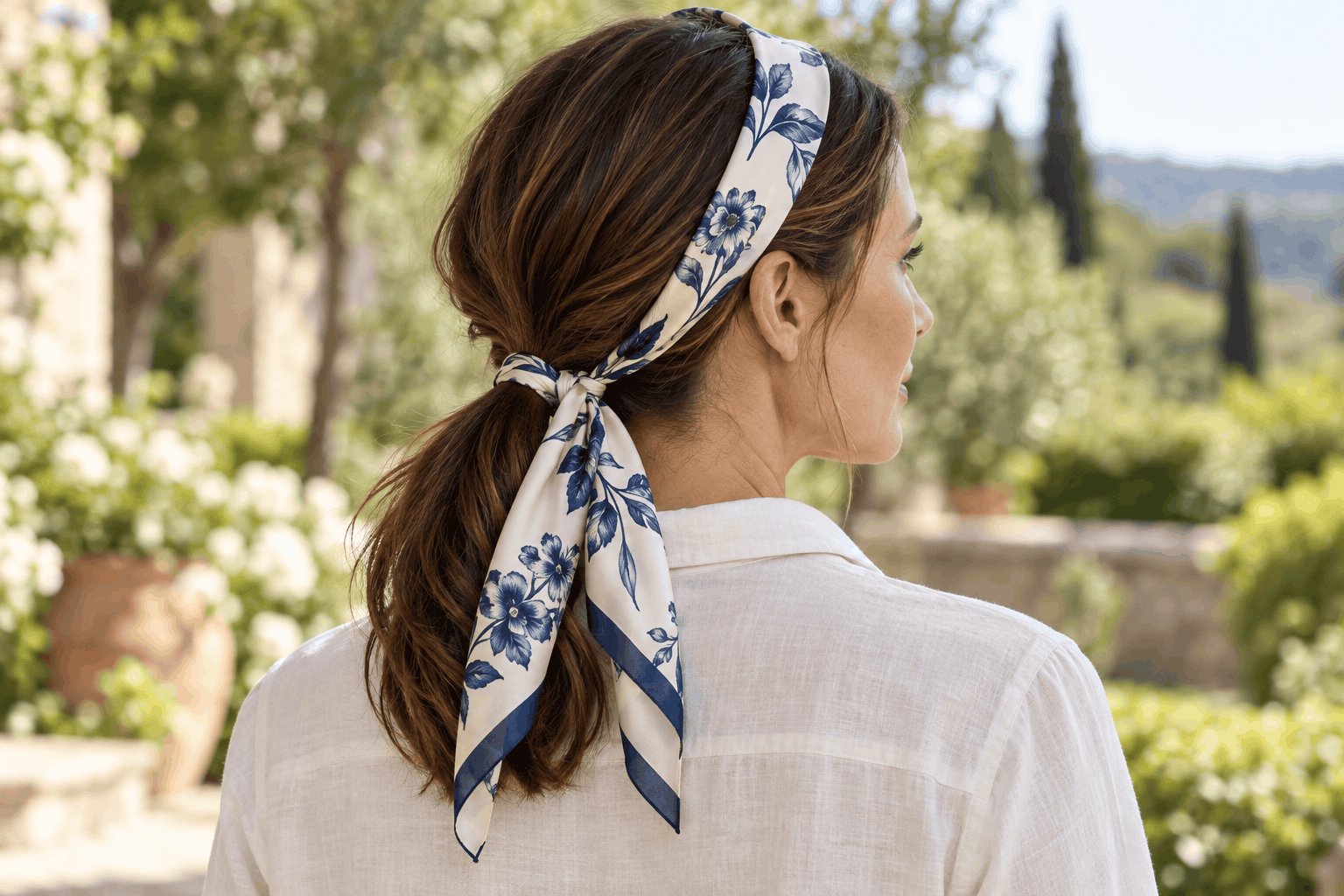
2. A small top knot for a more visible accent
A top knot makes the scarf part of the hairstyle from the front. Keep it small and slightly off-centre for a restrained finish, especially with a short bob or tucked-back hair.
- Begin with a narrow, flat scarf band.
- Place its centre at the nape, beneath your hair where possible.
- Bring both ends upward behind your ears and over the top of your head.
- Tie a small double knot slightly to one side, keeping the band comfortable.
- Arrange short ends beside the knot or tuck them underneath the band without leaving a bulky lump.
If the ends are very long, use the nape-knot style and let them hang behind you, or choose a shorter scarf. Repeatedly stuffing excess silk beneath a narrow headband can make it feel uneven.
Outfit idea: a muted rose-and-ivory scarf with a cream knit and simple earrings. The knot provides enough detail without needing a statement necklace.

3. A wider silk band that shows more of the pattern
A broader fold gives the scarf’s design more space. Try it with loose waves, curls or an updo, leaving the crown and the rest of your hair visible.
Fold the scarf into a band around 6–8 cm wide, then follow the nape-knot method. Position the front edge behind the hairline and smooth the sides before tying. You can narrow the fold slightly near the ears if a broad strip feels awkward there.
For a curly updo, style and secure the hair first, then place the scarf around the head. The headband does not need to flatten the curls or hold the whole hairstyle in place. Let the scarf frame the texture rather than pulling it tight.
If a large square feels too thick once folded, try a lighter scarf or reduce the width. A wider band should feel soft and settled, not like several ridges stacked across the crown.
Outfit idea: a muted jade-and-cream scarf with an ivory linen shirt or a simple summer dress.
How to keep a silk scarf headband from slipping
Silk can shift on smooth hair, and the most secure position varies from person to person. Try these adjustments before tightening the knot:
- Change the position slightly: move the band a little forward or back and check where it sits most naturally.
- Flatten the folds: a twisted or bunched underside can make the band sit unevenly.
- Use a secure knot: a single loose tie may work itself open; try a comfortable double knot.
- Add discreet support if needed: slide a smooth, snag-free hair grip over the band near the side of the head so it catches some hair beneath. Do not pierce the silk.
- Check the scarf’s proportions: very long tails or a heavy knot may pull the band out of position.
Remove any grip gently before untying the scarf, and stop if it catches a thread. Avoid spraying hairspray or applying styling products directly onto the silk. If you use hair products, let them dry before adding the scarf.
Turn your head, look down and walk around before leaving home. If the band presses, pulls or needs constant adjustment, retie it more loosely or choose another fold. Comfort matters more than keeping an exact position.
Adapt the look to your hairstyle
With short hair or a bob
Try a narrow band and a small knot. Leave the fringe visible if you like, or place the band just behind it. Tuck the sides of your hair behind your ears only if that suits the shape you want.
With long, loose hair
Tie beneath the hair at the nape for a quieter finish. Lift the hair clear while knotting so strands do not become trapped, then let it fall naturally over the tie.
With curls or textured hair
Experiment with band width around the volume of your hairstyle. A broad fold can display the print clearly, while a narrow one gives a smaller accent. Keep the tension comfortable and allow your preferred shape to remain visible.
With a bun or ponytail
Secure the hairstyle first. Use the scarf as a separate band around the head, with its knot positioned where it does not press against the bun or elastic. Tying a scarf only around a ponytail creates a different look from a headband.
Choose colours that suit the folded scarf
A headband reveals a narrow section of the design, so the border may matter more than the central motif. Fold the scarf in different directions to see which colours appear near your face.
For an easy starting point, repeat one colour from your outfit: navy with a blue detail, cream with an ivory ground, or a muted green accent with neutral clothing. A patterned headband can be the main decorative element when the rest of the outfit is simple.
Browse Lanting Loom’s square silk scarves and compare dimensions as well as artwork. Choose a piece you would also enjoy wearing at the neck or on a bag; our seven elegant ways to wear a silk scarf offer more ideas for the same accessory.
Care for the scarf after wearing
Untie the scarf, open the folds and allow it to air before storing it. Keep it away from wet hair, freshly applied cosmetics and rough hair accessories. If it becomes marked, follow its care label rather than treating it like an ordinary cotton hairband.
See our silk care guide for cleaning and storage advice. A little attention after wearing helps keep the scarf ready for its next use.
Frequently asked questions
What size silk scarf is best for a headband?
Choose enough usable length to go around your head comfortably and tie securely. A medium square around 65–70 cm may suit a compact style, while an 88–90 cm square offers more length and volume. Fit depends on your head size, hairstyle and fold.
Can I wear a silk scarf headband with short hair?
Yes. A narrow band with a small top knot or tucked ends can work well with a bob or short cut. Adjust the placement around your fringe and ears rather than trying to copy a long-haired style exactly.
Should I tie the knot at the top or underneath my hair?
A nape knot keeps the front smooth and can be hidden beneath loose hair. A top knot makes a more visible accent. Choose whichever stays comfortable and works with your hairstyle.
Can I use a silk twilly as a headband?
Yes, if it is long enough to encircle your head and leave room for a secure knot. Twillies vary in length, so check the measurements. A ribbon that works on a handbag handle may still be too short for your preferred headband style.
Why does my silk scarf headband keep sliding?
The position, smoothness of your hair, weight of the ends or looseness of the knot may be contributing. Try a flatter fold, a slightly different position or a smooth hair grip. Avoid solving slipping by making the band uncomfortably tight.
