

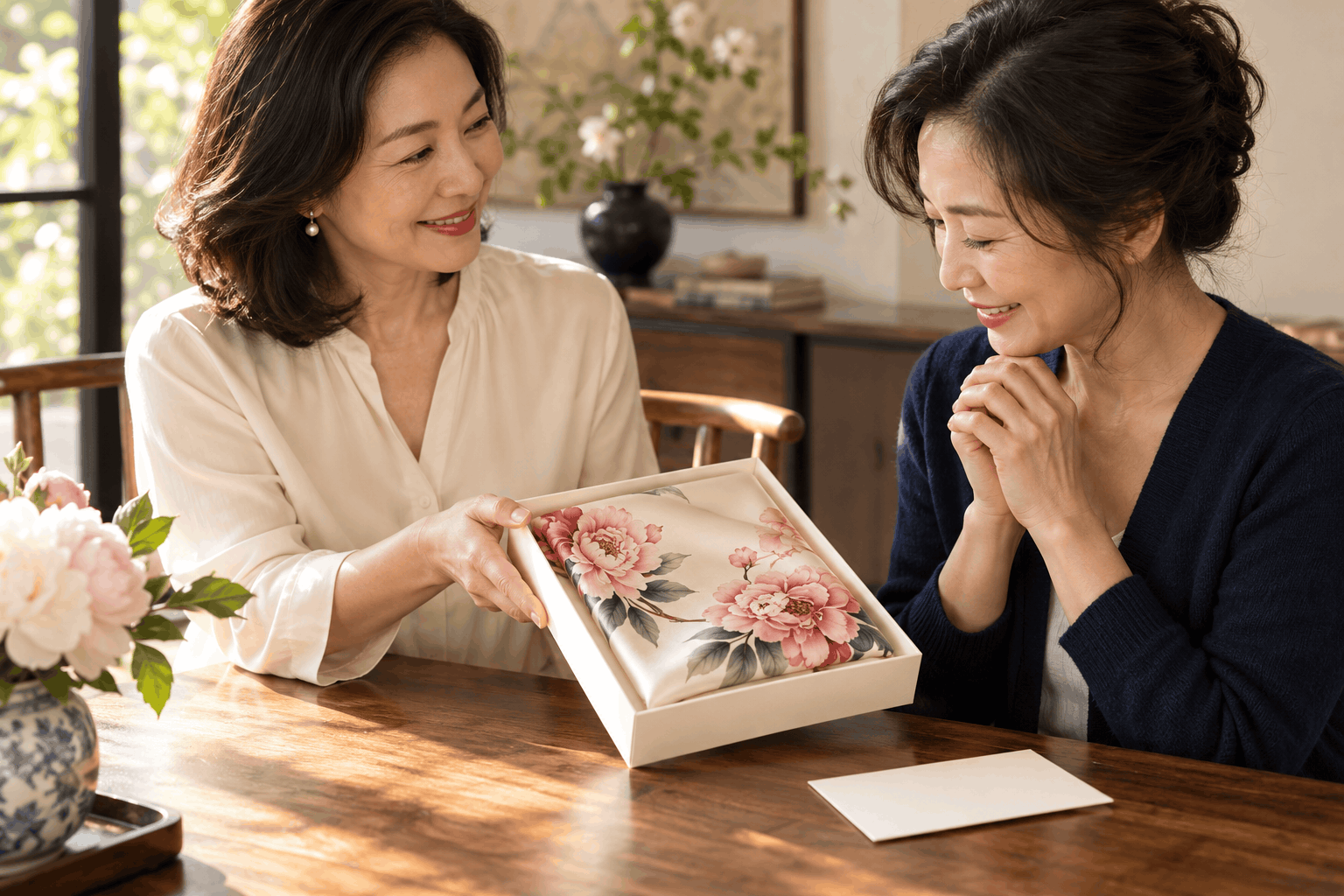
A peony in full bloom is difficult to overlook. Its layered petals, generous shape and rich colour give it a presence that can fill a painting, soften a textile or become the centre of a decorative object.
Peony meaning in Chinese art is closely associated with wealth, honour, prosperity and beauty. These associations make it an appealing motif for gifts that express admiration or good wishes. But the flower is not a universal code: the surrounding imagery, the object and its historical setting all help shape its meaning.
Understanding that background allows you to enjoy the design more fully—and to explain a gift in words that feel thoughtful and personal.
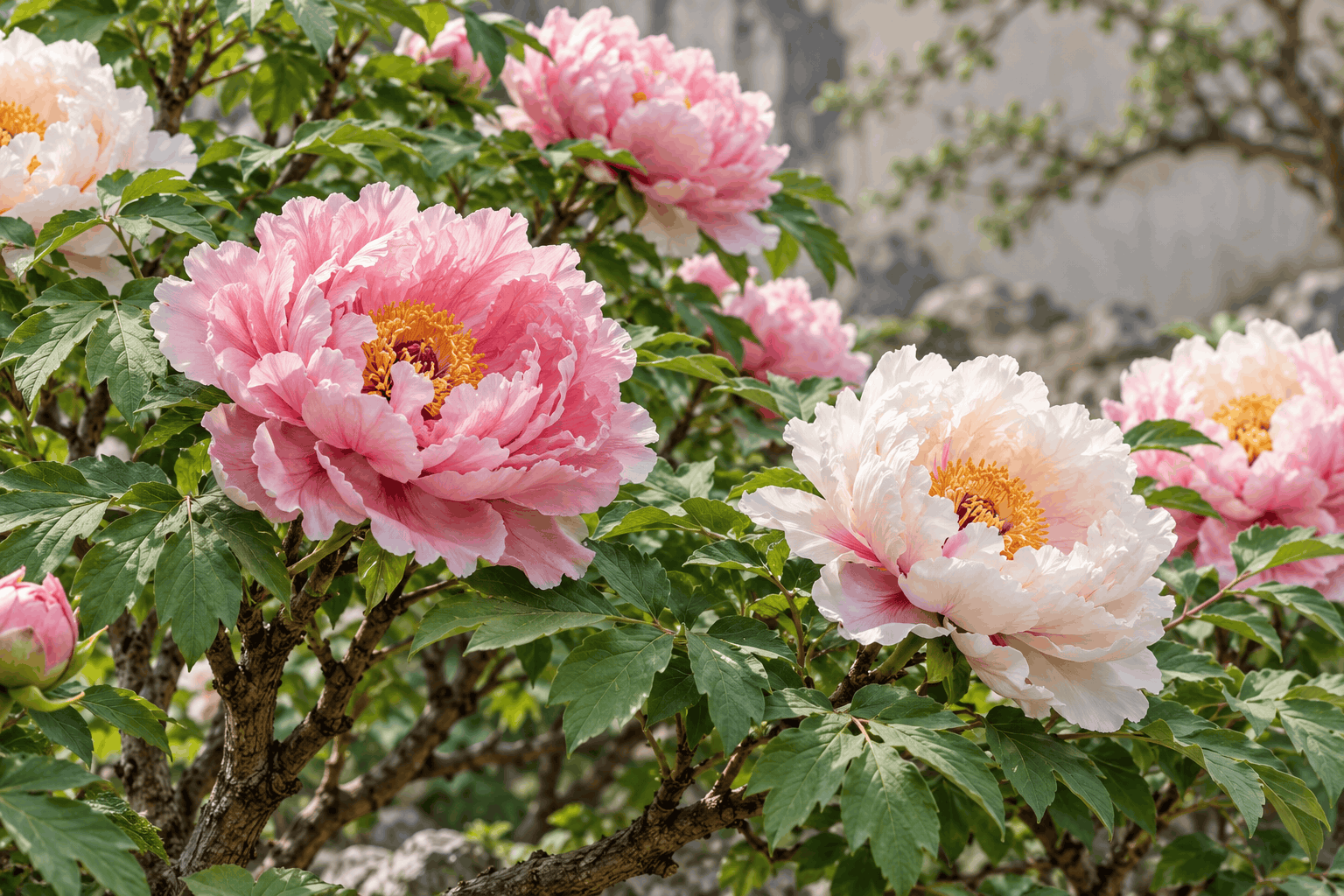
What does the peony symbolise in Chinese art?
The peony is often described as the flower of wealth and rank, or fuguihua (富貴花). Here, wealth and honour belong together: the association includes prosperity as well as distinction and social standing.
The Smithsonian’s National Museum of Asian Art explains that the tree peony was admired at the Tang court and continued to carry associations with status and power. Its celebrated titles include “king of flowers.”
For a contemporary gift, you might draw on that history to express a wish for someone to flourish. That is a personal interpretation of the motif, not a promise that the object will bring financial success.
Beauty and abundance: why the flower has such presence
Look closely at a peony composition and you can see how its visual character contributes to its appeal. A large blossom gives an artist room to explore overlapping petals, concentrated colour and contrasts between flowers and foliage.
In Zhao Zhiqian’s Peony, dated 1862, The Metropolitan Museum of Art connects the subject with material prosperity and good fortune. Its account also places flower painting within a taste for beauty and auspicious imagery among urban buyers.
This example is a useful reminder that the peony was more than a pretty botanical subject. A viewer could appreciate both the brushwork and the favourable associations carried by the bloom.
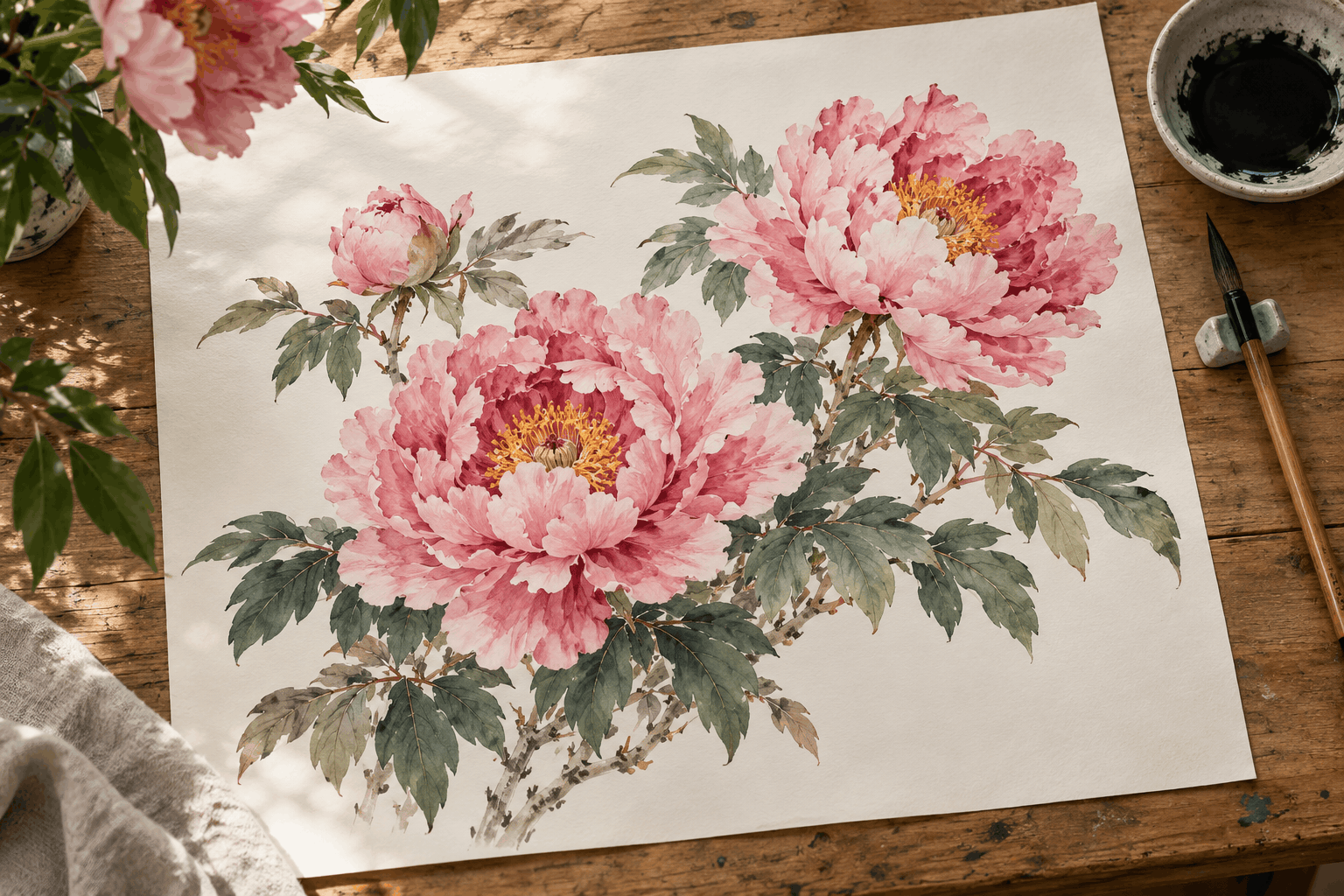
Peonies appear beyond paintings
The flower’s meaning also travelled through objects people could handle, display and wear. Looking across different materials helps explain why the motif remains so adaptable in contemporary design.
Carved lacquer: a flower with sculptural depth
The Met’s early fifteenth-century covered box with peonies and seasonal flowers includes tree peonies identified as symbols of honour and wealth. The flowers are carved into red lacquer, giving the decoration a depth quite different from painted petals.
A motif does not need naturalistic colour to remain recognisable or meaningful. Shape, arrangement and material all contribute to its effect.
Embroidery: flowers that form a shared message
On a Qing-dynasty embroidery of magnolia, crabapple and tree peony, the plants work together as a visual rebus—a message built through images and wordplay.
The Met explains the combination as yutang fugui (玉堂富貴), a wish for riches and honour. The meaning belongs to the arrangement of plants, rather than to the peony alone.
When you encounter a floral design, look at the whole composition. Other plants, animals, inscriptions or the object’s intended use may add something that a single-flower description misses.
Does every peony colour have a fixed meaning?
It is tempting to choose a gift from a simple chart that assigns one meaning to red, another to pink and another to white. For Chinese art, a better starting point is the explanation of the specific work or design.
The museum examples above establish associations with prosperity, honour and beauty; they do not provide a universal colour code for every peony image. A contemporary designer may also choose colours for the composition or for the way a textile will be worn.
When choosing a scarf, treat colour first as a practical and personal decision. Does the recipient prefer deep blue, soft pink, ivory or a stronger contrast? If the maker explains a particular colour choice, you can share that story too.
From peony imagery to a contemporary silk scarf
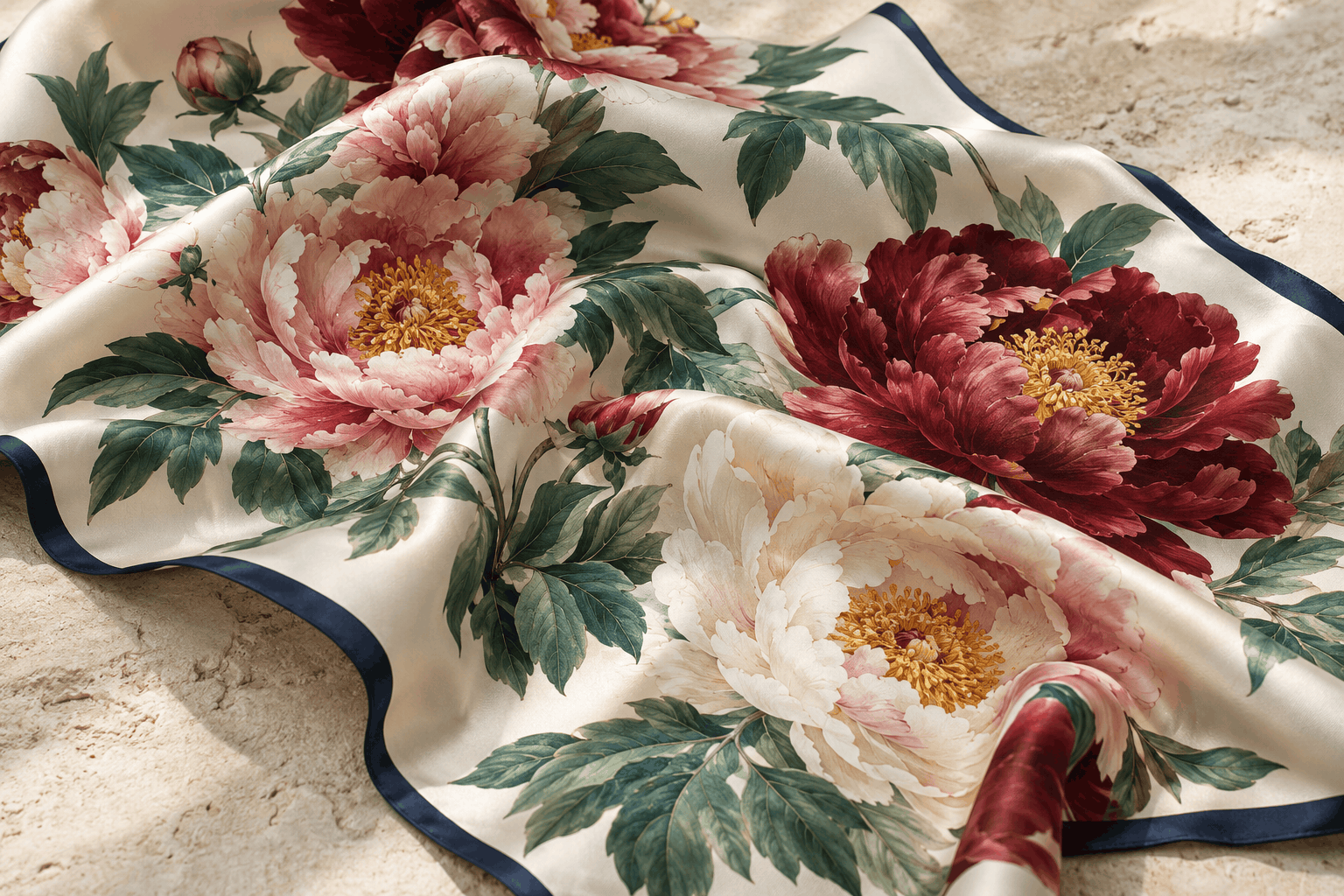
A scarf changes how a floral composition is experienced. Unfolded, it can show a complete arrangement; tied at the neck, it may reveal only a blossom, a few leaves and part of the border.
When considering a peony-inspired scarf, examine both the full design and its folded appearance. A large flower may create a bold area of colour, while smaller blossoms can form a more repeated pattern. Neither approach is inherently more meaningful—the choice depends on the wearer.
Check the product’s own description to confirm that the motif is a peony. A general floral print should not automatically inherit peony symbolism, and a contemporary printed scarf should not be described as antique embroidery or a historical reproduction.
Lanting Loom’s design stories explain its approach to translating cultural sources into contemporary compositions. For help with format and wearability, read our guide to choosing a meaningful scarf gift.
When can a peony-inspired gift feel appropriate?
The following are contemporary gifting suggestions based on the flower’s associations. They are not rules requiring a peony for a particular occasion.
A birthday or personal milestone
A peony design can express admiration and a wish for good things ahead. Choose it for someone who enjoys flowers, art or expressive accessories, then make the message specific to her interests.
A wedding or anniversary
The motif can accompany your wish for a flourishing shared life. That is a thoughtful way to use its prosperous associations without claiming that every peony image has one fixed meaning about marriage.
A professional achievement
A peony-inspired object may suit a promotion, business milestone or celebration of someone’s work. Keep the message centred on the achievement and your respect for the recipient.
A thank-you or a gift for a host
Sometimes the strongest reason is simple: the recipient loves peonies. A connection to her garden, favourite painting or preferred colours can make the choice more personal than a lengthy explanation of symbolism.
What to write with a peony-inspired gift
A short note can connect the cultural meaning with your own reason for choosing the piece. Mention the association briefly, then turn towards the person receiving it.
- For a birthday: “Peonies have long been associated with beauty and prosperity in Chinese art. I chose this with a wish for a year full of things you love.”
- For an achievement: “A small celebration of what you have accomplished, with warm wishes for everything still to come.”
- For an anniversary: “These generous blooms made me think of the life you are building together. Wishing you many more happy years.”
- For a friend who gardens: “These peonies reminded me of your garden and the lovely afternoons we have spent there.”
Use only details that fit your relationship. The design provides a starting point; your words give the gift its particular meaning.
Choose the object as carefully as the symbolism
A meaningful motif works best on something the recipient will enjoy. For a scarf, consider the colours, dimensions, material and care requirements. For a decorative object, think about her home and the things she likes to display.
If you are comparing several symbols, our guide to Chinese symbols that make meaningful gifts offers other starting points. There is no need to force a peony connection when another design feels more personal.
Explore Lanting Loom’s current collection and read each piece’s description for its actual inspiration. For presentation and message options, consult gift services and the individual product page.
Frequently asked questions
What is the main meaning of the peony in Chinese art?
Wealth and honour are central associations, alongside prosperity, beauty and good fortune. The meaning of a particular artwork also depends on its composition and context.
Why is the peony called the king of flowers?
The title reflects the flower’s celebrated status. The National Museum of Asian Art connects the tree peony with admiration at the Tang court and its continuing associations with status and power.
Is a peony gift only suitable for romantic occasions?
No. Its associations extend beyond romance. A peony-inspired gift can express admiration, congratulations or good wishes, depending on the recipient and your message.
Does a peony design guarantee good luck or wealth?
No. It can express an auspicious wish, but symbolism is not a guarantee of an outcome. Present the meaning as a cultural association and a personal sentiment.
Can I assume any large floral scarf shows peonies?
No. Stylised flowers can be difficult to identify. Check the maker’s description before attaching a specific cultural meaning to the print.
