

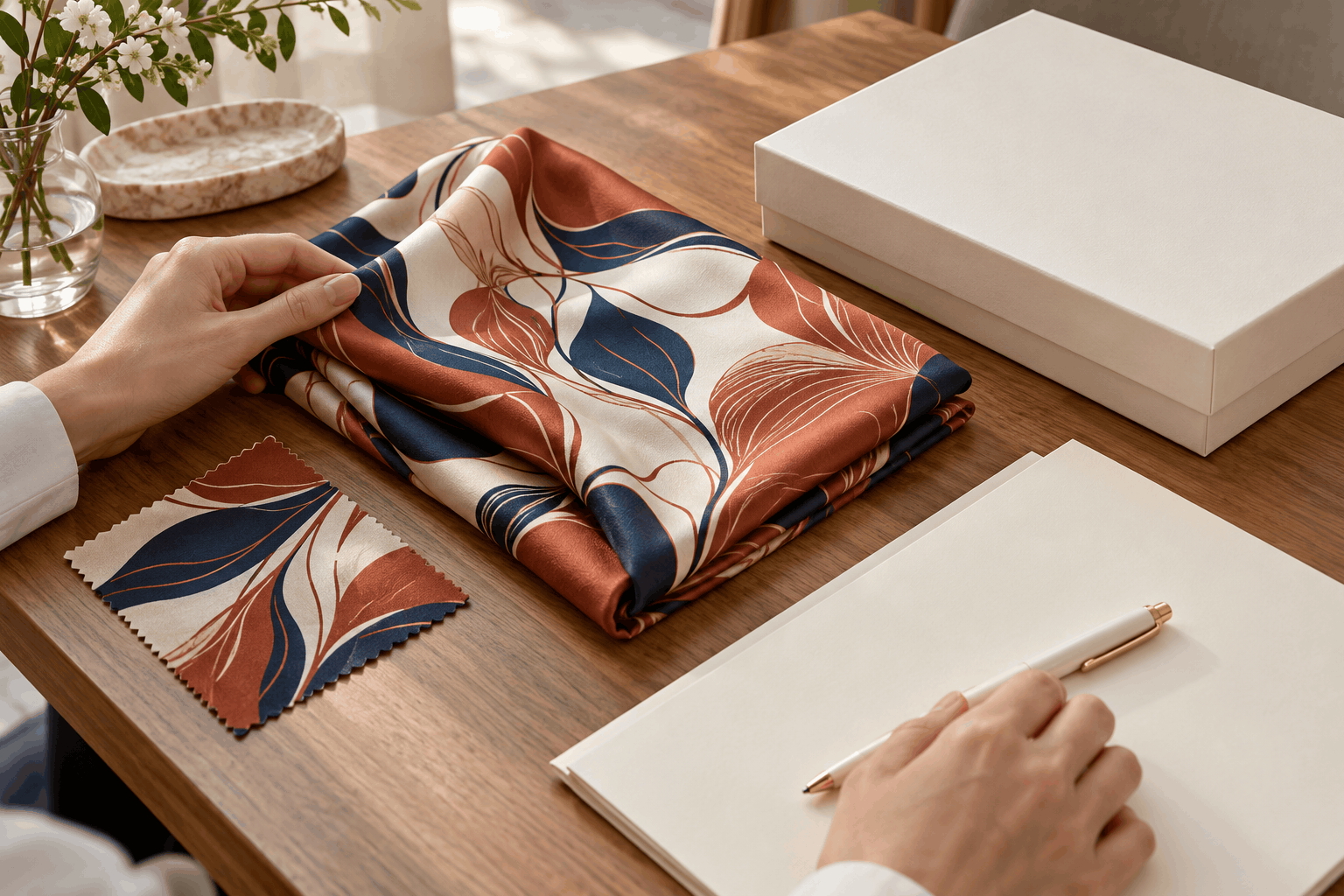
The sample has arrived, the event date is approaching and several colleagues have opinions. Before replying “approved,” take a moment to establish exactly what you are accepting—and what the supplier is authorised to do next.
To review a custom silk scarf before approving production, compare the current physical sample with the agreed brief, assess it as a wearable gift, resolve outstanding changes and identify the exact versions authorised for manufacture. A positive reaction to the design is useful feedback, but it is not a complete production instruction.

This guide focuses on the final decision and communication process. For the detailed inspection points, use our silk scarf sampling checklist for corporate buyers alongside the review.
1. Put the current brief and sample in the same review
Bring together the latest specification, artwork, physical sample, packaging proof and revision list. Check that everyone is discussing the same design, colourway and version.
Ask the supplier to identify anything provisional. A scarf made with a substitute fabric or a box printed on temporary stock may help the discussion, but it should not silently become the production reference.
Start the meeting with three questions:
- Who will receive this scarf, and how do we expect them to use it?
- Which requirements were agreed before sampling?
- Which decisions are still open?
This prevents the review from becoming a fresh design brief after the supplier has already completed the agreed work.
2. Judge the scarf as a gift someone will wear
Look beyond the full square laid on a table. Fold the handling sample, tie it in the intended style and view it against clothing similar to what recipients might wear.
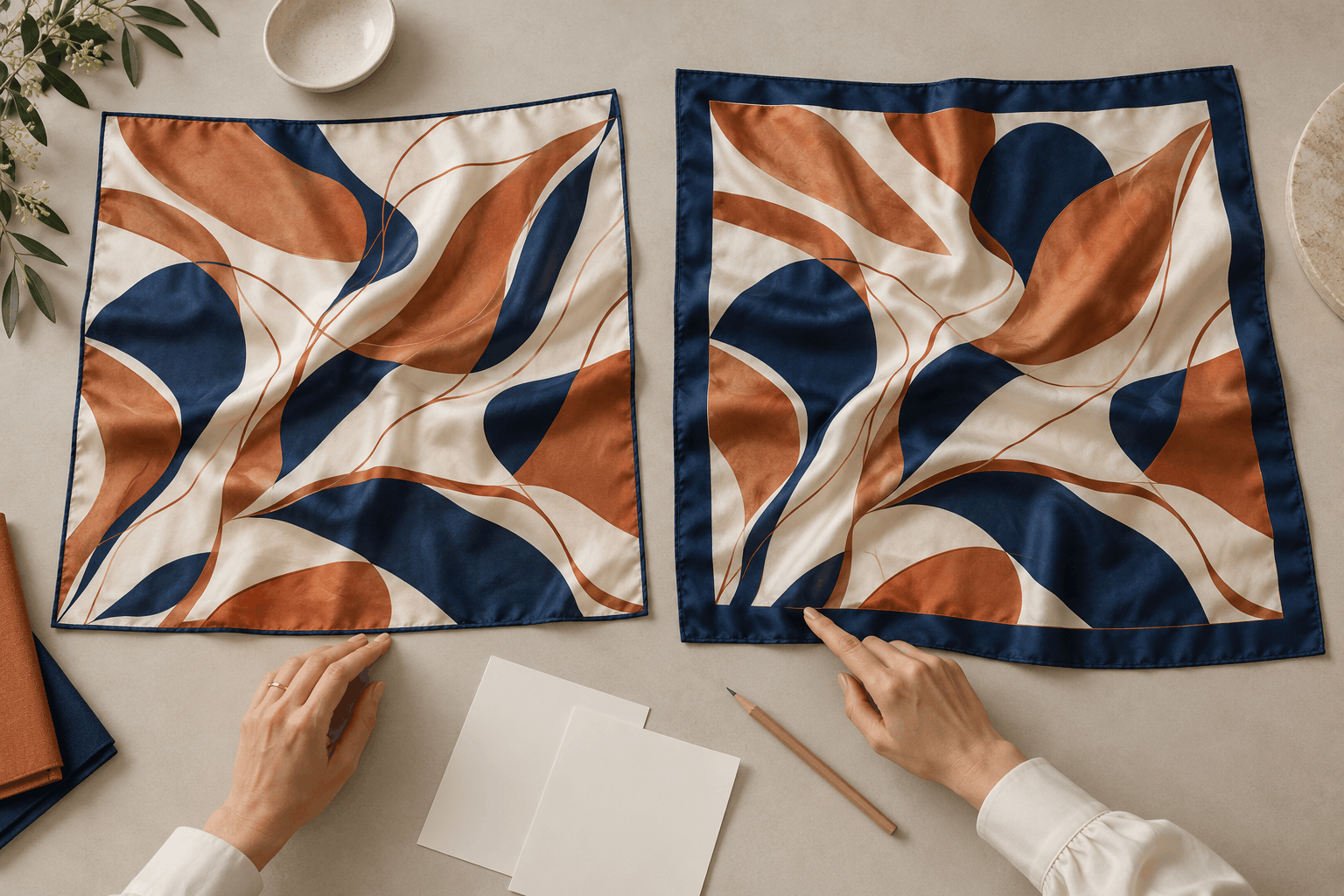
Notice which colours dominate after folding, whether the border becomes unexpectedly prominent and whether important artwork disappears in the knot. A composition can look balanced when open yet feel very different around the neck.
Consider the recipient rather than the reviewer’s personal wardrobe. An expressive museum piece, a discreet executive gift and a hotel keepsake may need different visual effects.
If the intended format feels awkward, return to the brief before changing the artwork. Sometimes the issue is the amount of fabric or the proposed styling, rather than the print itself.

3. Decide whether the branding has the right presence
Check the relationship between the organisation’s identity and the scarf’s appeal. A logo that appears modest on a large artwork file may become the focal point when the fabric is folded.
Review the mark’s size, placement, orientation and contrast in the intended styling. Confirm that any names, dates or wording use the approved version.
If the gift feels more promotional than intended, discuss whether some identity belongs on the card or sleeve instead. That is a design decision to resolve before production, not an instruction to remove required branding without approval.
Lanting Loom’s bespoke scarf service considers artwork, wearability and presentation together.
4. Separate a correction from a new request
Not every comment has the same implication. Classify the feedback before asking the supplier to act.
- A mismatch with the agreed requirement: an incorrect logo version, wrong wording or a finish that differs from the specification.
- A point that was never resolved: unclear reverse appearance, an unconfirmed colour reference or a packaging detail still awaiting selection.
- A new preference: a different palette, larger format or redesigned border requested after the original direction was followed.
Ask the supplier to confirm the action, cost and schedule implications for each item. An unresolved requirement needs a decision; a new preference may require a revised scope.
For example, “the border does not match the approved artwork” is a correction. “We now prefer a narrower border” is a change request. Both can be reasonable, but they should not be communicated as if they were identical.
5. Turn subjective comments into usable feedback
“More luxurious” or “less busy” describes a reaction, not a production instruction. Explain what you are seeing and where, then ask for a specific revision or a proposed solution.
Instead of “the scarf feels too dark,” try: “When folded into the agreed neck style, the navy border occupies most of the visible area. Please propose an adjustment that reveals more of the ivory ground.”
For colour, use the agreed physical reference and consistent review conditions. Photographs can locate an issue, but a phone image should not replace a physical colour approval.
Send one consolidated revision list. Nominate a coordinator to resolve conflicting comments before they reach the supplier.
6. Check that revisions have not created new problems
Review the revised sample against both the previous comments and the complete brief. A narrower border may improve the folded appearance but affect logo clearance. A different fabric may change the drape, printed colour and packaging fit.
Ask what needs to be re-sampled when a change is proposed. A corrected card spelling may be reviewed through an agreed proof process, while a change to the scarf’s material or printing may need a new physical reference.
Do not assume an earlier approval still applies to an element that has changed. Record which approvals remain valid and which must be repeated.
Give each revision a clear reference, and mark older files as superseded. Avoid mixing an approved colour from one sample with an approved layout from another unless the supplier has confirmed how the combined result will be verified.
7. Choose a clear decision: approve, revise or hold
Use a decision that describes the actual status:
- Approve the sample: the identified sample meets the agreed requirements within the stated scope.
- Request revision: list the changes and the evidence needed for another review.
- Hold: the decision cannot be made until missing information, testing or stakeholder approval is available.
Partial approval must be explicit. “Scarf artwork approved; packaging remains on hold; production is not authorised” is clearer than “approved subject to comments.”
If you intend to release one stage before another, agree exactly what may proceed, what remains blocked and what commitments that creates. Do not rely on an informal message to define a staged release.
8. Confirm the order still matches the approved product
Before authorising manufacture, reconcile the final sample with the purchase order and quotation. Confirm the quantities by design, colourway and size, along with packaging, delivery details and the current schedule.
Check whether revisions have changed the price or arrival date. A deadline does not resolve an outstanding quality decision; if time is short, discuss a feasible alternative and its trade-offs.
Our guides to custom silk scarf costs and minimum order quantities can help frame the commercial questions.
9. Send a production release that identifies the exact references
A written release should identify the product being approved and the work being authorised. Use your organisation’s normal purchasing process and have the authorised person issue it.
The following is a starting point to adapt once all required decisions are complete:
We approve sample [reference and revision] for [design, colourway and size], against specification [version] and artwork [version]. Packaging and printed materials are approved as [references].
All actions in revision list [reference] are closed. We authorise production of the quantities listed in purchase order [reference], under the agreed commercial terms and delivery schedule.
Please confirm receipt and that these are the references your production team will use. Any proposed substitution or change must be submitted for written approval before implementation.
Do not use this wording while actions remain open. If you are approving only the sample, say so and state that production authorisation will follow separately.
10. Keep a reference for production and delivery checks
Retain the approved sample, final files, proofs and decision record. Where agreed, the supplier should keep a matching reference, with a clear process for resolving any conflict between the sample and written specification.
Sample approval establishes the target; it does not show that every piece in a future batch meets it. Confirm the agreed bulk inspection and receiving checks, including how discrepancies will be reported.
For a repeat order, review the retained references and ask whether materials, processes or availability have changed. A previous approval should not hide an unreviewed substitution.
Plan the approval process before sampling begins
The final review is easier when the brief already names the decision-makers, sample stages, revision scope and production-release process. Include those points when discussing a project through Lanting Loom’s corporate gifting service.
A well-documented decision gives both buyer and supplier the same answer to a simple question: what exactly are we making?
Frequently asked questions
Can I approve a custom silk scarf from photographs?
Photographs can support artwork discussions and show the location of a problem. They do not fully establish colour, feel, drape or finishing. Agree which decisions require a physical sample.
What if different departments disagree?
Return to the agreed brief and each department’s approval responsibility. Have one coordinator resolve the comments and send a single decision to the supplier.
Does approving artwork authorise production?
It should not be left ambiguous. State the scope of each approval and issue production authorisation through the agreed purchasing process.
Can I change the design after approval?
Ask the supplier immediately what work has begun. Request written confirmation of feasibility, cost and timing before assuming the change can be made.
What should happen if the sample still has an unresolved issue?
Identify the issue, required action and review method. Hold the affected approval until it is resolved, or document an explicitly agreed staged process rather than giving a vague conditional approval.
