

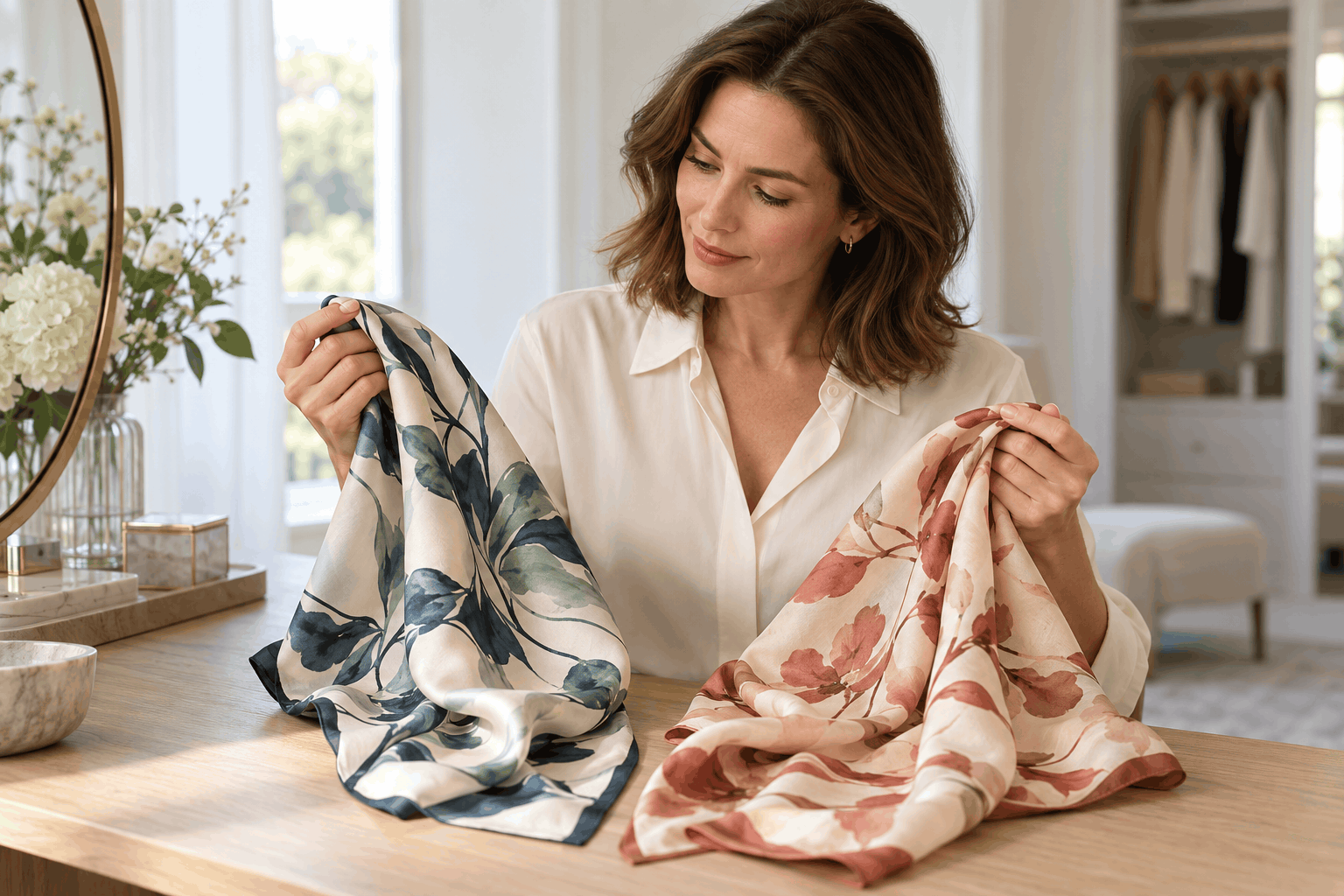
Your first luxury silk scarf should feel exciting to choose and easy to wear. Perhaps you are drawn to a botanical print, a striking border or the way silk softens a favourite jacket. The challenge is finding a piece that looks just as appealing in your everyday wardrobe as it does in a product photograph.
To choose your first luxury silk scarf, decide how you will wear it most often, select a suitable size, and look for colours that work with clothes you already own. Then check the stated fibre composition, fabric, finishing and care instructions before comparing prices.
You do not need a scarf that does everything. One beautiful piece that works comfortably with two or three familiar outfits is a strong beginning.
1. Choose one main way you want to wear it
Before looking at designs, finish this sentence: “I would like to wear my scarf with…” Be specific. A navy blazer at work, a white shirt at weekends or a simple dress for dinner gives you a clearer starting point than a general wish to dress more elegantly.
- For a small neck accent: look for a square that leaves enough length for a comfortable knot without excessive folds.
- For a shoulder drape: choose a larger format and check photographs showing its actual coverage.
- For a handbag accent: a narrow scarf or a small square may be enough.
- For several styling options: choose the size around your most frequent use, then treat the others as a bonus.
If you are unsure, start with a simple neck knot. It lets you enjoy the colour and pattern without learning an elaborate arrangement. Our silk scarf styling guide can help you decide which look feels most natural.
2. Select the size before falling in love with the print
A scarf can be beautiful and still be the wrong size for the way you want to use it. Product dimensions normally describe the edges of a square, not its diagonal, and every knot uses some of the available length.
- Small squares, roughly 45–55 cm: useful for compact accents, subject to your preferred fit and knot.
- Medium squares, roughly 60–70 cm: a practical starting point for everyday neck styling with moderate volume.
- Larger squares, roughly 88–90 cm: more scope for generous folds, visible artwork and light shoulder draping.
- Long scarves: useful when you prefer hanging ends or a fluid drape; check both length and width.
These are broad comparisons, not fixed rules. Fabric thickness and your own proportions change the result. If possible, use a scarf you already own to test the approximate dimensions, remembering that a different fabric will fall differently.
For a first purchase intended mainly for neckwear, start by comparing medium squares. If your main wish is a shoulder drape, start larger. See our silk scarf size guide for more detail.
3. Test the colours against three familiar outfits
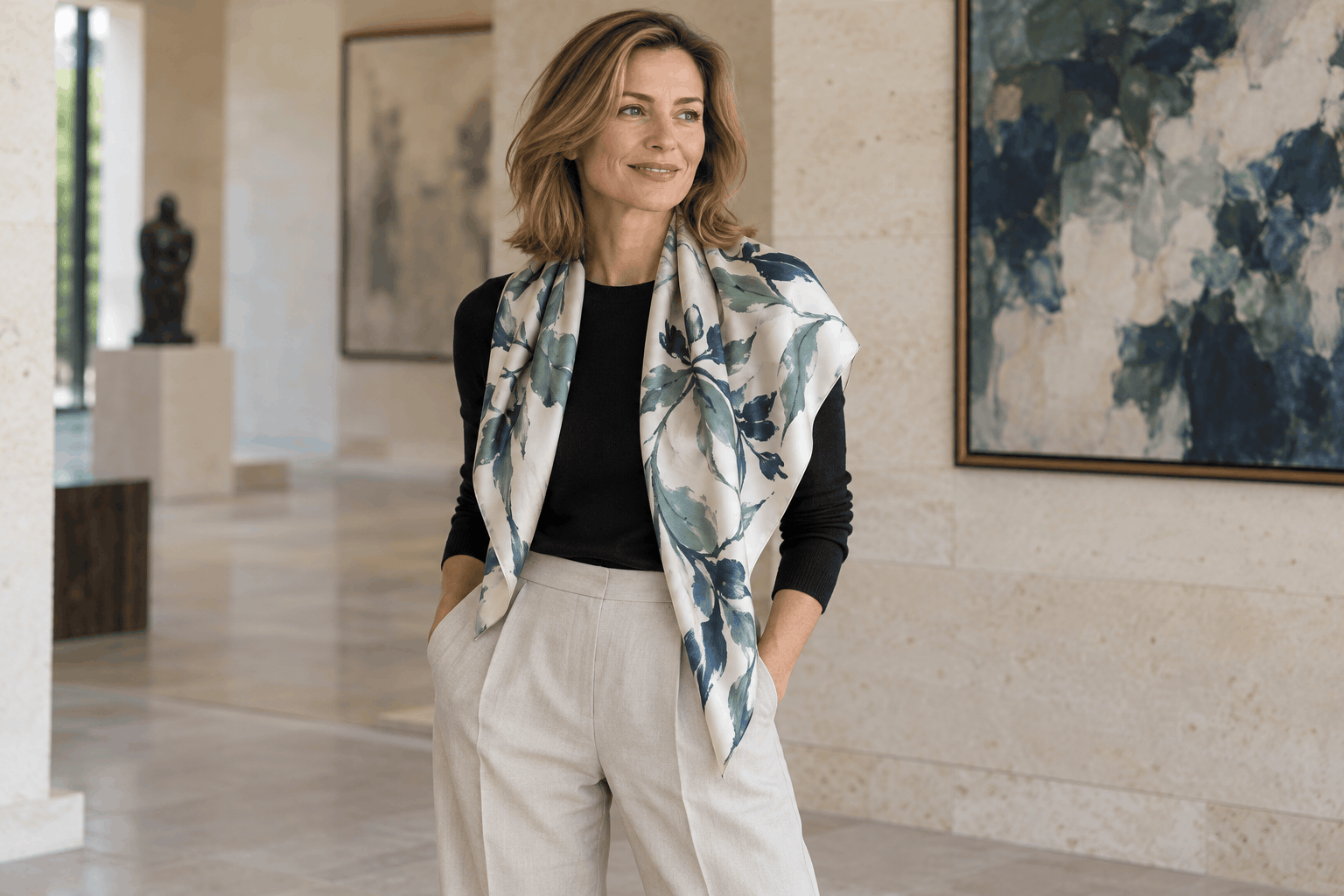
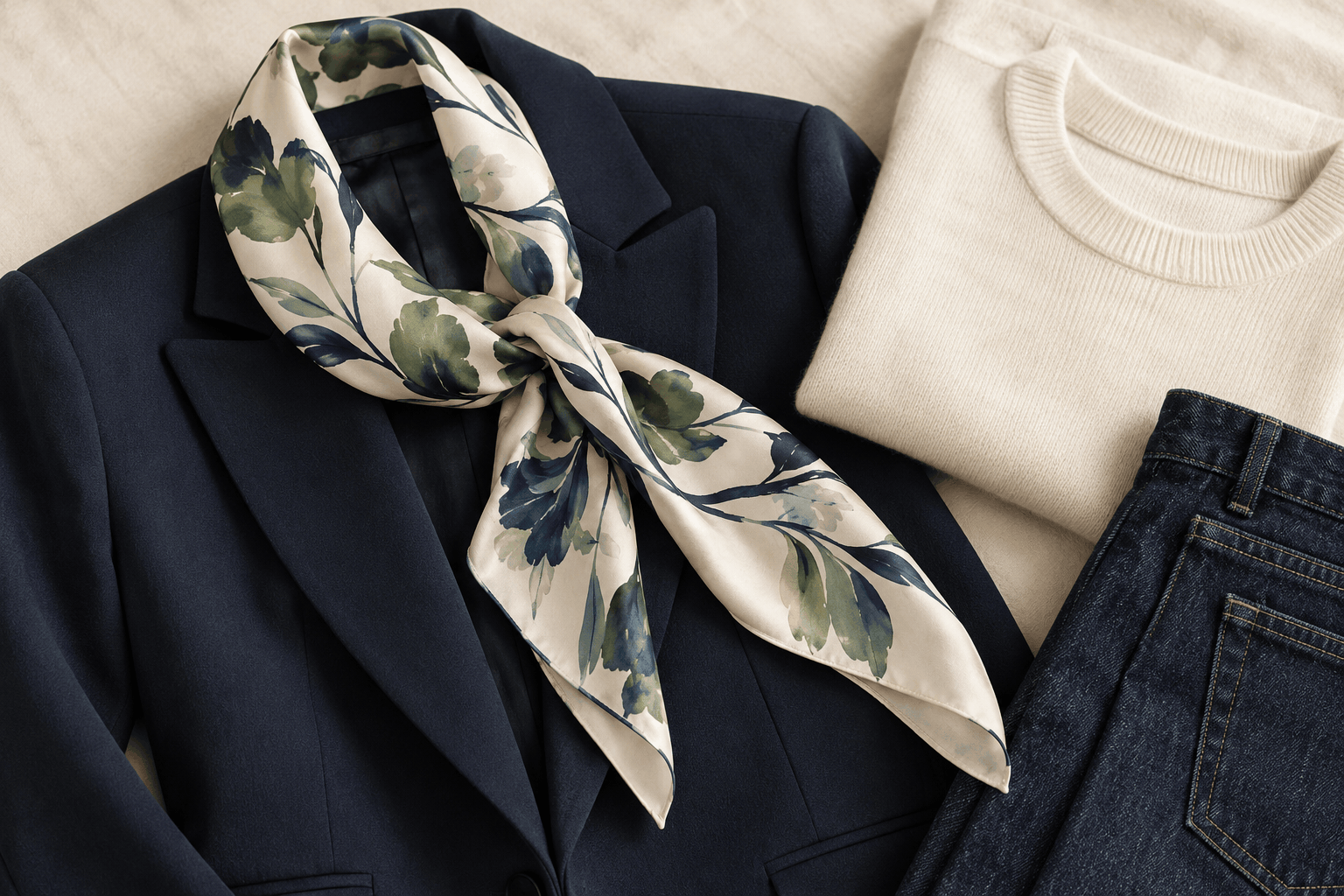
Choose three outfits you genuinely wear, then imagine the scarf with each one. They might be your work blazer, a weekend knit and a simple dress. You are looking for useful connections, not a perfect match with every item in your wardrobe.
If you often wear navy, ivory or denim, a scarf containing blue and cream can be easy to introduce. Camel and brown can work beautifully with blue, terracotta or muted green. A black wardrobe can give a brighter print room to stand out.
You can still choose a new colour. A scarf is a manageable way to experiment; it simply helps to know which existing outfit will support it.
Look at the folded view as carefully as the flat photograph. A bold border may become the most visible feature in a neck knot, while a central motif can disappear between the folds. Check which colours will actually sit near your face.
4. Understand the material and the way it falls
If you want pure silk, look for a clear statement such as “100% silk” in the product specification. Words such as “silky”, “silk-feel” or “satin” do not, on their own, confirm the fibre content.
Silk is a fibre; satin and twill describe weave structures. CottonWorks’ introduction to weaving identifies plain, twill and satin as the three basic weaves. The practical point for a buyer is to check composition and fabric construction separately.
- Silk twill: has a diagonal weave and often offers a more defined fold. It can be a useful starting point for neat knots and structured styling.
- Silk satin: typically has a smooth, lustrous face. Consider it if you enjoy a brighter surface and a fluid effect.
- Lightweight plain-weave silk, such as habotai: can feel airy and less substantial. Assess whether that lighter effect suits your intended use.
These are tendencies rather than guarantees. Weight, yarn and finishing also affect the result. Ask for a worn photograph or a short video if the product images do not show how the scarf moves.
If a listing provides a momme figure, treat it as a fabric-weight detail rather than an overall quality score. A heavier scarf is not automatically the better choice for a small, comfortable neck knot.
5. Look closely at the print, reverse and edges
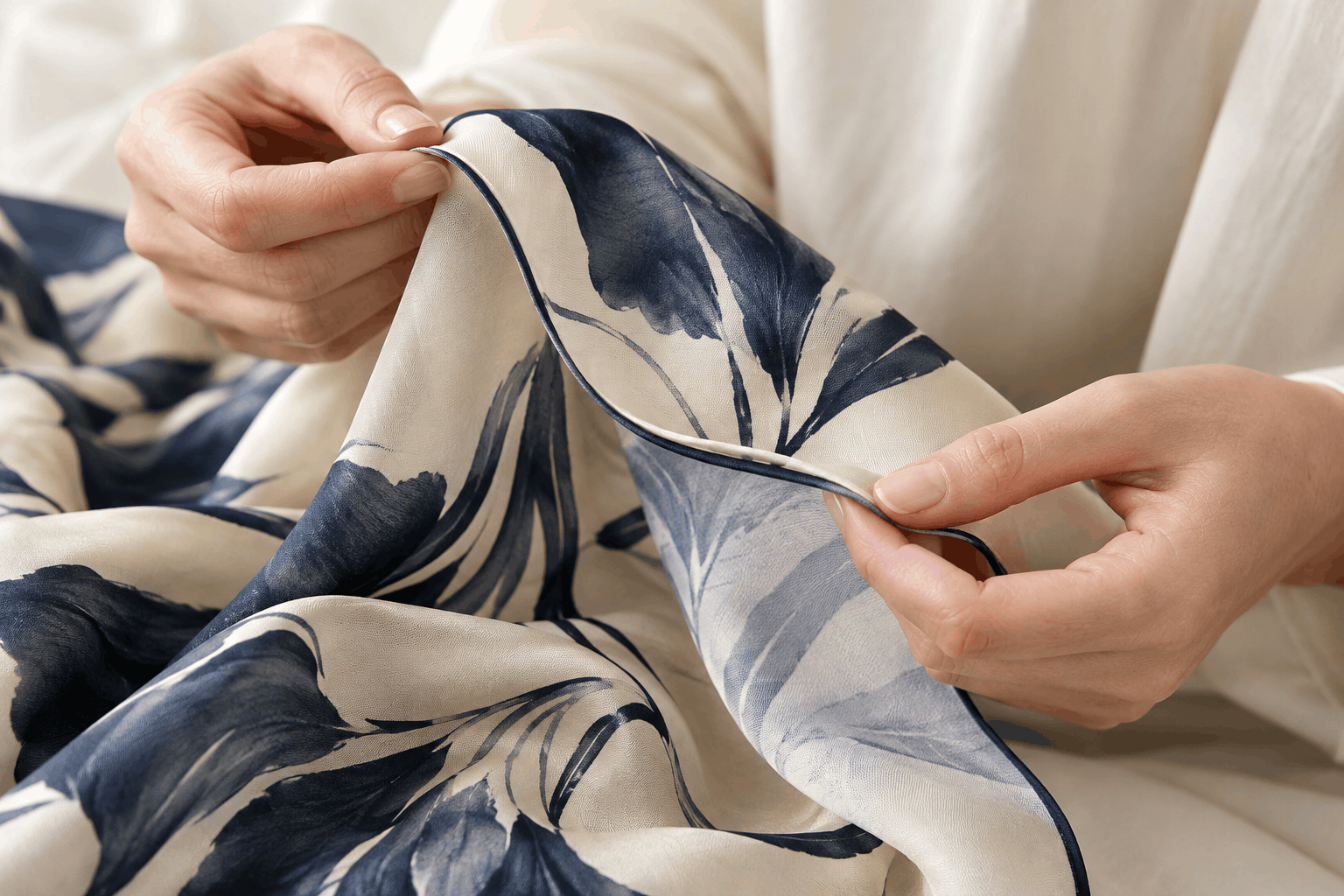
Luxury should be supported by details you can see and descriptions you can understand. Close-up photographs are useful because a beautifully styled image may reveal very little about the actual finishing.
- Print: look for intentional detail and colour relationships. Soft, painterly artwork should not be judged by the same visual standard as a crisp geometric design.
- Reverse: ask whether the back is lighter or has its own printed treatment. A paler reverse is not automatically a defect, but it will matter if your chosen fold exposes both sides.
- Edges: look for secure, reasonably even finishing without obvious loose threads, open sections or distracting puckering.
- Description: distinguish printed artwork, woven pattern, embroidery and the method used to finish the hem.
A hand-rolled hem describes an edge-finishing process; it does not mean the entire scarf was handmade. A machine-finished edge can also be neat and suitable. Compare the finished result and the accuracy of the description rather than making one technique your only test.
At Lanting Loom, material and production details should be checked on the individual product page. Our product FAQ explains this approach.
6. Decide what makes the price worthwhile to you
Set a budget you are comfortable with before comparing collections. You may value an unusual design, a generous format, particularly thoughtful finishing or a meaningful connection to the artwork. Knowing your priorities makes it easier to understand a price difference.
Compare like with like. A compact scarf and a large square use different amounts of fabric; a scarf-only purchase and a gift set may include different items. Check exactly what is included rather than assuming every accessory in a photograph comes with the order.
For a first scarf, give wearability real weight. A design you can imagine wearing next week may bring more pleasure than a more expensive piece you feel obliged to save for a special occasion.
A story can add meaning, too. Look for a specific explanation of the inspiration and a clear distinction between contemporary interpretation and traditional production methods. Explore our design stories if you enjoy understanding the ideas behind a piece.
7. Check care, delivery and returns before ordering
Read the care instructions before buying. If a scarf requires professional cleaning, decide whether that fits your routine. Do not assume that every silk scarf can be hand-washed simply because another one can.
For an online purchase, check the delivery estimate, any applicable import charges and the return conditions. International return postage can affect the practical cost of trying a piece at home.
Lanting Loom’s shipping information, returns policy and silk care guide explain what to review before ordering. If a product detail is unclear, ask before completing the purchase.
A simple first-scarf shortlist
When two or three designs appeal equally, use these questions to make the choice:
- Can I name the first outfit I will wear it with?
- Is the size suitable for my main styling method?
- Do I like the colours that remain visible when it is folded?
- Are composition, finishing and care clearly described?
- Am I comfortable with the total cost and return arrangements?
If one scarf answers those questions clearly and still makes you want to pick it up, it deserves a place on your shortlist. You can discover more adventurous formats later as you learn what you enjoy wearing.
Begin with Lanting Loom’s square silk scarves, or browse the full collection to compare formats. Choose the piece whose design you love and whose details make sense for your life.
Frequently asked questions
What is the best size for a first luxury silk scarf?
For everyday neck styling, a medium square around 60–70 cm is a useful starting point. Choose a larger format if your main aim is a shoulder drape or fuller styling. The best fit depends on the fabric, knot and way you plan to wear it.
Should my first scarf be neutral or colourful?
Either can work. A patterned scarf with a familiar neutral colour and one accent shade is often easy to combine with existing clothes. Check the folded view to see which colours will be most visible.
Is silk satin the same as pure silk?
“Silk satin” describes silk woven in a satin structure, but “satin” alone does not establish the fibre content. Check the stated composition if you want a scarf made from 100% silk.
Does a luxury scarf need a hand-rolled hem?
No single finishing method establishes overall quality. Hand rolling may be a detail you value, but design, fabric, print and the quality of the completed edge also matter. Check the exact claim rather than interpreting “hand-finished” as “entirely handmade”.
How much should I spend on my first silk scarf?
There is no universal minimum that makes a scarf luxurious. Choose a comfortable budget, compare the specifications and included items, and consider how often you expect to wear it. A higher price alone does not tell you whether it is the right first purchase.
