

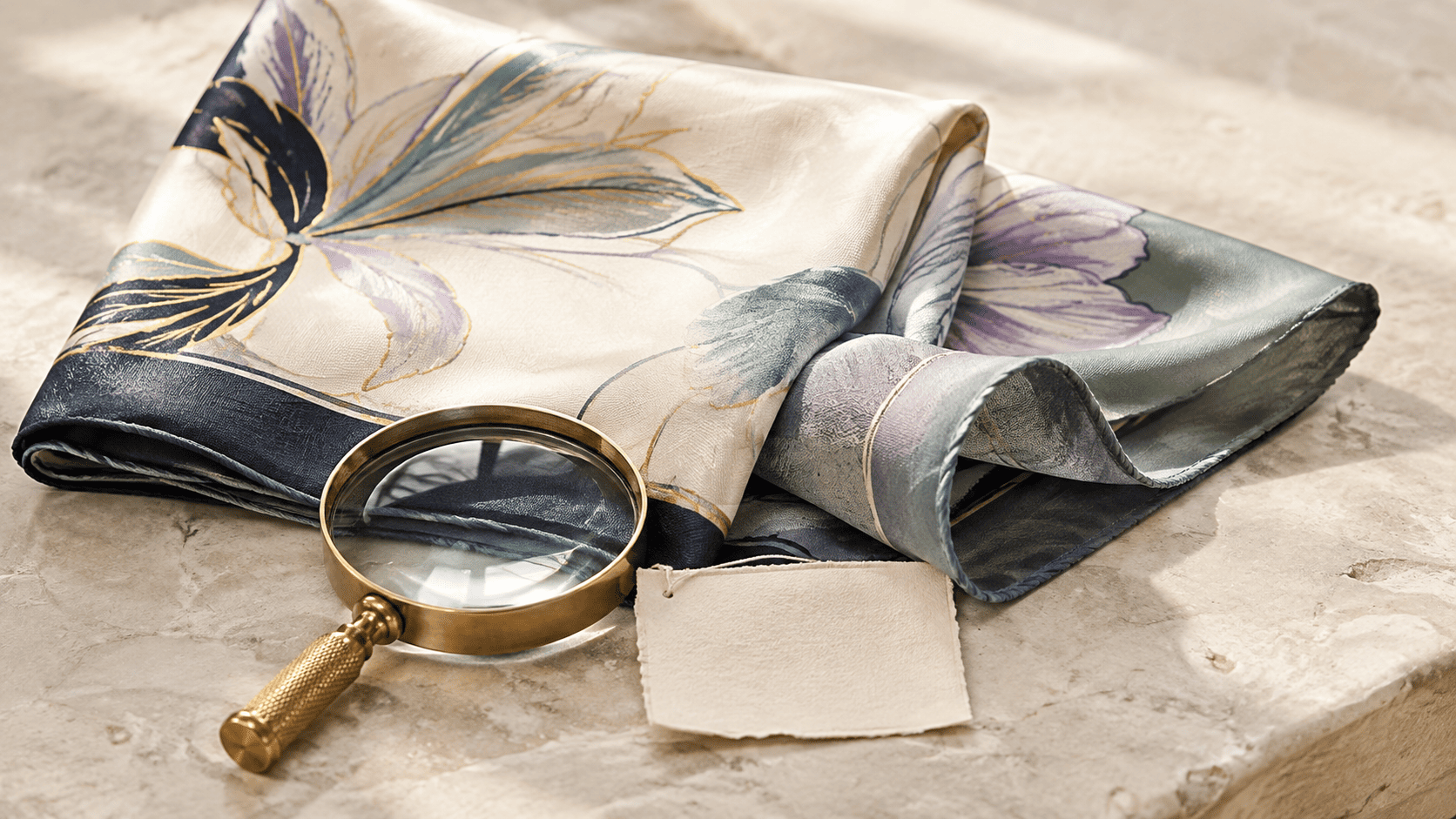
The safest way to tell whether a scarf is real silk is to combine evidence rather than trust one home test. Begin with the fibre label and the seller’s product information. Then examine how the fabric reflects light, drapes, feels and is constructed. These clues can support a judgement, but none proves fibre content on its own. When certainty matters—for example, with a valuable vintage scarf—professional fibre analysis is more reliable than burning, rubbing or wetting the fabric.
Can you identify real silk at home?
You can gather useful evidence at home, but you usually cannot authenticate an unknown scarf with certainty without specialist testing. Weave, dyes, coatings, fabric weight and age all affect appearance and feel. A structured silk twill does not behave like a light silk habotai, while a good polyester satin may feel smoother than a heavily textured natural silk.
It also helps to separate two questions:
- Is the fibre silk? This concerns material composition.
- Is the scarf well made? This concerns weaving, printing, design, edges and finishing.
A scarf can be genuine silk without being exceptional quality. Conversely, clean stitching and an attractive print do not prove that the fibre is silk. For a broader overview of both material and construction, consult the complete guide to silk scarves.
1. Read the fibre label and product description
The label is the best starting point because it makes a specific, accountable claim. Look for the fibre percentage, country of manufacture or processing, care instructions and the responsible business. In the United States, the Federal Trade Commission’s Textile Fiber Rule generally requires covered textile products to disclose the generic fibre names, percentages by weight, the manufacturer or marketer and the country of origin.
Labels can be removed, inaccurate or counterfeit, particularly on second-hand goods, so treat them as strong evidence rather than infallible proof. Check whether the information is consistent across the sewn label, packaging, product page and receipt.
| Wording | What it means |
|---|---|
| 100% silk | A direct fibre-content claim. |
| Silk blend | Silk is combined with another fibre; percentages should be stated where required. |
| Silk satin | Ideally means satin woven from silk, but verify the fibre percentage because satin itself is a weave. |
| Silky, silk-like or silk feel | Describes an impression, not silk fibre content. |
| Mulberry silk | A raw-material description commonly associated with Bombyx mori; it does not by itself prove overall scarf quality. |
2. Observe the lustre as the scarf moves
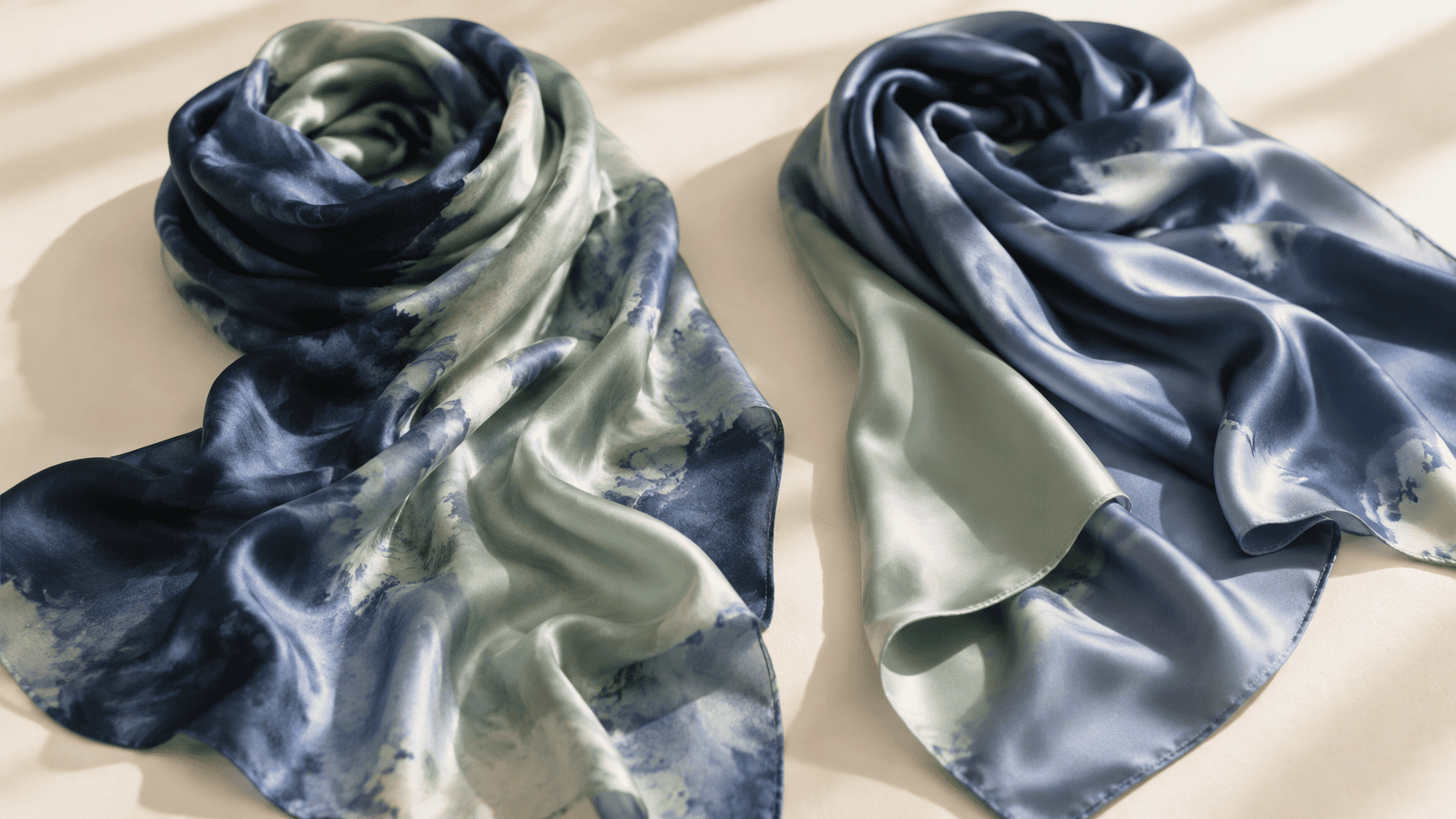
Natural silk often reflects light with depth rather than a fixed surface glare. Turn the scarf slowly near a window. Highlights may shift across folds and reveal subtly different tones because of the fibre’s structure and the way the yarn is woven.
Many synthetic satins show a more uniform shine, but this is only a clue. Matte silk exists, and high-quality manufactured fibres can create sophisticated optical effects. Lighting, colour, weave and finishing can easily mislead the eye.
3. Feel the drape, temperature and handle
Silk typically feels smooth without necessarily feeling slippery. It warms quickly against the skin and combines softness with a degree of resilience. A silk twill may hold a crisp fold, while habotai feels lighter and more fluid. That variation is why “real silk must feel exactly like this” is not a reliable rule.
Compare the unknown scarf with a verified sample of similar weave and weight if possible. Comparing a heavy silk twill with a thin polyester chiffon tells you little. The more alike the constructions, the more useful the comparison becomes.
The Canadian Conservation Institute explains that silk consists primarily of the protein fibroin and that unprocessed silk includes sericin gum in its overview of natural fibres. Those material characteristics help explain silk’s distinctive behaviour, but they cannot be verified simply by touching a finished scarf.
4. Inspect the weave, printing and edges—but judge them separately
Use natural light or a magnifying glass to inspect the surface. Silk twill should reveal a fine diagonal structure; satin has longer floats that create a smoother face; habotai is a plain weave. Understanding these differences prevents a common mistake: assuming all genuine silk should look equally glossy. Our guide to silk twill, satin and habotai explains how construction changes the result.
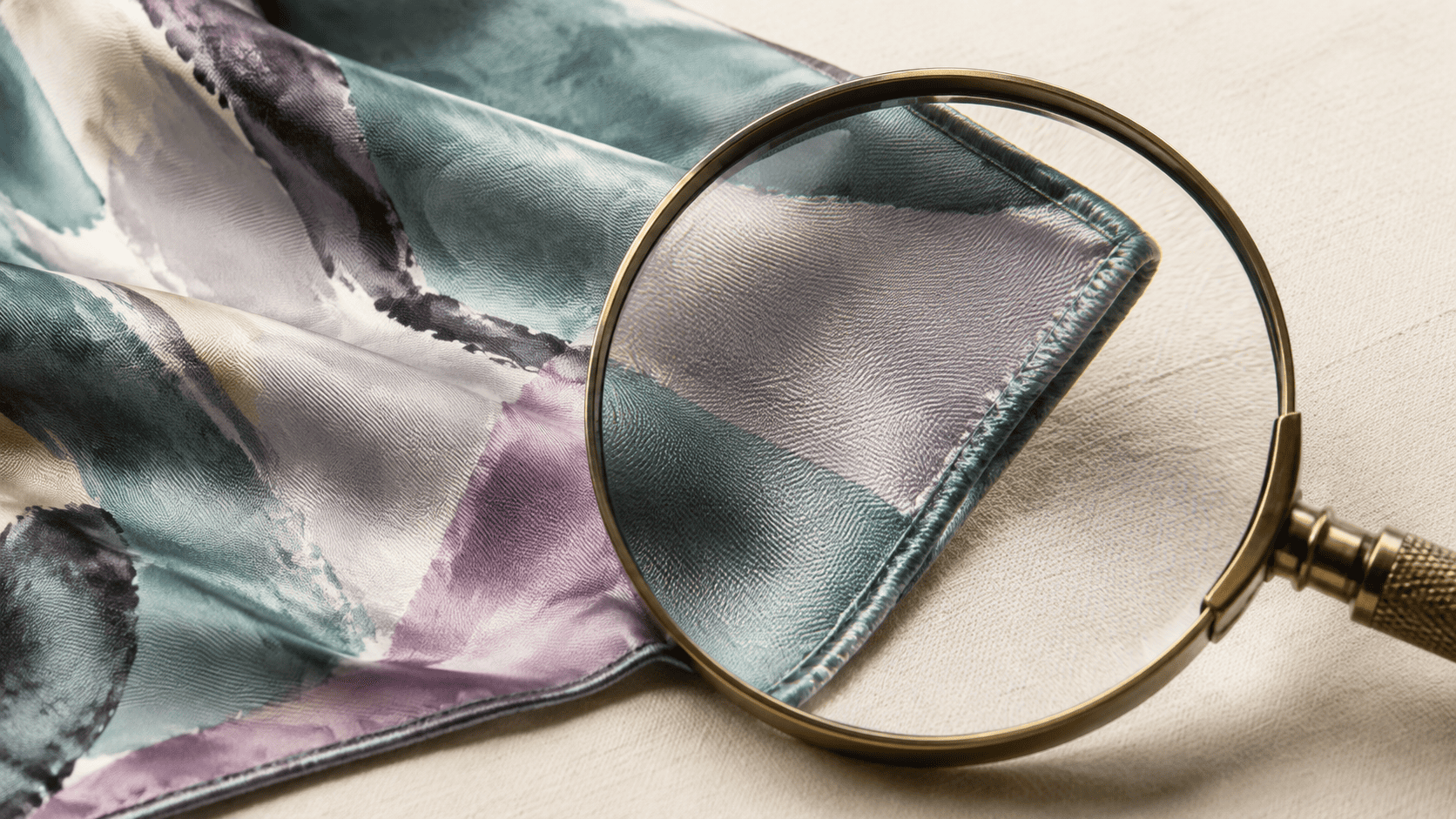
Check whether printed lines are intentional, colours transition cleanly and the reverse is consistent with the printing method. Examine the hem for even stitching, controlled corners and loose threads. Hand-rolled edges can indicate skilled finishing, but machine-finished genuine silk and hand-finished synthetic scarves both exist.
5. Consider the seller, price and traceability
An unusually low price can justify caution, but price is not proof. Genuine silk varies greatly by fibre grade, weave, weight, printing, finishing, production location and brand. Vintage condition and resale knowledge also affect second-hand prices.
More useful questions include:
- Does the seller state the fibre percentage, dimensions, weave and care requirements?
- Are the photographs detailed and consistent?
- Is the business identifiable, with clear contact and return information?
- Do product claims remain consistent across the website, label and packaging?
- Does the seller explain what makes the scarf distinctive beyond simply calling it “luxury”?
Transparent information will not replace laboratory testing, but it reduces uncertainty and gives the buyer recourse if a product is misrepresented.
Which popular silk tests are unreliable?
| Popular test | Why it should not decide the answer |
|---|---|
| Wedding-ring test | Whether fabric passes through a ring depends heavily on size, thickness, weave and finish—not only fibre. |
| Rubbing for warmth | Friction, coatings and expectations influence the sensation; it is subjective. |
| Water-drop test | Absorption changes with weave and finishing, and water may leave a permanent ring. |
| Crush or wrinkle test | Weight and construction alter creasing, and unnecessary crushing can mark the scarf. |
| Burn test | It is destructive, creates fire and fume risks, and blends, dyes or finishes can confuse the result. |
Conservators may use controlled burn testing on a tiny, separated fibre sample as one analytical method; the Canadian Conservation Institute discusses it alongside microscopy in its technical note on identifying natural fibres. That does not make burning part of a finished scarf a sensible consumer test. Do not cut or ignite a scarf to settle a buying question.
When is professional fibre testing worthwhile?
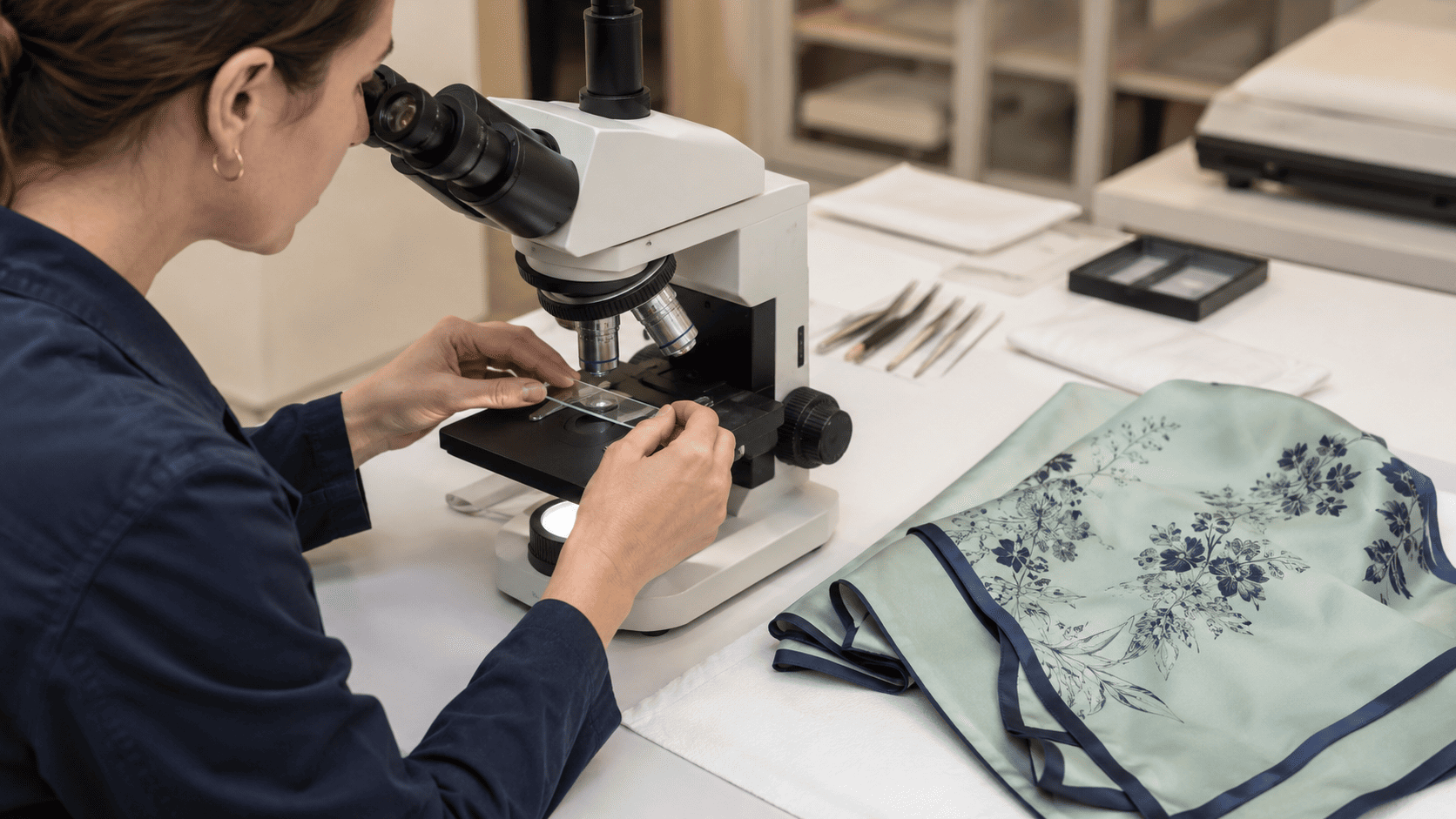
Professional examination is appropriate when the scarf is valuable, historically significant, disputed or being sold with an important attribution. Microscopy can identify characteristic fibre morphology, while specialist laboratories may use additional analytical methods when ordinary microscopy is inconclusive.
A Smithsonian paper on fibre identification in practice describes microscopy as a central method for natural-fibre identification while also acknowledging its limitations. The important lesson is that authenticating material is an evidence-based task, not a parlour trick.
A practical checklist before you buy
- Read the fibre percentage rather than relying on words such as “silky.”
- Confirm the weave, dimensions and care instructions.
- View the scarf under changing natural light.
- Compare its drape with a verified fabric of similar weight and construction.
- Inspect the weave, print, reverse, hem and corners.
- Check the seller’s identity, consistency and return policy.
- Avoid damaging tests; seek specialist help when certainty justifies the cost.
Once you are confident in the material, choose the scarf for wearability rather than fibre prestige alone. Size, colour, construction and design determine whether it will become part of your wardrobe. Browse Lanting Loom’s silk twillies and square silk scarves, or use the silk scarf size guide to compare formats.
Frequently asked questions
Is satin the same as silk?
No. Silk is a fibre; satin is a weave structure. Satin may be woven from silk, polyester or another fibre, so check the composition label.
Does real silk always shine?
No. Lustre varies with weave, yarn, colour and finish. Silk twill usually has a controlled sheen, while silk satin is more reflective and some crepe silks appear comparatively matte.
Can fake silk feel soft?
Yes. Modern manufactured fibres can be extremely soft and fluid. Touch can contribute to an assessment but should not override the label, seller information or professional analysis.
Should I use the burn test on a scarf?
No. It damages the scarf and introduces fire and fume risks. Results can also be confused by blended fibres, dyes and finishes. Use documentary evidence and nondestructive inspection, or consult a textile specialist.
How should I care for a confirmed silk scarf?
Follow its individual care label. Protect it from perfume, cosmetics, abrasion, strong sunlight and excessive heat, and do not assume every silk scarf is washable. See Lanting Loom’s silk-care guidance for cleaning, drying, pressing and storage principles.