

A silk scarf is one of the rare accessories that can change character without changing form. Folded narrowly, it can add a precise line of colour at the neck. Knotted to a bag, it becomes a small graphic accent. Opened across the shoulders, a larger square reveals the complete design and can take the place of a light layer. Choosing well depends on more than finding an attractive print: the fibre, weave, weight, dimensions, finish and design all influence how the scarf feels and behaves.
The simplest buying rule is to begin with use. Decide where and how you expect to wear the scarf, then choose the size and construction that support that purpose. Silk twill is a versatile choice when you want a scarf that holds a clean fold and knot; satin offers stronger surface lustre; habotai is lighter and more fluid. Quality should be judged as a complete combination of material, weaving, printing, finishing and thoughtful design—not by one number or label alone.
What makes a scarf a silk scarf?
Silk is the fibre from which the yarn is made. Twill, satin and habotai describe fabric constructions rather than different species of silk. This distinction matters because two scarves can both be labelled 100% silk yet have very different surfaces, weights and drape.
Most fine fashion scarves are woven from filament silk: long, continuous fibres that can create a smooth surface and clear colour. “Mulberry silk” generally refers to silk associated with the domesticated silkworm Bombyx mori, traditionally fed on mulberry leaves. The description tells you something about the raw material, but it does not by itself guarantee excellent weaving, printing or finishing.
Silk is especially well suited to scarves because it combines low bulk with strength, softness and a natural interaction with light. It can accept detailed colour, fold into compact shapes and sit comfortably close to the skin. A well-designed square also has two visual lives: the complete composition when opened and the smaller fragments that appear after folding.
Silk also carries an unusually deep cultural history. The Metropolitan Museum of Art’s overview of Chinese textiles describes silk’s importance across centuries of weaving, embroidery, dress and exchange. For a closer look at this relationship, read why silk has such an important place in Chinese culture.
Which silk fabric is best for a scarf?
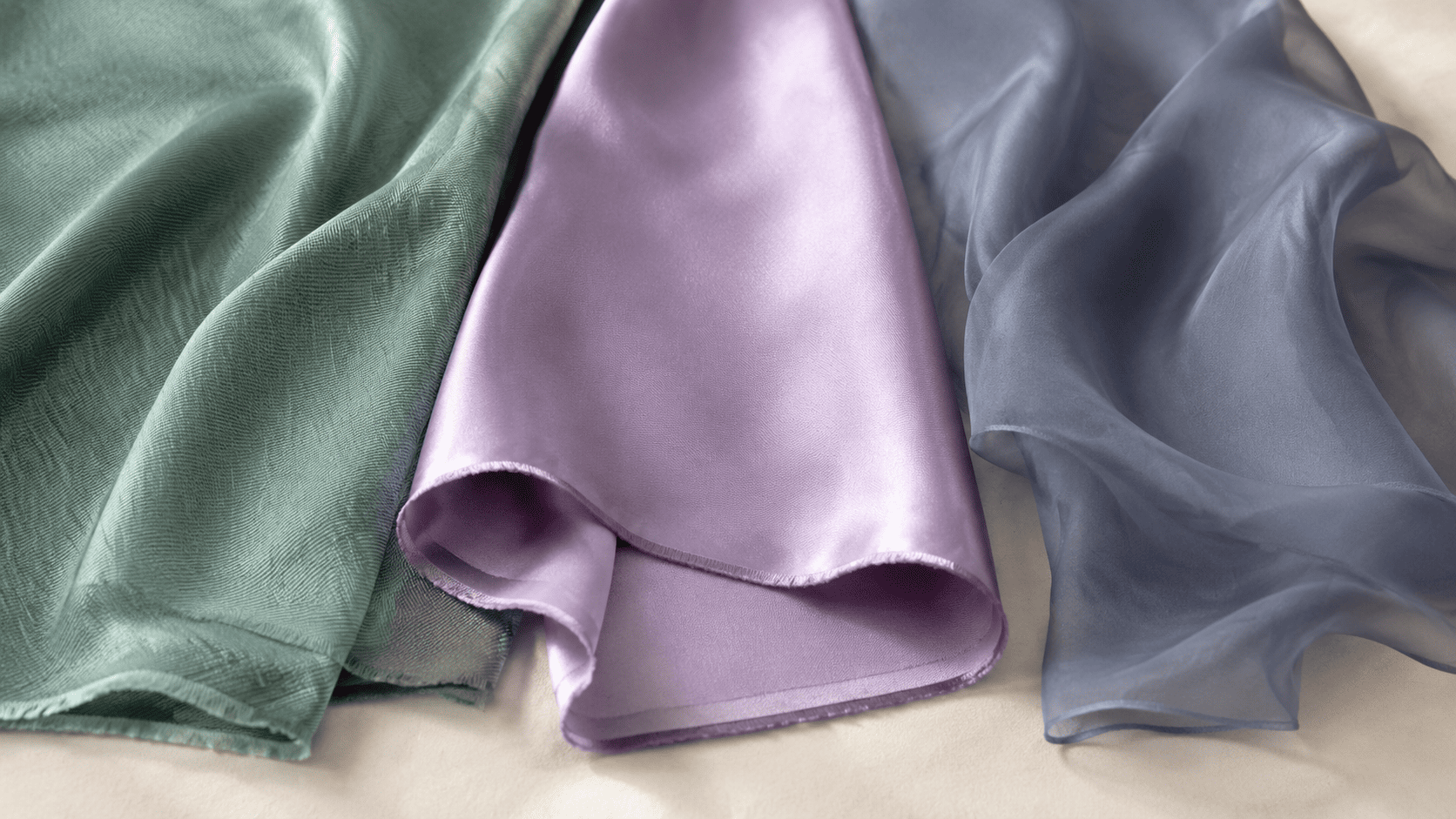
There is no single best silk fabric for every scarf. The right construction depends on whether you prefer structure, shine, lightness or volume. The Smithsonian identifies plain, twill and satin as three fundamental weave structures in its explanation of woven construction. In practical scarf terms, those structures influence how the fabric catches light, holds a fold and moves.
| Fabric | Typical character | Often suits | Consider |
|---|---|---|---|
| Silk twill | Subtle diagonal structure, controlled lustre, enough body for defined folds | Classic squares, twillies, neck knots and bag styling | Weight and finishing still change the result |
| Silk satin | Smooth, luminous face with a quieter reverse | Evening styling and designs intended to emphasize shine | A very smooth surface can show pulls and marks readily |
| Silk habotai | Plain weave, light hand and fluid movement | Soft draping, warm-weather wear and airy larger formats | Lighter versions may not hold sculptural knots as firmly |
The Museum of Fine Arts Boston describes habotai as a soft plain-weave silk, illustrating why fabric names should not be confused with fibre names. Other silk constructions—such as chiffon, georgette, crepe, organza and jacquard—can also make beautiful scarves, but they answer different design needs.
If you are choosing one versatile first scarf, a medium-weight silk twill square is often the easiest place to begin. It balances softness with sufficient structure for a neat knot and allows a printed design to remain visible in small folds. For a deeper comparison, see silk twill, satin and habotai: what is the difference?
How can you judge the quality of a silk scarf?
A quality scarf should be assessed as a complete object. Fibre matters, but so do the yarn, density, weave, print, colour, edges and design. Price and brand recognition are not technical tests, while one impressive specification cannot compensate for poor finishing.
1. Read the fibre label and product description
Look for an unambiguous fibre composition and exact dimensions. “Silky,” “satin” or “silk feel” does not mean the scarf contains silk: satin is a weave and can be produced from different fibres. If a seller uses terms such as mulberry silk or silk twill, the rest of the description should be equally specific.
2. Consider weight in context
Silk is sometimes measured in momme, a traditional unit related to fabric weight. A higher figure normally indicates more material within a given area, but higher is not automatically better. A light habotai and a substantial twill are intended to behave differently. Compare momme only among reasonably similar fabrics and formats, and judge it alongside density, handle and intended use.
3. Look at the weave and surface
Twill should show a fine diagonal structure rather than a flat plastic gloss. Satin should catch light smoothly without looking coated. Habotai should feel light and fluid, not papery. Natural silk lustre usually shifts as the fabric moves; it is more complex than a fixed mirror-like shine.
4. Examine the printing from both sides
Colour does not always appear equally strong on the reverse, especially when the printing method, fabric weight and palette vary. That alone is not a defect. More useful questions are whether lines are intentional, colours are balanced, registration is clean and the design still looks considered when folded. A scarf is worn in motion, so both sides may be seen.
5. Inspect the edges
Hand-rolled hems are valued because they require skilled finishing and give an elegant dimensional edge. Machine-finished hems can also be clean and durable. Whatever the method, inspect the corners, consistency, loose threads and whether the edge complements the fabric rather than distorting it.
6. Judge the design as a wearable composition
A scarf can look impressive when displayed flat yet become muddled when folded. Strong scarf design considers the centre, borders, corners, changes in scale and how colours meet in common folds. The best test is not only “Do I like the picture?” but also “Do I like the fragments I will actually wear?”
Avoid destructive home tests. Burning threads is unsafe, can damage the scarf and does not tell you whether the weaving, finishing or design is good. Reliable lab fibre identification is different from social-media “hacks.” For a valuable purchase, prioritize transparent product information, a trustworthy seller and a clear return policy.
What silk scarf size should you choose?
Scarf dimensions determine the knots, coverage and visual scale available to you. Names such as “small,” “medium” and “large” vary between brands, so always check centimetres or inches rather than relying on the label.
| Format | Common approximate dimensions | Useful for |
|---|---|---|
| Twilly or ribbon | 5–10 × 85–120 cm 2–4 × 33–47 in |
Small neck knots, hair, wrists and bag handles |
| Petite square | 40–50 cm 16–20 in |
Neckerchief folds, hair accents and compact colour |
| Medium square | 60–70 cm 24–28 in |
Everyday neck styling, headbands and many hair knots |
| Classic large square | 85–90 cm 33–35 in |
Neck, shoulders, head covering, belts and statement folds |
| Oversized square | 100–140 cm 39–55 in |
Wraps, dramatic draping and greater coverage |
A larger scarf is not automatically more useful. If you mainly want a small neck accent or bag detail, extra fabric may create unnecessary bulk. If you want shoulder coverage or dramatic folds, a petite square will feel limiting. Height and body scale can influence proportion, but personal style matters more than rigid rules. Our detailed silk scarf size guide compares formats, uses and gift suitability.
How do you choose the right silk scarf for your wardrobe?
Begin with the clothes you already wear. A scarf should expand your wardrobe rather than require a new one around it.
- Choose its main job. Decide whether it will be a neck scarf, hair accessory, bag accent, light wrap or statement piece.
- Select the size. Match the dimensions to the knots and coverage you actually want.
- Select the construction. Choose twill for controlled structure, satin for luminosity or habotai for light movement.
- Find an anchor colour. Look for at least one colour that already appears in your coats, shirts, knitwear, bags or jewellery.
- Check the folded view. Imagine the borders and corners rather than judging only the fully opened artwork.
- Read the care instructions. A scarf that does not suit the care you are willing to provide may remain unworn.
Neutral does not have to mean beige. Deep ink blue, softened jade, plum, burgundy and forest green can function like wardrobe neutrals when they repeat colours you already own. Conversely, a bright scarf can be practical when the rest of your wardrobe is quiet.
Pattern scale also changes the effect. Small repeated motifs appear intricate and even after folding. Large compositions produce more variation: one corner may feel restrained while another feels expressive. That ability to reveal different sections can make a thoughtfully composed square exceptionally versatile.
How can you wear a silk scarf?
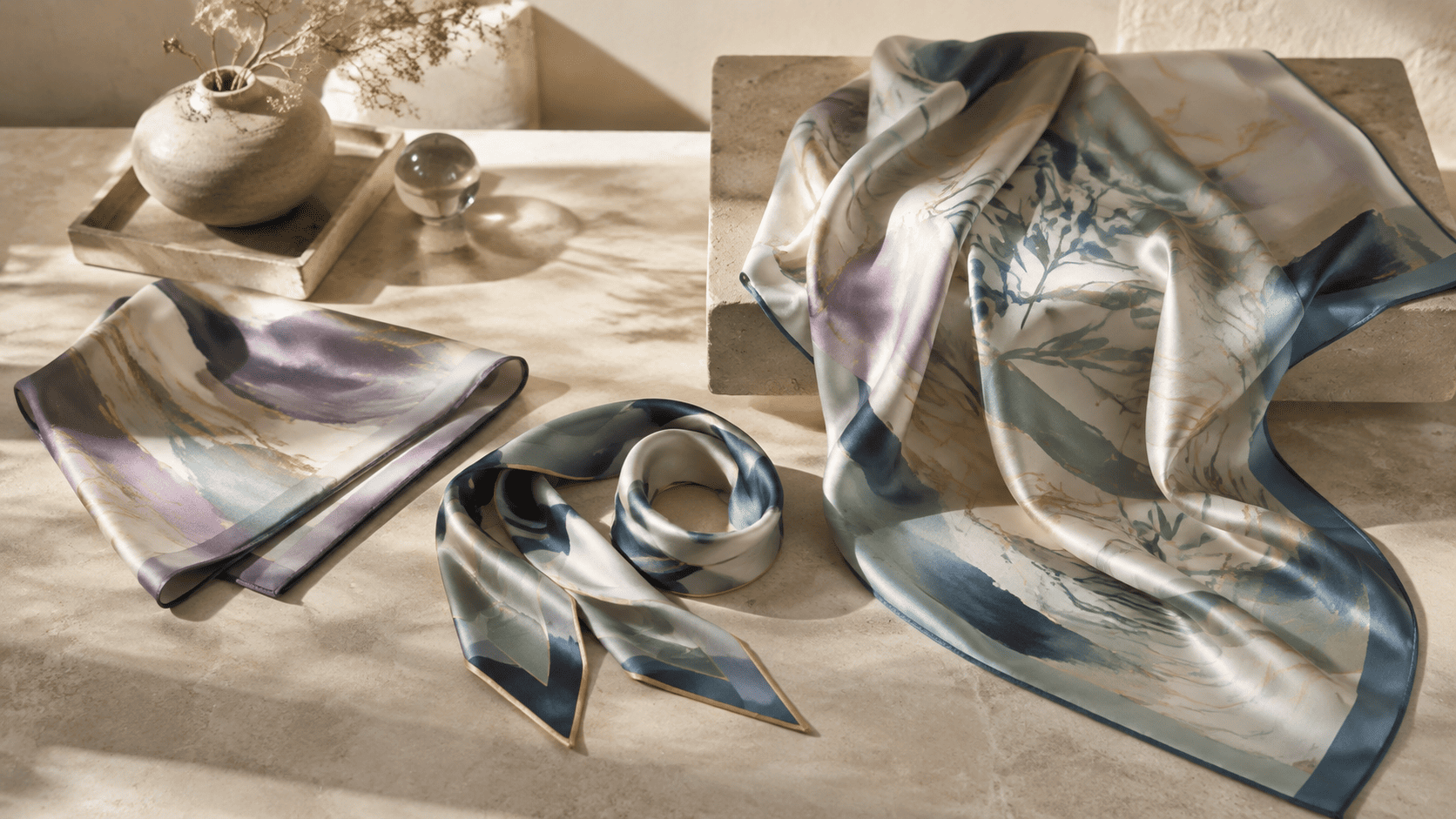
The easiest styles begin with simple folds rather than complicated knots. Fold a square diagonally into a triangle for a relaxed neck drape. Fold it repeatedly into a long band for a neat front knot, headband or belt. Let a large square rest over the shoulders to show more of the artwork.
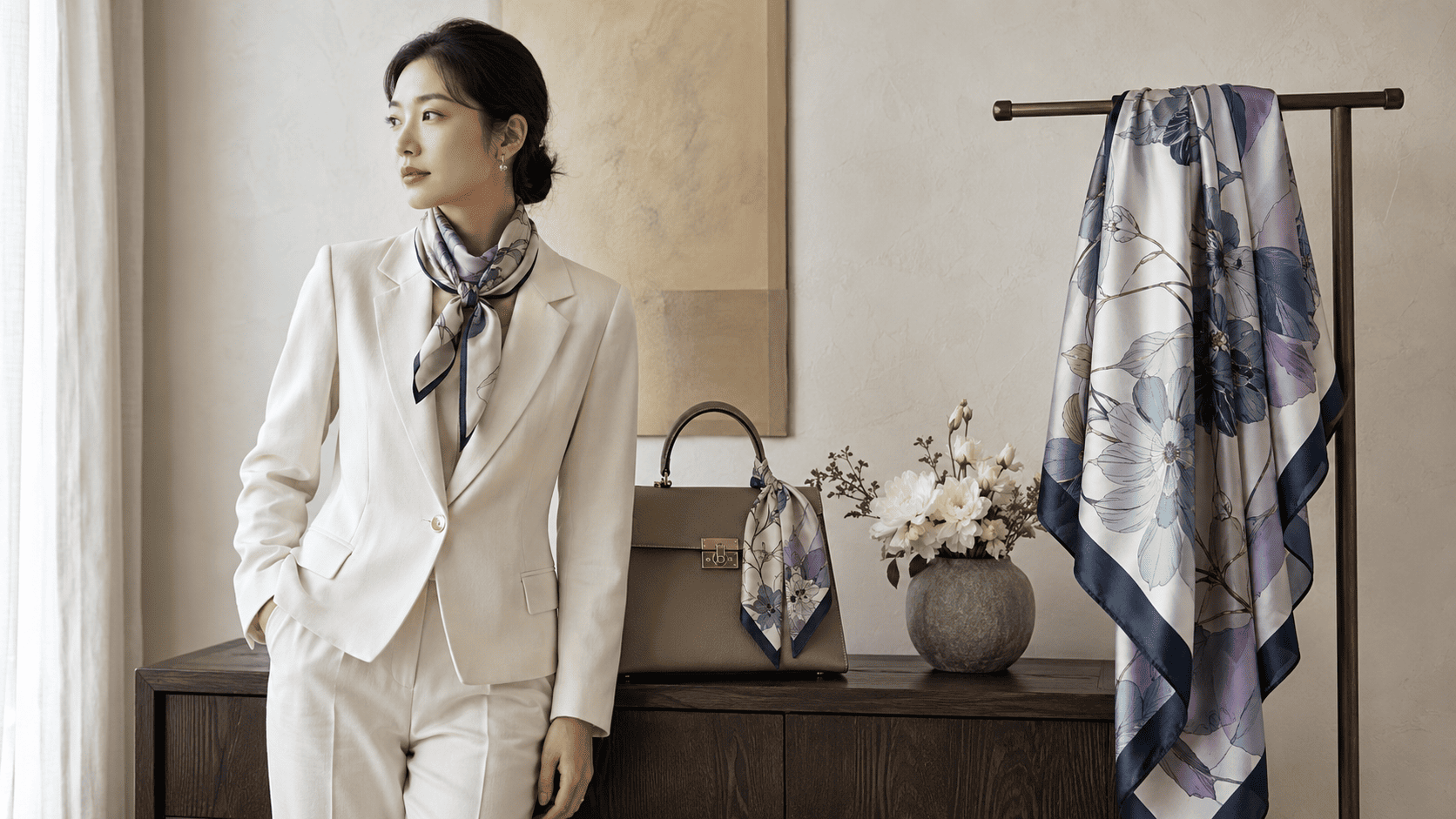
A twilly can circle the neck once, tie around a low ponytail, sit at the wrist or wrap one handbag handle. A medium square can form a small triangle, sailor knot, headband or hair covering. A large square can create those styles with more volume, while also working as a shawl-like layer.
Silk is smooth, so begin with a secure base fold and avoid pulling a knot tighter than necessary. A scarf ring can hold fabric without a bulky knot, although its edges should be smooth enough not to snag the silk. For step-by-step inspiration, explore seven elegant ways to wear a silk scarf.
Does the meaning of a scarf design matter?
Meaning is not required for beauty, but it can give a scarf emotional depth. A design connected with a place, artwork, plant or story may become more memorable because the wearer understands what shaped it. That relationship is strongest when the cultural source has been researched and transformed, not simply copied as decoration.
Chinese silk has long carried artistic and social meaning. The Met’s publication When Silk Was Gold describes luxury textiles as important vehicles through which techniques and patterns moved across Asia. A contemporary scarf can acknowledge that depth while still being designed for an international wardrobe today.
At Lanting Loom, cultural translation begins by identifying what is essential in a source—perhaps the rhythm of bamboo, the quiet resilience of a plum blossom, the framing of a moon gate or the movement of water at the Orchid Pavilion. Those qualities can then become colour relationships, lines, borders and negative space. The goal is not to place as many traditional symbols as possible on silk. It is to create a beautiful accessory whose story rewards closer attention.
When evaluating a culturally inspired scarf, ask whether the maker names the source, distinguishes history from interpretation and explains how the design was transformed. Lanting Loom’s Design Stories present that relationship between source and contemporary wearability.
Is a silk scarf a good gift?
A silk scarf can make an excellent gift because it does not depend on conventional clothing sizes and can carry a personal message through colour or design. It is especially suitable for birthdays, graduations, professional appreciation, new chapters, anniversaries and host gifts. The challenge is choosing for the recipient rather than for yourself.
Observe the colours they repeat, the scale of accessories they prefer and whether their style is minimal or expressive. A twilly is approachable for someone who enjoys small accents or handbags. A medium square offers broad everyday use. A large square feels more substantial and gives the design greater presence, but may be less natural for someone who rarely wears accessories.
Meaning should support the relationship. Orchid imagery may express admiration for cultivated character or friendship; plum blossom can recognize resilience and renewal; bamboo can suggest integrity and adaptability. Such interpretations should be offered as context rather than a rigid code. For a recipient-led process, see how to choose a meaningful scarf as a gift, or browse curated silk scarf gift sets.
How should you care for a silk scarf?
The product’s care label always takes priority. Construction, dyes, printing, edge finishing and embellishment can change what is safe, so there is no universal cleaning method for every silk scarf.
- Keep perfume, hairspray and cosmetics from being sprayed directly onto the silk.
- Blot spills with a clean white cloth; do not rub or experiment with concentrated stain removers.
- Use professional cleaning when the label requires it or when the print, finish, stain or colourfastness is uncertain.
- If hand washing is expressly permitted, use cool water and an appropriate gentle cleanser; never twist or wring.
- Dry flat away from direct sunlight and heat.
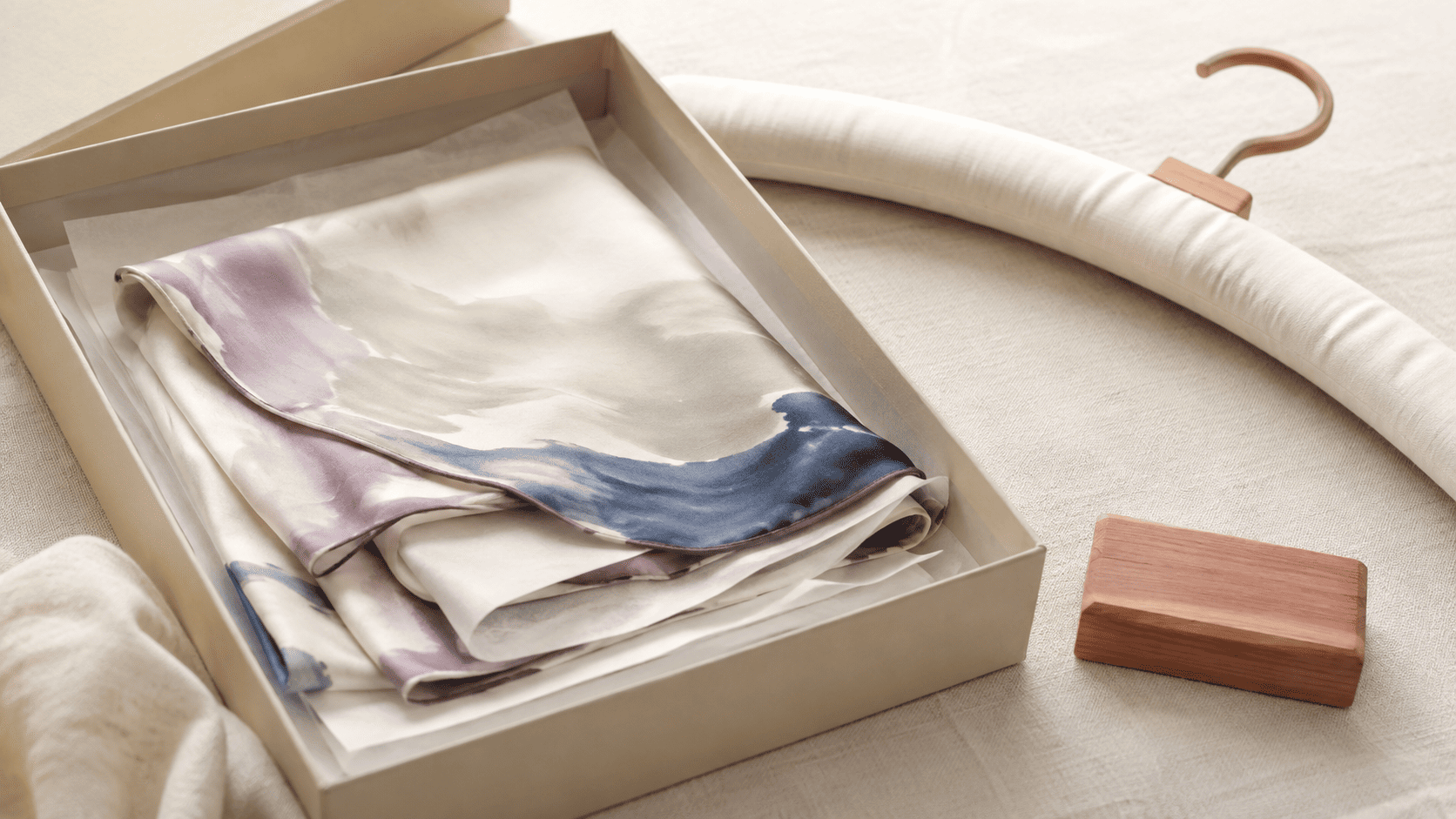
- Store completely clean and dry, loosely folded with acid-free tissue or on a smooth padded hanger.
- Keep sharp jewellery, exposed zips and rough bag hardware away from the surface.
The Canadian Conservation Institute explains that textiles can be affected by light, physical forces, water, pests, pollutants, heat and humidity in its guidance on caring for textiles and costumes. A wearable scarf does not need museum storage conditions, but the same principles—clean handling, limited light, gentle support and a stable dry environment—are useful. Consult Lanting Loom’s complete silk-care guidance before cleaning or pressing.
What should you check before buying?
Before completing a purchase, confirm the following:
- the exact fibre composition;
- the weave or fabric type;
- dimensions in centimetres or inches;
- how the edges are finished;
- the care requirements;
- photographs showing both the full design and useful details;
- shipping, duties and return conditions;
- whether the design still appeals when imagined in folds;
- whether its colours connect with the intended wardrobe or recipient.
A silk scarf is most valuable when it is worn. The strongest choice is therefore not necessarily the largest, brightest, heaviest or most expensive scarf. It is the one whose material, scale and story invite you to reach for it repeatedly.
Explore Lanting Loom’s silk twillies for focused accents, or discover square silk scarves for compositions that transform with every fold.
Frequently asked questions
What is the most versatile silk scarf size?
A medium square of approximately 60–70 cm is highly versatile for everyday neck and hair styling without excessive bulk. A classic 85–90 cm square offers more coverage and styling options, but its extra volume may not suit every wearer. The best size depends on the intended use.
Is silk twill better than silk satin?
Neither is universally better. Silk twill generally offers more structure and a controlled sheen, making it practical for defined folds and knots. Silk satin has a smoother, more reflective face and suits designs or occasions where luminosity is central.
Does a higher momme number always mean better silk?
No. Momme helps describe weight, not overall quality. A higher number generally means a denser or heavier fabric, but the ideal weight depends on the weave and intended use. Fibre, weaving, printing, finishing and design must be considered together.
How can you tell whether a scarf is real silk?
Start with the fibre label, seller transparency, price context, surface, drape and return policy. Real silk often has a nuanced lustre that changes with the angle, but appearance alone is not definitive. Avoid destructive home tests; professional fibre analysis is more reliable for a valuable or disputed item.
Can you wash a silk scarf at home?
Only when the individual care label explicitly permits it. Some washable silk scarves can be handled gently in cool water, while particular dyes, prints, finishes and hand-rolled edges may require professional cleaning. Never assume that all 100% silk scarves share the same care instructions.
Why do silk scarves make meaningful gifts?
They combine beauty, utility and personal interpretation without requiring a conventional clothing size. Colour, format and design story can be matched to the recipient, making the gift feel selected rather than generic.