

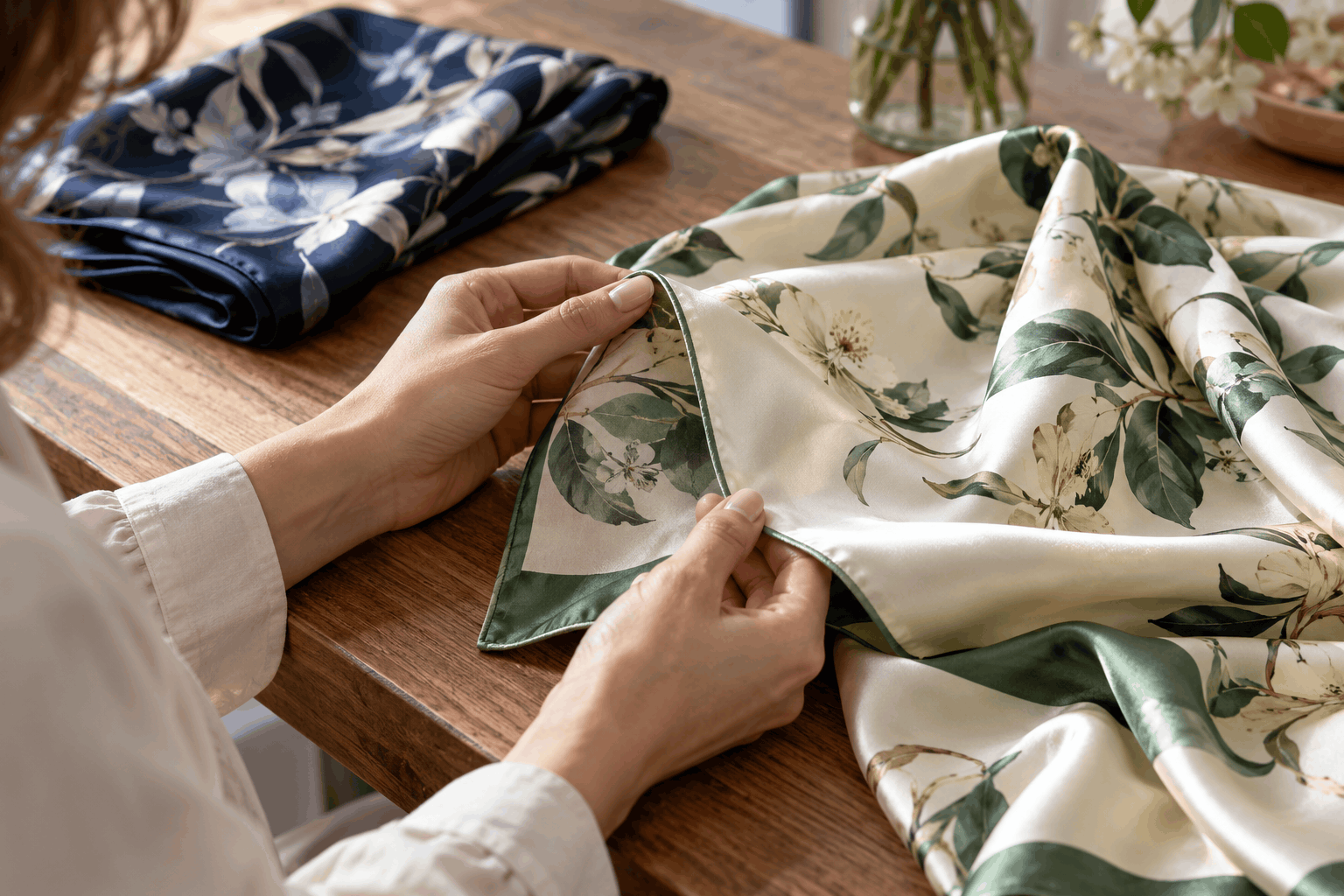
A silk scarf can bring colour to a clothing rail, complete an outfit and offer a gift option without adding another garment size. For an independent boutique, however, a beautiful design is only part of the buying decision. The range also needs to fit your customers, your available cash and the way your shop sells.
When buying wholesale silk scarves for an independent boutique, look for a coherent assortment, clearly specified materials, consistent finishing, workable order quantities and transparent pricing. Confirm replenishment, sales-channel permissions and after-sales terms before committing.
1. Start with your customer and your shop
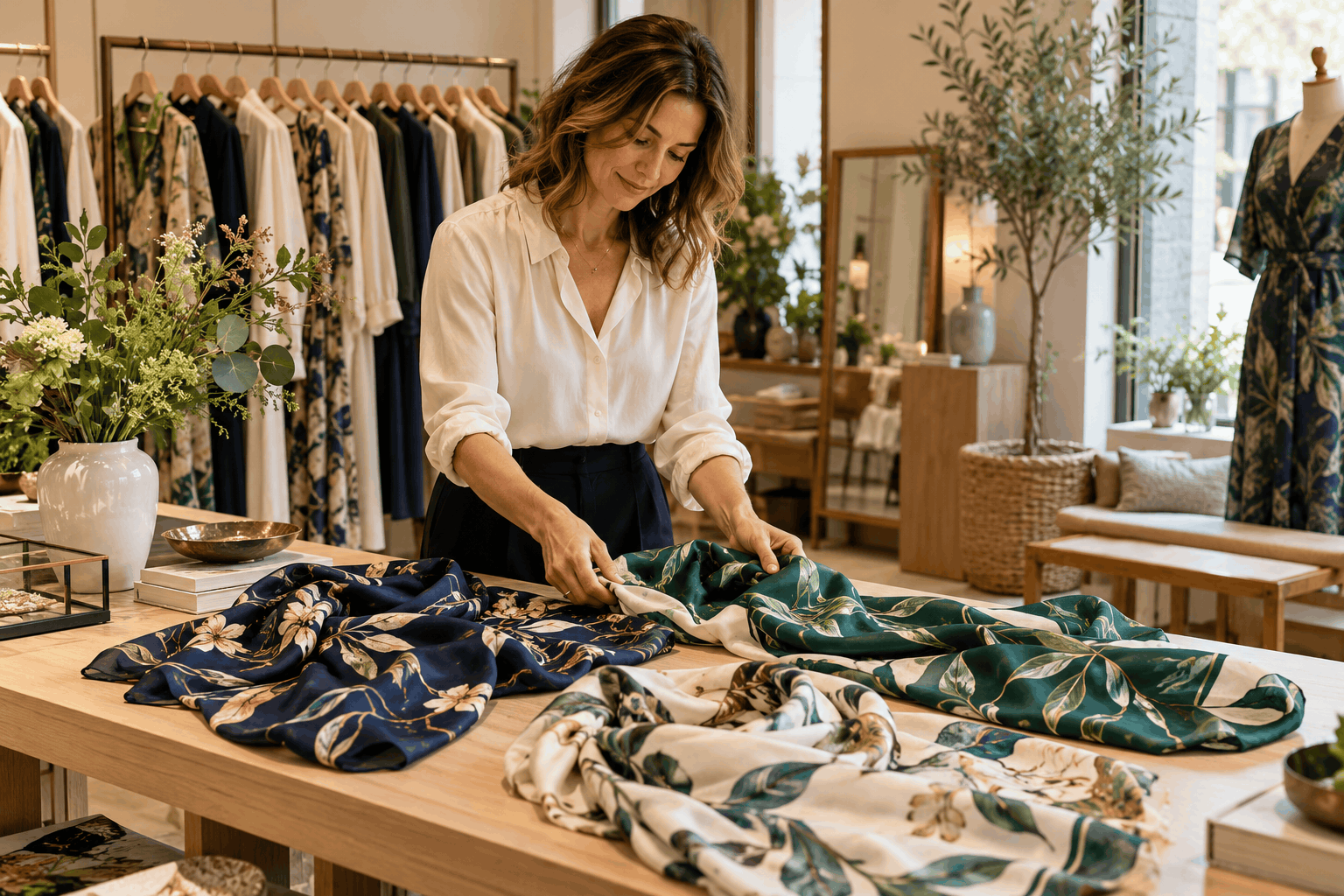
Think about the purchases your customers already make. Does your boutique sell understated wardrobe pieces, expressive occasionwear or gifts with an artistic story? A scarf should have a clear place in that selection.
Review your existing colours, typical accessory prices and common gifting occasions. Consider whether customers are likely to wear a scarf at the neck, over the shoulders or on a handbag. These uses can call for different proportions.
Before contacting suppliers, write a short buying brief covering:
- Your customer profile and the role scarves will play in the shop.
- Your intended retail price range and opening-order budget.
- Preferred colours, formats and styling uses.
- Your selling channels and required arrival date.
A focused brief makes it easier to compare relevant proposals instead of selecting attractive products that have little connection to one another.
2. Build an assortment with a reason for every design
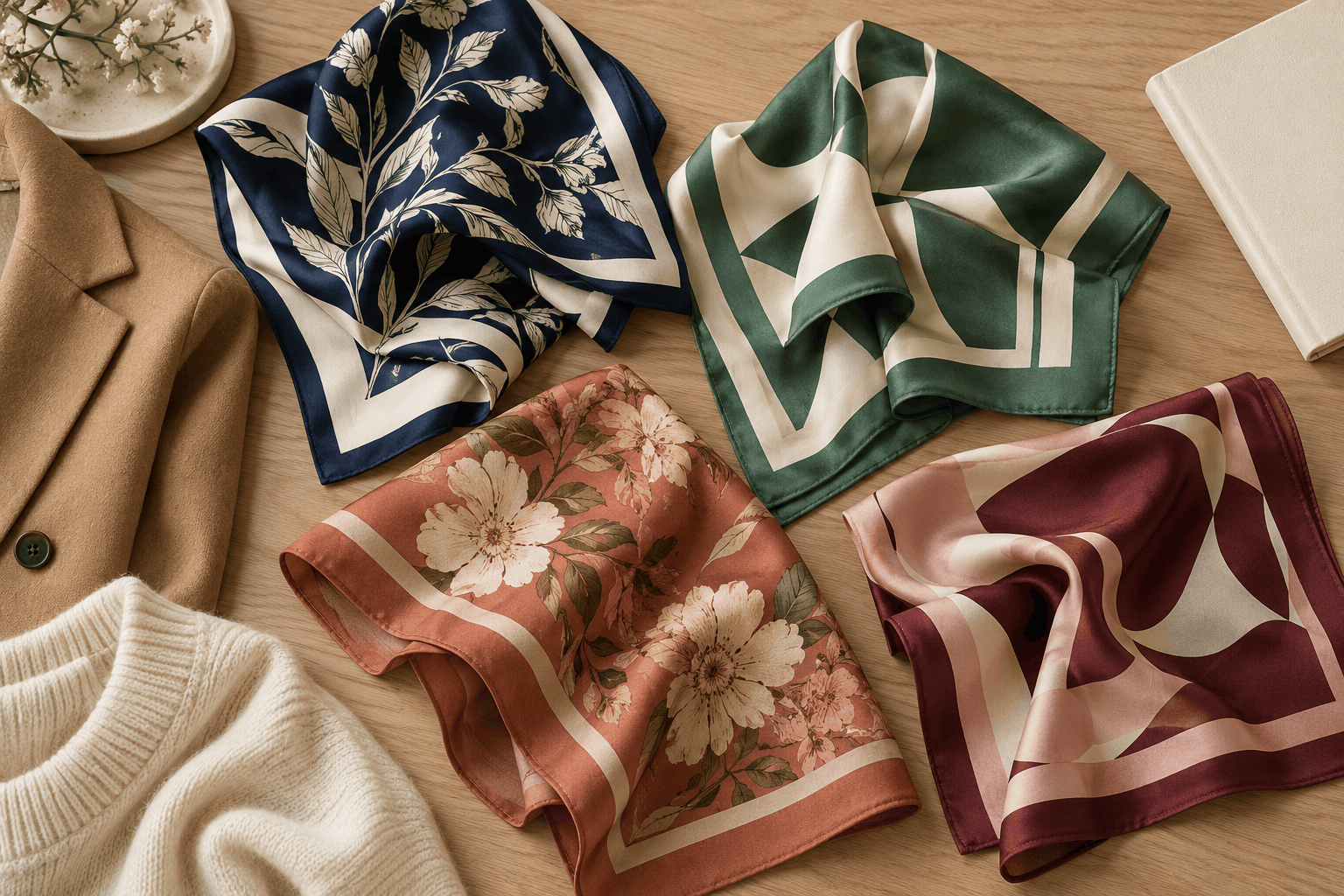
A small opening range can include an easy neutral, a colour that complements your current clothing collection and a more expressive print. This is a planning approach, not a fixed formula: your customers and sales history should determine the balance.
Check how the designs look together on a table or rail. Similar palettes can create a recognisable collection, but several near-identical options may compete for the same customer rather than broaden the offer.
Balance breadth with depth. More designs give customers choice, while more units of selected designs give you stock to sell after the display piece attracts attention. Buying one of everything can leave a fragmented range and little opportunity to learn which designs sell consistently.
For format decisions, use our guide to choosing a silk scarf size, then assess samples alongside the garments you already stock.
3. Ask for specifications that support your product descriptions
Descriptions such as “silky,” “premium” or “luxury finish” do not establish fibre content. Ask for the declared composition, fabric construction, finished dimensions, hem type and care instructions for each product.
Silk is a fibre; satin describes a fabric construction. A satin appearance alone does not establish that a scarf is silk. Your supplier’s product information should make the distinction clear enough for your staff and online listings.
If fabric weight is quoted in momme, record it as part of the specification rather than treating the highest number as an automatic quality ranking. The right weight depends on the intended feel, drape and use.
Request support for any origin, production or certification claims you plan to repeat. Confirm which details apply to the actual stock you are buying, rather than to another collection or a general supplier brochure.
4. Review a finished sample before placing the opening order
A finished scarf lets you assess details that catalogue photographs cannot fully show. Check the surface, print definition, reverse appearance, corners and edges. Look for puckering, loose threads, snags or unexpected differences from the specification.
Fold and tie the sample. A striking open print may become a mostly dark border when worn, while a quiet design may reveal attractive colour combinations in a simple knot.
Review the label and packaging as part of the retail product. Can customers find the care information? Does the presentation protect the scarf without making it awkward to display or store?
Use our silk scarf sampling checklist to organise the inspection. Keep the agreed sample or a clearly identified reference for checking the delivery.
5. Compare the total buying cost and realistic selling price
Compare quotations for the same specification and presentation. Identify what is included in the unit price and what is charged separately: packaging, freight, applicable import charges, samples and any development work.
For a simple product-level comparison, gross margin is the selling price less the cost of goods sold, divided by the selling price. It differs from markup, which uses cost as the denominator. Shopify’s guide to gross margin explains the calculation.
As a hypothetical example, a scarf with an assigned unit cost of £30 sold for £75 generates £45 gross profit and a 60% gross margin. If it sells at £60 after a discount, that becomes £30 gross profit and a 50% margin. These are illustrative figures, not Lanting Loom prices or recommended targets; the selling prices exclude sales tax.
Gross profit still needs to support the costs of running the shop. Allow for discounts, payment fees, damaged display stock and other operating costs in your wider buying plan. A promising full-price margin is less useful if the range routinely needs heavy reductions.
6. Understand opening-order and reorder minimums
Ask whether the minimum applies to the total order value, each design, each colourway or a fixed pack. A small headline minimum can still create a large commitment when several variants are required.
- Can eligible designs be mixed within the opening order?
- Must you buy fixed packs, or can you choose quantities by design?
- Are reorder minimums different from opening-order minimums?
- Do boxes or other presentation options have separate minimums?
- When are payment and any balance due?
Distinguish buying existing designs for resale from commissioning a new scarf. They may involve different availability, development charges and production commitments. Our custom scarf MOQ guide explains why a bespoke minimum needs to be checked against the exact brief.
Compare the total amount committed as well as the price per piece. A larger order should have a clear sales purpose, not simply qualify for a discount.
7. Check how replenishment will work
Ask which designs are available now, which are seasonal and which would need another production run. “Available to order” does not necessarily mean ready to dispatch.
Confirm the expected schedule for both the opening order and a later reorder. If a successful design takes time to replenish, include that gap in your stock planning. Ask how the supplier communicates discontinued designs, material changes and revised prices.
Do not assume a repeat order will be identical without checking. Keep product references and confirm how any changes to colour, fabric, dimensions or presentation will be communicated.
8. Clarify sales channels, imagery and exclusivity
Tell the supplier whether you sell in a physical shop, on your own website, through social channels or on marketplaces. Ask which channels the proposed supply arrangement covers.
Request permission to use product photographs and written descriptions, including any restrictions on editing or advertising use. Your shop will also need accurate dimensions, composition, care details and a concise design story.
If local exclusivity matters, define the products, territory, duration and conditions in writing. An existing design, exclusive colourway and completely bespoke collection are different arrangements. None should be assumed simply because you place a wholesale order.
It is also useful to understand the brand’s own retail presence and promotional calendar when planning your positioning.
9. Make the range easy to understand and try
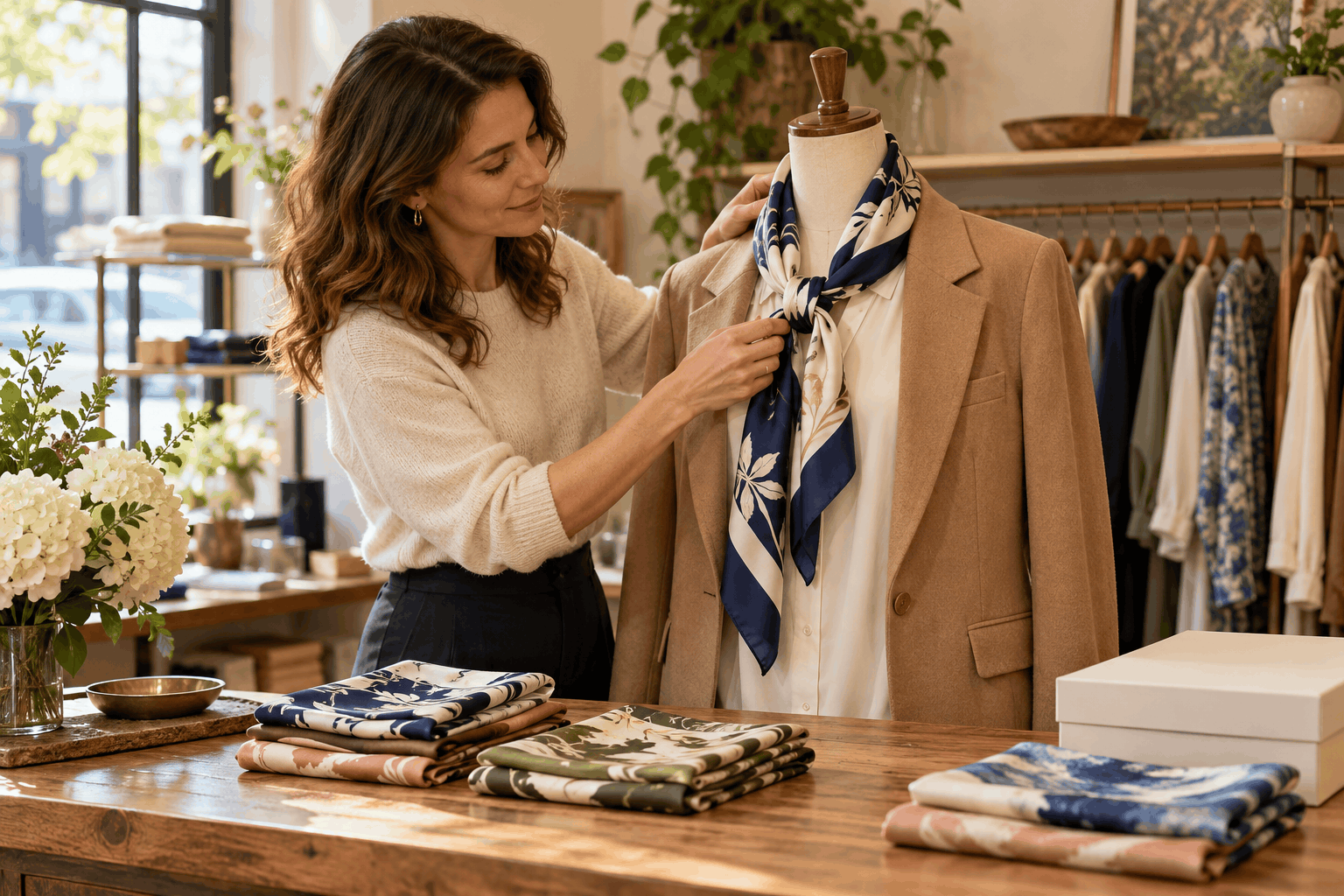
Plan the display before the stock arrives. Show one scarf open enough to reveal its design and another styled with clothing your customers recognise. Keep a mirror nearby so shoppers can see how the colours work on them.
Give staff a short, accurate introduction to each design: what it is made from, its dimensions, its inspiration and a simple way to wear it. A specific story is more useful than repeatedly describing every scarf as luxurious.
Confirm whether gift boxes, cards and care information are included, optional or supplied separately. Count their storage space and cost when comparing offers. For care guidance, start with the product’s own instructions and consult our silk care guide.
10. Agree delivery checks and after-sales terms
Before ordering, establish how shortages, transit damage and product defects should be reported, what evidence is needed and which remedies may be available. Confirm the relevant reporting periods in the trade agreement.
Ask separately about unsold stock. A defect policy does not establish a right to return slow-selling designs, and a consumer returns policy should not be assumed to apply to a trade order.
On arrival, check quantities and product references against the order, inspect condition and record any discrepancies promptly. Keep packaging and delivery information where they may be needed to investigate damage.
Use the first order to learn before expanding
Set a review date for the opening range. Track units sold by design, realised selling prices, customer comments and requests for unavailable colours or formats. Note whether a design sold quickly or simply had fewer units available.
Review display and staff familiarity before concluding that a slow seller has no appeal. A scarf that remains folded in a box has had a different opportunity from one styled beside a popular jacket.
Use that evidence to adjust the next order. Replenishing proven designs and making selective additions can be more manageable than restarting the assortment each season.
Discuss a boutique selection with Lanting Loom
Explore the current Lanting Loom collection to identify designs that suit your shop, then email info@lantingloom.com with your boutique’s location, website, selling channels, preferred designs, approximate quantities and intended launch date.
Ask for confirmation of retail-partner suitability, available products, trade pricing, minimums, sample arrangements and delivery terms. Browsing the retail collection does not establish wholesale availability or terms.
If you want an original collection, explain that in your enquiry and explore our bespoke silk scarf options. Keep the development brief distinct from a request to stock existing designs.
Frequently asked questions
How many silk scarf designs should a small boutique start with?
There is no universal number. Choose a coherent range that fits your budget, display space and customers, while retaining enough units of selected designs to assess demand. Avoid adding variants solely to reach a price break.
Can different designs be mixed in a wholesale order?
That depends on the supplier’s terms. Ask whether the minimum applies per order, design, colourway or pack, and have your proposed quantities confirmed before paying.
Should I choose existing designs or a private-label collection?
Existing designs may suit a buyer who wants to assess customer demand without commissioning artwork. Private-label and bespoke projects require separate discussion of branding, development, samples, quantities and ownership.
What margin should a boutique aim for on silk scarves?
Use a target that fits your own costs and sales model. Compare total product cost with realistic selling prices, including likely discounts, and distinguish gross margin from markup and net profit.
What should I request before placing the first order?
Request current product specifications, sample terms, a detailed quotation, minimums, stock status, reorder information, image-use permissions and written delivery and after-sales terms.
