

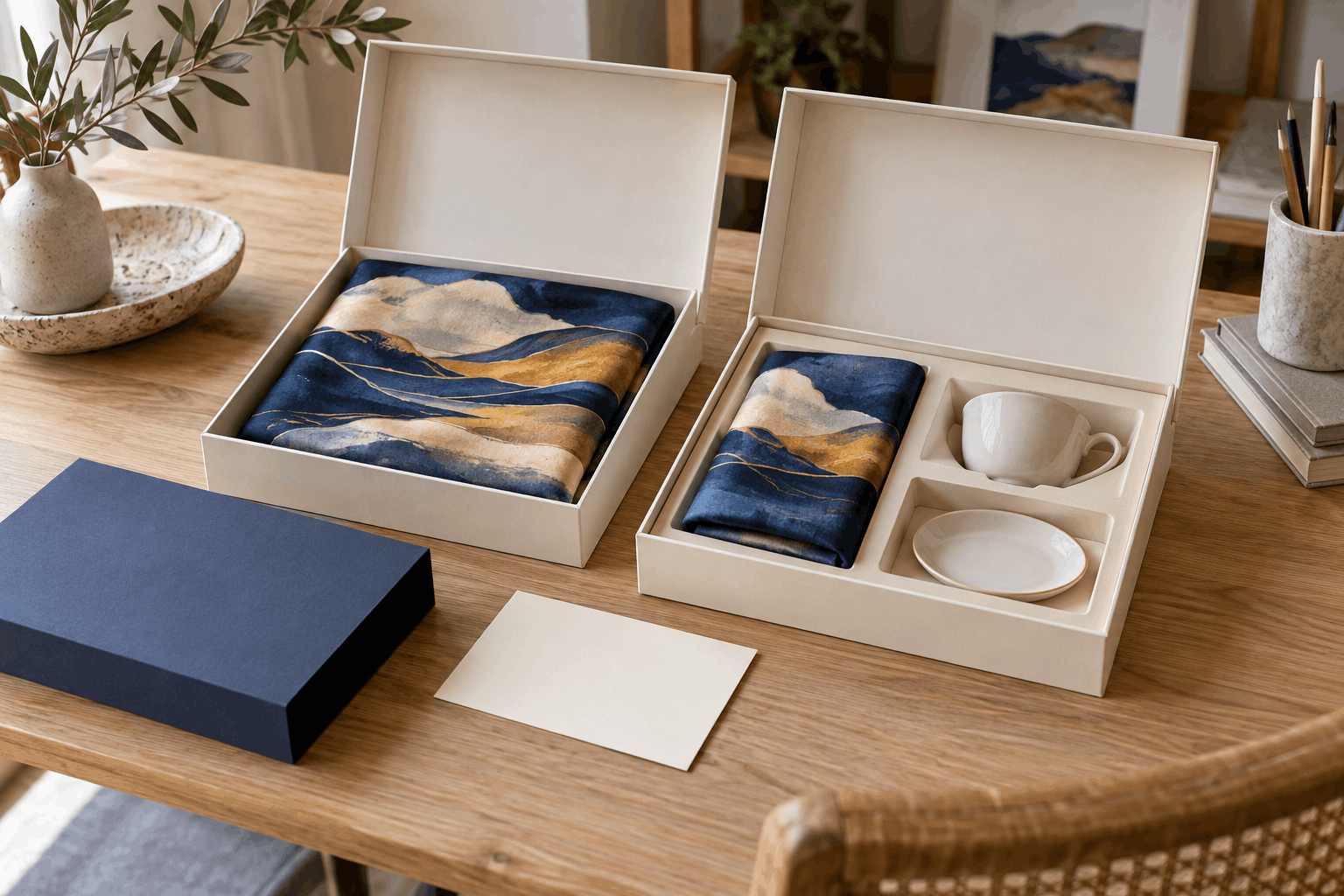
You want a corporate gift that feels specific to your organisation and occasion. But where should that individuality come from: the packaging, the product itself or a combination of both?
Choose custom packaging when an existing product already suits the recipient and the main task is to personalise the presentation. Choose a custom product when the object itself needs to express your story, meet a particular specification or remain connected to the occasion after the packaging is removed.
Combining both can be worthwhile when each serves a clear purpose. The important decision is how much development your project actually needs.
This guide compares custom packaging vs custom product development, including their practical implications for budgets, sampling, quantities and future orders.
What Are You Trying to Change?
Start by identifying what an existing gift cannot currently do for your project.
Perhaps you have found a scarf that suits the recipients, but its presentation does not communicate your anniversary. A personalised sleeve and message card may address that need.
Alternatively, you may want the scarf to interpret a museum collection, a hotel’s architecture or a company’s history. That calls for product design work because the meaning needs to live within the object.
A useful question is: if we removed the packaging, would the gift still need to be different?
If the answer is no, explore presentation changes first. If the answer is yes, define precisely what needs to change about the product before requesting a quotation.
Our guide to writing a corporate gifting brief can help you describe the intended result.
Custom Packaging Has Different Levels of Complexity
Custom packaging can mean anything from a printed card to a newly developed presentation box. These options involve different costs, production requirements and approval decisions.
Personalised Presentation Elements
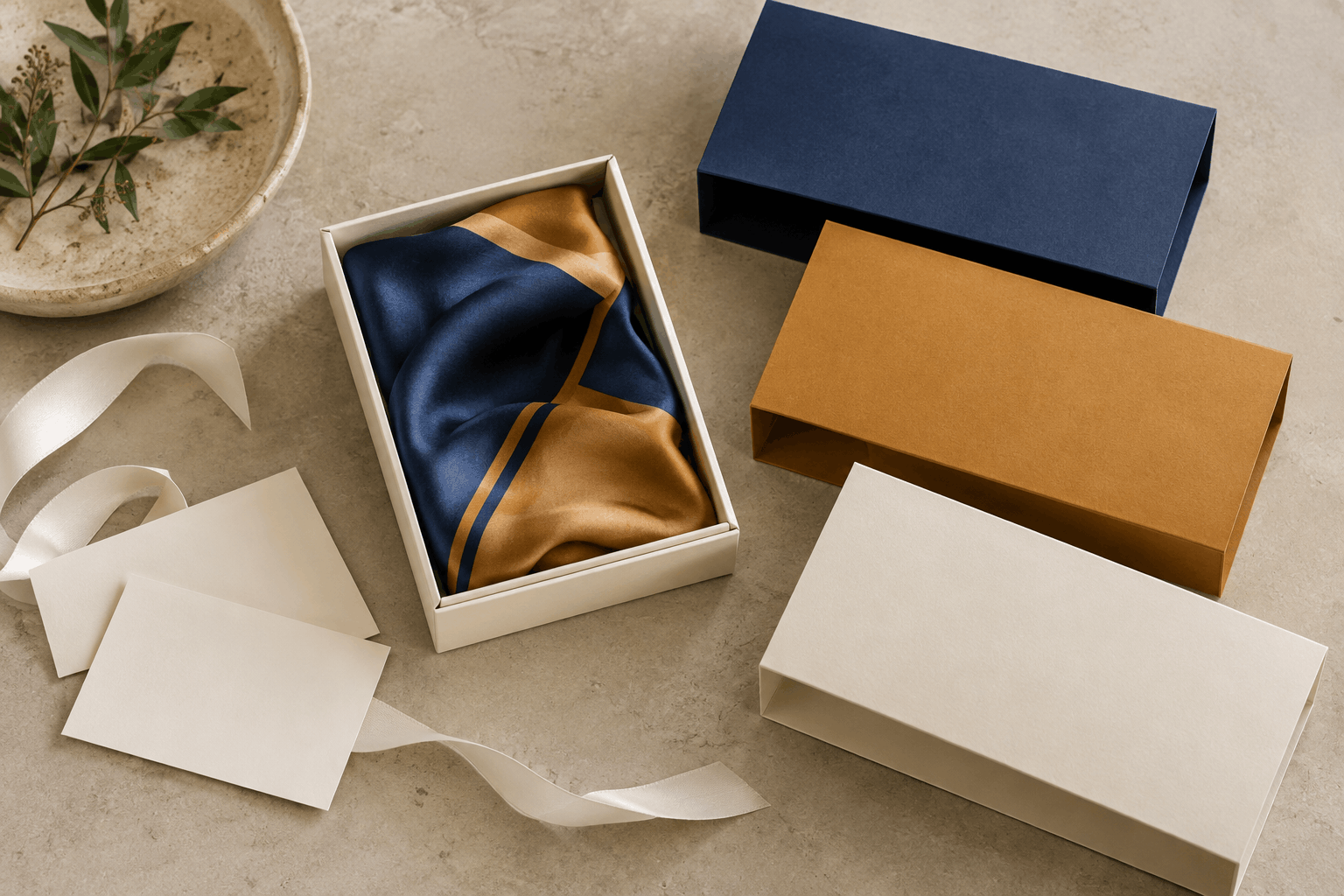
This approach uses an existing product and suitable existing packaging, then adds elements such as a message card, printed sleeve or event insert.
It can be appropriate when the gift is already well chosen and you need to explain who it is from, why it was selected and what the occasion means.
Confirm that any additional components fit the existing box and can be assembled consistently. Even a simple sleeve needs the correct dimensions.
Custom Decoration on an Existing Box
You may retain an established box structure while changing the printed artwork, colour treatment or surface decoration, subject to the supplier’s capabilities.
This creates a more distinctive presentation without necessarily redesigning how the box opens or holds the product. Ask which parts of the packaging remain standard and which are being produced specifically for your order.
A Newly Developed Packaging Structure
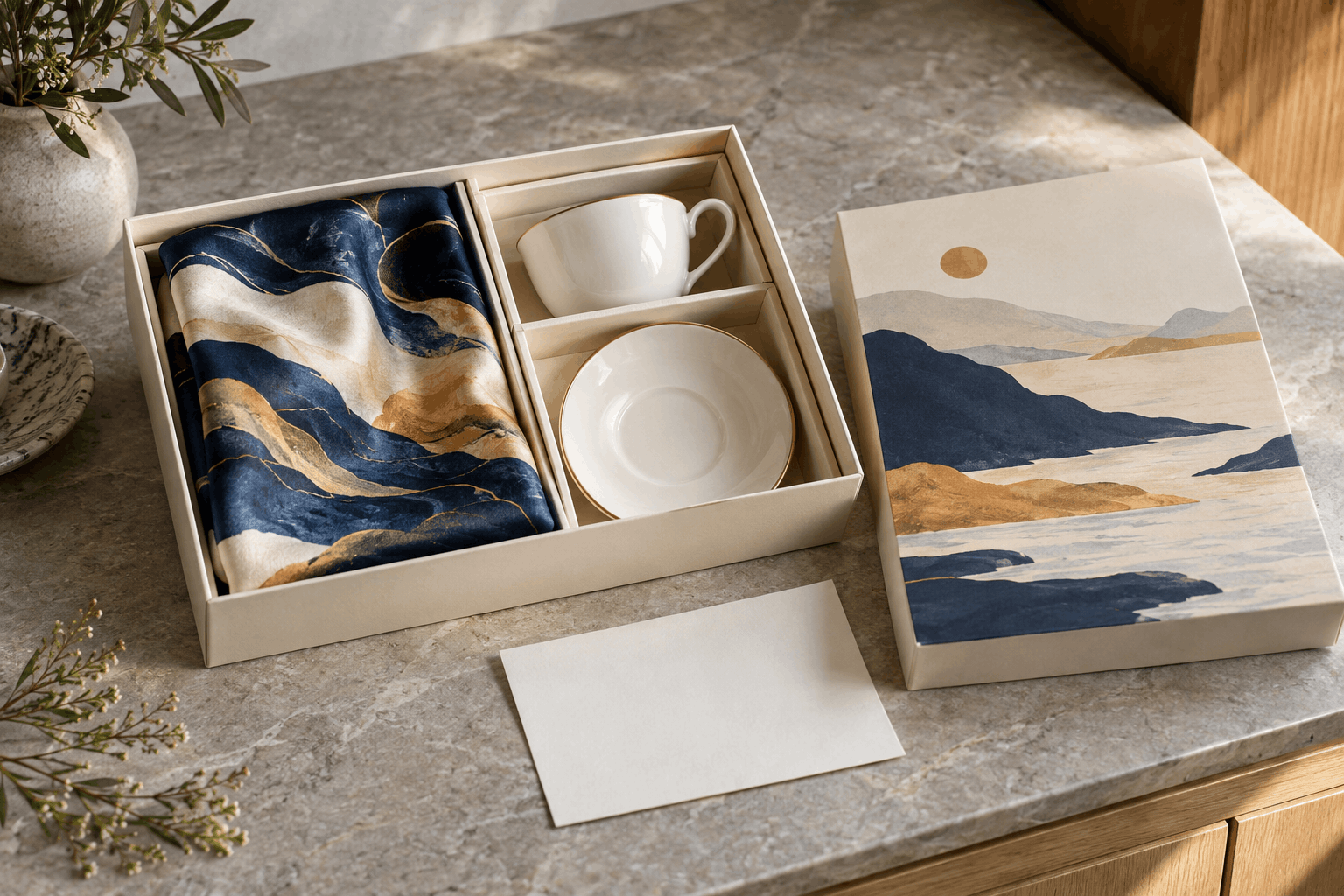
A new box size, closure or internal arrangement is a separate development task. A scarf and teacup set, for example, may need compartments that hold the pieces securely and make them easy to remove.
This involves more than visual design. Fit, assembly, protection and packed dimensions all need attention.
Do not assume that packaging customisation is always the quick option. A complex presentation structure can require substantial sampling and revision.
Custom Products Also Range From Small Changes to Original Development
Product customisation should be described just as carefully.
Adding a discreet corporate mark to an existing design is different from creating original artwork. Changing a colour combination is different from changing the material, dimensions or construction.
For a silk scarf project, the scope might include:
- Adapting an existing design with permission.
- Developing a new colour combination.
- Creating original artwork around a story or place.
- Adjusting the format or dimensions.
- Selecting a different fabric specification or finish.
Availability depends on the supplier, production method and order requirements. Ask for a written description of the proposed changes rather than relying on the word “bespoke.”
Product customisation does not need to centre on a logo. The artwork, proportions or material can provide the distinction. If your main question concerns branding placement, see our guide to putting a logo on the product or packaging.
Compare the Routes Against Your Project Priorities
| Project priority | Route to consider first | What to check |
|---|---|---|
| Make an existing gift specific to an event | Custom card, sleeve or packaging artwork. | Message, fit, print quality and assembly. |
| Create a lasting interpretation of a story | Custom product design. | Artwork development, materials and physical samples. |
| Present several existing items as one gift | Custom packaging or an adapted insert. | Component fit, protection and complete-set availability. |
| Meet a product requirement that existing options cannot satisfy | Product specification development. | Feasibility, minimum quantities and performance requirements. |
| Support several occasions throughout the year | A shared product with changeable presentation elements. | Stock planning, version control and reorder arrangements. |
| Create a coordinated commemorative edition | Custom product and selected packaging elements. | Combined development costs and approval dependencies. |
These are starting points for comparing options. A supplier’s existing capabilities and available components may change which route is most practical.
When Custom Packaging Is Enough
Custom packaging is a strong option when the recipient would already enjoy the chosen product and the missing element is context.
Consider a client appreciation project using an existing scarf design. A well-written card can explain why its story felt appropriate, while a restrained sleeve identifies the organisation and occasion.
The product remains suitable for personal use, and the presentation makes the selection feel deliberate.
This approach can also help when the same gift supports several occasions. You might retain one product and box while changing the card for a speaker invitation, a partnership milestone or an employee celebration.
However, presentation cannot correct an unsuitable product. Before investing in the box, confirm that the item’s quality, design and usefulness are right for the audience.
When the Product Itself Should Be Custom
Custom product development becomes more compelling when the intended meaning needs to remain visible after the gift is unpacked.
A museum may want a scarf that interprets an exhibition through original composition. A hotel may want a wearable keepsake inspired by its surroundings. A company may want a design that marks a significant chapter in its history.
In these situations, the product carries the story into use. The packaging can explain that connection, but it cannot substitute for it.
Custom development also makes sense when existing products do not meet an important practical requirement. Define that requirement clearly so the supplier can assess whether it is achievable within the project’s budget and schedule.
Explore bespoke silk scarf options with a clear distinction between essential requirements and creative preferences.

Where Should the Budget Go?
Begin with an acceptable product standard, then compare what each additional investment contributes.
If the existing product already meets the brief, elaborate product development may add little. If the story depends on original artwork, spending most of the budget on an oversized box may leave too little for the work that matters.
Request separate figures for:
- Product supply and any product development.
- Artwork, setup and sampling.
- Packaging design and production.
- Inserts, cards and personalisation.
- Assembly, inspection and transport.
- Any surplus components that must be purchased.
Ask whether development fees are one-time charges and what would be charged again on a repeat order. Also confirm whether sample fees are credited against production.
Compare the total cost for the same number of complete, deliverable gifts. A low unit price can be misleading if one proposal excludes packing or requires you to purchase extra boxes.
Our guide to choosing corporate gifts at different budget levels provides a broader framework for allocating the budget.
Check Minimum Quantities for Every Component
The product and packaging may have different minimum order quantities. Printed cards, sleeves, boxes and inserts may also be produced in different batch sizes.
Ask what happens if your required quantity falls between those minimums. Will you need to buy additional components? Can they be held for later use, and who will manage storage?
Check minimums by design and colour variation as well as total order size. Dividing one order into several versions may affect the economics.
For repeat programmes, keeping the main product and box consistent while changing smaller printed elements may be worth evaluating. Confirm future availability rather than assuming the same components will remain in stock.
Build the Schedule Around Dependencies
Packaging and product decisions are connected. A change in scarf dimensions can affect folding and box fit. Replacing a teacup can make an approved insert unsuitable.
Confirm the product dimensions and complete set contents before finalising structural packaging. Visual concepts can develop alongside one another, but production needs stable specifications.
Ask for separate milestones for product approval, packaging approval, production completion and final assembly. The complete gift cannot be ready until all required components are available.
For a fixed event date, identify which decisions must be settled first and what simpler alternatives remain feasible if development takes longer than expected.
The Design Council’s design framework emphasises defining the challenge and testing possible solutions. For a gifting project, that supports reviewing a complete sample early enough to resolve fit or presentation issues.
What Should You Sample?
Choose samples that answer the actual questions in your project.
For packaging changes, review dimensions, print, finish, closure and the fit of the real contents. For product development, assess material, colour, construction and usability.
A digital image is useful for layout and wording, but it cannot demonstrate the physical fit of a gift set. It also has limits for colour approval. Adobe’s colour-proofing guidance explains that on-screen reliability depends on the monitor, profiles and viewing conditions.
When both product and packaging are changing, review them together before final release. Agree which features each sample represents and record any differences from the intended production version.
Our bespoke design and approval guide explains how to keep those decisions clear.
A Combined Approach Can Keep Development Focused
You do not have to customise every component to create a distinctive gift.
A custom scarf can be paired with an existing suitable box and an original story card. Alternatively, a carefully selected scarf and teacup can be brought together through a fitted presentation without developing new versions of both products.
These combinations allow you to concentrate development on the part that creates the greatest value.
For a hypothetical anniversary project, the organisation might commission original scarf artwork, use an established box format and place the anniversary date on a removable sleeve. The product retains its relevance after the anniversary year, while the sleeve makes the occasion clear.
Frequently Asked Questions
Is custom packaging always cheaper than a custom product?
No. A personalised card may involve limited development, while a newly engineered box can be a substantial project. Compare the exact scope, quantity and complete delivered cost.
Which option is better for a small order?
Start by checking available products and packaging formats, then explore limited presentation changes. Supplier minimums determine what is practical; there is no universal quantity threshold.
Does a custom product need custom packaging?
No. An established box may work well if it fits, protects the product and supports the intended presentation. A story card can provide the project-specific context.
Can we begin with custom packaging and develop a product later?
Yes, provided the first project is planned as a complete gift in its own right. Recipient feedback may help inform later development. Confirm whether any packaging components could accommodate a future product before ordering surplus stock.
Choose the Part That Needs to Be Different
The right route begins with the project’s purpose. Custom packaging can give a suitable existing gift a clear occasion and identity. Custom product development can turn a story or requirement into something the recipient keeps and uses.
To discuss your options with Lanting Loom, share the audience, occasion, quantity, budget and required arrival date, together with what you want to change. Explore our corporate gifting options to review a suitable balance of product, presentation and personalisation.
