

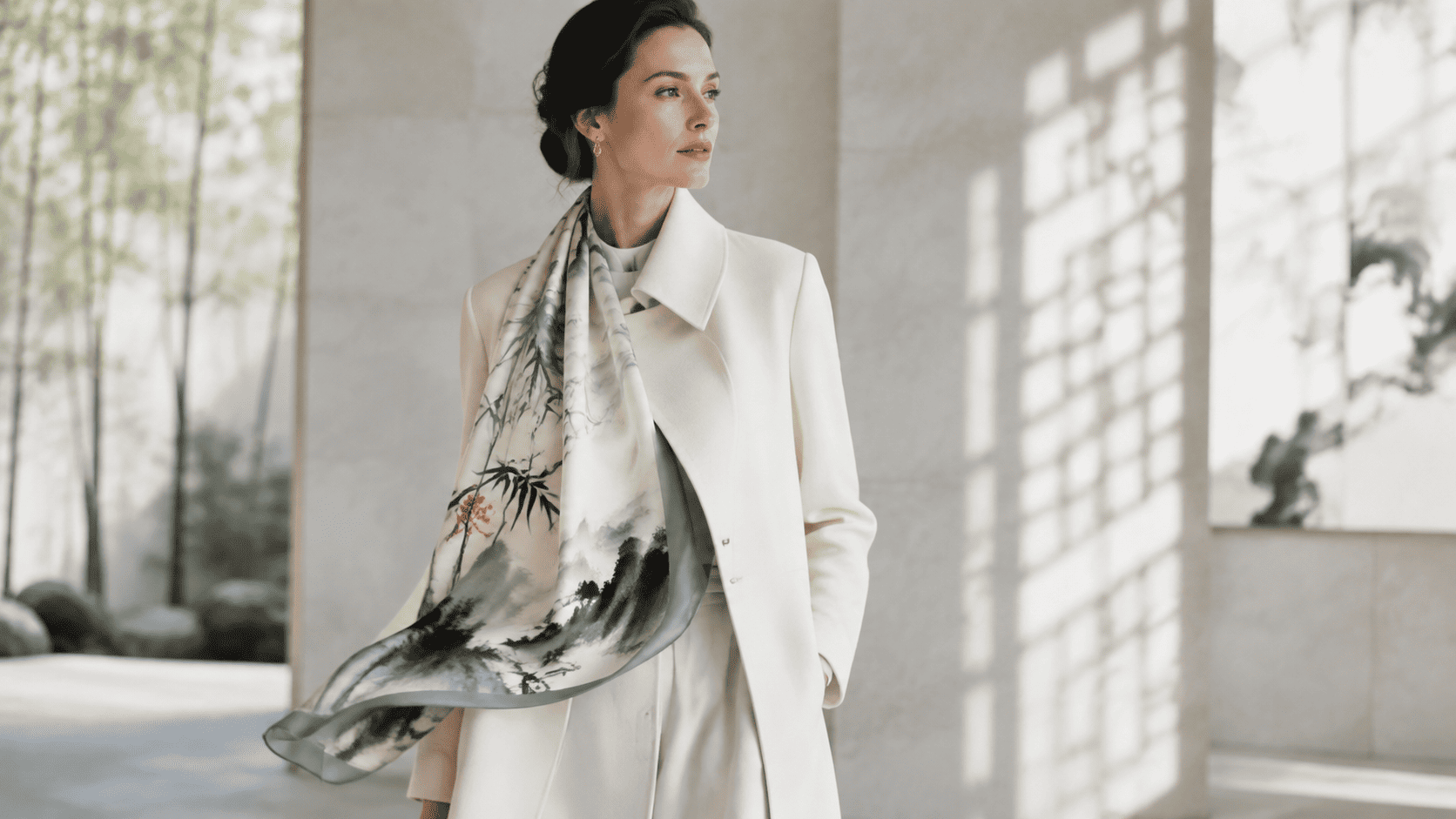
Chinese-inspired fashion today is moving beyond literal copies of historical dress and predictable collections of dragons, red silk and gold embroidery. Its most convincing work begins with research, identifies what is visually or culturally meaningful in a source, and transforms that quality into a garment made for contemporary life.
A bamboo painting might become vertical seam lines and a sense of flexible structure. A garden window can inform the geometry of a jacket. Plum blossom may appear as a cropped seasonal rhythm rather than an all-over floral print. Ink painting can influence movement, balance and negative space without reproducing a scroll on fabric. This process is best understood as translation: source, interpretation, design decision and wearability.
What does contemporary reinterpretation look like?
| Cultural source | A literal approach | A contemporary translation |
|---|---|---|
| Bamboo | Repeated bamboo print | Vertical rhythm, flexible panels or resilient structure |
| Chinese garden | A complete pavilion scene | Layered views, framed openings and geometric seams |
| Ink landscape | Painting copied onto fabric | Tonal depth, flowing movement and deliberate empty space |
| Plum blossom | Dense decorative flowers | Sparse asymmetry, winter contrast and a restrained colour accent |
| Blue-and-white porcelain | A vase image on a dress | Cobalt palette, broken scale and curved compositional lines |
1. Designers are treating tradition as a changing archive
There is no single, timeless form of “Chinese dress.” Clothing changed across dynasties, regions, communities, occupations and contact with other cultures. The twentieth-century qipao itself developed through modern urban life rather than remaining an untouched ancient garment. The Museum at FIT’s China Chic: East Meets West makes this essential point: Chinese fashion has evolved continually and has also influenced dress beyond China.
For a designer, that means research must be precise. “Inspired by the Qing dynasty,” “derived from a Song painting” and “informed by a Suzhou garden” are different starting points. A clearly identified source gives the work direction; the broad label “Oriental” removes history, geography and authorship.
It also leaves room for personal experience. Contemporary Chinese and diaspora designers may approach the same garment, motif or craft through different memories and identities. Tradition becomes material for dialogue, not a rulebook that produces one approved visual result.
2. Motifs are being cropped, enlarged and abstracted
One of the clearest changes is scale. Rather than arranging a complete historical scene across a dress, designers may isolate the curve of a cloud, magnify one petal or let a branch enter from the edge. Cropping creates tension and gives the wearer space to complete the image through movement.
Abstraction also allows deeper qualities to survive without literal copying. The expressive pressure of a brushstroke can become a soft-to-sharp colour boundary. The pause between ink marks can become negative space. The irregular rhythm of rocks or garden paths can organise panels across a coat. Explore five Chinese symbols and their meanings to see why understanding a motif’s context matters before translating its appearance.
3. Historical silhouettes are becoming construction ideas
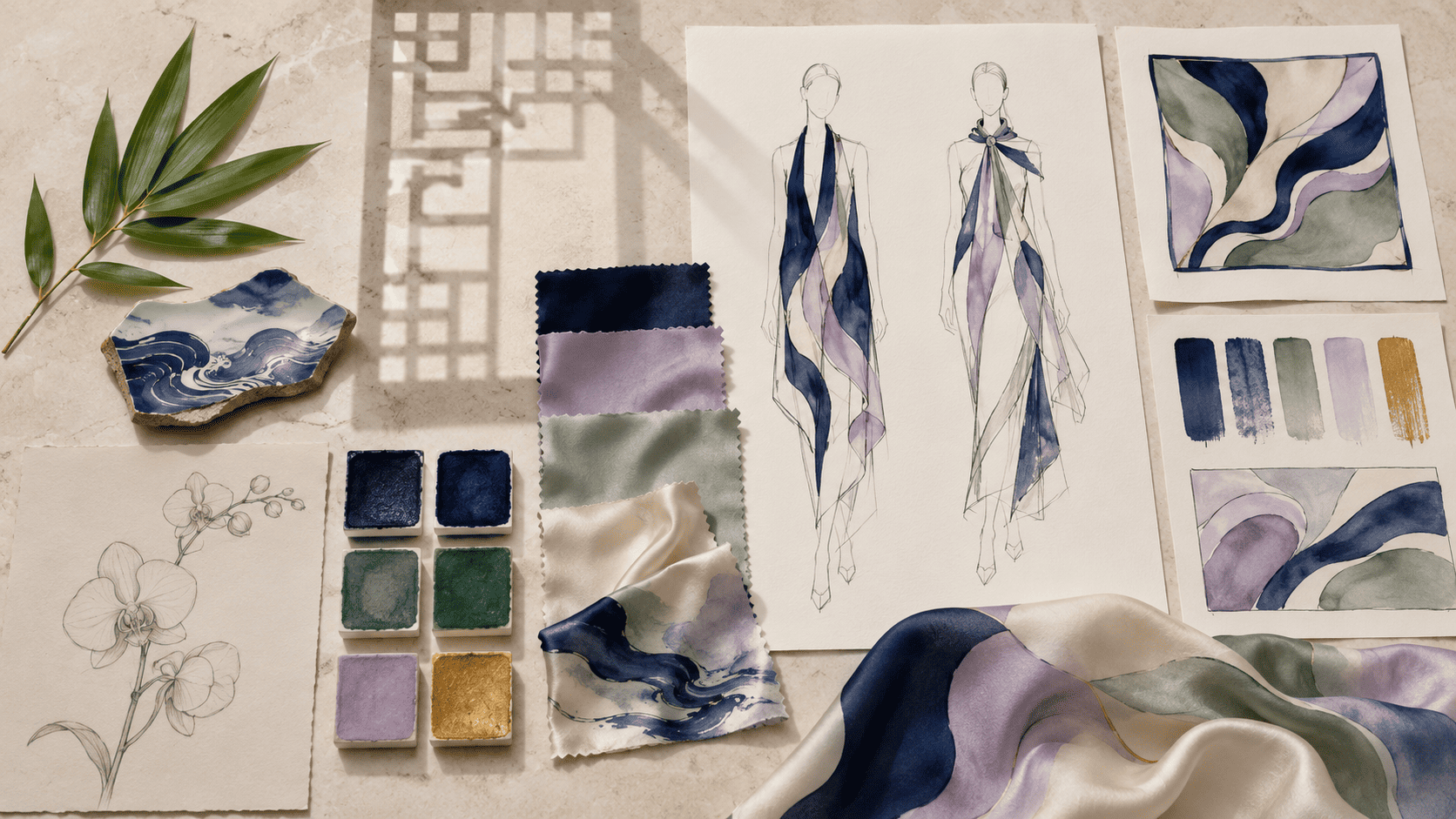
Reinterpretation is not limited to surface print. Wrapped fronts, standing collars, side fastenings, layered panels and wide sleeves can inspire pattern cutting without reproducing a complete historical outfit. A designer might retain an asymmetric closure but simplify the line, combine it with Western tailoring or change the proportion for movement and daily wear.
This approach recognises that a silhouette carries social history. A court robe, qipao and contemporary jacket served different bodies, settings and expectations. Removing one feature and placing it in a new garment changes its meaning; responsible design acknowledges that change rather than calling the result “traditional.”
Guo Pei offers a couture-scale example of cross-cultural construction. M+ describes her practice as blending historic Chinese craftsmanship, global inspirations and Western tailoring. Her work can be theatrical and opulent, but its relevance lies in transformation: sources from different traditions are reorganised through an individual design language.
4. Colour is moving beyond the red-and-gold formula
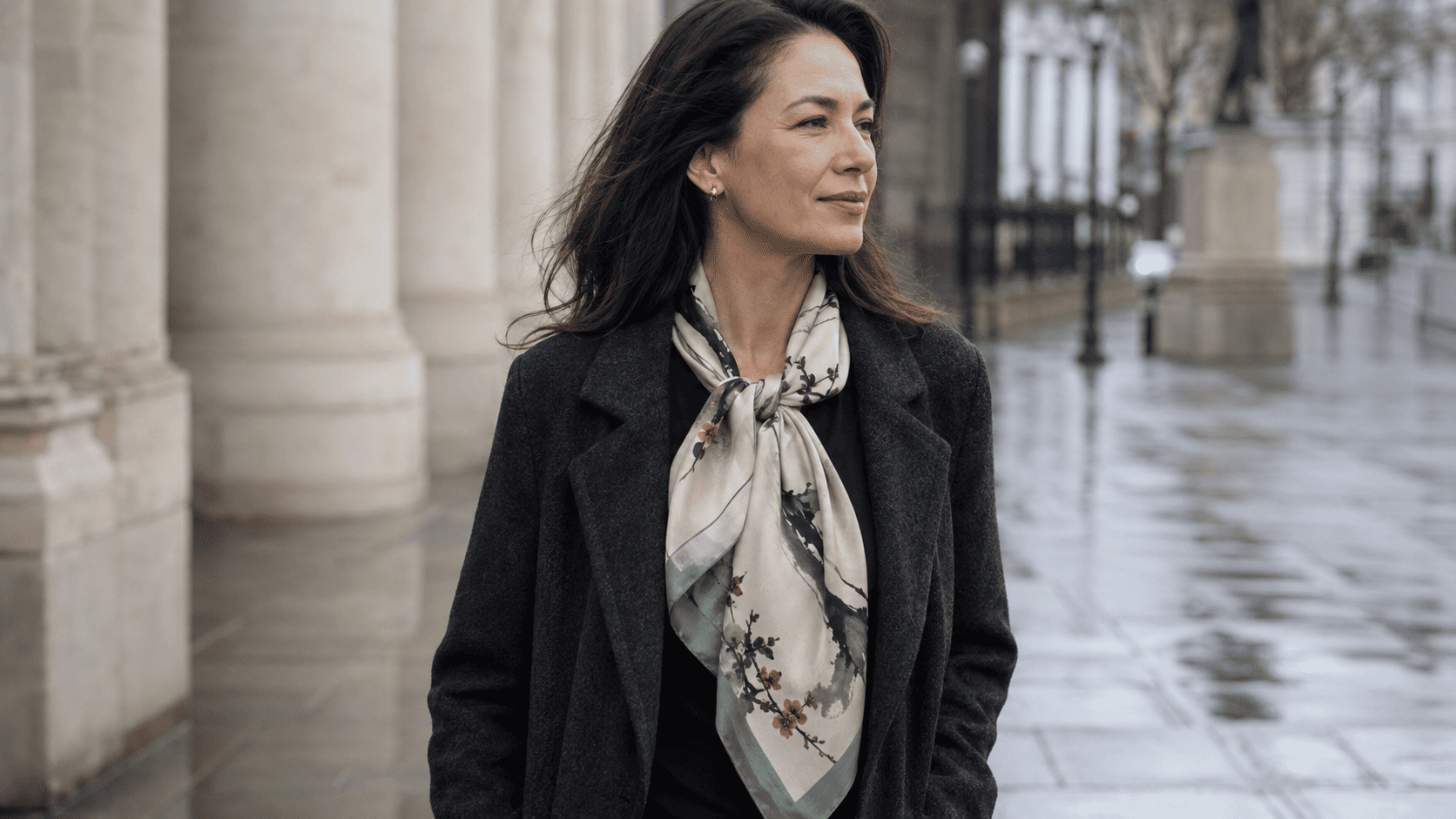
Red and gold have real cultural and ceremonial associations, but treating them as the only recognisably Chinese palette turns a complex visual tradition into shorthand. Contemporary fashion increasingly draws from mineral pigments, celadon, ink, blue-and-white porcelain, muted jade, orchid tones, weathered architecture and seasonal landscapes.
The result can feel culturally grounded without announcing itself loudly. Ink black against warm ivory may recall calligraphy; mist blue and mineral green can suggest landscape depth; a single cinnabar accent can carry more energy than an entire red garment. Colour works best when it is connected to a source and suitable for the wearer’s real wardrobe.
5. Craft is being combined with new materials and technology
Some designers reinterpret tradition through technique. Embroidery can move from flat ornament to three-dimensional structure; bamboo may become both motif and material; hand processes can be paired with laser cutting, digital printing or engineered textiles. The V&A notes that Feng Chen Wang draws on her cultural heritage—including bamboo and traditional craft—within contemporary fashion design.
Other designers make continuity itself central. The Design Museum describes Ma Ke’s Wuyong studio as committed to the continuation and innovation of traditional Chinese handicrafts. The phrase matters: preservation and reinvention are related but not identical. A new garment may sustain knowledge, adapt a technique or simply reference its appearance; clear descriptions should distinguish those possibilities.
Digital tools also change how motifs are developed and encountered. A brush mark can be scanned, enlarged, separated into layers and printed across silk so that each fold reveals a different composition. Technology does not remove cultural depth by default; it depends on the quality of the research and the choices made afterward.
6. Chinese-inspired fashion is becoming globally wearable
Contemporary relevance depends on how a piece lives beyond a runway image. A beautifully resolved scarf, coat or blouse should coordinate with an international wardrobe and offer pleasure before its story is explained. Cultural meaning then adds recognition, connection and collectability.
This is especially visible in accessories. A silk scarf can hold a complete composition when open, yet become almost abstract when folded. One corner may show plum blossom, another mineral colour, and another a line derived from architecture. The wearer edits the artwork with every tie. Read why silk has such an important place in Chinese culture, then explore the contemporary square silk scarves shaped by this material history.
7. Context and credit are part of the design
Fashion has a long history of imagining China from outside. The Metropolitan Museum of Art’s China: Through the Looking Glass examined how Chinese aesthetics shaped Western fashion, while also revealing how fantasy and cultural reality can diverge. Inspiration is not automatically informed interpretation.
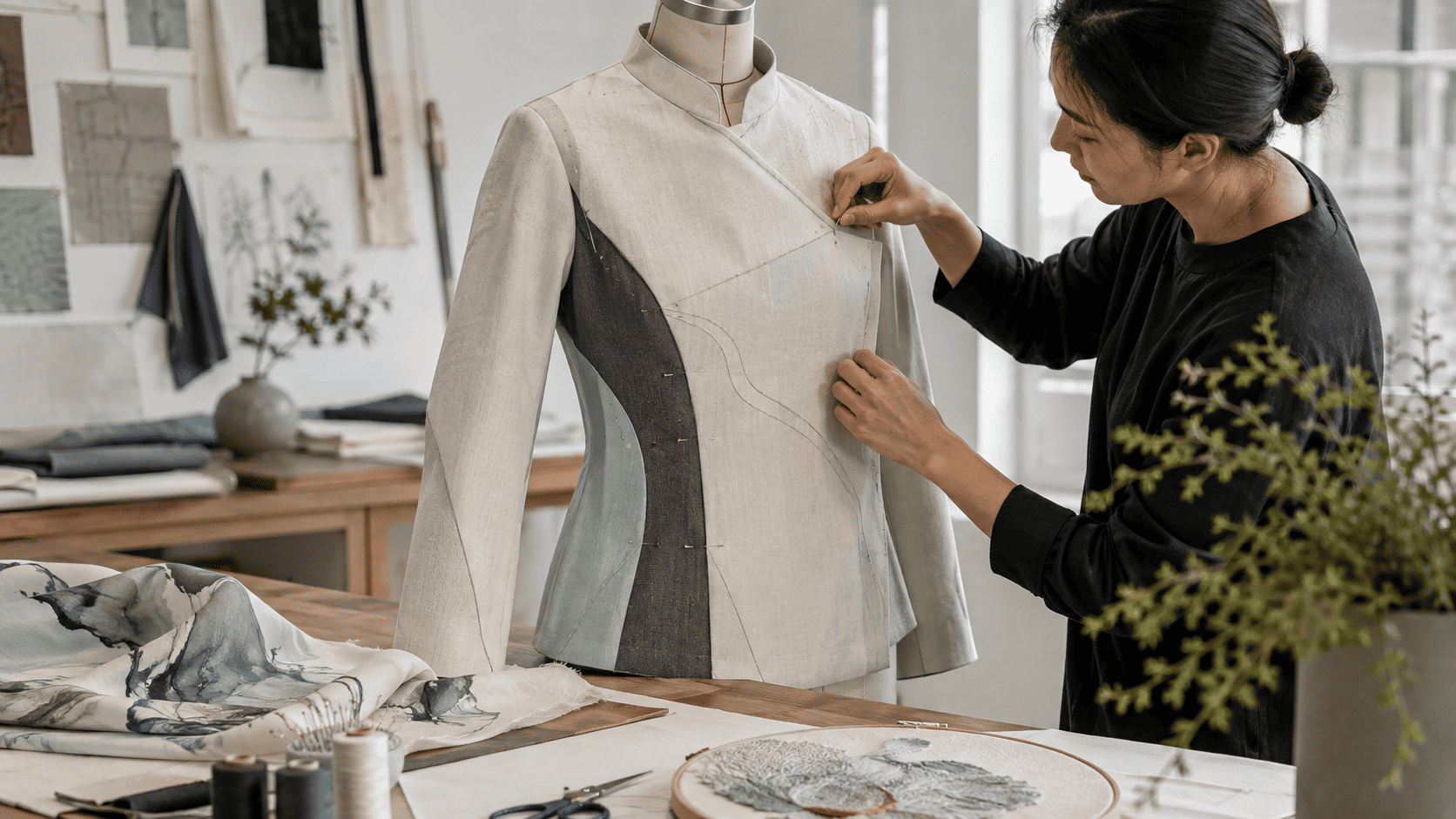
Better practice identifies the source, checks permissions where a specific artwork or archive object is involved, credits collaborators and describes techniques accurately. It avoids claiming a garment is handmade, heritage craft or historically authentic when those statements cannot be supported. It also recognises that sacred, rank-specific or politically sensitive imagery may require more care than a botanical study.
At Lanting Loom, our design philosophy follows a simple sequence: source, interpretation, translation and wearability. Beauty comes first, but cultural depth gives beauty lasting meaning. Explore our Design Stories to see that process in practice.
Frequently asked questions
What is contemporary Chinese-inspired fashion?
It is modern fashion informed by Chinese art, dress, materials, craft, philosophy, landscape or cultural experience. Strong examples transform their sources through silhouette, colour, structure or material rather than merely adding recognisable symbols.
Is Chinese-inspired fashion the same as hanfu or qipao?
No. Hanfu and qipao refer to particular clothing histories and forms. A contemporary design may learn from their construction, but a modern jacket with a standing collar or wrap line should not automatically be labelled traditional dress.
Why can chinoiserie be problematic?
Chinoiserie developed largely as a European imaginative style rather than a faithful representation of Chinese culture. It can be visually inventive, but it may also repeat stereotypes or merge unrelated references. Context, specificity and the perspective of the maker matter.
How can shoppers recognise thoughtful reinterpretation?
Look for a clearly identified source, original design decisions, accurate material and production information, and an explanation of how the reference was transformed. The piece should also succeed as wearable fashion rather than relying on cultural symbolism alone.