

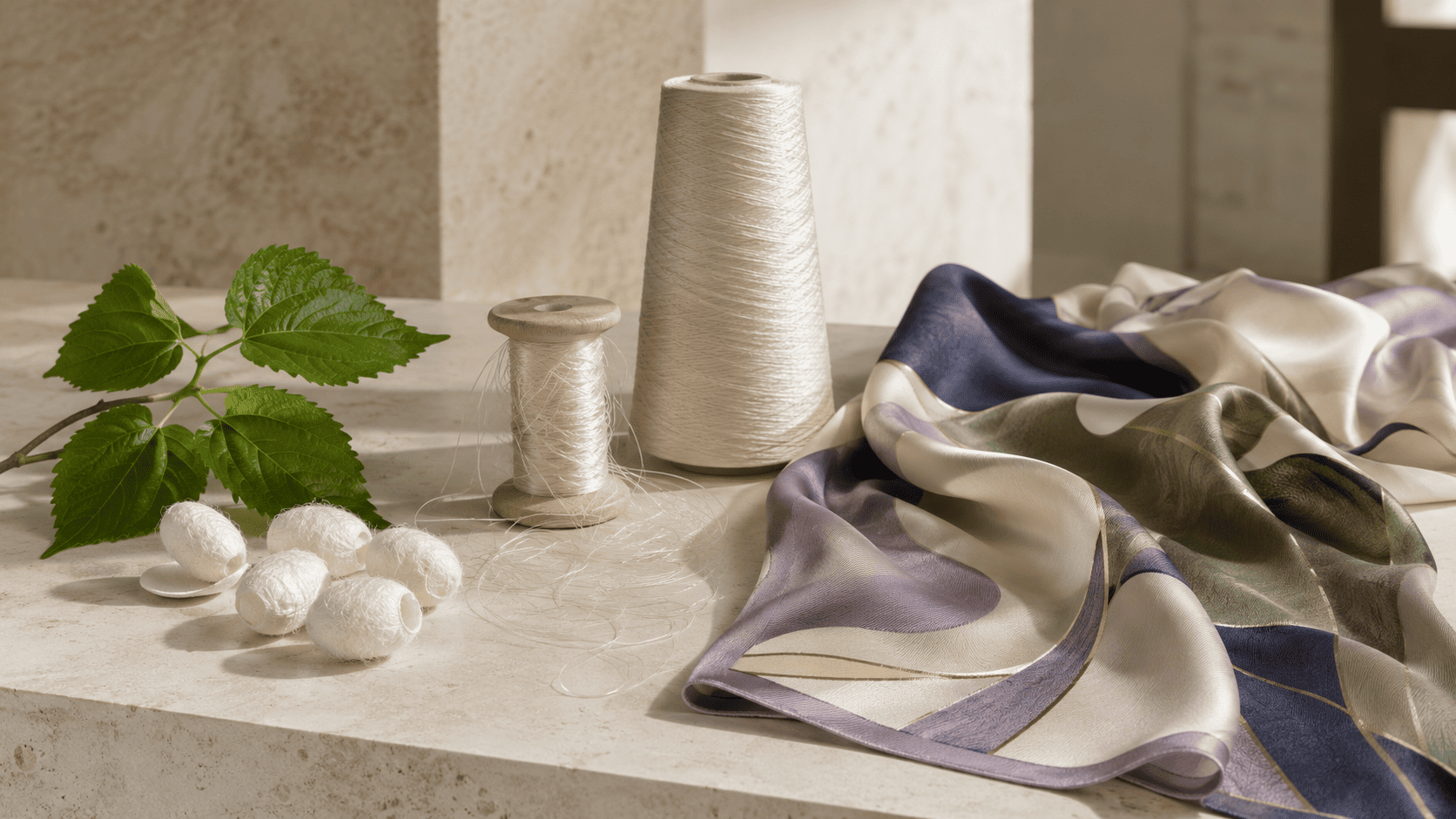
Silk begins as a protein filament spun by a silkworm around itself to form a cocoon. In conventional mulberry-silk production, silkworms are raised on mulberry leaves, the completed cocoons are collected and softened, and several extremely fine filaments are reeled together into raw silk. The yarn is then prepared, woven into fabric, degummed as required, dyed or printed, finished and—when destined for a scarf—cut and hemmed. The principles are ancient, although today’s equipment can range from hand-operated reels and looms to highly controlled mills.
The silk-making process at a glance
| Stage | What happens | What it produces |
|---|---|---|
| Sericulture | Silkworms are hatched and raised, usually on mulberry leaves | Mature larvae ready to spin |
| Cocooning | The larva extrudes protein and builds a protective cocoon | A cocoon of continuous filament |
| Harvesting | Cocoons are collected, dried or heated, and sorted | Stable cocoons for reeling |
| Reeling | Warm water softens sericin; several filaments are drawn together | Raw silk strand |
| Yarn preparation | Strands may be doubled, twisted and cleaned | Yarn suited to its fabric |
| Weaving | Warp and weft interlace in a chosen construction | Twill, satin, habotai or another fabric |
| Colour and finishing | Fabric is degummed, dyed or printed and given its final handle | Finished silk ready to cut and hem |
1. Sericulture: raising silkworms and mulberry
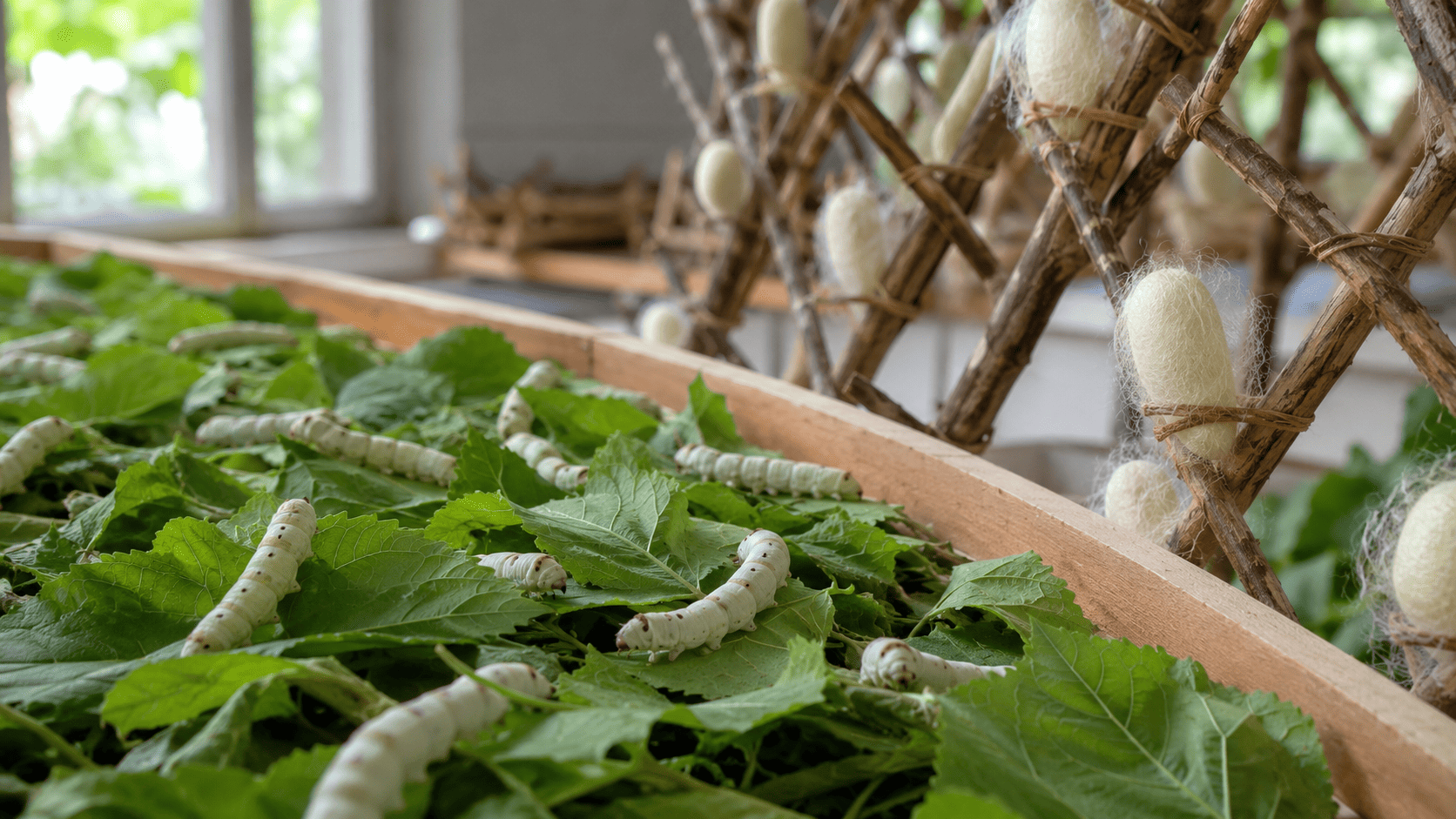
The cultivation of silkworms for silk is called sericulture. The principal cultivated species is Bombyx mori, the domesticated mulberry silkworm. Eggs hatch into larvae that eat repeatedly as they grow through several stages. Their food and rearing conditions matter: temperature, humidity, hygiene and the freshness of the leaves all influence development and cocoon quality.
“Mulberry silk” therefore identifies a production system, not a weave or a universal grade. Twill, satin and habotai describe how yarns become fabric; mulberry describes the silkworm and its food source. Our guide to what mulberry silk is explains that distinction in more detail.
2. How a silkworm spins its cocoon
When ready to pupate, the larva stops feeding and searches for a support. It secretes liquid protein through structures near its mouth while moving its head repeatedly. The material solidifies in air, building layer after layer around the animal. The filament has a fibroin core held together and coated by sericin, a natural gum.
The Canadian Conservation Institute’s guide to natural fibres describes cultivated silk as a continuous protein filament and notes that unprocessed silk contains fibroin held together by sericin. The FAO’s account of cocoon structure further explains how these proteins form the protective shell. A cocoon is not simply a ball of ready-made sewing thread.
3. Why cocoons are harvested before the moth emerges
If development continues naturally, the moth must break through the cocoon to emerge. That interrupts the long filament. Conventional reeled-silk production therefore uses heat or drying after the cocoon is completed, preventing emergence and stabilising the cocoon before storage and reeling. This kills the pupa, an aspect buyers may reasonably consider when choosing animal-derived fibres.
Silks made after moth emergence are often marketed as “peace” or “Ahimsa” silk. The broken or otherwise unreelable material is generally processed as shorter fibres and spun into yarn, so its texture, uniformity and lustre can differ from filament silk. Production methods and claims vary; the label alone does not establish a particular welfare, environmental or quality standard.
4. Softening and reeling the cocoon
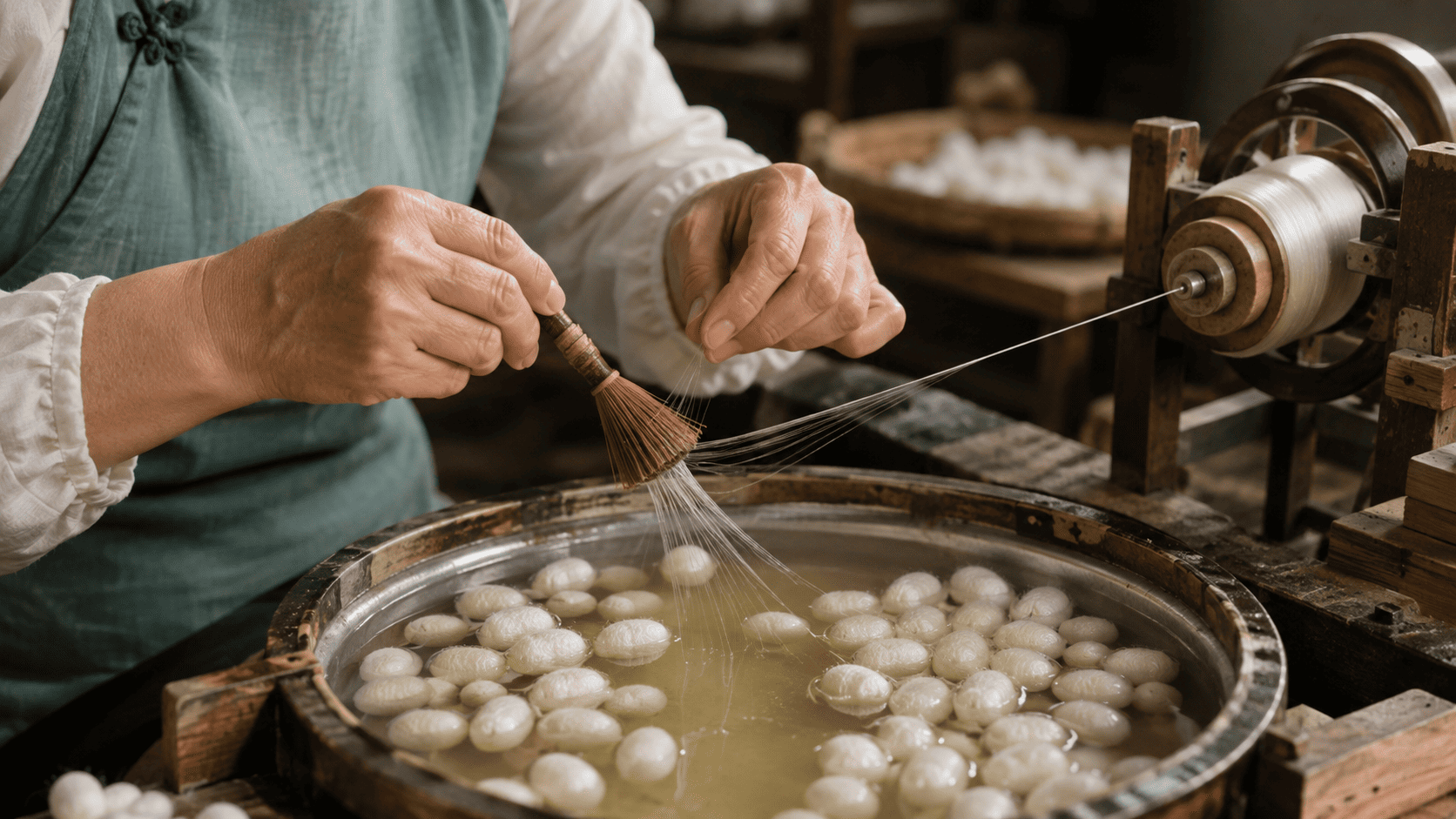
Sorted cocoons are placed in hot or warm water to soften the sericin and help locate the filament ends. A brush or similar tool catches loose fibres at the surface. Because one filament is too fine to function as ordinary textile yarn, filaments from several cocoons are gathered and reeled together as a single raw-silk strand.
The Food and Agriculture Organization’s silk reeling manual describes individual cocoon filaments as hundreds of metres long and explains why several are combined during reeling. The reel’s speed, water conditions, cocoon quality and the operator’s ability to replace ending filaments all affect the evenness of the strand.
5. From raw silk to weaving yarn
Reeled raw silk still carries sericin and requires preparation for its intended use. Strands may be wound, doubled and twisted—a group of operations often called throwing—to create yarn with the strength, flexibility and appearance needed for warp or weft. Defects and weak places must be controlled because fine, tightly tensioned warp threads endure repeated stress on the loom.
Degumming removes some or most of the sericin, revealing greater softness and lustre and improving dye uptake. It may occur at different points depending on the desired yarn, fabric and production route. Removing gum also reduces weight, which is one reason a fabric’s finished momme should not be confused with a simple measure of quality.
6. Weaving determines how the silk behaves
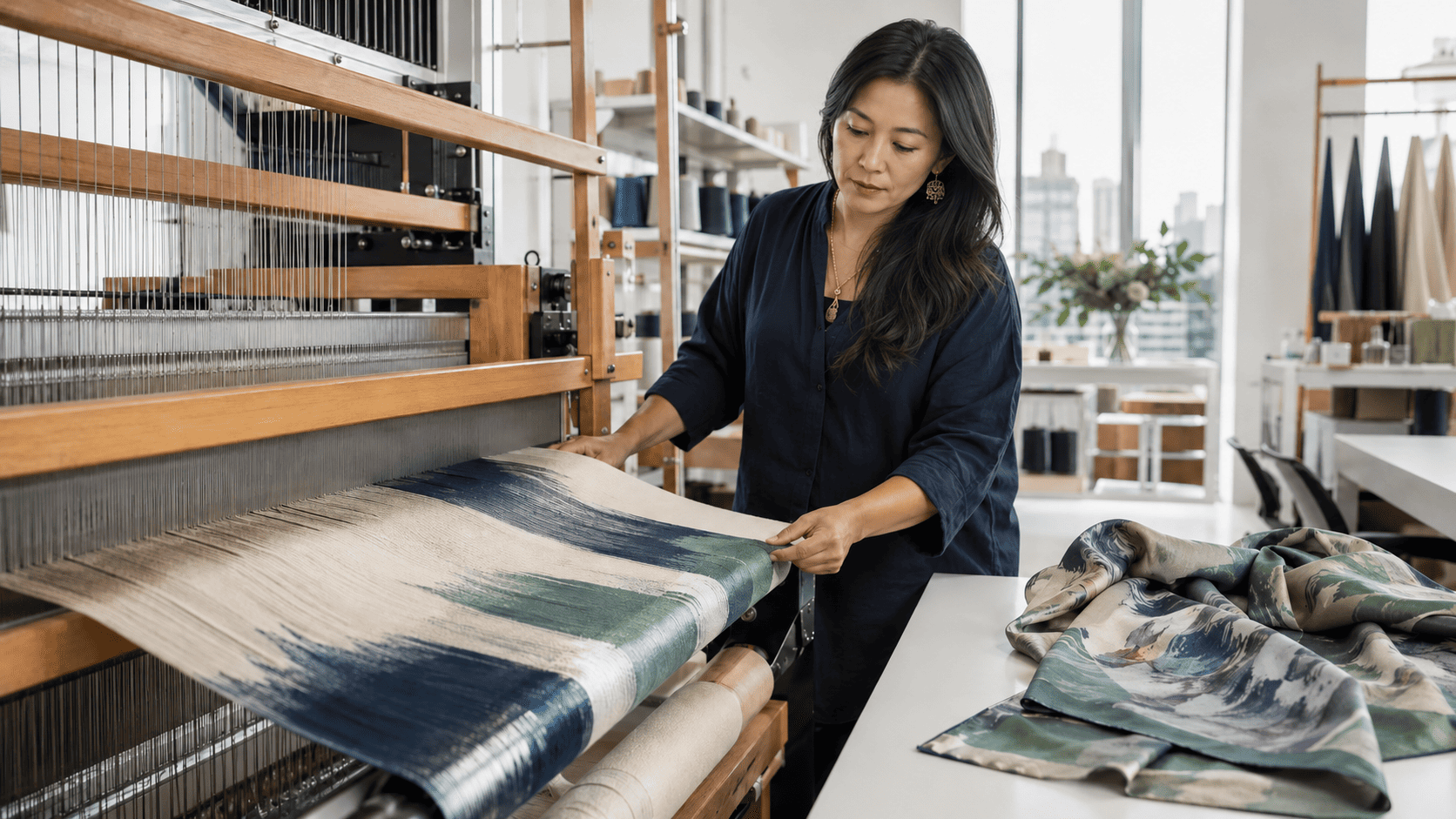
On the loom, lengthwise warp yarns are held under tension while the weft travels across them. Their interlacing pattern creates the fabric construction. A twill has diagonal structure and often combines drape with controlled body; satin exposes longer floats for a smoother, more reflective face; habotai is usually a light plain weave with a softer, airier fall.
The fibre can be the same while the fabrics feel markedly different. Yarn twist, density, weight and finishing further change the result, so “100% silk” does not tell you how a scarf will drape. Compare the constructions in silk twill, satin and habotai.
7. Dyeing, printing and finishing the fabric
Colour can enter before or after weaving. Yarn-dyed silk uses coloured yarns to build the fabric, while piece dyeing colours woven cloth. Printed scarves begin with fabric and add a design through screen, roller, inkjet or other printing systems. Each route demands control of colour penetration, registration, fixation and washing.
Finishing adjusts the fabric’s handle, dimensions and surface. For a scarf, the cloth is then inspected, cut and hemmed. A rolled edge may be made by hand or machine; neither term alone proves the overall quality. Artwork, fabric, print clarity, colourfastness, dimensions and finishing must work together. This is why the complete journey matters when learning how to evaluate a real silk scarf.
Why silk has its characteristic lustre
Silk’s beauty is not created by shine alone. The fine filament and its cross-sectional structure interact with light, while the weave and finish determine how reflections appear across the cloth. Satin may look highly luminous because of its long surface floats; twill usually gives a more controlled glow. Colour, folds and movement make the surface change continuously rather than reflect like metal or plastic.
That combination of biology, skilled processing and responsive beauty helps explain silk’s important place in Chinese culture. The Smithsonian’s overview of the Silk Road shows how the material also connected makers, markets and cultures far beyond its place of origin. For a wider introduction to fibre, weave, size and care, continue with the complete guide to silk scarves.
Frequently asked questions
How long is the silk filament in one cocoon?
It can extend for hundreds of metres, and some sources report considerably more than a kilometre. The usable reeled length varies because outer and inner portions, breaks and cocoon quality affect recovery.
Is one silk thread made from one cocoon?
Not usually. One cocoon filament is extremely fine, so several are commonly gathered together during reeling to form a practical raw-silk strand.
Are silkworms killed to make conventional silk?
Yes. In conventional reeled mulberry silk, heat or drying prevents the moth from emerging and breaking the continuous filament. Shoppers who object to this should examine the producer’s method and claims carefully.
Is handmade silk automatically better than mill-made silk?
No. Hand and industrial methods can each produce excellent or poor results. Judge the actual fibre, yarn consistency, weave, colour, finish and suitability for use rather than assuming the scale of production determines quality.
Does silk come off the cocoon as fabric?
No. The cocoon provides filament. That filament must be reeled and prepared as yarn, then woven or knitted before it becomes fabric. Dyeing, printing and finishing create the final colour, feel and performance.
To preserve the result of this long process, follow the scarf’s label and the practical guidance in how to care for a silk scarf.
