

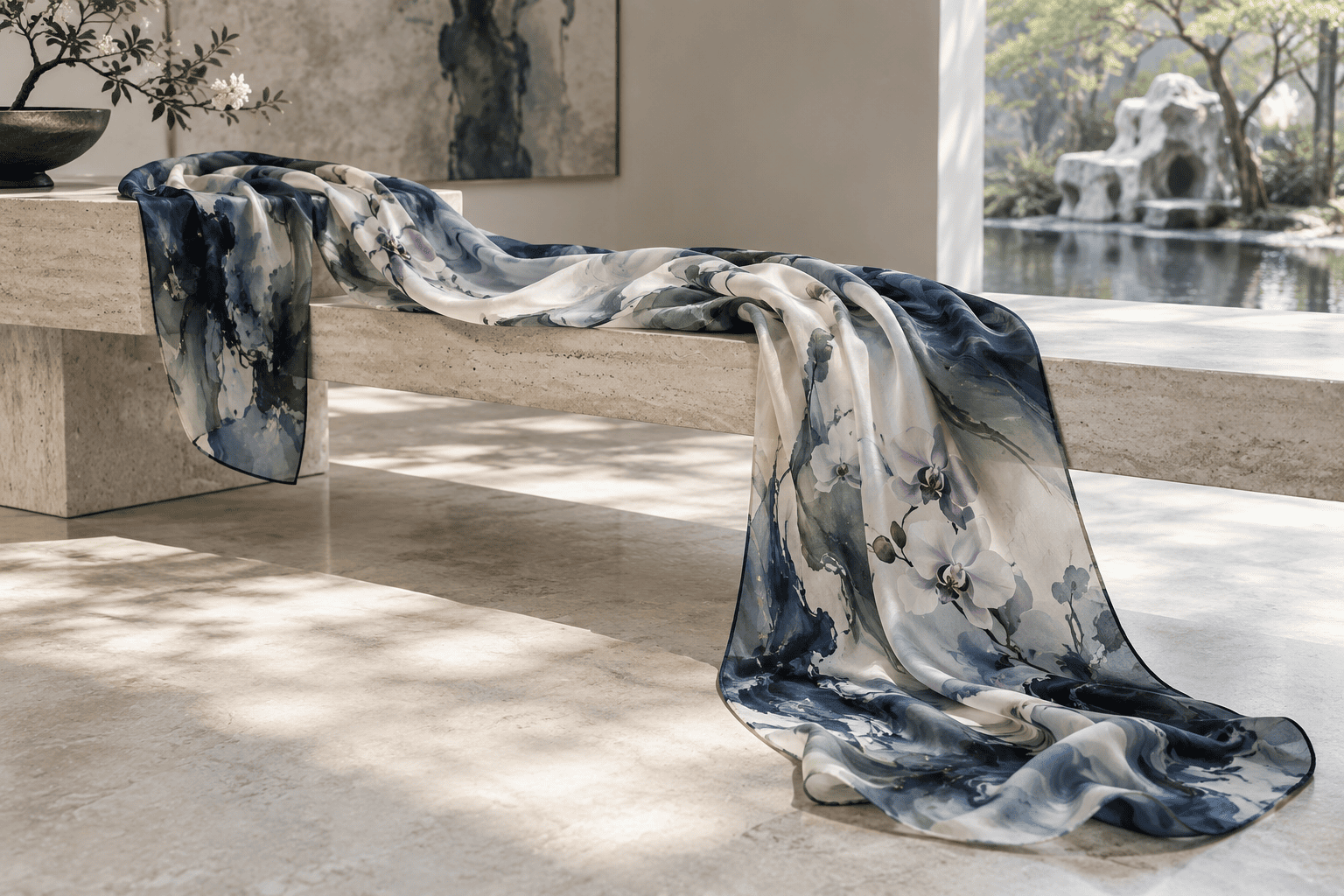
A long silk scarf is an elongated scarf designed for draping, looping and wrapping rather than diagonal folding. Its length creates movement, while its width determines whether it behaves like a light neck scarf, a generous stole or an airy shoulder layer. There is no universal standard size: names such as “long scarf,” “shawl” and “wrap” vary between brands, so the dimensions and fabric should guide your choice.
For most wardrobes, a length of approximately 175–180 cm offers enough fabric for a simple drape, one neck loop or an asymmetric shoulder style. Widths around 50 cm feel lighter and more streamlined; widths around 60–65 cm provide greater coverage. Sheer asymmetrical silhouettes can extend to a 200 cm long edge without feeling heavy because their construction is exceptionally light.
What is a long silk scarf?
A long silk scarf usually has a rectangular or elongated shape in which the length is substantially greater than the width. Unlike a square scarf, it does not need to be folded diagonally before creating long ends. That makes it intuitive to wear: place the centre behind the neck, let both ends fall, loop once or move one end over a shoulder.
The category includes more than one silhouette. A 175 × 50 cm scarf can create elegant vertical lines with limited bulk. A 180 × 60–65 cm scarf moves closer to a shawl and can cover the shoulders. An asymmetrical beach scarf may have different long and short edges, allowing the hem to fall diagonally. Explore Lanting Loom’s long silk scarf collection to compare these proportions in finished designs.
What long silk scarf size should you choose?
Begin with the way you expect to wear it. Length controls how many times the scarf can wrap and how far the ends fall. Width controls coverage, volume and warmth. Two scarves of equal length can therefore feel completely different if one is 50 cm wide and the other is 65 cm wide.
| Approximate size | Typical character | Useful for |
|---|---|---|
| 175 × 50 cm | Long and relatively streamlined | Neck loops, simple drapes and light shoulder styling |
| 180 × 50 cm | Classic elongated proportion | Long front lines, one-loop styles and scarf-ring arrangements |
| 180 × 60–65 cm | More generous and shawl-like | Shoulder coverage, asymmetric drapes and belted layers |
| Up to 200 cm with an asymmetrical edge | Expansive but potentially very light | Resort wear, translucent capes and sweeping diagonal lines |
These are useful examples rather than industry rules. Always read the actual measurements. Butterfly in Magnolia Light, for example, measures 175 × 50 cm, while Bamboo in Blue Mist uses a broader 180 × 65 cm silhouette. The added width changes the second design from a long accent into a more substantial shoulder layer.
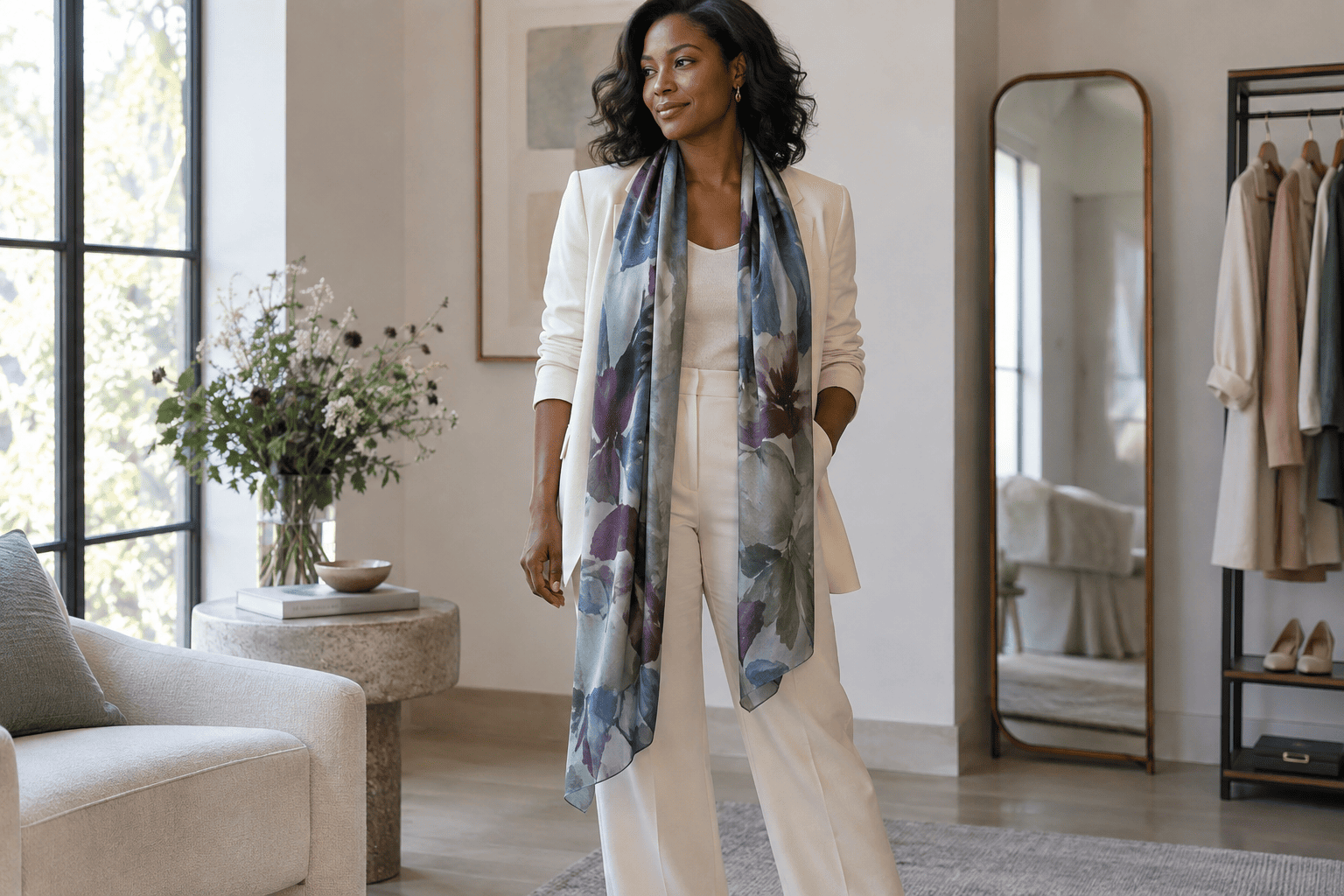
How can you style a long silk scarf?
1. The simple vertical drape
Place the centre behind your neck and let both ends fall at the front. This shows the borders and end motifs clearly with little bulk, particularly over a plain dress, knit or coat.
2. The single loose loop
Wrap the scarf once around the neck and leave the ends relaxed. Keep the loop open so the silk retains movement. A 175–180 cm length usually provides enough fabric without shortening the ends excessively.
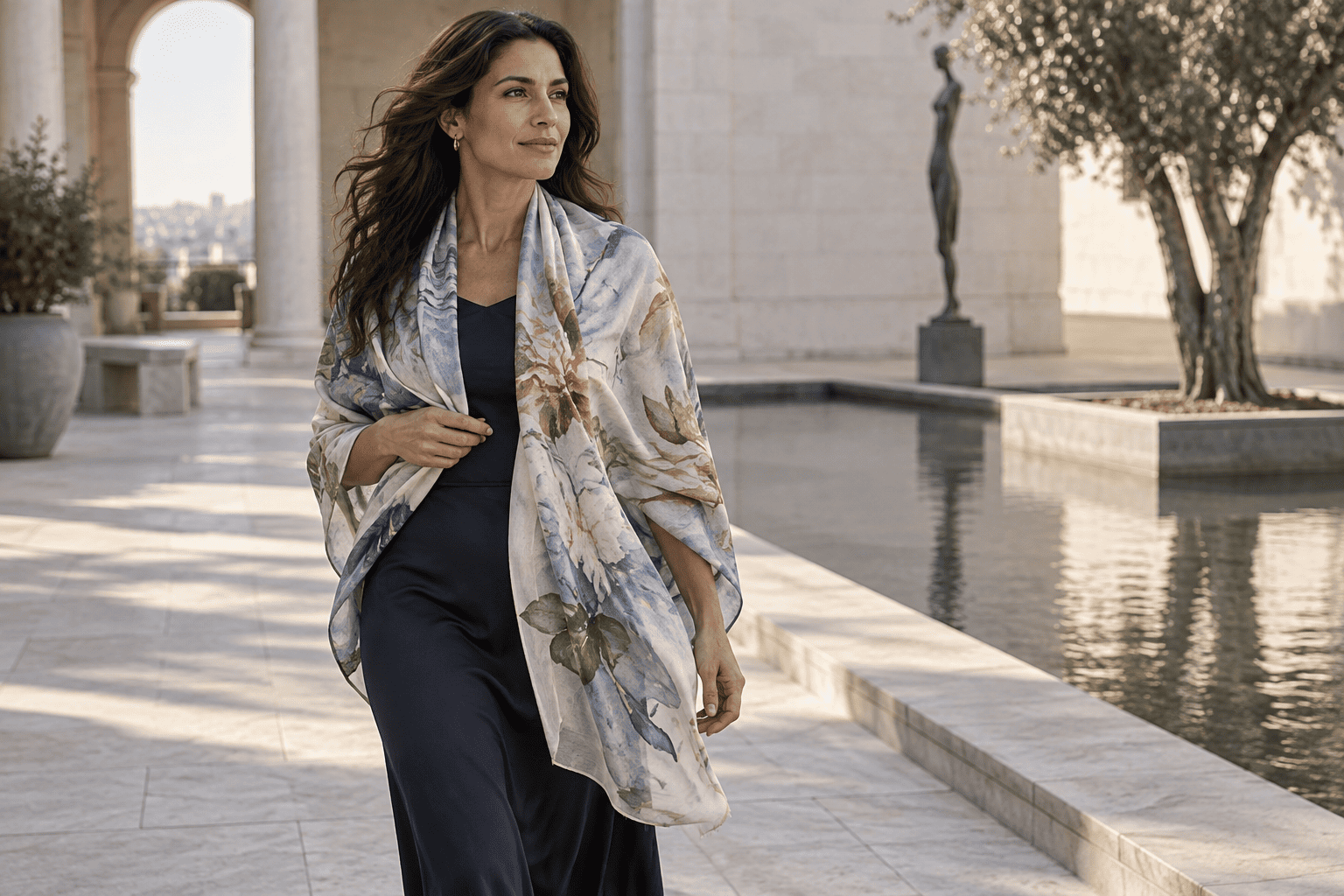
3. The asymmetric shoulder drape
Spread a wider scarf across the shoulders and let one end fall farther than the other. This reveals more artwork and suits designs that change from end to end, such as Garden Song in Olive.
4. The scarf-ring arrangement
Gather the scarf through a smooth scarf ring or clasp. It can hold an asymmetric shape without a bulky knot. Ensure every edge touching the silk is polished.
5. The lightly belted layer
Drape the scarf over the shoulders and add a slim belt at the waist without pulling the fabric taut. This creates a soft layer while leaving the lower design visible.
Long scarves are smooth and mobile, so begin with simple arrangements. Avoid tightening knots more than necessary, and keep brooches, unfinished metal edges and textured bag hardware away from the fabric.
Which silk fabric is best for a long scarf?
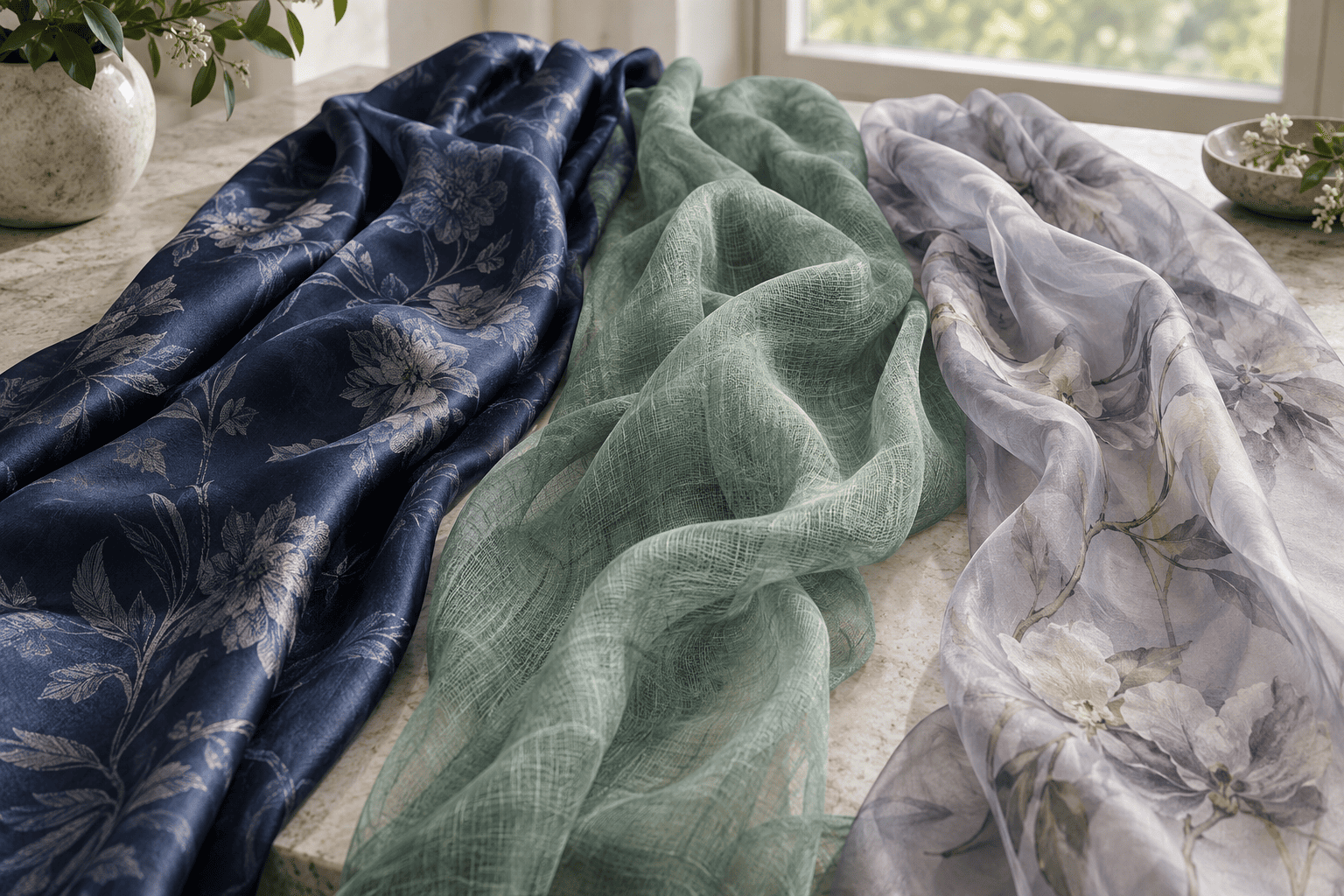
The best fabric depends on whether you want structure, luminosity, transparency or weightless movement. Silk is the fibre; satin, gauze, chiffon and twill describe different constructions. A fabric name therefore tells you how the yarns are arranged, not whether the scarf is automatically pure silk.
| Silk construction | How it behaves | Consider before choosing |
|---|---|---|
| Jacquard silk satin | Luminous, fluid and subtly patterned through weaving | Works well for polished drapes and broader shawl-like forms |
| Silk gauze | Airy, lightly structured and often translucent | Offers volume without the weight of a dense fabric |
| Silk chiffon | Sheer, exceptionally light and responsive to movement | Beautiful for layering but requires care around jewellery and rough surfaces |
| Silk twill | More controlled, with a fine diagonal structure | Holds defined folds and knots but may feel fuller at generous widths |
Fabric weight should be considered together with size. A high number is not a universal sign of superiority: an expansive chiffon scarf is designed to be lighter than a structured twill. Lanting Loom’s guide to silk momme weight explains why weight must be judged in context.
How can you judge quality before buying?
Start with transparent information. Confirm the fibre percentage, dimensions, construction, printing and finishing descriptions, country of origin and care instructions. “Silky” and “satin” do not prove silk content. The US Federal Trade Commission’s apparel-labelling guidance notes that most textile products sold in the United States must identify fibre content, country of origin and the responsible manufacturer or marketer.
Study both full-length and detailed photographs. The design should remain considered when draped. Check the borders, placement of end motifs, reverse appearance, hems and corners rather than assuming one finishing method is always superior.
For material questions, use the label and seller’s traceability before relying on visual tricks. Modern manufactured fibres can imitate shine and softness. Lanting Loom’s guide to identifying a real silk scarf explains why destructive home tests are unreliable.
How should you choose colour and design?
A long scarf reveals its design as vertical strips, overlapping layers and moving ends. Consider what will appear near the face: a darker border can frame it, while a pale centre may add luminosity. Begin with an anchor colour already present in your wardrobe, then decide whether the scarf should blend quietly or introduce contrast. For a comparison with square formats, consult the complete guide to silk scarves.
How should you care for a long silk scarf?
Always follow the sewn-in care label. The fabric, dyes, print, finish and edges determine what is safe. Keep perfume and hairspray from direct contact, remove jewellery that may snag the surface and avoid dragging long ends across rough seating, bag hardware or the ground.
Store the scarf clean, dry and untied, either loosely folded with suitable tissue or gently supported. The Canadian Conservation Institute’s guidance on caring for textiles and costumes explains how light, water, physical forces and pollutants can affect textiles. For everyday cleaning, pressing and storage advice, use Lanting Loom’s silk care guide.
A practical checklist before you choose
- Decide whether the main use is neck styling, shoulder coverage, travel or occasion wear.
- Check exact length and width rather than relying on “long,” “shawl” or “wrap.”
- Choose the construction for the movement, structure and transparency you want.
- Consider whether the fabric’s weight suits its overall dimensions.
- Imagine the borders and end motifs when the scarf is hanging or looped.
- Verify fibre, origin, finishing and care information.
- Confirm that the colours work near the face and with existing outerwear.
The right long silk scarf is not simply the largest or most elaborate. It is the one whose proportions, fabric and design support the way you genuinely want to wear it. Compare the current Lanting Loom long scarves by use and movement first, then choose the story and colour that make the piece feel personal.
Frequently asked questions
What is a good length for a long silk scarf?
Approximately 175–180 cm is versatile for a simple drape, loose neck loop and asymmetric styling. A 200 cm edge can work in a very light design. Width and weight remain equally important.
Is a 50 cm or 65 cm width better?
A width near 50 cm is more streamlined; 60–65 cm offers greater shoulder coverage and a shawl-like effect. Wider is not automatically better.
Can a long silk scarf be worn year-round?
Yes. Chiffon and gauze suit airy warm-weather layers, while denser satin or twill adds more presence in cooler seasons. Silk is not protection against severe weather.
Are long silk scarves suitable as gifts?
Yes, for someone who enjoys scarves, shawls or elegant layers. Check their colours and accessory scale; a lighter 50 cm width may suit a first-time wearer.
