

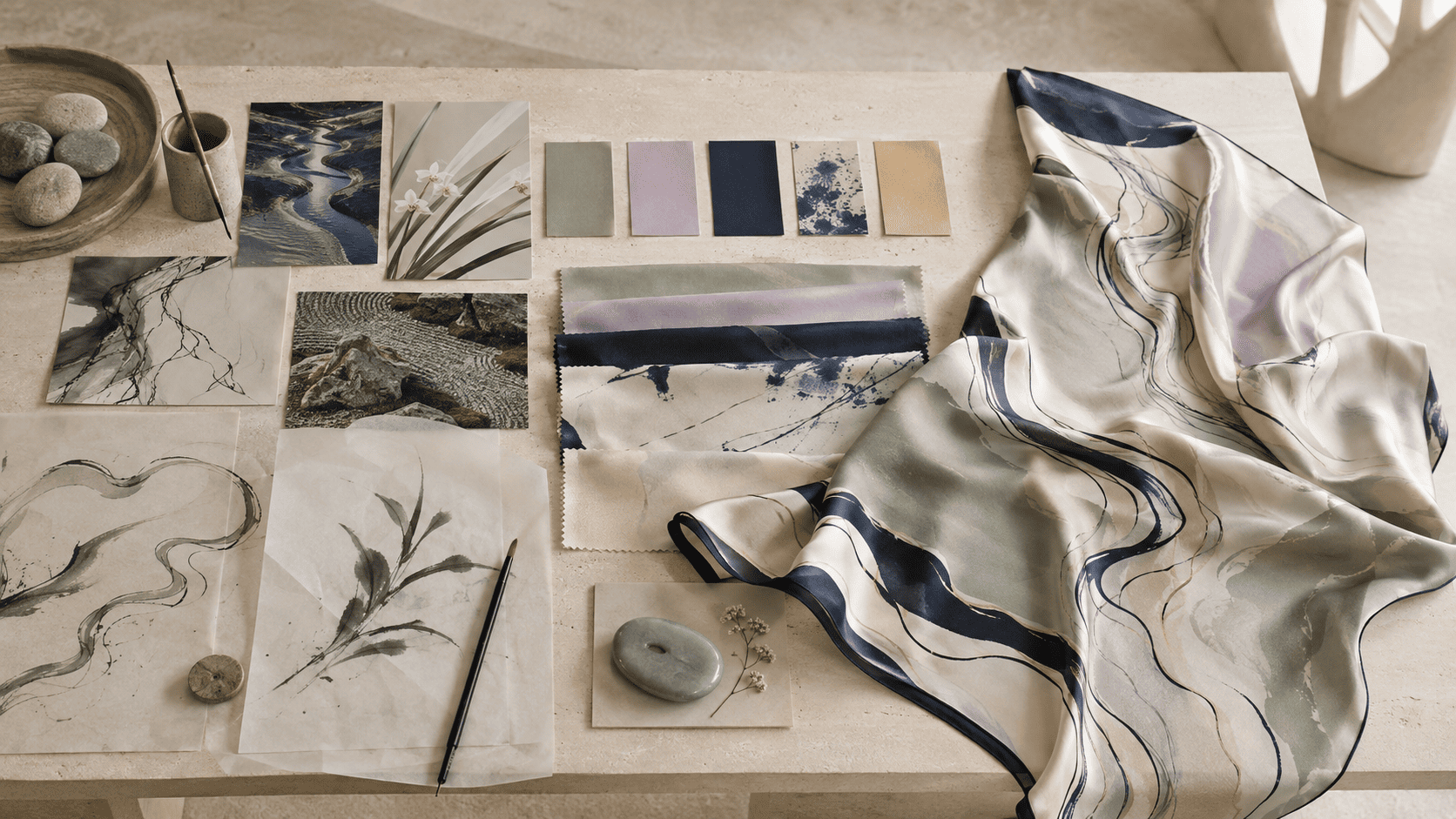
A Chinese cultural story becomes a contemporary silk scarf through translation rather than literal reproduction. The process begins with a specific, verifiable source—perhaps a painting, poem, garden, historical gathering or symbolic plant. Designers identify its emotional and visual essence, translate that essence into original line, colour, rhythm and composition, and then test the artwork on silk as a moving, folded accessory. The result should succeed first as beautiful contemporary fashion; cultural depth gives it resonance, distinction and meaning.
Reinterpretation is different from decoration
A scarf is not culturally meaningful merely because it contains orchids, bamboo or calligraphic marks. Symbols removed from context feel generic, while too many references compete. Responsible reinterpretation begins with one clear source and a reason for choosing it.
Nor does it require copying an old artwork onto fabric. A historical handscroll was composed for gradual viewing; a scarf is seen flat, folded, knotted and in motion. The designer’s role is to understand the source, then create a new visual system suited to a different object and audience. This is central to the contemporary approach explored in how traditional Chinese motifs are being reinterpreted today.
1. Begin with a specific and credible source
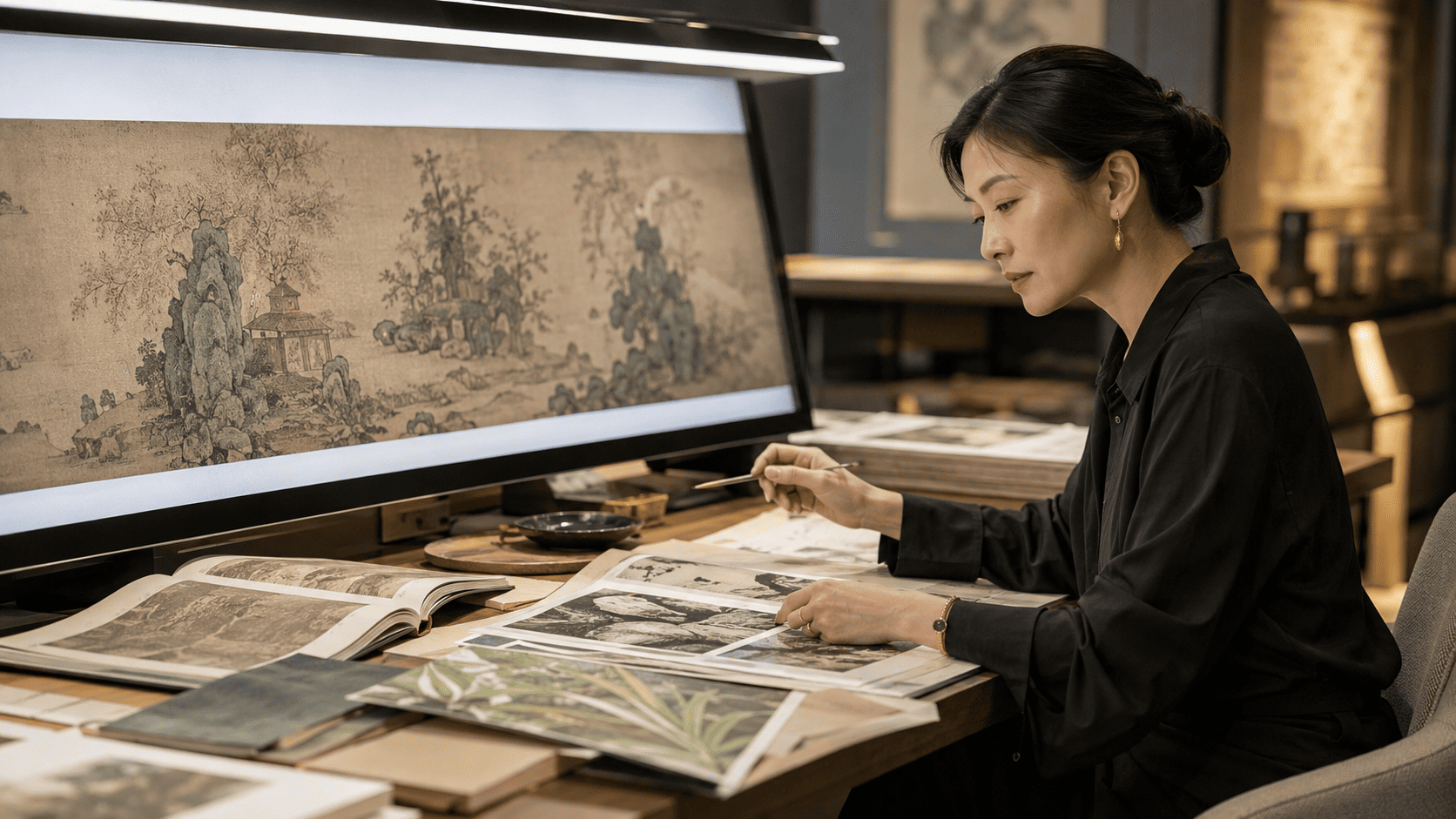
The first stage is research through museum records, scholarly catalogues, primary texts, landscapes, plant forms and later interpretations. Dates, medium, historical setting and changes in meaning matter. A source should be named accurately rather than called vaguely “ancient Chinese art.”
Consider the Orchid Pavilion gathering. In 353, Wang Xizhi and other guests met beside a winding stream, composed poems and shared wine. Wang’s preface transformed a joyful spring occasion into a meditation on fellowship, time and impermanence. The Metropolitan Museum of Art’s record for Qian Gu’s Gathering at the Orchid Pavilion shows how a much later painter reimagined the episode as a handscroll. It demonstrates that cultural stories have often been interpreted anew rather than preserved in one fixed image.
Read the story behind the Orchid Pavilion before treating the gathering as a design source. Research should distinguish the 353 event, Wang Xizhi’s lost original manuscript and the surviving copies and later paintings.
2. Find the emotional core of the story
Research supplies facts; interpretation identifies what the design should express. The Orchid Pavilion might suggest friendship, water, renewal or a fleeting perfect moment. Each direction could produce a different scarf. Illustrating the entire event would more likely create a crowded souvenir than contemporary fashion.
The same discipline applies to symbolic plants. An orchid may convey quiet refinement, principled character or friendship, depending on context. The National Museum of Asian Art traces associations including integrity, loyalty and friendship in Chinese orchid painting. Bamboo and plum have other histories. Our guides to orchid symbolism, bamboo symbolism and plum blossom symbolism explain these distinctions.
3. Translate meaning into a contemporary visual language
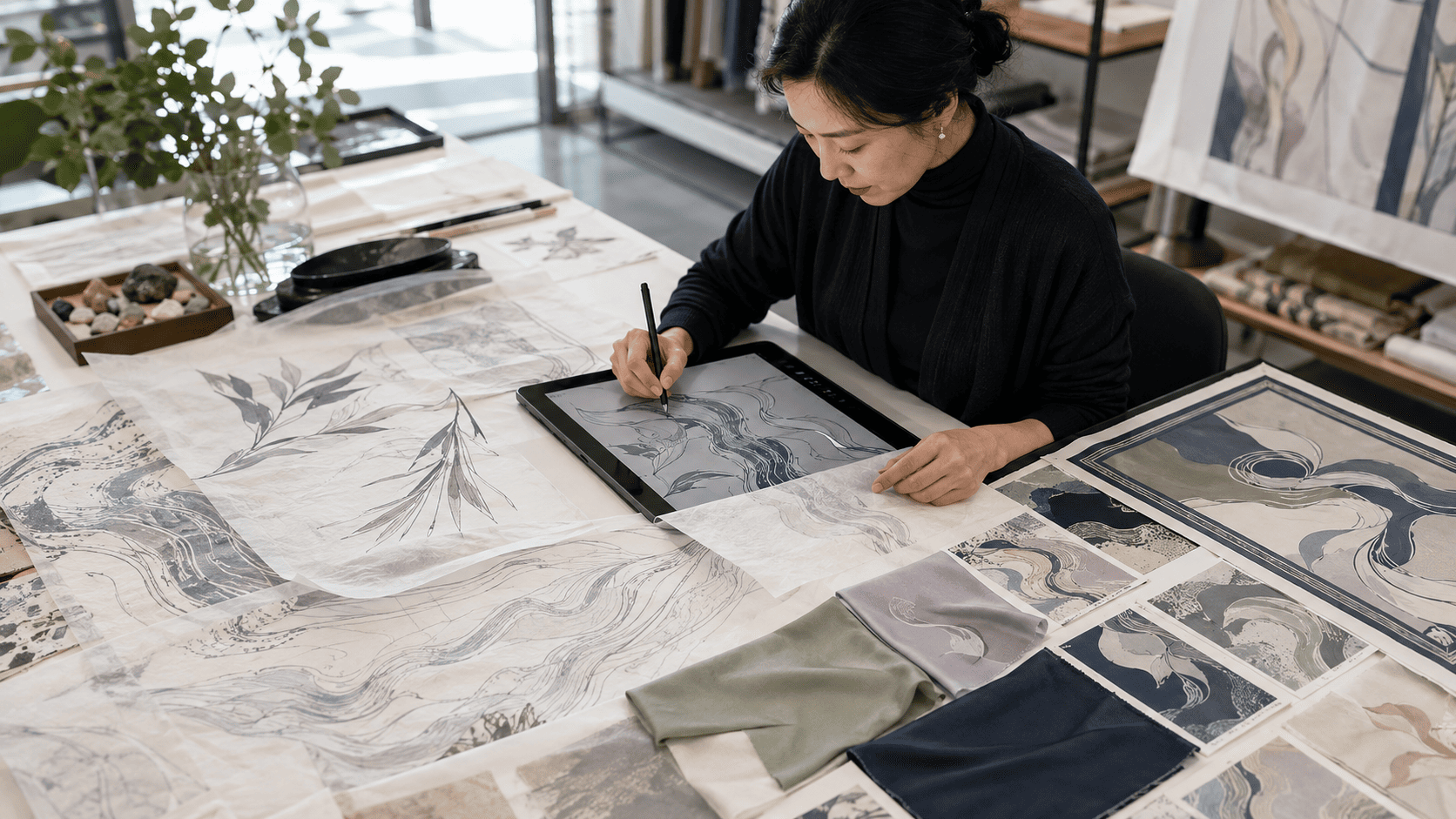
The designer now moves from subject to visual principle. Water need not become a literal river; it might become a directional line that guides the eye across the square. Calligraphy can inspire changes in pressure, speed and spacing without reproducing characters. Orchid leaves can suggest long, controlled arcs rather than botanical illustration. Garden stones may become blocks of negative space or a contrast between weight and movement.
| Cultural source | Possible contemporary translation | What to avoid |
|---|---|---|
| Winding stream | Flowing paths, shifting scale and asymmetric movement | Treating every blue curve as a fixed symbol |
| Calligraphic rhythm | Variation in line weight, pause, energy and empty space | Invented or unreadable pseudo-characters |
| Orchid leaves | Long arcs, restraint and delicate tonal contrast | Assuming every orchid has one universal meaning |
| Garden stones | Anchoring shapes and deliberate negative space | Adding decorative rocks without narrative purpose |
4. Build a palette for modern wardrobes
Colour carries mood and determines wearability. Historical pigments, ink and paper tones cannot simply be copied from a digital photograph. Their relationships might instead become warm ivory for space, mineral jade for calm, muted orchid for warmth, ink blue for structure and restrained gold for light.
A strong palette works in several combinations. When the scarf is folded, only a fraction of the full square remains visible. Borders, corners and central fields should therefore create different but compatible colour stories. Beauty and versatility are not compromises; they are part of translating the source into fashion.
5. Design for a square that will rarely stay flat
A scarf is a moving composition. The designer must test the artwork as a full square, a diagonal triangle, a narrow bias fold, a loose drape and a knot. Important details cannot all sit at the centre, where they may disappear. Corners provide flashes of colour; borders frame the face or jacket; diagonal movement helps the artwork remain alive when folded.
Scale matters too. A delicate line may vanish in printing, while a flower can dominate unexpectedly at the neck. Repeated cropping and actual-size mock-ups separate a scarf design from an illustration placed on a square.
6. Choose silk that supports the idea
The same artwork behaves differently on different fabrics. Silk twill offers structure and controlled drape; satin brings stronger lustre; habotai usually feels lighter. The choice depends on format, colour, detail and styling—not a hierarchy in which one weave is always superior.
Compare silk twill, satin and habotai, and use our explanation of silk momme to understand why weight is only one part of the decision.
7. Prototype, print and refine
Digital artwork is not the final authority. Print strike-offs reveal how colour, line and negative space behave on real silk. Designers evaluate colour accuracy, penetration, registration, fine detail and the relationship between the printed face and reverse. A line may need strengthening; a pale tone may need more separation; a border may require a different proportion.
Finishing also changes perception. Cutting accuracy and the scale, colour and consistency of a rolled hem affect the composition. The entire object—not merely the flat print—must feel resolved. The V&A’s account of a Chinese-inspired scarf design collaboration offers another example of cultural narrative moving into a wearable format through deliberate visual choices.
8. Test the scarf on a person, not only a table
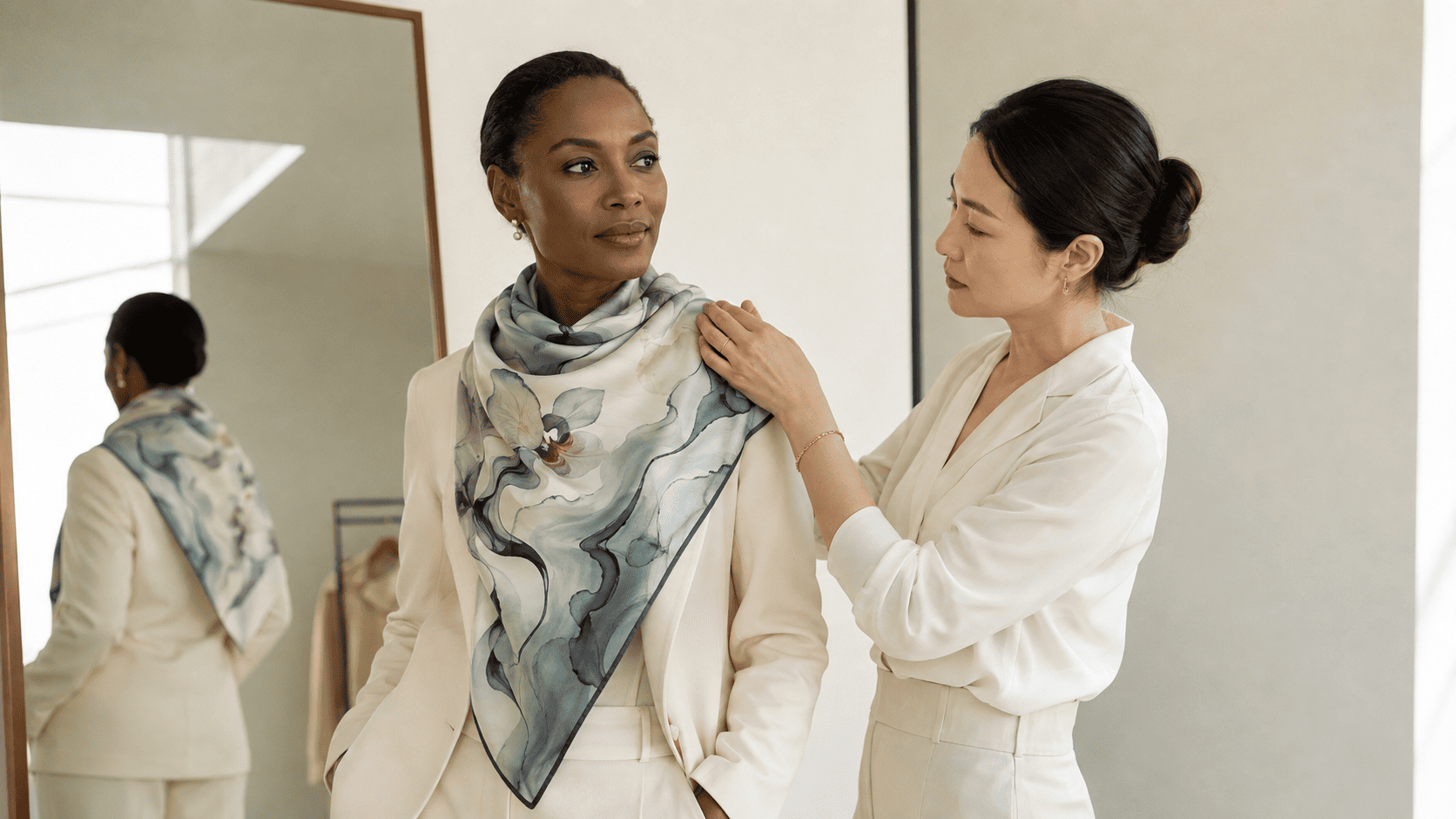
The final test is wearability. The scarf is viewed against different skin tones, jackets and necklines. Designers check whether focal elements frame the face, the palette works in daylight and several folds create distinct looks. A culturally informed scarf should enter contemporary life naturally.
Cultural responsibility is part of the design
A responsible story-led scarf names its sources, separates evidence from interpretation and does not claim that one motif meant the same thing in every period. A contemporary print should not be described as an ancient craft or heritage object unless its production supports that claim.
The Met’s discussion of the Three Friends of Winter, for example, connects pine, bamboo and plum with moral rectitude, survival and renewal in particular artistic traditions. That context can inform new work, but a contemporary designer still needs to explain what was selected, transformed and newly created.
From a cultural story to a personal story
Once worn or given, the scarf acquires another layer of meaning. The Orchid Pavilion may resonate with friendship, bamboo with a new chapter and orchid rhythm with quiet strength. The design story offers a starting point rather than dictating the wearer’s interpretation.
Explore Lanting Loom’s Design Stories, learn how to choose a meaningful scarf gift, or continue with the complete guide to silk scarves.
Frequently asked questions
Does a Chinese-inspired scarf copy traditional Chinese art?
It should not have to. Contemporary interpretation can study a credible source, preserve its emotional or visual principle and create an original composition suited to silk and modern dress.
How can a designer use calligraphy without printing Chinese characters?
Calligraphy can inspire rhythm, pressure, speed, balance and negative space. These qualities can become abstract lines without inventing characters or reproducing a historical text.
Why do scarf borders and corners matter?
Most scarves are worn folded, so corners and borders often become more visible than the centre. Their colours and proportions determine how many distinct looks the scarf can create.
Is cultural meaning more important than beauty?
No. A scarf should first work as a beautiful, wearable fashion accessory. Accurate cultural meaning adds depth and emotional value, but it cannot rescue an awkward composition or impractical palette.
What makes cultural reinterpretation respectful?
Specific research, accurate attribution, original design, transparent language and an awareness that meanings vary by context. Respect also means knowing what to omit rather than decorating with every available symbol.
