

They notice the cut of a jacket, remember the colours in a painting and linger in the museum bookshop. Choosing a Chinese New Year gift for someone who loves fashion and art is an opportunity to show that you have noticed what interests them.
The best Chinese New Year gifts for fashion and art lovers connect visual pleasure with personal relevance. An expressive silk scarf, a well-chosen art book, a piece by a maker they admire or a shared exhibition visit can all work. Start with how the person enjoys art: wearing it, studying it, collecting it or making time to see it.
The festive meaning can come from a documented design reference or from your own wishes for the year ahead. It does not require the gift to match a particular decorative style. For broader ideas, explore our guide to meaningful Chinese gifts.
First, identify the kind of visual pleasure they enjoy
“Loves art” covers a wide range of interests. Someone fascinated by costume history may not want a decorative sculpture. A collector of ceramics may be particular about glaze and form. A friend who visits every photography exhibition may appreciate a book more than another accessory.
Look for clues in things they have shared with you: an exhibition they talked about, a scarf they wear repeatedly, a favourite illustrator or the way they combine colours. These are more useful than guessing from age or assuming that every fashion enthusiast wants a recognisable luxury label.
| What they enjoy | A promising gift | What to check first |
|---|---|---|
| Building expressive outfits | A silk scarf with an interesting composition | Their usual colours, preferred proportions and existing scarves |
| Learning about art and fashion | A focused book or exhibition catalogue | Subject, language, depth and whether they own it |
| Discovering living artists | A print or small work chosen with them | Artist, medium, dimensions and space at home |
| Spending time in museums | An exhibition visit or suitable membership | Current programme, access, dates and membership terms |
| Collecting useful design objects | A small ceramic piece or wearable accessory | Maker, materials, care and practical use |
| Making things themselves | A workshop or materials they have requested | Experience level, preferred medium and availability |
1. A silk scarf that works as wearable art
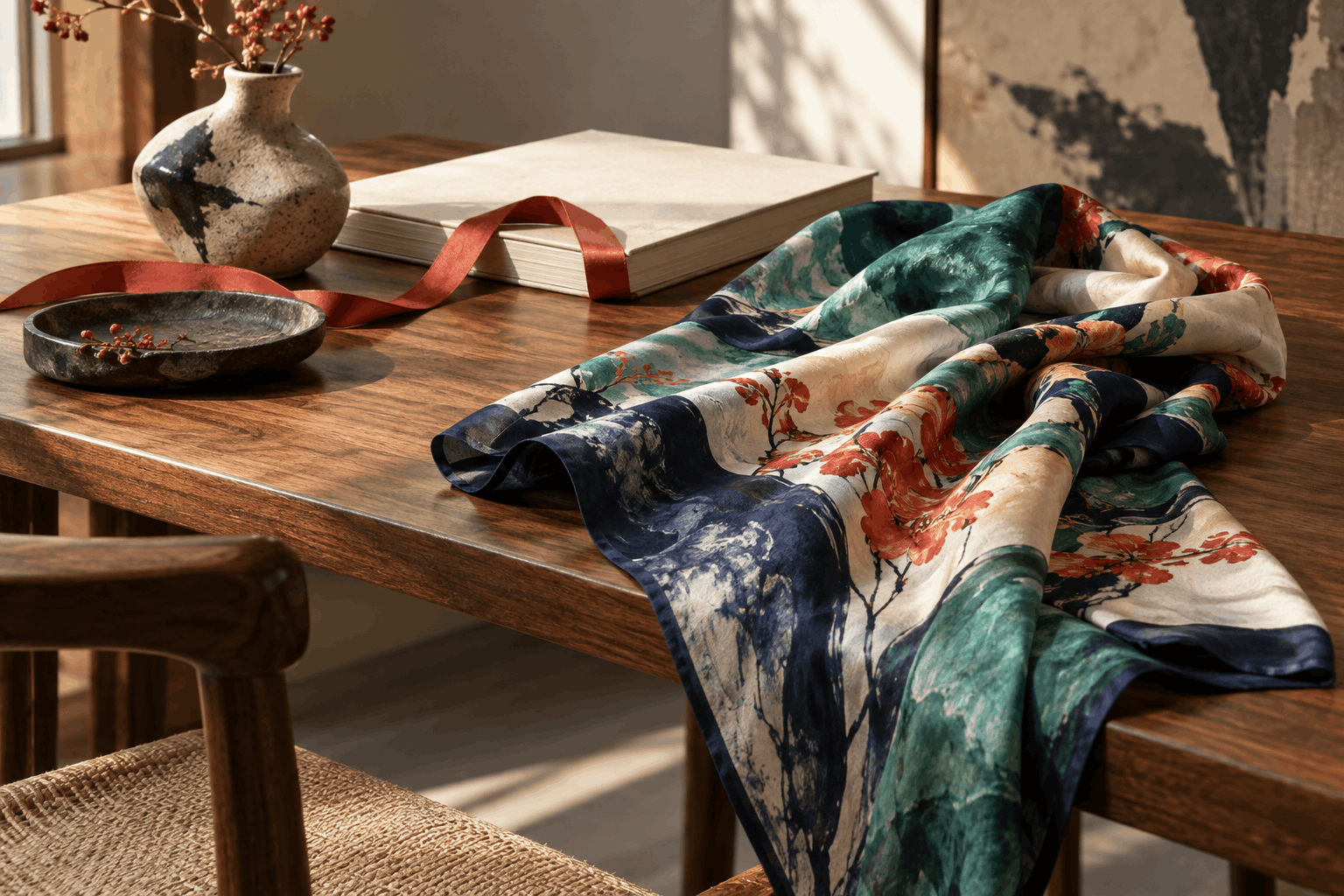
A scarf connects the two interests directly: it is a composition of line, colour and texture that changes when worn. The gift becomes especially thoughtful when you can picture it with something already in the recipient’s wardrobe.
Try a simple three-outfit check. Could they wear it with their everyday coat, a favourite shirt and an outfit for dinner? The combinations do not need to be identical in mood. A richly coloured scarf might brighten a neutral jacket while echoing one colour in a printed dress.
Examine the design in two states. Laid flat, it should have a composition the recipient will enjoy looking at. Folded or draped, its visible colours and border should still work together. A beautiful central image may largely disappear in a narrow fold, so styling photographs matter as much as the full product image.
Choose the format before choosing the motif
A small square can suit someone who likes a compact accent at the neck. A long scarf may appeal to a person who prefers an easy drape. A larger square or shawl offers more surface for a design, but also asks the wearer to be comfortable with more fabric.
Check exact dimensions rather than relying on labels such as “petite” or “signature.” Compare them with a scarf the recipient already uses, if you know one. Explore Lanting Loom’s scarf collection and signature scarves with that practical preference in mind.
Read the materials as carefully as the story
Look for fibre composition, weave, print information, edge finish and care instructions. A design printed onto silk and a pattern woven into the textile are different things; neither should be described as embroidery unless it is embroidered. An art-inspired product also need not be hand-painted to be beautiful.
If the wearer prefers very simple clothing, an expressive scarf can provide the detail they enjoy. If they already combine several patterns, choose a piece with enough visual clarity to hold its place in the outfit. The question is how they dress, not how you would style them.

2. An art or fashion book with a specific point of view
A book is a strong option when you know the recipient’s interests but are less confident about choosing clothing or art for their home. Aim for a subject they would want to explore rather than a large volume selected mainly for its cover.
Possible directions include Chinese textile design, the work of a contemporary Chinese artist, museum collections, photography, dress history or the relationship between fashion and painting. Check sample pages and the contents. A reader who enjoys scholarship may want substantial essays; someone interested in visual composition may value thoughtful reproductions and clear captions.
For someone curious about expressive line, The Metropolitan Museum of Art’s introduction to Chinese calligraphy provides a useful starting point. It explains the relationship between writing, brushwork and individual expression. That can help you identify a meaningful subject for a book without treating every loose brushstroke as calligraphy.
Before buying, check the language, edition and condition, especially for a second-hand catalogue. A brief note explaining why you chose that subject can make even a modest book feel unusually personal. Do not write inside a collectible edition unless you know the recipient would welcome it.
3. A print or small artwork chosen with care
Art can be a memorable New Year gift, particularly when it connects with an artist the recipient already follows. It is also a choice worth discussing. A person may enjoy seeing a work in a gallery without wanting to live with it.
If you know their taste well, check the artist, title, medium, size and what the purchase includes. Establish whether you are buying an original work, an original print in an edition or a reproduction. A numbered item is not automatically a unique work, and an edition description should explain what is being offered.
Frame size and presentation affect how easily the gift finds a place at home. Avoid choosing a large work simply because it feels more substantial. A small piece can be more suitable when its scale matches the recipient’s available space.
If you are unsure, turn the choice into a shared occasion. Offer to visit an artist’s studio, gallery or print fair together within an agreed budget. This gives the recipient a say while preserving the pleasure of discovery. Our Chinese gifts for art lovers guide includes further ways to approach personal taste.
4. A gallery day with time to enjoy it
For someone who values experiences or already owns many beautiful objects, plan a day around an exhibition they would genuinely want to see. It might focus on Chinese art, textiles, fashion, photography or a contemporary artist whose work interests them.
Check the venue’s current programme before booking. Confirm dates, ticket requirements, accessibility and whether the recipient is free. If you are considering membership, compare its actual benefits with their habits: how often they visit, whether they like bringing a guest and whether special exhibitions are included.
The most thoughtful part may be the space around the visit. Leave time to look slowly, browse the bookshop and discuss what stood out. An overfilled itinerary can turn a gift of shared attention into another appointment.
A flexible invitation can be more comfortable than a fixed booking. Write, “I’d love to take you to an exhibition of your choice this spring—let’s choose a date together.” This offers something concrete while letting the recipient shape it.
You can add a small keepsake if it suits your budget, but the experience need not be accompanied by an expensive object. The connection to Chinese New Year can be your wish to spend more meaningful time together in the coming year.

5. A small piece by a designer or maker they admire
A sculptural brooch, a useful ceramic object or another carefully chosen accessory can suit someone who follows independent designers. Start with the maker’s work and the recipient’s habits rather than a generic claim of cultural authenticity.
For jewellery or a brooch, check materials, fastening, weight and dimensions. A striking piece in a close-up photograph may be too heavy for the clothing the recipient usually wears. For ceramics, establish whether the object is decorative or intended for food and drink, and read the maker’s care instructions.
Ask what makes the work distinctive. Is there a documented technique, an original design process or a clearly explained source of inspiration? Retain that information with the gift. Avoid adding claims of handcraft, heritage recognition or rarity that the maker has not supported.
The gift does not need to use a traditional motif to connect with Chinese creative culture. A living Chinese designer’s contemporary work has its own context. Explain that context accurately, without expecting it to represent an entire culture.
6. A creative workshop—or a small set built around one interest
If the recipient enjoys making art, a suitable workshop can be more engaging than another finished object. Possible subjects include calligraphy, textile printing or ceramics, but the right choice depends on what they want to learn. Check the teacher’s experience, course level, materials, language and cancellation terms.
A beginner-friendly session may be welcoming for someone who is curious. An experienced maker may prefer a specific masterclass or supplies they have requested. Avoid buying a large generic art kit for someone with strong preferences about tools.
For a physical gift, build a compact combination around a single interest. A scarf and a relevant art book can connect wearing with looking. A small ceramic cup and an invitation to discuss a book over tea can make a quieter pairing. These are personal combinations, not traditional New Year customs.
If choosing a ready-made Lanting Loom gift set, read the included-item list and individual product details. Select a set because the recipient will enjoy its components, and use the note to explain the connection.
Give cultural meaning a clear place in the choice
Fashion and art lovers often appreciate the distinction between an interesting reference and a vague story. Keep three things separate: what the artist or designer says inspired the work, what an established cultural source supports, and what the object means to you personally.
The Met’s Noble Virtues exhibition overview discusses bamboo as an image of character enduring difficulty and plum blossom as an emblem of bravery. Those meanings can enrich a documented botanical design. They do not mean that every leaf or flower in a print carries the same message.
A note might say, “I chose this bamboo design because its association with resilience reminded me of you.” If the attraction is mainly visual, “The colours reminded me of the exhibition we loved” is equally thoughtful. The personal connection does not need to become a historical claim.
For more on pairing contemporary aesthetics with meaning, read modern Chinese New Year gifts. If colour or motif is central to your choice, our guide to New Year gift colours and symbols offers further context.
How to present the gift to someone who notices details
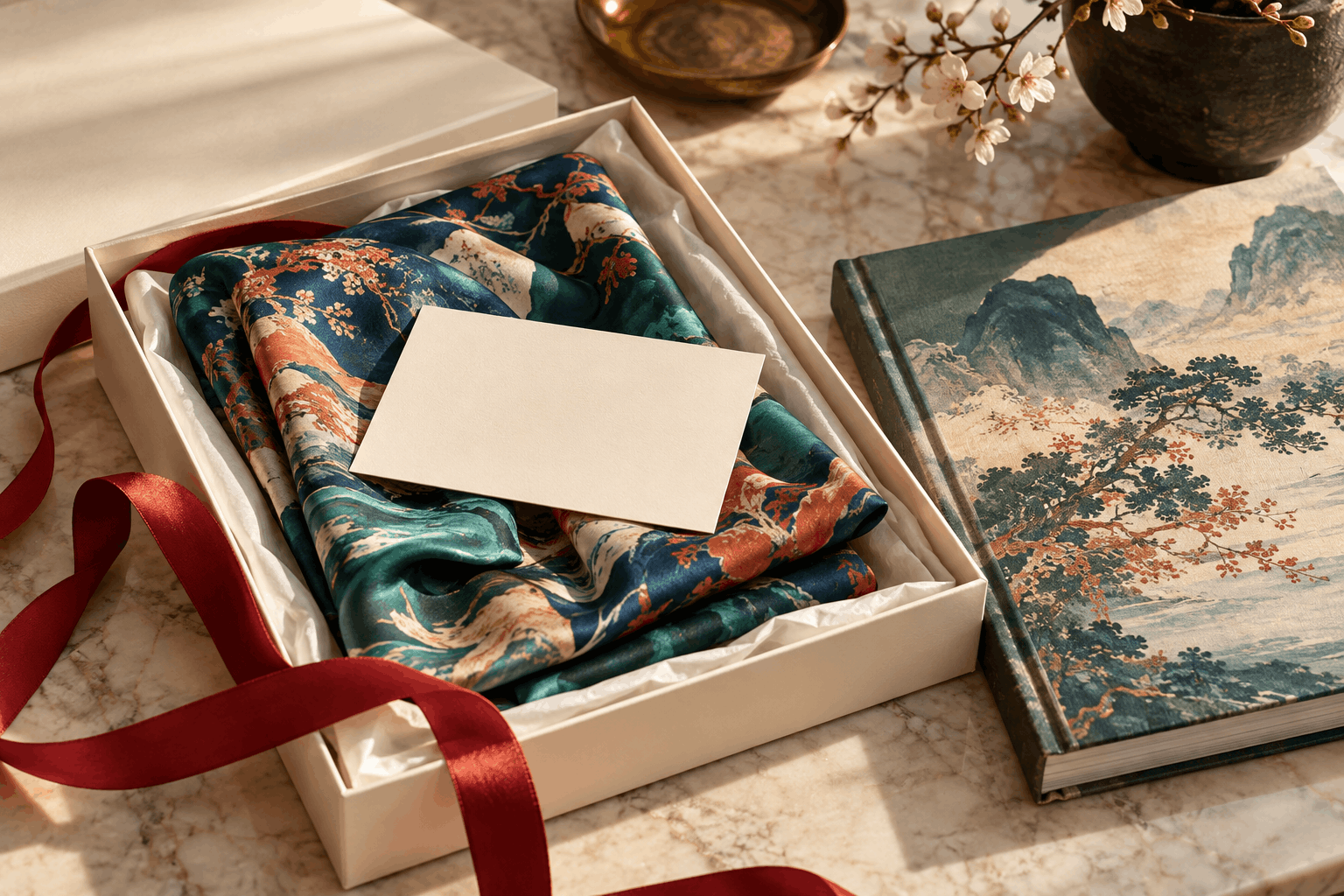
Let the presentation help them understand the object. Keep a design-story card, maker information or edition details where relevant. Protect delicate surfaces and textiles, and make the wrapping straightforward to open.
A note in your own words is usually more useful than several paragraphs of promotional language. Mention the specific detail that led you to choose the gift. You might connect the scarf’s palette to their favourite coat or explain that the book continues a conversation you had in a gallery.
- For a scarf: “The colours reminded me of the paintings you stopped to look at longest. I hope you enjoy wearing a little of that feeling.”
- For a book: “For the conversations we’ll have and the ideas you’ll discover this year.”
- For an exhibition visit: “A New Year invitation to spend an afternoon looking, wandering and catching up.”
Keep practical information available too. An exchange option can make a wearable gift easier to receive; a flexible date can do the same for an experience. For arranging the handover or delivery, see when to give Chinese New Year gifts.
Common mistakes when buying for someone with strong taste
Choosing the label before the object. A recognisable name will not make an unsuitable colour or shape more wearable. Focus on the actual piece.
Confusing a familiar motif with a personal connection. A zodiac animal may suit a collector, but it is not the only way to make the gift seasonal. Let the recipient’s interests guide the choice.
Buying art that demands a prominent place. A large framed work is a substantial decision for someone else’s home. Discuss it first if you are unsure.
Assuming creative people want equipment. Tools and materials can be highly specific. Ask what they need or choose an experience together.
Adding more items to make a gift seem complete. One well-chosen scarf or book may communicate more care than an assortment whose contents have little relationship to each other.
Frequently asked questions
What is a good Chinese New Year gift for someone who loves fashion and art?
A silk scarf with a distinctive composition is a good starting point for someone who enjoys accessories. An art book, a small work chosen together or a gallery visit can suit someone whose interest is primarily in looking and learning.
Is a silk scarf too personal to give?
It depends on the relationship and how well you know their style. Use familiar colours and a format they already enjoy. If you are uncertain, check exchange arrangements or choose the design together.
Should the gift have a Chinese motif?
A documented motif can add meaning, but it is not the only connection. A book on Chinese art, work by a contemporary Chinese designer or an experience related to the recipient’s interests can also make sense.
What if they already own many scarves?
Look for a specific gap they would welcome, such as a different size or a colour they have mentioned wanting. Otherwise, choose a book or shared experience rather than adding another similar accessory.
Should I buy an artwork as a surprise?
Only when you have strong evidence of the recipient’s taste and the work’s suitability for their space. Choosing together is often a better option for a significant purchase.
Can the gift be thoughtful without being expensive?
Yes. A focused book, a carefully planned visit or a small piece with a clear personal connection can be more enjoyable than a costly object that does not fit the recipient’s life.
Choose something that continues a conversation
The most memorable gift often begins with something you have noticed: a favourite colour, an artist they admire, the way they wear a scarf or the time they take to study a painting. Let that observation guide your choice and your message for the year ahead.
Explore Lanting Loom’s silk scarves and gifts for pieces that bring visual storytelling into everyday dress. Choose the design they will enjoy wearing, then tell them what made you think of them.
